
Blueprint for Building an AI-Ready MarTech Stack in 2026
Laying the Groundwork for an AI-Ready MarTech Stack
Digital marketing in 2026 no longer thrives on manual tasks and disconnected tools. Companies are evolving rapidly, expecting marketing technology systems to serve as intelligent engines rather than digital filing cabinets. A well-designed MarTech Stack combines automation, analytics, data orchestration and integration — enabling teams to act on insights, personalize user journeys, and scale operations without overwhelming overhead.
Building such an AI-ready stack requires more than buying tools. It calls for planning, discipline, and alignment between business goals, operations, and data flow. In this blueprint, we outline a structured approach to assembling a modern MarTech Stack that supports automation, measurement, and sustainable growth.
What It Means to Be “AI-Ready”
An “AI-ready” MarTech Stack does more than automate routine tasks. It supports data collection, real-time analysis, segmentation, lifecycle orchestration, and decision support. Core characteristics include:
- Unified data collection from multiple touchpoints
- Structured tracking of user journeys across web, email, mobile or product interfaces
- Automation of repetitive tasks (notifications, outreach, re-engagement)
- Tools that can integrate and exchange data smoothly
- Dashboards and analytics for continuous insight
With this foundation, marketing teams can deploy predictive models, personalization, and data-driven campaigns. The stack becomes a living system that grows with the business.
Blueprint: Steps to Build Your Stack
1. Audit Your Current Tools and Data Sources
Begin by listing all existing tools: CRM, email platforms, analytics, support systems, content management, ads, lead generation. Note which systems store user data, which handle messaging, and which manage revenue or subscription events. Identify where data silos exist or where duplication occurs.
2. Define Key Events and Metrics to Track
Decide the user or customer events that matter most — signups, trial start, purchase, upgrade, churn, interactions. For a SaaS, this may include activation and retention events. For ecommerce, purchase, cart abandonment, repeat purchase. These events form the spine of your stack.
3. Select a Central Data Platform or Event Pipeline
Rather than forcing every tool to connect directly, use a central data layer to collect events from various sources. This layer can feed analytics, automation and reporting. It ensures that all downstream tools operate on the same data foundation.
4. Choose Core Systems: CRM, Email & Customer Communication, Analytics, Automation
For CRM and communication, pick a system that supports webhooks, API integration, and custom fields. For analytics, use a tool that provides event-level tracking, funnel analysis, and cohort reports. For automation, ensure your chosen platform can act on events, segment users, and trigger workflows.
5. Build Integration and Data Flow Logic
Set up consistent naming and event definitions. Ensure that user identities (email, user ID, session ID) are unified across systems. Build pipelines that route events from collection to analytics and automation. Maintain data hygiene and avoid duplication.
6. Establish Dashboards and Reporting
Create dashboards that tie user behavior to business outcomes. Examples: conversion funnel, user activation rate, engagement frequency, customer lifetime value, churn rate. Use these reports to inform future marketing or product decisions.
7. Automate Lifecycle & Behavior-Based Campaigns
Once events and data flows are in place, define lifecycle stages and behavior triggers. Automate welcome sequences, onboarding messages, re-engagement, upgrade prompts, churn prevention flows, and more.
8. Monitor, Iterate, and Refine
No stack is perfect at first. Monitor performance, audit data quality, refine event definitions, test new flows, retire tools that do not deliver. Regular cleaning and pruning ensures the stack remains efficient.
How the Blueprint Works: A Real Example
At Product Siddha we once faced a challenge when our external lead-generation platform was no longer available. We designed and built a custom lead engine that scraped, enriched, and processed leads automatically. That engine became the central pipeline for lead data. From there we built dashboards, segmentation logic, and automated outreach flows.
Because data collection, enrichment, automation, and reporting all relied on the same foundation, the system remained robust even when lead sources changed. That project illustrates how an integrated MarTech Stack provides resilience, flexibility, and scalability.
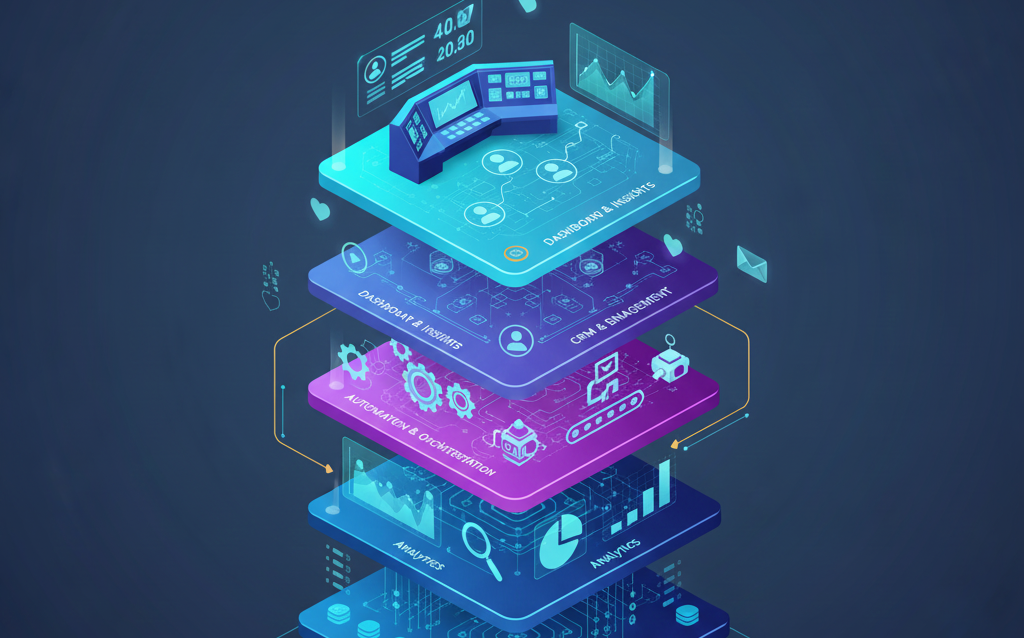
Typical Components in an AI-Ready MarTech Stack
| Layer | Purpose |
|---|---|
| Data Collection & Event Tracking | Capture user and customer actions from web, mobile, product, CRM |
| Data Warehouse / Event Pipeline | Centralize, process, and store events in unified format |
| Analytics & Reporting Platform | Analyze behavior, funnels, retention, segmentation |
| CRM & Customer Database | Manage contacts, leads, customers, properties, subscriptions |
| Automation Engine | Trigger actions: emails, notifications, messages, workflows |
| Campaign Tools (Email, Ads, Messaging) | Reach users based on events and segments |
| Dashboard & Insights Layer | Provide visibility for teams and stakeholders |
Why This Approach Matters in 2026
The marketing environment continues to become more complex. Multiple channels, user expectations for personalization and privacy demands all add pressure. A loosely connected set of tools cannot respond quickly and coherently.
An AI-ready MarTech Stack delivers agility. It allows teams to react to user behavior, test campaigns, measure outcomes and refine strategy rapidly. It also reduces reliance on manual coordination across departments.
For businesses that invest in structured systems, the results show in efficiency, better customer journeys and reliable reporting. It makes growth more sustainable and less dependent on luck or individual effort.
How to Align Organizational Culture and Process
Technology alone does not guarantee success. Teams must commit to consistent definitions of data and events. Communication between marketing, product and operations must be clear. Responsibilities around data hygiene and maintenance should be assigned.
Leadership must view the stack as a strategic asset. That means investing time in planning, onboarding, and review. It also means resisting tool proliferation. Each component should exist for a clear purpose, and the stack should remain as simple as possible while meeting requirements.
Final Thoughts: Building for Today and Tomorrow
Constructing an AI-ready MarTech Stack is not a one-time project. It is an ongoing infrastructure task. As products evolve, new channels emerge, and customer behavior shifts, the stack must adapt.
When thoughtfully assembled, the stack becomes a backbone for consistent marketing and user communication. It supports automation, personalisation, measurement and long-term growth.
For firms ready to step into this future, the path begins with clarity, data discipline, and purposeful integration. A well built MarTech Stack is not about tools — it is about building a system that grows with the business.
Let Product Siddha’s blueprint be a guide for your next steps.