
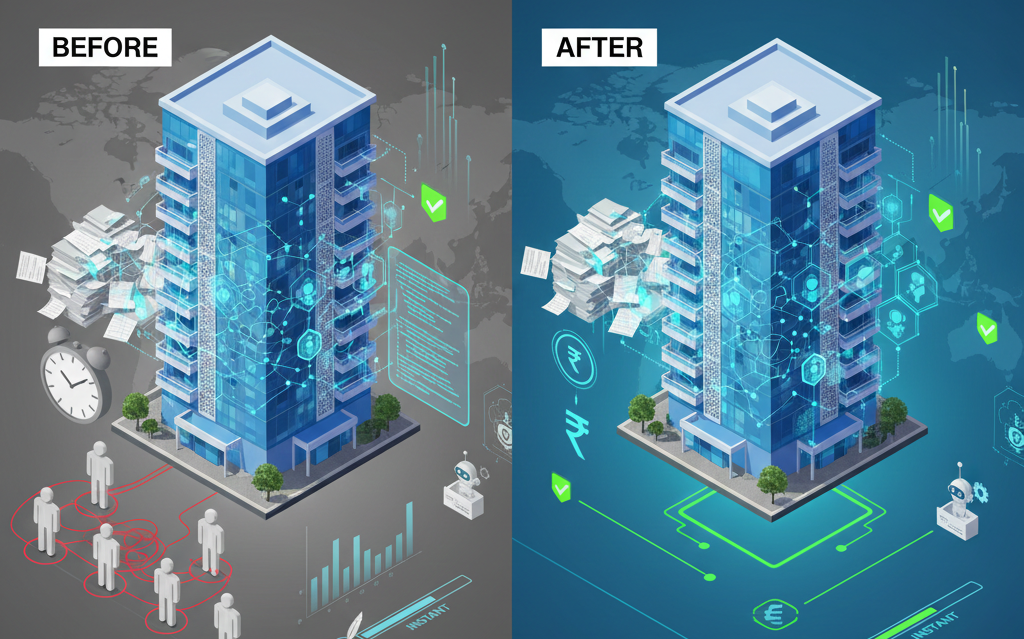
Blockchain & Smart Contracts: Future of Automated Property Transactions
Property Deals at a Turning Point
Property transactions have always relied on trust, paperwork, and time. Buyers sign agreements they may not fully understand. Sellers wait weeks or months for payments to clear. Lawyers, brokers, and registrars act as safeguards, yet delays and disputes remain common.
As property markets expand across borders and investment models grow more complex, these frictions become harder to ignore. Automation has already reshaped banking and payments. Real estate is now entering the same phase.
Blockchain and smart contracts are central to this shift. Together, they are laying the groundwork for automated property transactions that reduce manual steps while preserving legal and financial certainty.
Product Siddha works with platforms that operate at this intersection of property, data, and automation. The focus is not disruption for its own sake, but reliability at scale.
Understanding Blockchain in Property Transactions
Blockchain is best understood as a shared ledger. Every transaction recorded on it is time-stamped, tamper-resistant, and visible to permitted parties. Once recorded, it cannot be quietly altered.
In property transactions, this ledger can store:
- Ownership history
- Sale agreements
- Payment milestones
- Compliance records
This matters because property disputes often arise from missing or inconsistent records. A shared ledger reduces ambiguity by ensuring that all parties refer to the same source of truth.
For automated property transactions, blockchain provides the foundation. Smart contracts provide the logic.
What Smart Contracts Actually Do
A smart contract is not a contract in the traditional sense. It is a set of coded rules that execute automatically when conditions are met.
In a property sale, those conditions might include:
- Buyer deposits funds into escrow
- Title verification is completed
- Regulatory approval is confirmed
Once these conditions are satisfied, the smart contract triggers the next step. Payment is released. Ownership records update. Notifications are sent.
There is no waiting for manual confirmation. No reliance on verbal follow-ups. The process moves forward because the rules are met.
This is the core of automated property transactions. Execution replaces interpretation.
Where Automation Changes the Experience
Automation does not remove people from the process. It removes uncertainty.
For buyers, automated property transactions offer clarity. They can see exactly when funds will move and under what conditions. There is less room for surprise.
For sellers, cash flow becomes more predictable. Payment milestones are enforced by code rather than reminders.
For platforms and developers, automation creates consistency. Every transaction follows the same rules, reducing operational risk.
These gains compound as transaction volume grows.
A Real Platform Example from Product Siddha
One relevant Product Siddha case study involved product management and analytics for the UAE’s first lifestyle services marketplace. While not limited to property sales, the platform handled high-value service transactions where trust and timing were critical.
The challenge was coordination across multiple parties. Payments, service fulfillment, and confirmations often fell out of sync. Manual intervention was frequent.
Product Siddha helped design structured workflows supported by automation and clear data stages. While blockchain was not the sole focus, the work reflected the same principle that drives automated property transactions today. Clear rules, enforced systematically, reduce friction and dispute.
This experience informs how Product Siddha approaches blockchain-based property systems. Automation must align with real operational behavior, not theoretical models.
Smart Contracts and Compliance
One common concern is regulation. Property transactions are tightly governed. Automation must respect local laws, not bypass them.
Smart contracts can be designed to include compliance checks. For example:
- Identity verification before contract activation
- Regulatory approvals as required conditions
- Jurisdiction-specific clauses encoded into logic
In this way, automated property transactions can improve compliance rather than weaken it. Every step is logged. Every action is traceable.
Auditors and regulators gain clearer visibility into transaction flows.
Cross-Border Property Transactions
International property investment is growing, yet it remains complex. Currency conversion, escrow handling, and legal verification often slow deals.
Blockchain simplifies cross-border coordination by providing a neutral transaction layer. Smart contracts execute based on verified inputs, not geographic location.
For example, an overseas buyer can fund a transaction once local approvals are confirmed. The release of ownership records and payments happens automatically.
This does not eliminate legal review. It reduces delays caused by coordination gaps.
Key Benefits of Automated Property Transactions
| Area | Impact |
|---|---|
| Speed | Reduced settlement time |
| Transparency | Shared, verifiable records |
| Cost | Lower manual processing overhead |
| Accuracy | Fewer errors from re-entry |
| Trust | Rules enforced consistently |
These benefits are practical, not abstract. They address long-standing inefficiencies that both buyers and sellers experience.
Integration with Existing Systems
Automation works best when it connects with existing tools. Property platforms already rely on CRM systems, payment gateways, and analytics dashboards.
Blockchain-based automation does not replace these systems. It coordinates them.
Product Siddha’s experience building custom dashboards by stage and full-funnel attribution systems supports this integration-first mindset. Transaction data must flow into reporting and decision systems, not remain isolated.
Automated property transactions gain value when insights are accessible, not hidden behind technical layers.
Practical Limits and Responsible Use
Blockchain is not a cure-all. Poor data input still leads to poor outcomes. Smart contracts execute rules faithfully, even if those rules are flawed.
This is why domain expertise matters. Legal, financial, and operational knowledge must shape the logic before automation begins.
Product Siddha’s work across fintech, real estate automation, and analytics emphasizes this balance. Technology supports decisions. It does not replace judgment.
A Measured Path Forward
Automated property transactions represent a steady evolution, not a sudden overhaul. Early adoption often begins with partial automation. Escrow handling, milestone payments, or document verification.
As confidence grows, systems expand.
Blockchain and smart contracts offer tools that match the seriousness of property transactions. When used carefully, they improve reliability without sacrificing oversight.
For platforms and investors looking ahead, the question is not whether automation will arrive, but how responsibly it will be implemented.