
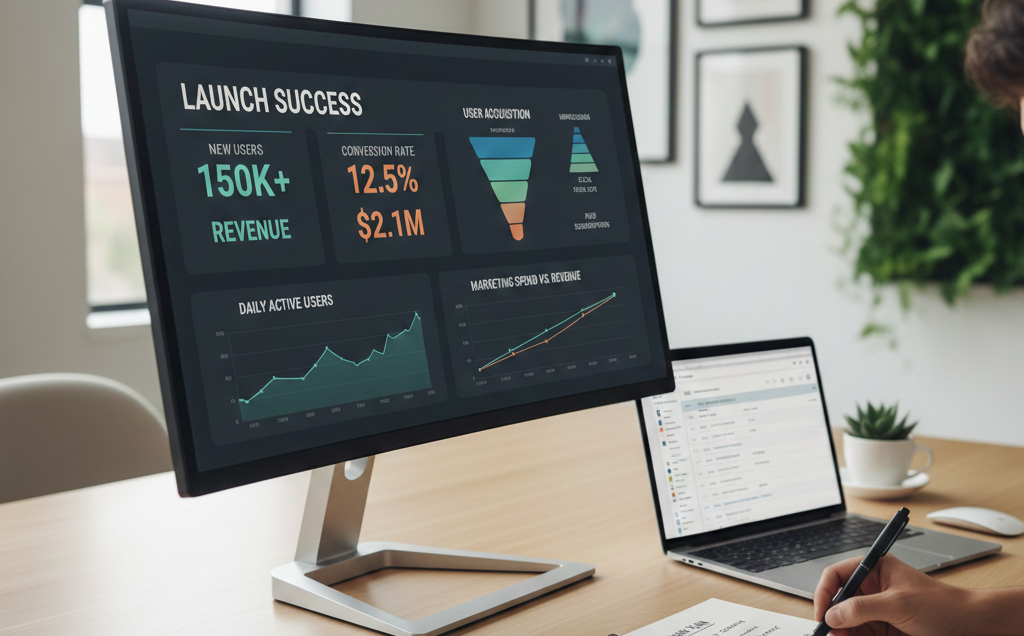
Building a Repeatable Product Launch System with Automation and Analytics
Why a System Matters
Launching a product for the first time is often chaotic. Teams scramble to coordinate timelines, marketing, development, and feedback. Without structure, you may rely heavily on manual effort, inconsistent tracking, and guesswork. That makes it hard to know what worked and what failed – and even harder to repeat success.
What many companies need instead is a repeatable product launch system. Such a system treats a product launch as a process rather than an event. It depends on automation to reduce manual work, and analytics to measure each stage. Over time it becomes a predictable, optimizable workflow.
This approach aligns with how Product Siddha operates. Their core framework – Build Real, Learn What Matters, Stack Smart Tools, Launch with Focus – reflects precisely this idea.
Key Components of a Repeatable Launch System
| Component | Purpose | What to Automate / Measure |
|---|---|---|
| Defined launch workflow | Ensures every launch follows the same steps | Task scheduling, notifications, handoffs |
| Analytics instrumentation | Captures user behavior and product performance | Event tracking (e.g. sign-ups, conversions, churn) |
| Data-driven decision points | Allows teams to evaluate and improve after launch | Dashboards for adoption, engagement, retention |
| Feedback and iteration loop | Enables continuous refinement with minimal friction | Automated feedback collection, release triggers based on metrics |
| Scalable tool stack | Reduces manual overhead and supports growth | Low-code workflows, integrated analytics, unified dashboards |
How Automation and Analytics Work Together
Automation and analytics are not separate helpers – they reinforce each other. Automation ensures repeatability. Analytics ensures insight. Together they make launching less risky, faster, and more informed.
For example, automation can handle every non-creative, rule-based task: scheduling deployment, notifying stakeholders, syncing databases, launching promotional emails, generating reports. Analytics then measures how users respond: Are signups rising? Is retention stable? Where do people drop off?
Armed with these insights, teams can iterate confidently. Maybe onboarding needs simplification. Maybe messaging around key features must change. Maybe pricing or positioning should shift. Each launch becomes a learning opportunity – and the data ensures learning is grounded in truth, not assumption.
Real Example: How Product Siddha Did It
When a popular prospecting database became unavailable, Product Siddha shifted from dependence on a third-party tool to building an internal lead-generation engine.
They used open tools like Google Maps API, n8n, and Apify to build an automated workflow: scrape live business data, enrich leads via LinkedIn, store clean data in Google Sheets, and schedule periodic updates – all without manual effort.
That engine became repeatable. It delivered fresh leads consistently. It cut costs relative to paying third-party subscription prices. It turned a brittle dependence into a stable, controllable system.
This same principle applies to product launches. Once you invest in automation and analytics infrastructure, each future launch reuses that foundation – with less friction, lower risk, and clearer measurement.
Another example: On a project for a U.S. music-discovery app, Product Siddha implemented full-stack analytics via Mixpanel. The team instrumented key user events: first use, activation, subscription conversion, retention after periods of inactivity.
With those analytics dashboards in place, product managers no longer needed to request custom reports. Teams made decisions weekly based on real user behavior. Interface tweaks, growth experiments, and marketing adjustments all came from the same data.
That data-driven approach enabled repeatable cycles: launch – measure – iterate – launch.
Steps to Build Your Repeatable Launch System
- Map your ideal launch flow
Identify every step needed: development, QA, marketing preparation, pre-launch content, promotion, user feedback, post-launch updates. Write it down. Keep it simple. - Automate every repeatable step
Use tools like workflow engines (e.g. n8n, Zapier, Make) to automate scheduling, notifications, data sync, content publishing, reporting, etc. The fewer manual handoffs, the fewer chances for error. - Instrument analytics from day one
Set up analytics to capture meaningful events: user signups, first-time use, feature adoption, conversion, churn. Use reliable tools that support funnel analysis, cohorts, and retention tracking. - Build shared dashboards
Create visual dashboards where stakeholders (product, marketing, executives) can see launch metrics at a glance. Ensure metrics link to business goals: activation rate, conversion rate, retention, revenue, engagement. - Define decision points/triggers
Decide ahead of time what metrics determine success or need iteration. For example: If activation < X% after 30 days, revisit onboarding flow. If retention drops below Y% in week 2, adjust messaging. - After-action review and documentation
After each launch, hold a review. Document what worked, what didn’t, and what should change next time. Store these lessons – they become part of the system. - Scale the tool stack as needed
As your launches grow in complexity or frequency, ensure your automation and analytics mechanisms scale too. Add data warehouses, experiment tracking tools, cross-platform integrations, or automated regression checks.
Why This Approach Beats a One-Off Launch
- Predictability: With a system in place, you understand roughly how long a launch will take, what resources it needs, and what work remains.
- Repeatability: Once built, the same flow can be reused for each product or feature launch.
- Insight: Analytics gives you objective feedback. You know what users do, where you lose them, what features they engage with.
- Speed and cost efficiency: Automation reduces manual work, lowers risk of human error, and saves time.
- Continuous improvement: Each launch yields data. Each data point refines future launches.
What to Watch Out For
Setting up automation and analytics requires investment in time and tools. Initial effort may feel heavy, especially for small teams. It can also create a false sense of security. A system is only as good as the process and data behind it. Poor instrumentation or unclear metrics may lead to misleading conclusions. Regular audits and updates are essential.
Also, avoid over-automation. Creative tasks – design, messaging, customer empathy – still need human judgment. Use automation to support people, not replace them.
Final Thoughts
Building a repeatable product launch system using automation and analytics is not magic. It is discipline, consistency, and smart design. Once you invest in the foundation – clean workflows, automated tools, proper analytics – each future launch becomes smoother, faster, and more reliable.
At Product Siddha we believe success comes from combining speed with structure, innovation with metrics. A launch is not a one-time act. It is part of an ongoing process: launch, measure, learn, improve, relaunch. Let that process be your advantage.