
Digital Twins for Real Estate – The Next Frontier After Virtual Tours
Opening View
Digital twins have moved from industry labs into everyday property practice. Where virtual tours gave a visual sense of space, digital twins provide a live, data-driven replica of buildings and portfolios. For developers, asset managers, and facility teams the shift matters because a functioning replica supports decisions across design, operation, and value management. Product Siddha recommends treating digital twins as an operational platform rather than a marketing asset. That change in perspective guides how teams deploy sensors, integrate systems, and use AI Automation to drive measurable outcomes.
What a digital twin actually is
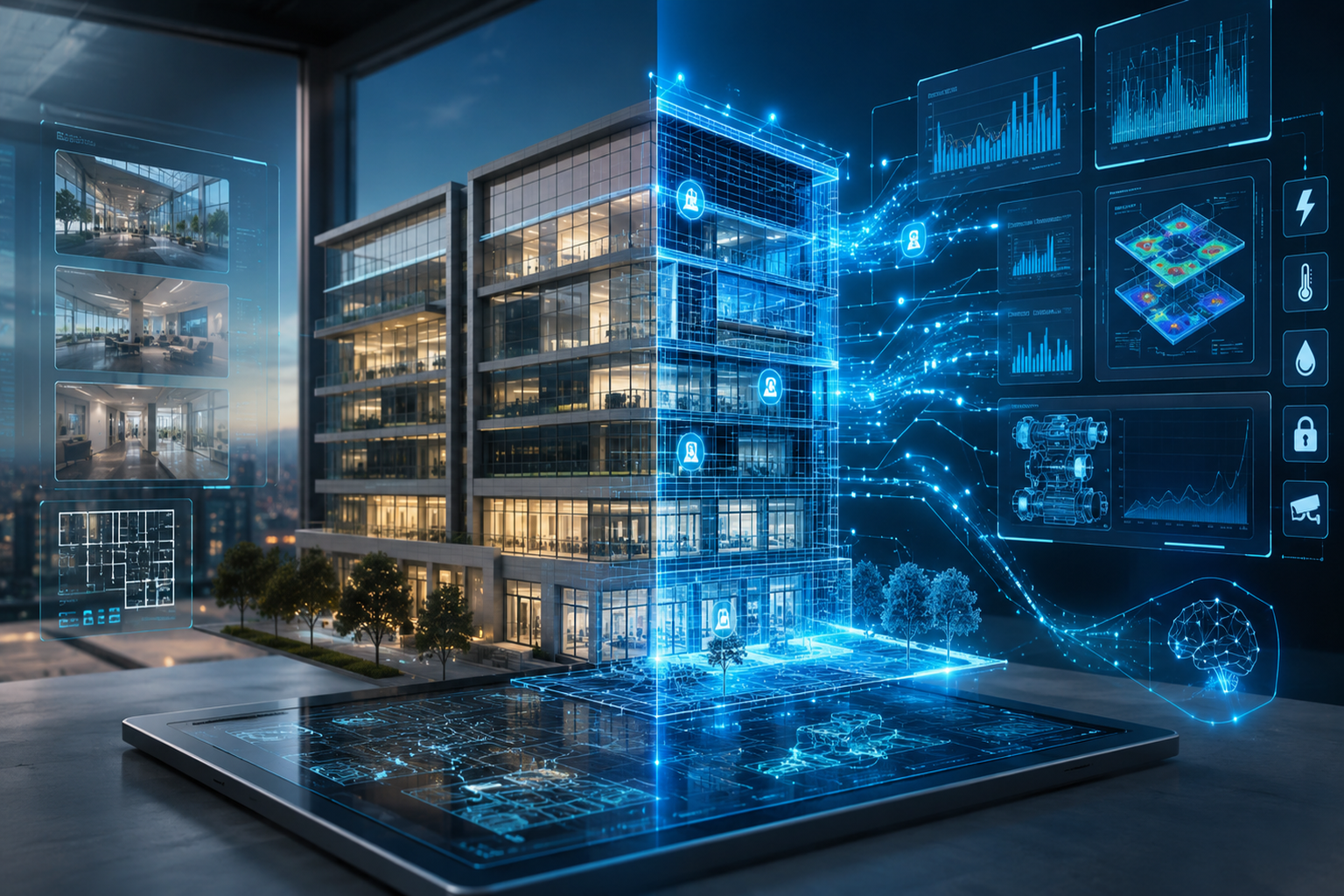
A digital twin is a dynamic model that mirrors a physical asset in detail. It combines 3D geometry, building information modeling (BIM) data, time-series sensor feeds, and business records into a single reference. Unlike a static model or a filmed walkthrough, a digital twin updates as conditions change. It can simulate scenarios, run performance forecasts, and expose APIs for downstream systems. For real estate this means using spatial analytics, geospatial data, and live telemetry to manage day-to-day tasks and longer term strategy.
How digital twins differ from virtual tours
Virtual tours are immersive but passive. They show space at a moment in time. Digital twins are active and connected. They allow queries such as which rooms have rising humidity, which floor has the highest energy draw, or where deferred maintenance is accumulating. That operational capability is what turns a digital twin into a tool for facility management, tenant services, and underwriting.
Core components of a real estate digital twin
- A detailed geometry layer drawn from BIM or photogrammetry.
- An asset registry that links physical objects to identifiers.
- Sensor and IoT feeds for temperature, occupancy, vibration, and energy.
- Historical and transactional data that add context to live readings.
- A simulation and analytics layer that supports predictive maintenance and energy optimization.
- Integration endpoints and APIs that connect the twin to CAFM, ERP, and loan systems.
Practical use cases that add value
Design and planning
Digital twins let design teams validate layouts and services before construction. They support clash detection, staging plans, and procurement schedules. BIM data in the twin reduces rework on site.
Operations and maintenance
Facility teams use twins to prioritize repairs based on real-time risk. AI Automation can turn sensor thresholds into tickets, order parts, and schedule vendors. The result is lower downtime and predictable maintenance costs.
Energy and sustainability
Twins link building meters, weather forecasts, and occupancy patterns. Automated routines tune HVAC settings based on predicted load. This approach supports energy reporting and helps owners meet audit requirements.
Leasing and tenant experience
Leasing teams use dynamic occupancy heatmaps and performance reports to demonstrate building value. Tenants receive responsive service because automated workflows route issues and provide progress updates.
Construction and retrofit
During construction a twin tracks progress against schedules. For retrofit projects the twin models baseline energy use and projects savings under different upgrade scenarios. That clarity helps owners prioritise investments.
Risk, compliance, and insurance
A twin that logs sensor data and maintenance actions offers a clear audit trail. Insurers and regulators often accept documented monitoring more readily than manual logs. This reduces friction in claims and compliance reviews.
Implementation hurdles and how to address them
Data quality and identity
A twin is only as reliable as its identifiers and inputs. Standardise asset coding early and resolve duplicate records. Work with cadastral and parcel data so physical boundaries match model geometry.
Systems integration
Many buildings have legacy systems. Prioritise adapters to critical systems such as access control, metering, and CAFM. Use modular APIs to keep future integration straightforward.
Governance and model drift
Define who owns the twin and how changes are versioned. Models evolve as equipment is replaced. Apply model governance and record retraining or re-surveys.
Security and privacy
Protect sensor feeds and tenant data. Encrypt streams and enforce role based access. Apply data retention policies that comply with local regulation.
Measuring return on investment
Select a small set of outcome metrics before deployment. Good candidates include mean time to repair, energy cost per square meter, occupancy efficiency, and vendor response time. Track baseline performance, run the twin for a pilot, and measure change. Use that evidence when expanding coverage.
How AI Automation amplifies the twin
AI Automation is the connective layer that turns insights into action. Use cases include automated anomaly detection on time-series data, rule-based ticket generation, predictive failure alerts, and scheduling optimization for field crews. Automation reduces manual steps and delivers a predictable workflow. Product Siddha advises pairing automation with clear human review gates in the earliest phases. That keeps teams confident while the system matures.
A practical rollout path
- Pilot on a single building with complete sensor coverage in core systems.
- Confirm data mappings and asset identifiers.
- Run parallel operations for a defined interval and collect outcome metrics.
- Introduce AI Automation for low-risk, high-frequency tasks such as HVAC scheduling.
- Scale across the portfolio, adding integrations and governance rules.
Vendor selection and internal skills
Choose partners that demonstrate open APIs, a history of integration, and tools for model governance. Internally hire or train a small team responsible for data quality and twin stewardship. Success depends on repeatable processes as much as on software features.
Closing Perspective
Digital twins represent a practical advance over virtual tours. They deliver continuous value by linking physical operations to analytics and by enabling automated workflows. The most successful deployments blend technical rigor with operational discipline. Product Siddha recommends starting with a narrow pilot, proving savings with clear metrics, and then expanding the twin to support broader business functions. When AI Automation is introduced carefully, it reduces routine labor and frees teams to focus on higher value work. The twin then becomes a living asset that supports better decisions across the property lifecycle.