
How Top Product Teams Turn Customer Signals into Roadmap Decisions
Listening Without Guesswork
Every product team claims to be customer-driven. In practice, most teams are surrounded by noise. Feature requests arrive through support tickets. Usage data sits inside analytics tools. Sales teams pass along anecdotes from calls. Founders add instinctive opinions. Somewhere between all this input, roadmap decisions are made.
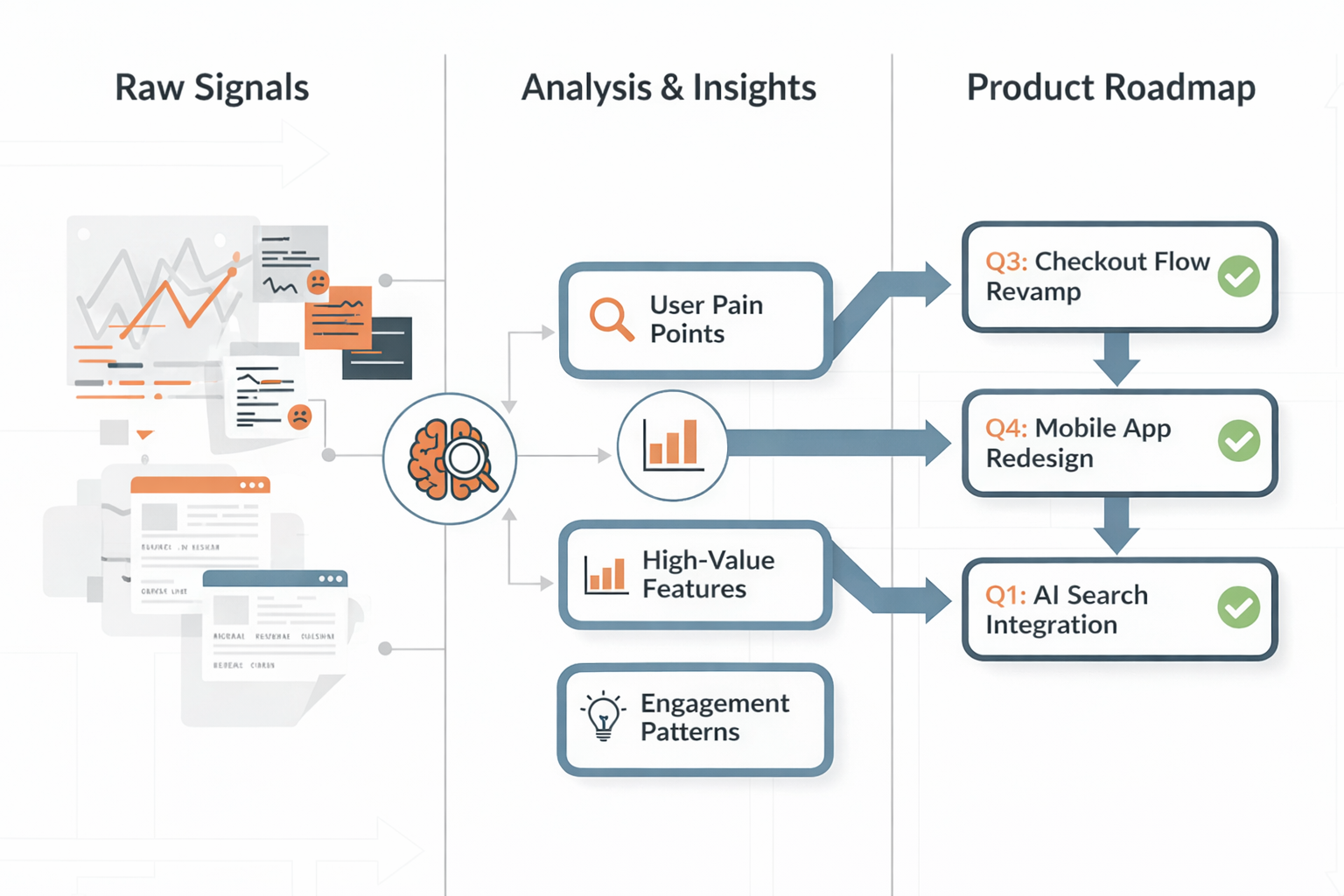
Top product teams handle this differently. They treat customer signals as evidence, not opinions. They do not chase every request or react to the loudest voice. Instead, they build a clear system that converts raw signals into decisions that stand the test of time. This is where disciplined Product Management begins.
What Counts as a Customer Signal
Customer signals are not limited to feedback forms or survey scores. In strong product organizations, signals fall into three broad categories.
First, there is behavioral data. This includes how users move through the product, where they pause, and where they drop off. Second, there is expressed feedback, such as support tickets, call notes, and direct messages. Third, there is outcome data, including retention, expansion, churn, and revenue patterns.
The mistake many teams make is treating these sources separately. Product Management works best when these signals are reviewed together, not in isolation.
Separating Patterns from Noise
Not every signal deserves action. One frustrated customer does not define a roadmap. Ten similar complaints might. A single power user request may reflect edge behavior, not the broader market.
Experienced product leaders look for patterns across time and segments. They ask simple questions. Does this behavior repeat? Does it affect a meaningful group of users? Does it connect to business outcomes we care about?
In Product Siddha’s work on product analytics for a ride-hailing app using Mixpanel, the team observed that riders were not abandoning the app at checkout, as originally assumed. Instead, they were hesitating earlier, during fare comparison. This insight only surfaced when behavioral data was studied alongside session paths and timing. The roadmap changed as a result. Pricing transparency features were prioritized over payment optimizations.
Turning Usage Data into Clear Product Questions
Data alone does not shape a roadmap. Interpretation does. Strong Product Management teams translate signals into questions before jumping to solutions.
For example, instead of asking, “Should we build feature X,” they ask, “Why are users failing to complete task Y?” This shift keeps teams focused on problems rather than outputs.
In the case of a SaaS coaching platform where Product Siddha implemented full-funnel attribution, product leaders initially believed onboarding content was the weak link. Funnel analysis showed a different story. Users were completing onboarding but failing to return in the second week. The roadmap shifted toward habit-building features rather than additional tutorials.
The Role of Qualitative Feedback
Quantitative signals show what users do. Qualitative signals explain why. Top teams combine both.
Customer interviews, support transcripts, and call recordings help product managers understand intent. However, they are used carefully. Teams avoid treating interviews as votes. Instead, they look for repeated themes and language that point to unmet needs.
When Product Siddha supported Product Management for the UAE’s first lifestyle services marketplace, interviews revealed that users were less concerned about service variety and more concerned about trust and follow-through. Usage data supported this insight, showing drop-offs after booking. The roadmap shifted toward provider verification and service tracking rather than expanding categories.
Prioritization Is Where Discipline Shows
Turning signals into decisions requires restraint. Not every validated problem becomes a roadmap item. Teams must weigh impact, effort, and alignment with long-term goals.
Strong product leaders use simple prioritization frameworks. They avoid over-engineering scoring models that create false precision. Clear reasoning matters more than complex math.
In building custom dashboards by stage for multiple organizations, Product Siddha emphasized clarity over volume. Dashboards highlighted only the signals tied directly to product outcomes. This allowed leadership teams to make roadmap calls with fewer meetings and less debate.
Avoiding the Trap of Opinion-Led Roadmaps
One of the hardest challenges in Product Management is managing internal pressure. Sales teams want features that close deals. Executives want differentiation. Engineers want technical improvements.
Top product teams do not ignore these inputs. They test them against customer evidence. If a proposed feature does not map to a validated signal, it is parked, not rushed.
This approach builds trust over time. Stakeholders learn that roadmap decisions are grounded in reality, not preference.
Signals Evolve as Products Mature
Early-stage products rely heavily on direct feedback and founder conversations. As products scale, behavioral data becomes more reliable. Mature products shift focus toward retention, depth of use, and efficiency.
Product teams that fail to adjust their signal mix often stall. They keep listening the same way long after their user base has changed.
In the case of building the world’s first AI-powered networking assistant, early roadmap decisions leaned heavily on founder-led interviews. As adoption grew, usage analytics revealed which networking actions delivered real value. The product evolved accordingly.
Making Roadmaps Understandable, Not Just Accurate
A roadmap is a communication tool. Even the best decisions fail if they cannot be explained clearly.
Top Product Management teams articulate why each roadmap item exists. They connect features to signals and signals to outcomes. This clarity helps engineering teams execute with confidence and helps leadership stay aligned.
Simple language matters here. Avoiding jargon keeps the roadmap accessible to everyone involved.
Where Many Teams Go Wrong
Teams struggle when they treat customer signals as validation after decisions are made. Others collect data endlessly without making calls. Both approaches weaken Product Management.
The balance lies in steady review cycles, clear ownership, and the willingness to say no. Signals guide decisions. They do not replace judgment.
Decisions That Hold Up Over Time
Great product roadmaps are not built in isolation or rushed meetings. They are shaped through careful attention to customer behavior, consistent analysis, and thoughtful prioritization.
Product Siddha’s experience across analytics, automation, and Product Management shows a common truth. Teams that listen well build products that last. They spend less time reacting and more time improving what matters.
Roadmaps built on real signals do not just reflect today’s needs. They prepare teams for tomorrow’s decisions.