
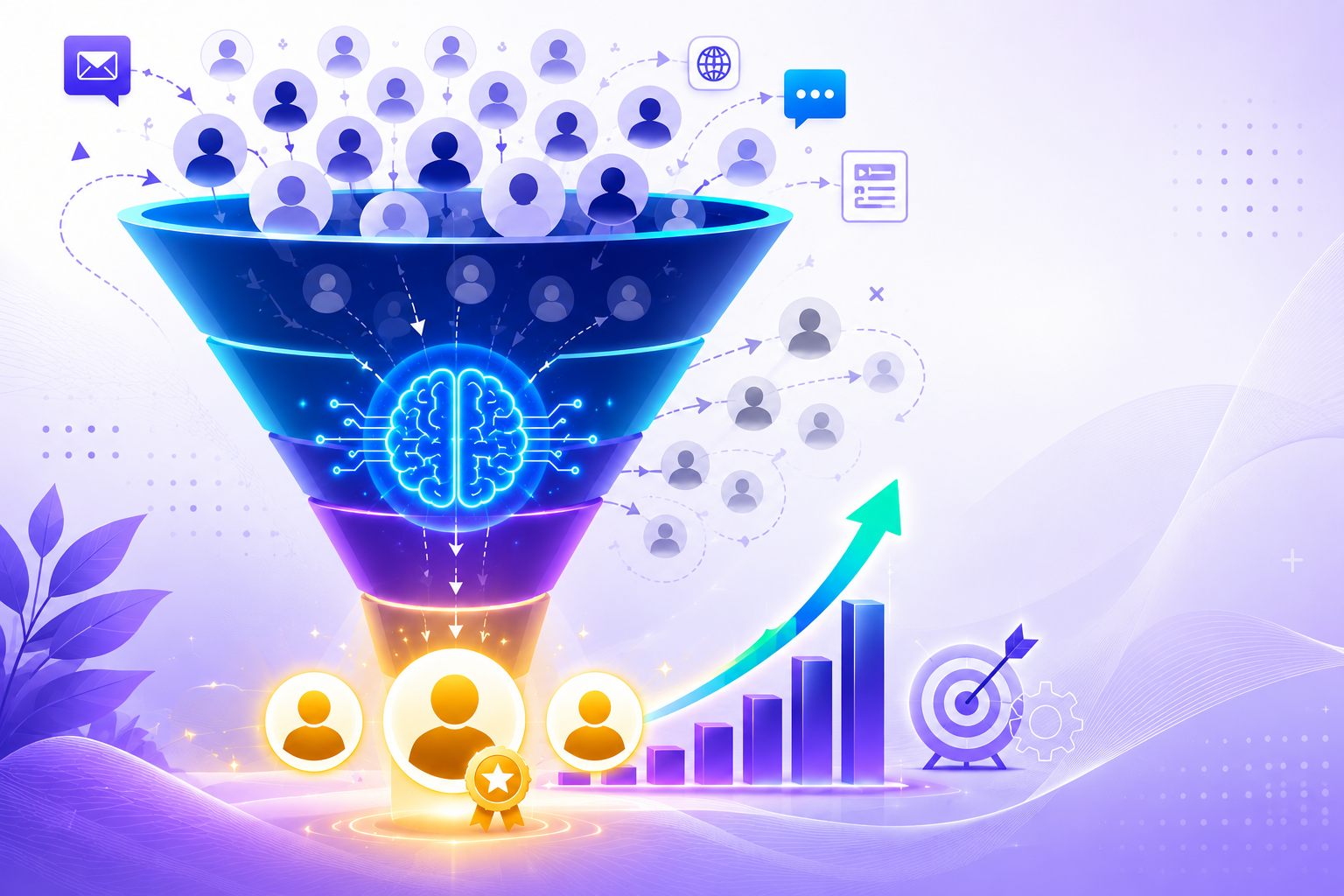
Lead Scoring Using AI: How to Prioritize Prospects That Actually Convert
The Hidden Cost of Chasing Every Lead
Every business wants more leads. Yet many sales teams face a different problem. They spend too much time on prospects who never become customers.
A contact form submission, a webinar attendee, or a downloaded whitepaper may look promising at first. In reality, not every lead has the same level of interest or buying intent. Treating all prospects equally often leads to wasted effort, slower sales cycles, and missed revenue opportunities.
This is where lead scoring becomes valuable. Traditional lead scoring methods rely on fixed rules and assumptions. While these systems can help, they often struggle to keep pace with changing customer behavior.
Today, organizations are turning to AI Automation to improve lead qualification and identify prospects that are most likely to convert. By analyzing large volumes of customer data, artificial intelligence can uncover patterns that human teams may overlook.
At Product Siddha, we have seen how AI-powered lead scoring helps businesses focus on high-value opportunities while reducing time spent on low-priority prospects.
Understanding Lead Scoring
Lead scoring is the process of assigning values to potential customers based on their likelihood of becoming paying clients.
These scores are typically generated using factors such as:
| Lead Attribute | Impact on Score |
| Website visits | Indicates interest |
| Email engagement | Shows interaction level |
| Content downloads | Signals research activity |
| Job title | Reveals decision-making authority |
| Company size | Helps determine fit |
| Product inquiries | Shows purchase intent |
| Previous interactions | Indicates relationship strength |
The purpose of lead scoring is simple. Sales teams need a reliable way to determine which prospects deserve immediate attention.
Without a scoring system, representatives often rely on guesswork. This can result in valuable opportunities slipping through the cracks while less promising leads consume valuable resources.
Why Traditional Lead Scoring Falls Short
For years, companies used manual scoring systems based on predefined rules.
For example:
- Downloading an eBook = 10 points
- Visiting a pricing page = 20 points
- Opening an email = 5 points
While these rules provide structure, they have limitations.
Customer behavior changes over time. Market conditions shift. New buying patterns emerge. Static scoring models rarely adapt quickly enough.
A prospect who downloads three resources may not be ready to buy. Another prospect who spends five minutes on a product comparison page might have strong purchase intent.
Traditional systems often fail to recognize these subtle differences.
As databases grow larger, maintaining rule-based scoring becomes increasingly difficult. This creates inconsistencies that affect both marketing and sales performance.
How AI Improves Lead Scoring
Artificial intelligence brings a more dynamic approach to lead qualification.
Instead of relying solely on predefined rules, AI models analyze historical customer data and identify patterns associated with successful conversions.
The system continuously learns from:
- Customer interactions
- Website behavior
- CRM records
- Email engagement
- Purchase history
- Product usage data
- Sales outcomes
As new information becomes available, the model adjusts its predictions.
This makes AI Automation particularly effective for businesses with large volumes of leads and complex customer journeys.
Rather than assigning scores based on assumptions, AI predicts the probability that a prospect will convert based on real-world evidence.
Key Benefits of AI-Powered Lead Scoring
Improved Sales Productivity
Sales representatives spend less time reviewing unqualified prospects.
Instead, they focus on leads with the highest conversion potential. This improves efficiency and increases the likelihood of successful outcomes.
Faster Response Times
High-intent prospects can be identified immediately.
When sales teams engage at the right moment, conversion rates often improve because customer interest remains strong.
Better Marketing Alignment
Marketing and sales departments frequently disagree about lead quality.
AI-driven lead scoring creates a shared framework based on data rather than opinions. This helps both teams work toward common goals.
Higher Conversion Rates
Businesses that prioritize qualified prospects often experience stronger conversion performance.
By directing resources toward the right opportunities, organizations can improve revenue generation without significantly increasing acquisition costs.
Continuous Learning
Unlike static models, AI systems evolve.
As customer behavior changes, machine learning algorithms refine their predictions and maintain scoring accuracy over time.
The Data Behind Effective AI Lead Scoring
The quality of an AI lead scoring system depends heavily on the quality of data available.
Organizations should focus on collecting information from multiple sources.
Demographic Data
This includes:
- Industry
- Company size
- Geographic location
- Job role
- Business type
These attributes help determine whether a prospect fits the ideal customer profile.
Behavioral Data
Behavioral indicators often provide stronger buying signals than demographic information alone.
Examples include:
- Website page views
- Session duration
- Product page interactions
- Form submissions
- Webinar attendance
- Resource downloads
Engagement Data
Customer engagement reveals ongoing interest.
Useful metrics include:
- Email opens
- Click-through rates
- Meeting requests
- Chat interactions
- Event participation
Product Data
Businesses offering software or digital products can gain valuable insights from usage patterns.
Product analytics can reveal:
- Feature adoption
- Login frequency
- Trial engagement
- User activity trends
Combining these data points creates a more complete picture of customer intent.
The Role of AI Automation in Modern Lead Management
Lead scoring is only one part of a broader AI Automation strategy.
Organizations increasingly use automation to streamline repetitive tasks throughout the customer acquisition process.
Examples include:
- Automated lead qualification
- Intelligent customer segmentation
- Predictive analytics
- CRM workflow automation
- Sales forecasting
- Marketing attribution analysis
When these capabilities work together, businesses gain a clearer understanding of customer behavior and purchasing intent.
This creates a more efficient path from prospect identification to customer conversion.
Building an AI-Driven Lead Scoring Framework
Successful implementation requires a structured approach.
Define Conversion Goals
Start by identifying what constitutes a successful outcome.
Examples may include:
- Product purchases
- Demo bookings
- Subscription upgrades
- Contract signings
Centralize Customer Data
Data scattered across multiple systems limits AI effectiveness.
Integrating CRM, marketing platforms, analytics tools, and product data creates a stronger foundation for predictive modeling.
Train the Model
Historical customer data allows machine learning algorithms to identify patterns associated with successful conversions.
The larger and cleaner the dataset, the more accurate the predictions tend to be.
Monitor Performance
Lead scoring should not be treated as a one-time project.
Businesses should regularly evaluate:
- Conversion rates
- Sales acceptance rates
- Pipeline velocity
- Revenue impact
Ongoing monitoring ensures continued accuracy and business value.
Looking Ahead
The future of lead management belongs to businesses that can identify opportunity before competitors do.
AI-powered lead scoring allows organizations to move beyond assumptions and make decisions based on evidence. Instead of relying on static rules, businesses can prioritize prospects according to actual buying behavior and conversion probability.
As customer journeys become more complex, AI Automation will play an increasingly important role in helping sales and marketing teams focus their efforts where they matter most.
At Product Siddha, we help organizations build intelligent marketing operations, implement AI automation solutions, and develop data-driven systems that improve lead qualification and business growth. By combining analytics, automation, and customer intelligence, businesses can create a more predictable path to revenue while delivering a better experience for prospective customers.