
MarTech Tools vs Custom Automation: What Works Better in 2026?
A Decision Most Teams Face
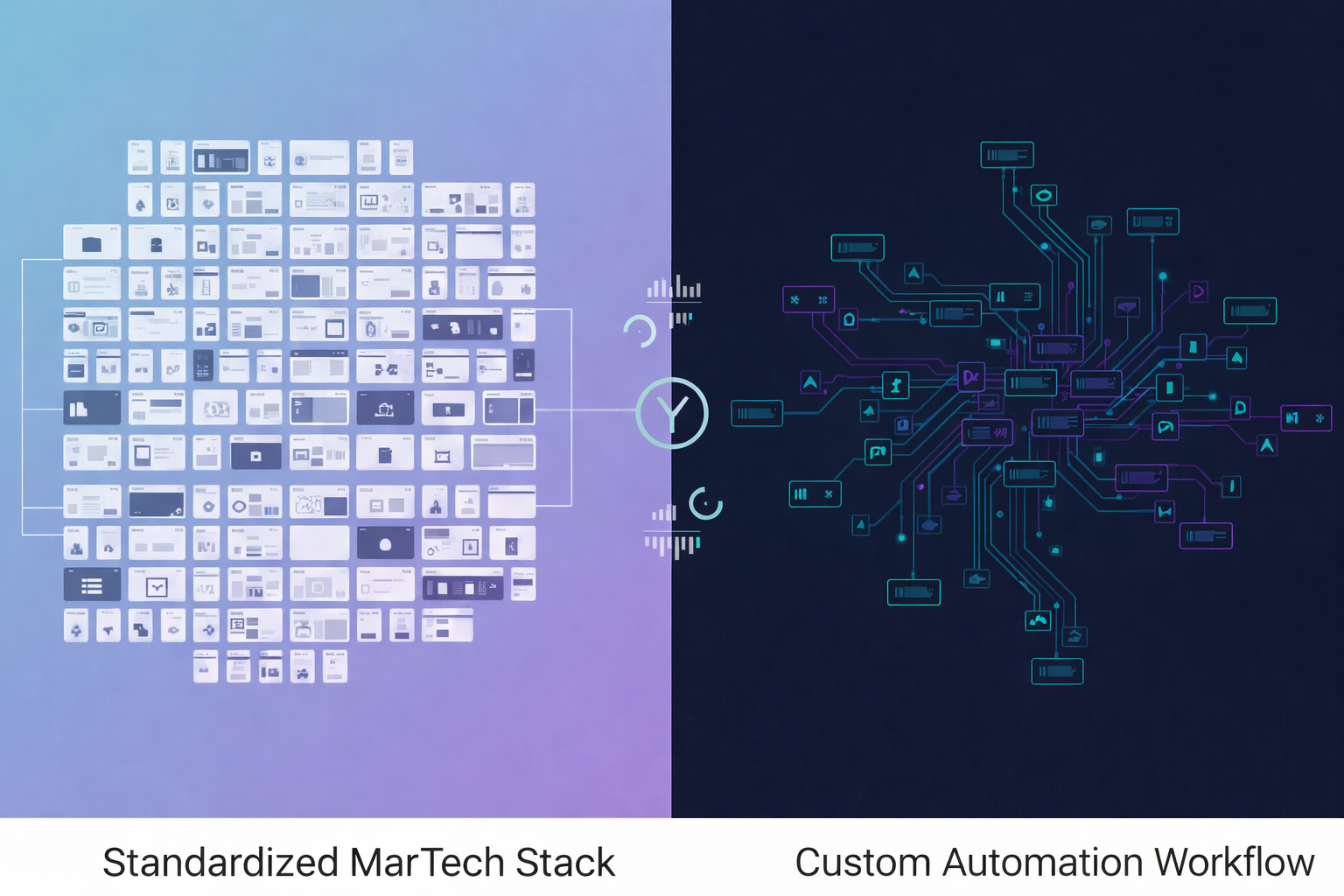
By 2026, most growing companies no longer ask whether to use technology in marketing operations. The real question is how. Off-the-shelf MarTech tools promise speed and structure. Custom automation promises flexibility and precision. Both approaches can work. Both can fail.
The deciding factor is not budget or trend. It is how closely the system reflects real business behavior. Product Analytics plays a central role in this decision because it reveals how users, teams, and systems actually interact.
This article examines where MarTech tools perform well, where custom automation becomes necessary, and how Product Analytics helps teams choose wisely.
What MarTech Tools Do Well
MarTech tools are designed to solve common problems at scale. Lead capture, campaign tracking, email workflows, and reporting come pre-configured. For many teams, this structure is helpful.
These tools reduce setup time. They enforce consistency. They allow teams to operate without deep technical resources.
Marketing teams often benefit early because MarTech tools offer immediate visibility. Dashboards show traffic, conversions, and engagement trends. For organizations with simple workflows, this may be enough.
The Hidden Limits of Standard Tools
Problems arise when business processes diverge from tool assumptions. Real customer journeys are rarely linear. Offline interactions, delayed decisions, and multi-touch relationships complicate tracking.
MarTech tools often flatten this complexity. They show what fits predefined models. What falls outside those models is either ignored or forced into unsuitable fields.
Product Analytics exposes these gaps. When teams analyze in-product behavior or operational workflows, they often find that standard tools fail to capture meaningful actions.
This is where frustration begins. Teams have data, but not insight.
What Custom Automation Offers
Custom automation starts with how the business actually works. Workflows are designed around real stages, not vendor defaults. Data flows follow decisions, not templates.
This approach requires more upfront thinking. It also requires technical expertise. The payoff is alignment.
Custom automation adapts as the business changes. It integrates offline and online signals. It supports nuanced tracking that standard tools cannot handle.
Product Analytics thrives in this environment because events and metrics are defined with purpose.
Learning From Real Implementations
Product Siddha’s work on Built Custom Dashboards by Stage offers a clear example. Standard dashboards showed activity volume. Custom dashboards revealed progress through meaningful stages. Teams could see where momentum slowed and why.
In another case, Product Analytics for a Ride-Hailing App with Mixpanel, custom event tracking uncovered friction that off-the-shelf reports missed. Growth improved not through more campaigns, but through better product flow.
These examples show how Product Analytics depends on data structure. When structure reflects reality, insight follows.
When MarTech Tools Are Enough
MarTech tools work well when processes are stable and predictable. Early-stage companies, single-market operations, and teams with limited variation often benefit.
Tools like CRM platforms and email automation systems provide guardrails. They prevent chaos. They establish baselines.
Product Analytics still adds value here by helping teams understand user engagement, but the need for customization remains low.
The key is knowing when the limits are reached.
When Custom Automation Becomes Necessary
As organizations grow, complexity increases. Multiple products, regions, sales motions, or offline interactions strain standard systems.
Custom automation becomes necessary when teams ask questions their tools cannot answer. Why do users drop after a specific interaction. Which offline actions influence conversion. How does behavior differ by segment.
Product Analytics often triggers this realization. Data reveals patterns that tools cannot explain.
In Product Analytics and Full-Funnel Attribution for a SaaS Coaching Platform, attribution required linking acquisition data with deep usage behavior. Custom automation made this possible. Standard tools alone could not support the analysis.
Cost Considerations in 2026
Cost is often misunderstood. MarTech tools appear cheaper upfront. Subscriptions are predictable. Setup is fast.
Custom automation appears expensive because development is visible. Over time, however, licensing costs rise and flexibility remains limited.
The real cost lies in missed insight. When teams make decisions without clarity, waste increases. Product Analytics helps quantify this hidden cost by revealing where value is lost.
Governance and Ownership
Tools come with rules. Custom systems require governance.
Without ownership, custom automation becomes brittle. Without flexibility, tools become constraints.
The most effective teams assign clear responsibility for data definitions, tracking standards, and review cycles. Product Analytics acts as the common language across teams.
This governance ensures that automation supports decision-making rather than obscuring it.
A Hybrid Reality
In 2026, most mature organizations use a hybrid approach. Core MarTech tools handle standard tasks. Custom automation fills gaps and supports advanced workflows.
Product Analytics connects both worlds. It ensures that data remains consistent, meaningful, and actionable.
The question is not tools versus custom automation. It is where each belongs.
Common Mistakes to Avoid
One mistake is customizing too early. Without stable processes, automation amplifies confusion.
Another mistake is clinging to tools long after they stop serving the business. Comfort replaces clarity.
Product Analytics helps teams avoid both. It reveals readiness for customization and highlights when tools no longer suffice.
A Clear Way Forward
Teams should begin with questions, not software. What decisions need better data. Where does uncertainty slow progress. Which actions matter most.
From there, choose tools or automation accordingly.
Product Siddha approaches this decision through analysis, not assumption. Systems are shaped around behavior, not branding.
Final Thoughts
MarTech tools and custom automation are not opposing choices. They serve different needs at different stages.
In 2026, the organizations that perform best understand their boundaries. They use tools for efficiency and custom automation for insight.
Product Analytics sits at the center, ensuring that every system supports real understanding.
When data reflects reality, decisions improve. When decisions improve, growth follows.