
Product Analytics vs Marketing Analytics: Key Differences Explained
Two Lenses, One Business
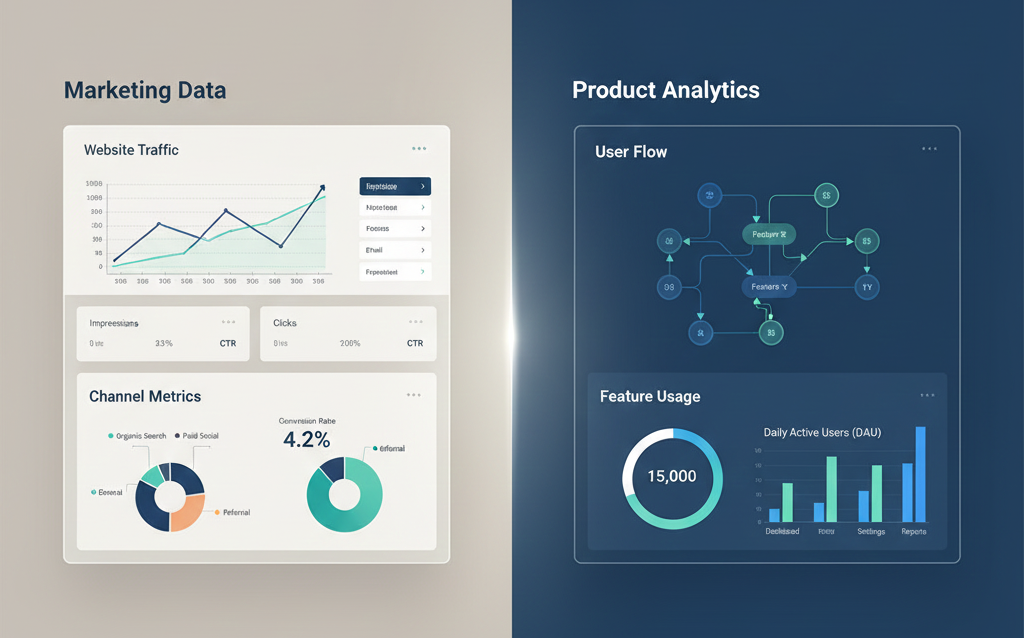
As digital products mature, teams collect more data than ever before. Yet confusion persists around what that data should explain. Two disciplines often get grouped together, even though they serve different purposes. Product Analytics and Marketing Analytics answer different questions, support different decisions, and influence different teams.
Understanding the distinction matters. When leaders treat both as interchangeable, they risk drawing the wrong conclusions. When used together with clarity, these analytics disciplines provide a complete picture of growth, usage, and value.
What Product Analytics Focuses On
Product Analytics examines how users interact with a product after they arrive. It tracks behavior inside the product experience. This includes feature usage, user flows, drop-off points, and long-term engagement.
The goal is to understand how value is delivered. Are users completing key actions? Where do they hesitate? What patterns separate active users from those who leave?
Product Analytics relies on event-level data. Every click, view, or action becomes part of a behavioral story. Over time, these stories reveal how the product performs in real conditions.
This discipline supports product managers, engineering teams, and leadership responsible for product decisions.
What Marketing Analytics Examines
Marketing Analytics looks outward. It focuses on how users arrive, what messages attract them, and which channels drive awareness. It measures campaign performance, traffic sources, and conversion paths before users enter the product.
The central concern is acquisition efficiency. Which channels bring relevant users. Which messages resonate. How spend translates into leads or sign-ups.
Marketing Analytics helps teams allocate budgets and refine outreach. It answers questions about reach and response, not usage depth.
Where Confusion Commonly Arises
Confusion begins when teams expect Marketing Analytics to explain user behavior after onboarding. Click-through rates and campaign reports cannot explain why users stop using a feature or abandon workflows.
Likewise, Product Analytics cannot explain why traffic dropped or why a campaign underperformed. Each discipline has limits.
Product Analytics explains what happens after entry. Marketing Analytics explains how users arrive. Both are necessary. Neither replaces the other.
A Practical Comparison
To clarify the distinction, consider a simple example.
A mobile app sees a drop in daily active users.
Marketing Analytics may show stable traffic and consistent campaign performance. Acquisition has not changed.
Product Analytics may reveal that a recent update introduced friction in a core workflow. Users encounter difficulty and disengage.
Without Product Analytics, the team might increase marketing spend unnecessarily. Without Marketing Analytics, the team might miss early warning signs of declining acquisition quality.
Product Analytics in Action
Product Siddha’s work on Product Analytics for a Ride-Hailing App with Mixpanel illustrates the practical role of Product Analytics. In this case, detailed event tracking revealed where users dropped out during ride booking. The issue was not demand, but friction in a specific step.
Once identified, teams adjusted the flow and engagement improved. Marketing efforts remained unchanged because the problem was internal to the product experience.
This example shows how Product Analytics protects teams from guessing. It replaces assumption with evidence.
When Marketing Analytics Takes the Lead
Marketing Analytics becomes critical during expansion or repositioning. When entering a new market or testing new messaging, teams need clear feedback on reach and response.
For example, HubSpot Marketing Hub Setup for a Growing Fintech Brand focused on organizing acquisition data and campaign tracking. The insights guided budget allocation and messaging adjustments.
Product Analytics would not have solved this problem alone. Marketing Analytics provided clarity at the top of the funnel.
The Overlap Zone
There is a small overlap between the two disciplines. Conversion tracking sits at the boundary. The moment a user signs up or completes onboarding, responsibility begins to shift.
This handoff is where alignment matters. Shared definitions and clean data ensure continuity. Without alignment, teams argue over numbers rather than improving outcomes.
Why Product Analytics Drives Long-Term Value
Product Analytics often receives less attention early on. Acquisition feels urgent. Growth targets demand traffic.
Over time, however, retention and engagement determine sustainability. Product Analytics reveals whether users find lasting value. It highlights which features matter and which create friction.
Teams that invest early in Product Analytics build products that improve steadily. Teams that delay rely on marketing spend to compensate for weak experiences.
Common Mistakes Teams Make
One common mistake is using marketing dashboards to judge product success. High traffic does not equal high value.
Another mistake is tracking too many product events without a clear purpose. Data volume without direction creates noise.
Product Analytics works best when tied to clear questions. Which actions predict retention. Which steps block progress. Which changes improve outcomes.
Using Both Disciplines Together
Strong organizations treat Product Analytics and Marketing Analytics as complementary. Marketing brings users in. Product ensures they stay and succeed.
This balance was evident in Product Analytics and Full-Funnel Attribution for a SaaS Coaching Platform, where attribution connected acquisition sources with in-product behavior. Teams gained clarity across the entire journey without blurring responsibilities.
Choosing the Right Metrics
Metrics should reflect responsibility. Marketing teams focus on cost per acquisition and channel efficiency. Product teams focus on activation, retention, and feature adoption.
Leadership reviews both through a strategic lens. The mistake is expecting one dashboard to answer every question.
Product Analytics excels at explaining user behavior. Marketing Analytics excels at explaining reach and response.
A Clear Takeaway
The difference between Product Analytics and Marketing Analytics is not technical. It is conceptual.
One examines how value is delivered. The other examines how attention is earned.
When teams respect this distinction, decisions improve. Resources are used wisely. Growth becomes repeatable rather than reactive.
Final Perspective
Product Analytics and Marketing Analytics serve different masters. Confusing them weakens both.
Organizations that understand the difference gain clarity at every stage. They know how users arrive and why they stay. They fix real problems instead of chasing surface metrics.
For teams working with Product Siddha, this distinction forms the foundation of meaningful analytics work. Clear questions lead to useful data. Useful data leads to better products.