
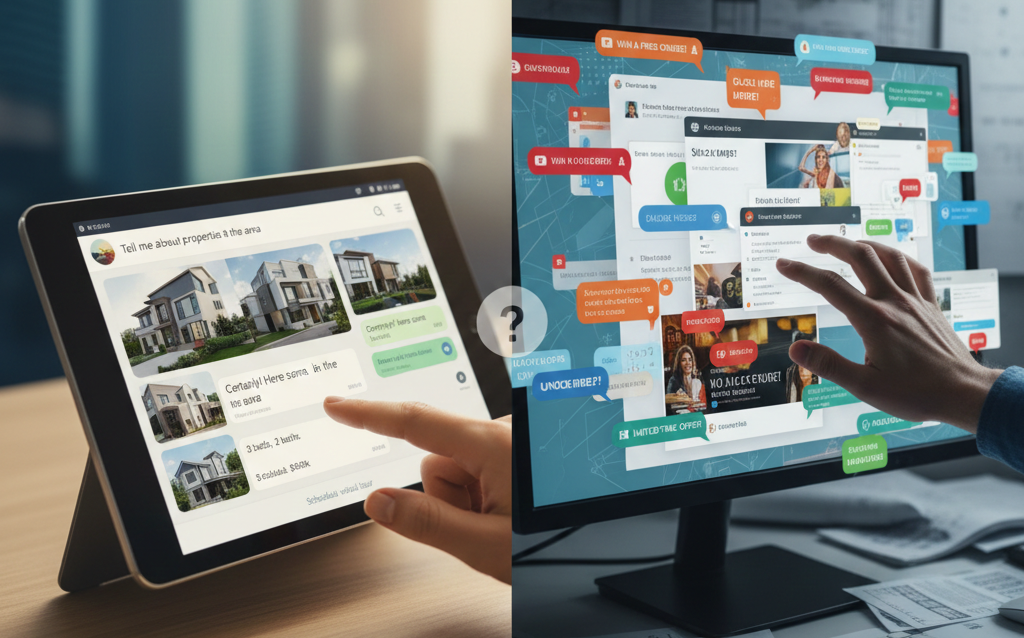
Real Estate Chatbots: Valuable Tool or Just Digital Noise?
Setting the scene
Real estate chatbots have become common across property websites, listing portals, and messaging platforms. Visitors are greeted instantly. Questions are answered around the clock. Enquiries are captured without human effort. Yet many brokers and developers quietly wonder whether these tools are helping or simply adding another layer of noise to an already crowded sales process.
The answer is neither simple nor universal. Real estate chatbots can create measurable value, but only when their role is clearly defined and tightly connected to how buyers behave. When deployed without restraint or context, they often frustrate visitors and burden sales teams with low-quality conversations. This article examines where real estate chatbots earn their place and where they fail, using grounded examples and operational patterns observed across real-world automation projects by Product Siddha.
What real estate chatbots are meant to solve
At their core, real estate chatbots exist to handle early-stage interactions. They greet visitors, respond to basic questions, and collect information before a human steps in. In markets where response speed influences outcomes, chatbots promise immediate engagement without expanding staff.
In practice, most buyer questions at the first touchpoint are predictable. Availability, price range, location, possession timelines, and site visit scheduling dominate early enquiries. A well-designed real estate chatbot can address these without friction, allowing sales teams to focus on conversations that require judgment and persuasion.
Problems arise when chatbots are asked to do more than they should. Buyers do not want long scripted conversations. They want clarity, acknowledgment, and a clear next step. When chatbots attempt to replace human interaction rather than prepare for it, trust erodes quickly.
Where real estate chatbots add real value
The strongest use cases for real estate chatbots appear in three areas: speed, consistency, and qualification.
Speed remains the most obvious advantage. Chatbots respond instantly, regardless of time or workload. For late-night visitors or weekend browsers, this immediacy signals seriousness and professionalism.
Consistency matters just as much. Chatbots deliver the same accurate information every time. There is no fatigue, no skipped questions, and no variation in tone. This is particularly useful for large inventories where details must remain precise.
Qualification is where value compounds. When chatbots are limited to collecting intent signals, such as preferred location, budget range, and timeline, sales teams receive better-prepared leads. Conversations begin further along the decision path.
In Product Siddha’s case study titled “From Lead to Site Visit – Voice AI Automation for a Real Estate Platform,” early automation focused on filtering genuine interest before human follow-up. The result was not more conversations, but fewer and better ones. Site visit conversion improved because sales teams spoke to buyers who were already prepared to engage.
When chatbots become digital noise
Despite their promise, many real estate chatbots fail for the same reasons. Overreach, poor language, and weak integration turn them into obstacles rather than assets.
Overreach is the most common mistake. Chatbots that ask too many questions at once or attempt complex conversations create friction. Buyers abandon the interaction or provide false answers simply to escape the flow.
Language is another frequent issue. Chatbots often rely on stiff or generic phrasing that feels disconnected from real speech. This breaks trust quickly. Buyers sense when they are being processed rather than heard.
Integration failures also undermine effectiveness. When chatbot data does not flow cleanly into the real estate CRM, leads lose context. Sales agents start conversations blind, repeating questions the buyer already answered. This repetition signals disorganization.
In these situations, chatbots do not reduce workload. They increase it by generating shallow interactions that require cleanup later.
Buyer expectations and conversational limits
Understanding buyer psychology is essential when evaluating real estate chatbots. Property decisions involve emotion, risk, and long-term commitment. Buyers tolerate automation only when it respects these stakes.
Chatbots are well suited for factual exchanges. They struggle with reassurance, negotiation, and nuanced objections. A buyer asking about parking availability expects a direct answer. A buyer expressing uncertainty about affordability expects empathy and explanation.
Effective implementations recognize this boundary. Chatbots hand over conversations gracefully when questions move beyond basics. This handoff must feel intentional, not abrupt. A simple acknowledgment followed by human follow-up preserves continuity.
Across Product Siddha’s automation projects, including non-real estate domains, the most successful systems treat chatbots as gatekeepers, not closers. Their role is to open doors, not to seal deals.
Measuring value beyond lead count
One reason chatbots disappoint is the way success is measured. Many teams focus on lead volume rather than lead quality. A spike in chatbot interactions may look impressive on dashboards but deliver little revenue impact.
More meaningful indicators include response time, qualification rate, and progression to site visits or calls. These metrics reflect whether the chatbot supports real outcomes rather than surface activity.
In real estate environments where chatbots are aligned with CRM workflows, teams gain clearer visibility into buyer intent. This allows managers to allocate attention where it matters most. When metrics stay shallow, chatbots remain superficial tools.
Chatbots within a broader system
Real estate chatbots rarely succeed in isolation. They perform best when embedded within a wider operational system that includes CRM discipline, response tracking, and clear ownership.
Product Siddha’s work building lead engines and custom dashboards highlights this principle across industries. Automation elements that operate without feedback loops tend to drift. Those tied to regular review and adjustment improve steadily over time.
In real estate, this means reviewing chatbot conversations alongside sales outcomes. Which questions correlate with site visits. Where buyers drop off. Which handoff points feel awkward. Without this reflection, chatbots stagnate.
| Aspect | High-Quality Chatbot Conversations | Low-Quality Chatbot Conversations |
|---|---|---|
| Opening message | Clear, polite greeting that explains purpose in one sentence | Generic greeting with no context or value explained |
| Question flow | Asks one focused question at a time based on buyer intent | Fires multiple questions at once, overwhelming the visitor |
| Language tone | Natural, simple language that mirrors how buyers speak | Robotic, scripted phrasing that feels impersonal |
| Information accuracy | Provides precise answers on price range, availability, and location | Shares vague or outdated information |
| Buyer control | Allows buyers to skip, pause, or request human follow-up easily | Forces buyers through a rigid conversation path |
| Qualification approach | Gathers only essential details like budget, area, and timeline | Collects excessive data with no clear purpose |
| Handoff to sales | Smooth transition with context passed into the CRM | Abrupt handoff or no handoff at all |
| CRM integration | Conversation history is visible to the sales team | Sales team starts blind and repeats questions |
| Buyer experience | Feels helpful and respectful of time | Feels intrusive or frustrating |
| Outcome quality | Fewer conversations with higher site visit or call conversion | Higher volume of chats with low follow-through |
A balanced assessment
Real estate chatbots are neither a cure-all nor a distraction by default. They are tools that amplify existing habits. In disciplined teams, they sharpen response speed and improve focus. In disorganized teams, they magnify confusion.
Their value depends on restraint, language, and integration. When chatbots stay within clear boundaries, they reduce friction. When they chase novelty, they create noise.
Product Siddha’s experience across automation, analytics, and real estate workflows points to a consistent conclusion. Chatbots succeed when they respect the human nature of property decisions and quietly support, rather than compete with, sales professionals.
Final perspective
Real estate chatbots earn their place when they feel helpful, brief, and purposeful. Buyers remember clarity more than cleverness. Sales teams value context more than volume.
Used wisely, chatbots create smoother entry points into complex transactions. Used carelessly, they become another window to close. The difference lies not in technology, but in intent.