
Sell.Do vs Zoho CRM: Best Real Estate Automation for Indian Builders 2026
Setting the Context
Indian real estate in 2026 looks very different from even three years ago. Builders are no longer struggling only with lead volume. The real problem is lead quality, delayed follow-ups, poor coordination between sales teams, and unclear visibility into what actually converts a prospect into a site visit or booking.
Automation has moved from being a support tool to becoming the backbone of sales operations. This is where the debate around Sell.Do vs Zoho CRM becomes important for builders searching for the Best Real Estate Automation suited to Indian market realities.
This article examines both platforms through a practical lens. It focuses on usability, automation depth, reporting clarity, and long-term scalability. Insights are grounded in real-world implementation experience from Product Siddha, including automation work for real estate platforms operating in high-volume lead environments.
What Builders Actually Need From Automation
Before comparing tools, it is important to understand what Indian builders expect from real estate automation today.
Most builders require:
- Fast lead capture from portals, ads, and walk-ins
- Immediate response through calls or WhatsApp
- Automated follow-ups without sounding robotic
- Clear tracking from lead to site visit to booking
- Simple dashboards that sales managers can actually use
Automation that looks impressive but creates friction for sales teams usually fails within months.
The Best Real Estate Automation is not the one with the longest feature list. It is the one that reduces human dependency at scale while keeping reporting clean and trustworthy.
Sell.Do Overview for Real Estate Teams
Sell.Do is built specifically for real estate developers. Its strength lies in understanding builder workflows rather than trying to be a general CRM.
Core Strengths
- Native integrations with Indian property portals
- Lead routing based on project, budget, and location
- Site visit scheduling tied to sales calendars
- Builder-friendly dashboards and reports
- WhatsApp and call automation tailored for real estate
Sell.Do works well for mid to large builders who want speed without heavy customization.
Where Sell.Do Falls Short
- Limited flexibility outside real estate use cases
- Reporting becomes restrictive at enterprise scale
- Advanced automation requires external tools
- Not ideal for builders with multi-business verticals
Sell.Do is practical and focused. It solves real problems quickly but does not always scale cleanly across complex organizations.
Zoho CRM Overview in a Real Estate Context
Zoho CRM is a horizontal platform. It is designed to serve many industries, including real estate, through customization.
Core Strengths
- Highly customizable workflows
- Strong automation engine
- Scales across multiple departments
- Advanced reporting when configured properly
- Integrates with Zoho ecosystem tools
Zoho CRM appeals to builders who want long-term control over automation logic rather than a pre-built system.
Where Zoho CRM Struggles
- Requires implementation expertise
- Real estate workflows are not native
- Initial setup time is longer
- Sales teams often resist complex interfaces
Without proper implementation, Zoho CRM can feel heavy for field-focused real estate sales teams.
Feature Comparison at a Glance
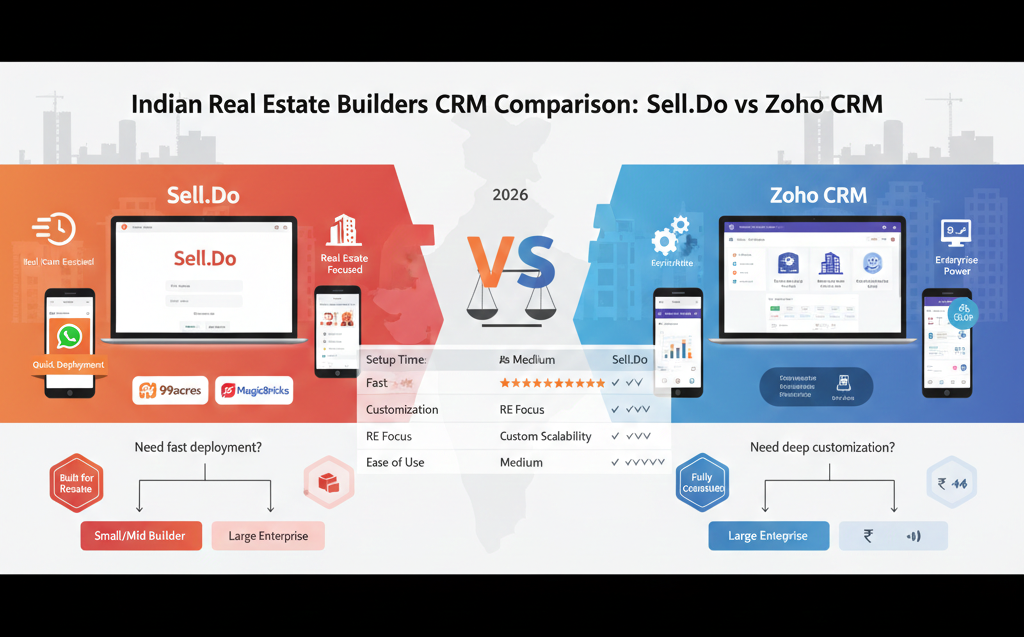
| Feature Area | Sell.Do | Zoho CRM |
|---|---|---|
| Real estate focus | Built-in | Custom-built |
| Lead automation | Strong | Very strong |
| Ease of adoption | High | Medium |
| Reporting depth | Medium | High |
| Scalability | Medium | High |
| Custom workflows | Limited | Extensive |
| Best fit | Builder-first teams | Enterprise builders |
Automation Depth That Matters
Automation is not just about emails and reminders. In real estate, automation must bridge marketing, inside sales, and on-ground teams.
Sell.Do automates lead assignment, follow-ups, and site visit reminders well. It works best when teams follow standard sales processes.
Zoho CRM, when implemented correctly, allows builders to automate:
- Budget-based lead scoring
- Multi-stage approvals
- Custom sales logic by project type
- Post-visit follow-up journeys
This makes Zoho CRM more powerful, but only when paired with proper implementation.
At Product Siddha, automation projects show that builders often underestimate the importance of workflow design. Tools alone do not fix broken processes.
Real-World Automation Example
One relevant example from Product Siddha’s portfolio is “From Lead to Site Visit – Voice AI Automation for a Real Estate Platform.”
In this engagement, automation was layered on top of existing CRM workflows to:
- Instantly call new leads within minutes
- Qualify prospects using voice logic
- Route qualified leads to sales teams
- Track call outcomes automatically
The outcome was not higher lead volume, but faster site visit scheduling and cleaner attribution. This kind of automation works with both Sell.Do and Zoho CRM, but Zoho offered deeper control at scale.
This highlights an important truth. The Best Real Estate Automation depends on how well automation aligns with actual sales behavior.
Reporting and Visibility
Builders often complain that CRMs show activity but not clarity.
Sell.Do offers ready-made reports that answer basic questions:
- How many leads came in?
- How many site visits happened?
- Which channel performed better?
Zoho CRM, when implemented correctly, answers deeper questions:
- Which sales actions increase site visits?
- Where do high-budget leads drop off?
- How long does each stage really take?
Product Siddha often builds custom dashboards by stage, allowing leadership teams to see the real health of the funnel rather than surface metrics.
Scalability for 2026 and Beyond
Smaller builders usually prefer Sell.Do for its simplicity. Large builders with multiple projects, cities, or international expansion often outgrow it.
Zoho CRM scales better across:
- Multiple brands
- Channel partners
- Centralized analytics
- Advanced automation logic
However, scaling Zoho CRM without expert implementation often leads to clutter and poor adoption.
This is where experienced real estate automation partners matter more than the tool itself.
Choosing the Best Real Estate Automation
There is no universal winner.
Choose Sell.Do if:
- You want fast deployment
- Your team prefers simplicity
- You operate mainly in residential real estate
Choose Zoho CRM if:
- You need deep customization
- You operate at enterprise scale
- You want long-term automation flexibility
In both cases, success depends on how well workflows are designed, automated, and adopted.
At Product Siddha, automation projects focus on business outcomes rather than tool features. Whether it is real estate platforms, SaaS products, or AI-driven systems, the principle remains the same. Automation should reduce friction, not add complexity.
Final Word
In 2026, the Best Real Estate Automation is not about choosing Sell.Do or Zoho CRM in isolation. It is about understanding your sales process, your team behavior, and your growth plans.
Tools can support growth, but only when automation is thoughtful, well-implemented, and aligned with how builders actually sell property in India.