
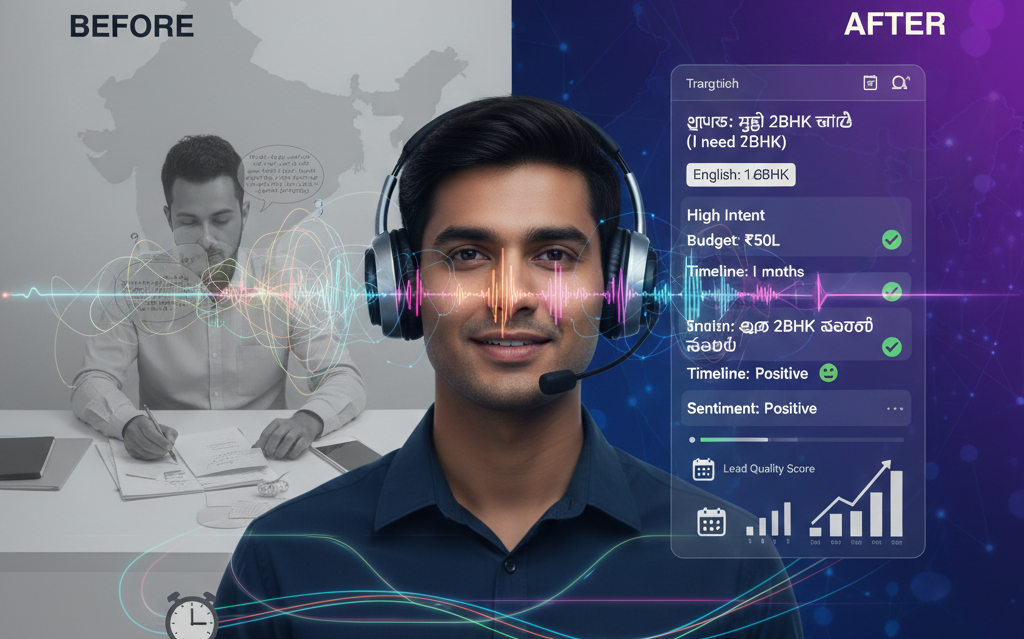
Voice AI for Real Estate: Automated Call Analysis in Hindi and Regional Languages
Listening at Scale
Real estate in India still runs on phone calls. Leads arrive online, but decisions move forward through conversations. Buyers ask questions, express doubts, negotiate timelines, and reveal intent through speech rather than forms.
As call volumes grow, listening becomes the bottleneck. Sales managers cannot review thousands of conversations. Feedback arrives late or not at all. This gap is where Voice AI for Real Estate has begun to change daily operations, especially when calls happen in Hindi and regional languages.
Automation here does not replace conversation. It ensures conversation is understood.
Why Calls Matter More Than Forms
Most real estate leads in India convert or drop based on the first call. Tone, clarity, and response speed matter as much as price or location.
Yet call analysis remains manual in many firms. Managers rely on summaries, not transcripts. Patterns are guessed rather than measured.
This creates three problems:
- Missed buying signals
- Inconsistent call quality across teams
- No clear link between calls and site visits
Voice AI for Real Estate addresses these issues by turning spoken conversations into structured data.
What Voice AI Actually Does in Real Estate
Voice AI listens to calls, transcribes them, and tags intent markers. These markers may include budget range, location preference, timeline, or objections.
When applied correctly, voice systems can:
- Detect language and dialect automatically
- Capture intent without manual notes
- Flag high-interest conversations
- Track reasons for call drop-offs
- Feed insights into CRM or dashboards
This is especially important in India, where buyers often switch between Hindi, English, and regional languages within the same call.
Hindi and Regional Language Complexity
Indian real estate conversations rarely follow scripted patterns. A single call may include Hindi, Marathi, Tamil, or Hinglish phrases. Manual analysis struggles here.
Voice AI trained for Indian languages recognizes:
- Local accents
- Informal speech patterns
- Mixed-language usage
- Region-specific expressions
This improves accuracy and prevents loss of meaning. Without this capability, automation risks misclassification and poor insights.
From Call to Actionable Insight
Automated call analysis becomes useful only when insights are actionable.
A typical workflow includes:
- Call recording and transcription
- Intent tagging
- Sentiment scoring
- CRM update
- Manager-level reporting
Product Siddha’s From Lead to Site Visit – Voice AI Automation for a Real Estate Platform case study demonstrates this clearly. In that project, voice analysis helped identify which calls showed genuine buying intent. These leads were prioritized for faster follow-up.
The result was not higher call volume. It was better use of existing calls.
Improving Sales Team Consistency
One common challenge for real estate firms is uneven call quality. Some agents perform well. Others struggle quietly.
Voice AI introduces fairness and clarity by:
- Highlighting missed questions
- Identifying unclear explanations
- Tracking follow-up promises
- Comparing call outcomes across teams
This allows managers to coach based on evidence rather than opinion. Over time, overall call quality improves.
Among Voice AI for Real Estate use cases, performance standardization delivers long-term value.
Call Analysis and Site Visit Conversion
Calls that lead to site visits share common traits. Clear budget discussion. Defined timelines. Proper objection handling.
When voice systems track these elements, firms gain insight into what works. Scripts improve naturally. Training becomes specific.
This mirrors lessons from Product Siddha’s Built Custom Dashboards by Stage case study. When visibility improves, decisions become precise. In real estate, call analysis feeds directly into funnel optimization.
Manual vs Automated Call Analysis
| Area | Manual Review | Voice AI Analysis |
|---|---|---|
| Coverage | Sampled | 100 percent |
| Language handling | Limited | Multi-language |
| Insight speed | Delayed | Near real-time |
| Bias risk | High | Low |
| Scalability | Poor | Strong |
Operational Benefits Beyond Sales
Voice AI also supports compliance and dispute handling. Recorded and analyzed calls provide clarity when disagreements arise.
This is useful during:
- Pricing disputes
- Commitment misunderstandings
- Agent performance reviews
Structured call records protect both the firm and the buyer.
Avoiding Common Implementation Errors
Voice automation fails when treated as a plug-in tool rather than an operational system.
Mistakes to avoid include:
- Ignoring language diversity
- Overloading agents with scores
- Failing to align insights with CRM
- Reviewing data without acting on it
Successful Voice AI for Real Estate projects start with clear goals and limited metrics. Complexity grows only after trust is built.
A Broader Automation Perspective
Voice systems work best when connected to wider automation workflows. Calls inform lead scoring. Lead scoring informs follow-up. Follow-up influences site visits.
This integrated thinking aligns with Product Siddha’s broader automation work across platforms and industries. Systems must speak to each other.
Voice is not a standalone channel. It is a signal stream.
Where Indian Real Estate Is Headed
As competition increases, builders and brokers cannot rely on intuition alone. Volume hides problems. Voice analysis exposes them.
Firms that adopt voice systems early gain:
- Clearer buyer understanding
- Faster response cycles
- More consistent sales quality
- Better forecasting accuracy
The future of Voice AI for Real Estate lies in quiet efficiency, not visible automation.
Closing Thoughts
Real estate remains a people business. Voice carries emotion, intent, and trust. Ignoring it at scale is no longer practical.
Automated call analysis in Hindi and regional languages allows firms to listen fully without slowing down. It turns everyday conversations into insight.
For teams working with Product Siddha, voice automation is treated as an operational lens rather than a technical feature. The goal is simple. Understand buyers better and act faster.