
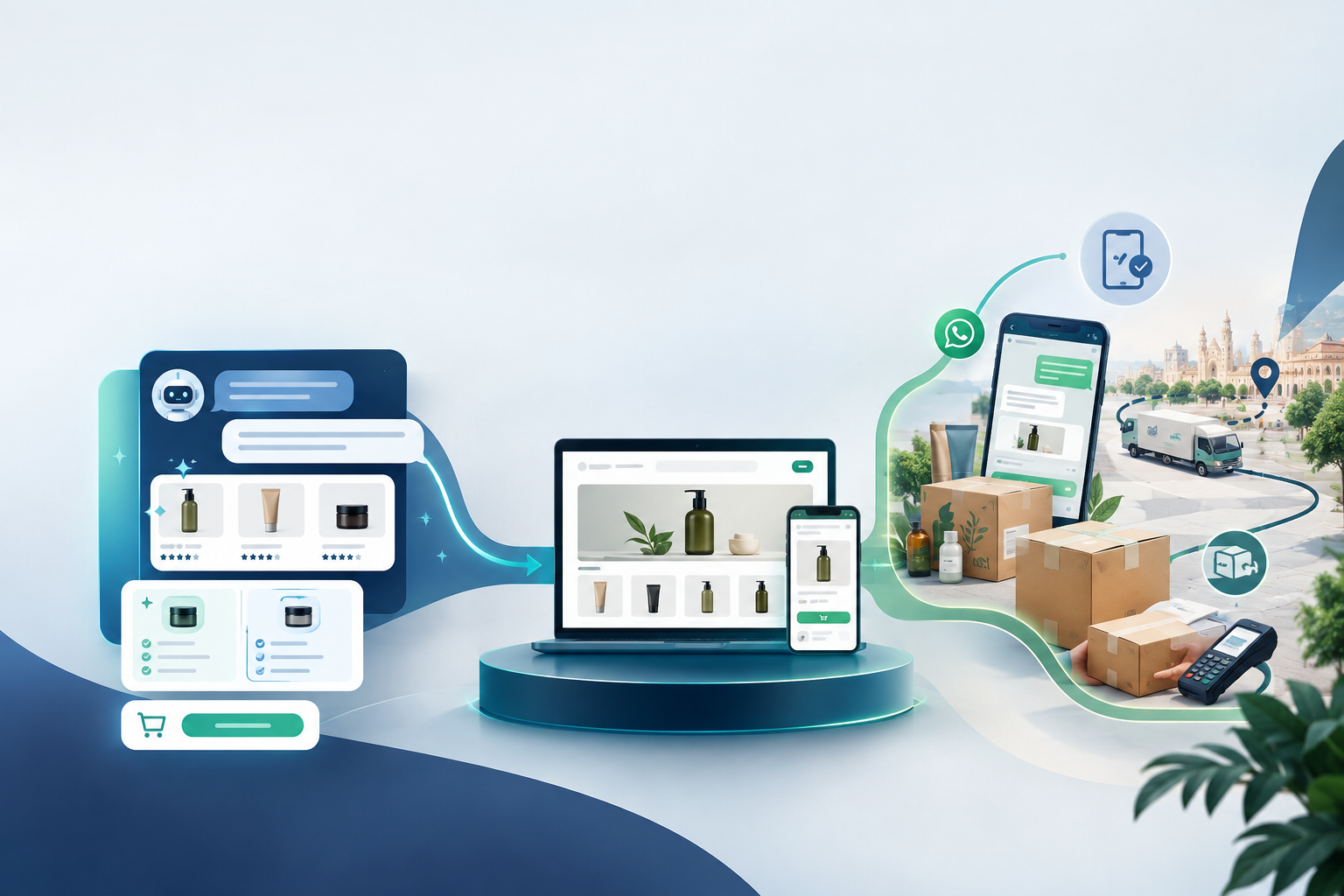
Does Agentic Commerce Even Work for Indian D2C Brands Yet?
Agentic commerce is moving from product demonstrations into real ecommerce infrastructure. Shopify now allows eligible merchants to make products discoverable across AI shopping channels such as ChatGPT, Microsoft Copilot, Google AI Mode, and Gemini. Shopify says its Agentic Storefronts are designed to take shoppers from product discovery through checkout within AI-driven shopping experiences.
That sounds like a major change for ecommerce.
For an Indian D2C brand, however, there is a more practical question.
Does agentic commerce actually fit the way Indian customers buy products today?
The answer is more complicated than a simple yes or no.
India has a large and increasingly sophisticated digital shopping market. UPI has become a normal part of everyday payments, online discovery is widespread, and D2C brands are reaching customers well beyond major cities. At the same time, COD remains important, WhatsApp is deeply embedded in everyday communication, and trust can play a significant role in the final purchase decision.
That creates an interesting gap between the way agentic commerce is designed to work and the way many Indian D2C transactions still happen.
What Agentic Commerce Changes
Traditional ecommerce usually follows a familiar path.
A customer searches for a product, visits a website or marketplace, compares products, adds one to a cart, and completes checkout.
Agentic commerce moves some of those steps into an AI conversation.
A customer might ask an AI assistant to find a particular type of product. The agent can consider the request, compare available products, answer questions, and potentially help complete the transaction without the customer manually visiting several websites.
Shopify describes this as a system where product information is supplied to AI agents through Shopify Catalog. The agent can then surface products based on information such as product details, availability and pricing. The transaction can be completed through Shopify Checkout where the relevant AI channel supports it.
This changes the starting point of the shopping journey.
The customer may begin with a conversation rather than a search box.
Shopify Is Building the Infrastructure
Shopify has moved quickly in this area.
Its current Agentic Storefronts product connects eligible merchants with AI shopping channels. Shopify says products can be discovered through ChatGPT, Microsoft Copilot, Google AI Mode and the Gemini app, with channel availability and checkout options varying by market and eligibility.
Shopify also says that its Catalog structures product information for AI discovery and that merchants can manage their agentic channels from the Shopify admin. The admin now includes reporting for orders, sales and conversions from supported AI channels.
There is a practical advantage here.
A D2C brand does not necessarily have to build a separate AI shopping system from scratch. Shopify is handling much of the product catalog and commerce infrastructure.
For brands already operating on Shopify, this lowers the technical barrier to experimenting with AI-based product discovery.
But There Is an Indian Market Problem
The bigger issue is geography.
Shopify’s current documentation states that Agentic Storefront purchasing across its AI channels is currently available to US buyers. For ChatGPT, Shopify says eligible merchants can sell to US buyers regardless of where the merchant is located. Google AI Mode and Gemini have additional eligibility requirements.
That means an Indian D2C brand should not assume that enabling Agentic Storefronts automatically creates a full AI checkout channel for Indian shoppers.
An Indian brand may be able to prepare its product catalog and participate in supported AI discovery, but the availability of direct AI checkout depends on the buyer’s market and the particular channel.
This distinction is important.
AI product discovery and AI-native purchasing are two different stages of agentic commerce.
A brand can prepare for the first without immediately receiving the full benefits of the second.
Indian Customers Already Have Another Shortcut
Indian ecommerce has its own version of conversational commerce.
It often happens through WhatsApp.
WhatsApp is widely used in India for personal and business communication. Meta-related research reported in 2025 found that nearly 60% of surveyed Indian shoppers had made a purchase after encountering a product offer on WhatsApp. The same report said WhatsApp had about 719 million monthly users in India at the time of the report.
This does not mean every Indian consumer wants to shop through WhatsApp.
It does show why Indian D2C brands should not look at agentic commerce in isolation.
A customer may discover a product on Instagram, ask a question on WhatsApp, receive a payment link, choose COD, and complete the purchase through a familiar mobile experience.
That journey may feel more natural to the customer than opening an AI shopping interface.
COD Changes the Equation
Payment behavior is another important difference.
UPI has transformed Indian digital payments. Shiprocket’s 2025 report, produced with KPMG, says UPI accounted for 84% of India’s retail digital payment volume in FY2024-25. The same report says around 105 million Indians still prefer COD, particularly in rural and semi-urban regions.
Razorpay’s current 2026 guide cites research estimating that 60% to 65% of Indian ecommerce orders were COD, with higher adoption in Tier 2 and Tier 3 cities.
These figures should not be treated as a precise current market-wide measurement because they come from different studies. They do, however, illustrate the central point.
India is not a single payment market.
A customer in Bengaluru who regularly uses UPI may have a very different checkout preference from a first-time buyer in a smaller city who wants to pay after delivery.
Agentic commerce needs to account for that variety.
Trust Still Matters
D2C brands often spend heavily to acquire a first-time customer.
The customer may have discovered the brand through an Instagram video, an influencer, a search result, or a recommendation from a friend.
Before placing an order, that customer may want to know:
- Is the product genuine?
- Can I return it?
- How long will delivery take?
- Is COD available?
- Can I speak to someone?
- What happens if the product arrives damaged?
- Is the brand reliable?
An AI shopping agent can answer some product questions when the underlying information is accurate and available.
It does not automatically solve the broader trust problem.
For Indian D2C brands, product reviews, transparent policies, delivery information, customer support, payment choices and brand familiarity can remain important parts of the purchase decision.
Where Agentic Commerce Can Help
Agentic commerce still has several useful applications for Indian D2C brands.
Consider a customer searching for a specific product.
Instead of typing several searches and opening multiple websites, the customer could ask an AI assistant to compare suitable products based on price, ingredients, size, use case or other requirements.
For a well-structured product catalog, this creates a new discovery opportunity.
Shopify says its Catalog automatically structures product information so AI channels can access product details. Its documentation also says merchants can control which products are made available through agentic channels.
This means Indian D2C brands can begin preparing for AI discovery even while direct AI purchasing develops at different speeds across markets.
Product Data Becomes More Important
Agentic commerce puts greater importance on product information.
A human shopper can sometimes understand a poorly written product page by looking at images, reviews and surrounding context.
An AI agent needs structured and reliable information to make useful recommendations.
A D2C brand should therefore review:
| Product information | What needs attention |
| Product title | Clear product identity |
| Description | Accurate use and benefits |
| Ingredients | Complete and readable details |
| Price | Current pricing |
| Availability | Accurate inventory |
| Variants | Size, color or format |
| Shipping | Delivery information |
| Returns | Clear policy |
| Images | Useful product visuals |
| Product category | Correct classification |
Shopify says Agentic Storefronts use product data such as titles, descriptions, images, pricing, inventory and shipping information when making products available to AI channels.
That makes product feed quality part of the preparation for agentic commerce.
Shopify vs WhatsApp and COD
For Indian D2C brands, the comparison is better understood as a difference between customer journeys.
| Area | Shopify Agentic Commerce | WhatsApp / COD-led Commerce |
| Product discovery | AI conversations | Social, messaging and referrals |
| Product comparison | AI-assisted | Customer or sales-assisted |
| Customer interaction | AI agent | Brand or support team |
| Payment | Depends on supported channel and market | UPI, cards, COD and other local options |
| Trust building | Product and brand information | Conversation, support and familiarity |
| Geographic maturity | Still developing by market | Already widely used |
| Automation | High potential | Already established |
| Indian D2C relevance | Emerging opportunity | Existing customer behavior |
The two approaches do not have to compete.
A D2C brand could prepare its catalog for AI discovery while continuing to use WhatsApp, email, its website, marketplaces and COD where customers prefer them.
What Indian D2C Brands Should Do Now
There is little reason for an Indian D2C brand to rebuild its entire commerce operation around agentic shopping today.
A more practical approach is preparation.
First, improve product data.
Second, make pricing, availability, shipping and return information easy to understand.
Third, make sure product feeds and structured commerce data are accurate.
Fourth, monitor where AI-generated traffic and product discovery begin appearing.
Fifth, continue improving existing channels such as WhatsApp, email, search, social commerce and the brand website.
Finally, watch the availability of AI checkout in the markets where the brand actually sells.
This approach allows the business to participate as the market develops without abandoning channels that already generate orders.
The Indian D2C Reality
Agentic commerce is real, and Shopify has built substantial infrastructure around it. Shopify reported that AI-driven traffic to Shopify stores grew eight times year over year in Q1 2026, while orders from AI-powered searches increased nearly 13 times. Those are Shopify’s own platform figures, so they should not be treated as a measurement of the entire Indian ecommerce market.
For Indian D2C brands, however, the more immediate question is market fit.
AI shopping may become an important discovery and buying channel. Yet Indian ecommerce already has deeply established behaviors around WhatsApp, UPI, COD, social discovery and direct customer conversations.
The sensible response is to prepare for both.
Prepare for the Next Buying Path
Agentic commerce does not require an Indian D2C brand to abandon its current customer journey.
Shopify’s Agentic Storefronts give eligible merchants a way to prepare product catalogs for AI-driven discovery and supported purchasing experiences.
At the same time, WhatsApp, UPI, COD and established ecommerce channels remain important parts of India’s shopping environment.
For Product Siddha, the practical opportunity is to help D2C brands connect these pieces. That means improving product data, lifecycle communication, customer segmentation, WhatsApp journeys and ecommerce infrastructure while keeping an eye on how AI shopping develops.
The question for an Indian D2C brand is therefore less about whether agentic commerce has arrived everywhere.
It is whether the brand’s product data, customer experience and commerce systems are ready when more Indian shoppers begin using AI agents to buy.