
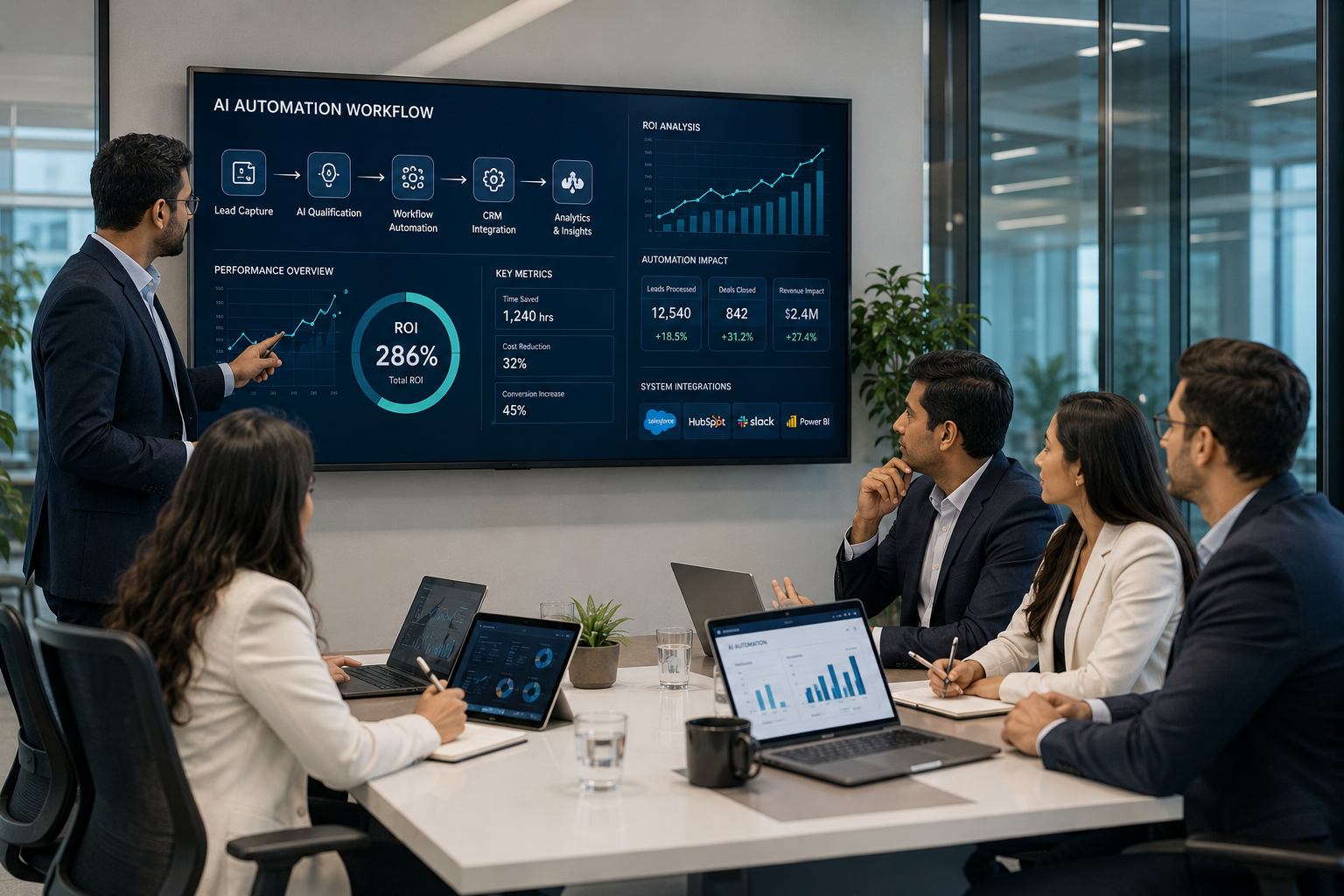
AI Automation Agency vs In-House Automation Team: Which Delivers Better ROI?
Smarter Automation Decisions
Businesses across retail, finance, healthcare, logistics, and SaaS are investing in automation to reduce repetitive work and improve operational speed. The question is no longer whether automation matters. The real question is who should build and manage it.
Some companies prefer an internal automation department. Others partner with an AI Automation Agency that already has the tools, workflows, and technical experience in place.
Both approaches can work. Still, the return on investment depends on budget, hiring capacity, business goals, and how quickly automation needs to produce results.
At Product Siddha, we have worked with organizations that started with internal teams and later shifted to agency partnerships after delays, rising costs, and integration issues slowed progress. We have also seen companies use a hybrid model successfully. The right choice depends on what the business truly needs.
Understanding the Two Models
An in-house automation team is built internally. The company hires developers, analysts, automation engineers, project managers, and system architects to create workflows and maintain automation systems.
An AI Automation Agency works as an external partner. The agency designs, deploys, tests, and manages automation solutions for the client using experienced specialists and established frameworks.
The difference is not only about staffing. It affects speed, maintenance, scalability, software integration, and long-term operating cost.
Cost Structure and Financial Impact
An internal automation department requires ongoing investment. Salaries, benefits, training, software licenses, cloud infrastructure, and hiring costs add up quickly.
Many businesses underestimate how expensive automation talent has become. Skilled AI engineers, data specialists, and automation architects are in high demand. Recruiting them takes time and often delays projects before development even begins.
An AI Automation Agency spreads those costs across multiple clients. That allows businesses to access senior-level expertise without maintaining a full-time technical department.
Typical Cost Areas
| Expense Category | In-House Team | AI Automation Agency |
| Hiring Costs | High | Minimal |
| Training | Ongoing | Included |
| Infrastructure Setup | Internal responsibility | Often managed by agency |
| Maintenance | Full internal cost | Shared service model |
| Scaling Projects | Requires more hiring | Faster expansion |
| Time to Deployment | Slower initially | Faster implementation |
For many mid-sized companies, agency partnerships create better ROI during the first several years of automation adoption.
Speed Matters More Than Most Companies Expect
Automation projects lose value when deployment drags on for months.
Internal teams often spend large amounts of time building workflows from scratch, selecting software tools, solving integration issues, and handling testing problems that experienced agencies already know how to avoid.
An AI Automation Agency usually works with tested implementation models. The agency has already built similar systems for other industries and understands where delays typically occur.
This shortens development cycles and reduces operational disruption.
For example, a retail company automating customer communication may need CRM integration, email workflow automation, customer segmentation, reporting dashboards, and AI-driven personalization. An experienced automation agency can often deploy these systems much faster because the architecture already exists.
Faster deployment improves ROI because businesses begin saving time and reducing manual labor earlier.
Technical Expertise and Problem Solving
Automation today involves more than simple workflow triggers.
Businesses now rely on:
- AI workflow automation
- Marketing automation platforms
- CRM integrations
- Data synchronization
- Predictive analytics
- Automated reporting
- Customer support automation
- Lead scoring systems
- Inventory forecasting
- Real-time dashboard reporting
An internal team may have expertise in one or two areas but struggle across the full ecosystem.
An AI Automation Agency usually brings specialists from multiple disciplines into a single project. This includes AI engineers, API developers, UX strategists, automation architects, and analytics professionals.
That depth matters when systems become more complex.
At Product Siddha, many clients initially approached us after internal projects stalled because software tools were not communicating properly. Integration problems often become the hidden cost of automation.
Scalability and Long-Term Flexibility
Business needs change quickly.
A company that automates customer support this year may need sales automation, reporting automation, or supply chain forecasting next year.
Internal teams may struggle to scale at the same pace because every new project requires additional hiring and training.
An AI Automation Agency can usually scale faster because the technical resources already exist. Agencies also stay updated with automation trends, emerging AI tools, and platform changes that internal departments may not monitor closely.
This flexibility becomes especially important during growth periods.
For example:
- A real estate company may need automated lead routing during expansion.
- A healthcare organization may require patient communication automation.
- An ecommerce brand may need automated product recommendation systems during seasonal demand spikes.
An experienced AI Automation Agency can adapt systems more quickly across these changing needs.
The Hidden Risk of Internal Dependency
One issue many businesses overlook is employee turnover.
When key automation engineers leave an internal team, critical knowledge often leaves with them. Workflows become difficult to maintain, documentation may be incomplete, and troubleshooting slows down.
Agencies reduce this risk because multiple specialists understand the project infrastructure. Support continuity becomes more reliable.
This does not mean internal teams lack value. In fact, businesses with mature technical operations often benefit from internal ownership. However, companies entering automation for the first time usually face a steeper learning curve.
When an In-House Team Makes Sense
An internal automation department can be the right investment under certain conditions.
In-house automation may work better when:
- The business has a large technical budget
- Automation is central to proprietary operations
- Internal data security policies require direct control
- The company already employs experienced AI engineers
- Long-term custom platform development is needed
Large enterprises sometimes prefer internal ownership because automation becomes part of their competitive advantage.
Still, building that capability takes substantial investment and management oversight.
When an AI Automation Agency Delivers Better ROI
Most growing businesses prioritize speed, lower upfront cost, and reliable execution.
An AI Automation Agency often delivers stronger ROI when:
- Automation needs immediate implementation
- Internal technical hiring is difficult
- Multiple systems require integration
- The business needs specialized expertise
- Scalability is important
- Budget efficiency matters
- Leadership wants measurable results quickly
For many companies, the agency model reduces risk while accelerating operational improvements.
Why Businesses Work With Product Siddha
Product Siddha helps businesses simplify automation adoption without creating unnecessary technical complexity.
Our team works across AI automation services, workflow optimization, marketing automation implementation, CRM integration, data automation, analytics systems, and operational process improvement.
We focus on practical execution rather than oversized technical frameworks that create long deployment cycles.
Businesses partner with Product Siddha because they need automation systems that improve productivity, reduce manual work, and support long-term operational growth.
Every organization operates differently. That is why automation strategies should match actual business workflows instead of forcing companies into rigid templates.
Final Perspective
The best automation investment is not always the one with the largest internal team. It is the one that creates measurable efficiency, reduces operational friction, and produces results within a reasonable timeline.
For many businesses, partnering with an AI Automation Agency creates faster and more predictable ROI than building an internal department from the ground up.
Internal teams can offer long-term ownership and control, but they also require substantial hiring, management, and infrastructure investment.
Companies evaluating automation should look beyond short-term staffing decisions and focus on scalability, deployment speed, technical expertise, and operational impact.
That broader view usually reveals where the strongest return truly exists.