
AI Decision Engines Explained for Business Leaders
The Business Shift
Every business makes hundreds or even thousands of operational decisions each day. Some are routine, such as assigning customer inquiries, routing service requests, qualifying leads, or onboarding new customers. Others involve inventory planning, customer support prioritization, workforce scheduling, and identifying operational risks. As organizations grow, these decisions become more frequent and more complex.
Traditional software follows predefined instructions. It performs tasks exactly as it is programmed. Modern businesses, however, require systems that can evaluate multiple sources of information, apply business rules, and recommend the most appropriate next step.
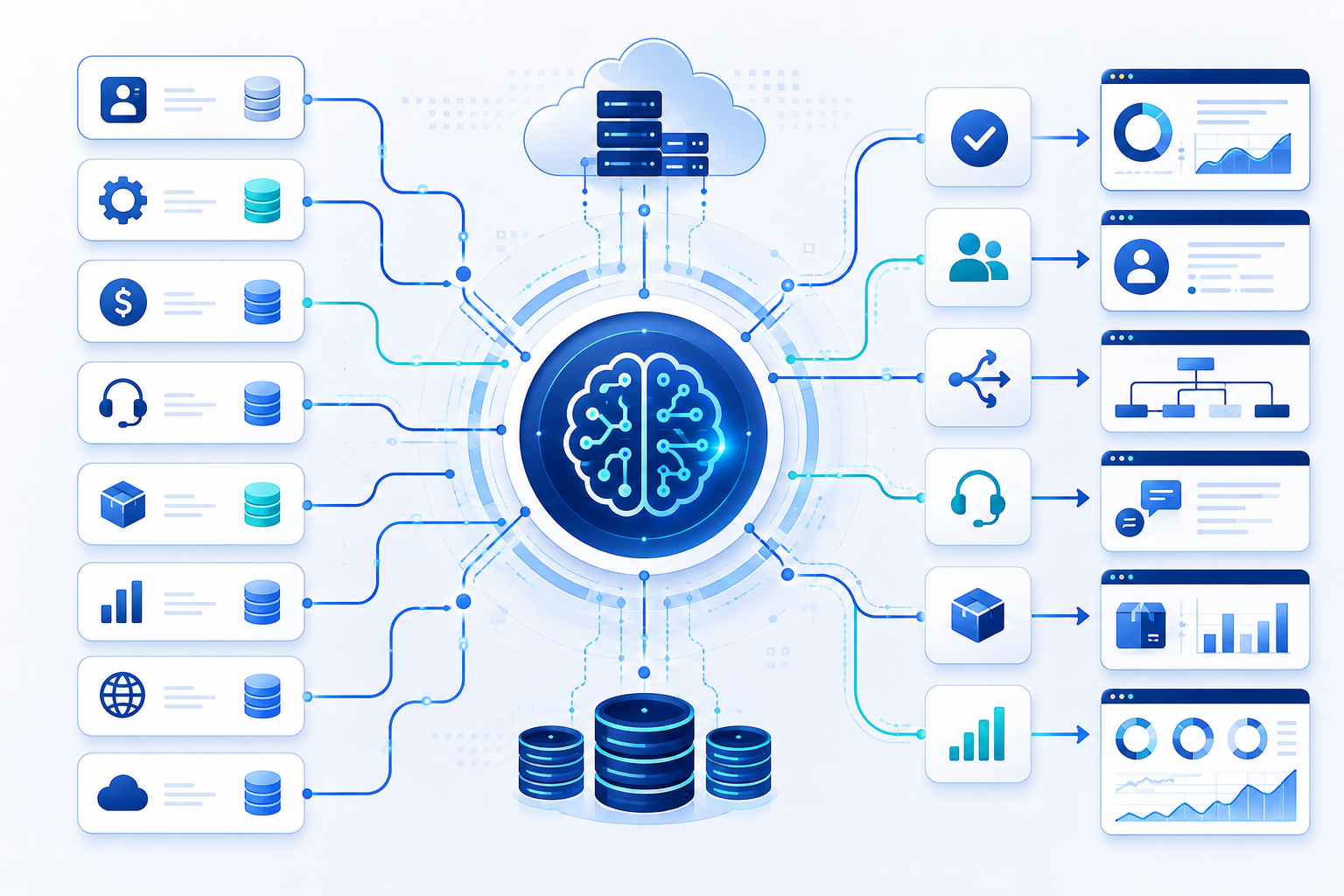
This is where AI Decision Engines become valuable. They combine business logic, data analysis, and intelligent automation to support consistent, timely, and informed operational decision-making across an organization.
At Product Siddha, we help businesses design AI-powered automation solutions that simplify operational decisions, improve efficiency, and reduce manual effort.
Understanding AI Decision Engines
An AI Decision Engine is a software system that evaluates available information, applies predefined business rules, analyzes patterns, and determines the most appropriate next action.
Unlike basic automation, which follows a fixed sequence of tasks, a decision engine evaluates changing conditions before selecting an outcome.
For example, an AI Decision Engine can:
- Route customer inquiries to the right department
- Prioritize sales opportunities
- Route customer onboarding requests
- Recommend inventory replenishment
- Assign service tickets based on urgency
- Recommend personalized product suggestions
- Prioritize document review workflows
These recommendations follow predefined business policies while using available operational data to improve consistency and efficiency.
How AI Decision Engines Work
An AI Decision Engine typically follows four stages.
1. Data Collection
The system gathers information from different business platforms such as:
- CRM software
- ERP systems
- Marketing platforms
- Customer support tools
- Inventory databases
- HR systems
- Website activity
- External APIs
The quality of the decision depends on the quality of the available data.
2. Data Processing
Incoming information is validated and organized before analysis.
During this stage, the system may:
- Remove duplicate records
- Verify customer information
- Standardize formats
- Combine information from multiple sources
- Update missing values
Accurate data helps produce reliable recommendations.
3. Decision Logic
This is the core of the decision engine.
Business rules and AI models evaluate the available information.
Examples include:
- Customer purchase history
- Customer onboarding status
- Product availability
- Lead quality
- Customer lifetime value
- Support ticket priority
- Service-level agreements (SLAs)
Based on these inputs, the system determines the most appropriate next action.
4. Automated Action
Once a recommendation is made, the engine automatically triggers the appropriate workflow.
Examples include:
- Assigning a customer onboarding specialist
- Creating a follow-up task
- Updating a CRM record
- Scheduling customer communication
- Notifying the appropriate department
- Escalating high-priority customer issues
The process happens with minimal manual involvement while following established business rules.
Business Problems AI Decision Engines Solve
Many organizations experience similar operational challenges.
| Business Challenge | AI Decision Engine Solution |
| Slow customer onboarding | Intelligent workflow routing |
| Lead assignment delays | Intelligent lead routing |
| Manual customer support | Ticket prioritization |
| Inventory shortages | Inventory forecasting recommendations |
| Document processing delays | Automated document classification |
| Inconsistent service routing | Rule-based request routing |
Rather than relying on employees to manually review every operational request, organizations can use AI Decision Engines to evaluate information, prioritize tasks, and recommend the next appropriate action. This creates greater consistency while allowing employees to focus on decisions that require experience and business judgment.
Key Benefits for Business Leaders
Faster Decision-Making
Routine operational decisions often consume valuable employee time.
AI Decision Engines evaluate information within seconds, allowing employees to focus on strategic work instead of repetitive administrative tasks.
Improved Consistency
Different employees may interpret business policies differently.
Decision engines apply the same business rules every time, reducing inconsistencies across departments.
Better Resource Allocation
The system helps assign work according to business priorities.
Examples include:
- Customer onboarding requests are routed more efficiently.
- High-priority service requests reach the appropriate teams sooner.
- Sales representatives receive qualified opportunities first.
This improves productivity while balancing workloads.
Reduced Operational Costs
Manual reviews require time and staff.
Automating routine operational decisions reduces administrative effort while maintaining consistent outcomes.
Scalable Operations
As organizations grow, operational requests increase.
Decision engines continue processing thousands of requests without requiring proportional increases in staffing.
Practical Business Applications
Sales Operations
AI Decision Engines help sales teams by:
- Scoring incoming leads
- Assigning prospects automatically
- Prioritizing follow-up activities
- Identifying promising sales opportunities
Sales managers gain better visibility while reducing manual assignment work.
Customer Service
Support teams often receive hundreds of requests every day.
Decision engines automatically:
- Classify customer issues
- Measure urgency
- Route tickets
- Recommend responses
Customers receive quicker service while support teams manage workloads more effectively.
Customer Onboarding
Customer onboarding often requires information to move across several business systems.
AI Decision Engines help by:
- Reviewing submitted information
- Checking document completeness
- Identifying missing details
- Routing applications to the correct team
- Triggering onboarding workflows
This shortens onboarding time while maintaining consistency across departments.
Supply Chain
Decision engines improve supply chain operations by:
- Recommending inventory replenishment based on demand forecasts
- Monitoring inventory levels
- Identifying supply chain delays
- Prioritizing replenishment requests
- Notifying operations teams about potential shortages
This helps businesses improve inventory planning while reducing operational disruptions.
Human Resources
HR departments can automate:
- Candidate screening
- Interview scheduling
- Employee onboarding
- Leave request routing
- Training recommendations
Administrative work decreases while employee experiences improve.
AI Decision Engines vs Traditional Automation
| Traditional Automation | AI Decision Engines |
| Executes fixed tasks | Evaluates multiple conditions |
| Limited flexibility | Adapts to changing data |
| Rule-based workflows | Combines rules with intelligent analysis |
| Performs repetitive actions | Selects the most appropriate next action |
| Minimal analysis | Provides data-driven recommendations |
Traditional automation performs repetitive work efficiently.
Decision engines extend automation by helping systems determine what should happen next based on business rules and available information.
Important Considerations Before Implementation
Business leaders should prepare several foundations before introducing an AI Decision Engine.
High-Quality Data
Poor data creates poor recommendations.
Organizations should clean and standardize their business information before implementation.
Clearly Defined Business Rules
Successful decision engines require documented business policies.
Leadership teams should identify:
- Customer priorities
- Operational thresholds
- Service-level objectives
- Escalation criteria
- Workflow rules
Integration with Existing Systems
Decision engines perform best when connected to:
- CRM platforms
- ERP software
- Customer databases
- HR systems
- Business intelligence tools
A connected technology environment improves decision quality and operational efficiency.
Continuous Monitoring
Business conditions change over time.
Decision rules should be reviewed regularly to ensure they remain aligned with company goals and operational requirements.
How Product Siddha Helps Businesses
At Product Siddha, we build AI-powered business automation solutions that simplify complex operational processes.
Our services include:
- AI Decision Engine development
- Workflow automation
- CRM automation
- Business process automation
- Intelligent lead routing
- Customer onboarding automation
- Data integration
- Reporting dashboards
- AI-powered operational solutions
We help organizations automate routine operational decisions while improving consistency, efficiency, and scalability across business functions.
Looking Ahead
Business growth brings increasing operational complexity. More customers, more service requests, more data, and more internal workflows place greater demands on employees and management teams.
AI Decision Engines provide a practical way to manage this complexity. By combining business rules, reliable data, and intelligent automation, organizations can evaluate information, prioritize work, and recommend consistent actions across departments.
Rather than replacing human judgment, these systems strengthen it. Routine operational decisions can be handled automatically, while employees remain responsible for situations that require experience, critical thinking, and business context.
At Product Siddha, we help organizations design AI Decision Engine solutions that improve operational efficiency, support better decision-making, and build scalable workflows that grow alongside the business.