
The New Agency Stack: AI Tools Every Marketing Agency Needs in 2026
A Shift in the Tools Agencies Depend On
Agency work has always relied on tools. In earlier years, these tools were separate systems. One handled reporting, another managed customer data, and a third tracked campaigns. Platforms like HubSpot for CRM, Google Analytics for website tracking, and Mailchimp for email marketing often operated independently. Teams moved between them and filled the gaps manually.
That pattern is changing. The modern agency stack is no longer a collection of disconnected tools. It is a connected system where AI tools support daily work and reduce the need for constant oversight. Tools like n8n, Zapier, and Make now connect workflows across platforms, reducing manual effort.
The focus is no longer on using more tools. It is on using the right ones in a structured way.
What Defines the New Agency Stack
The new stack is not built around volume. It is built around connection and flow.
A well-structured stack has three characteristics:
- Tools share data without manual transfer
- Workflows run without repeated input
- Outputs are consistent across projects
This is where AI tools for marketing agencies – such as HubSpot, Klaviyo, and Customer.io, play a central role. They allow systems to function together rather than in isolation.
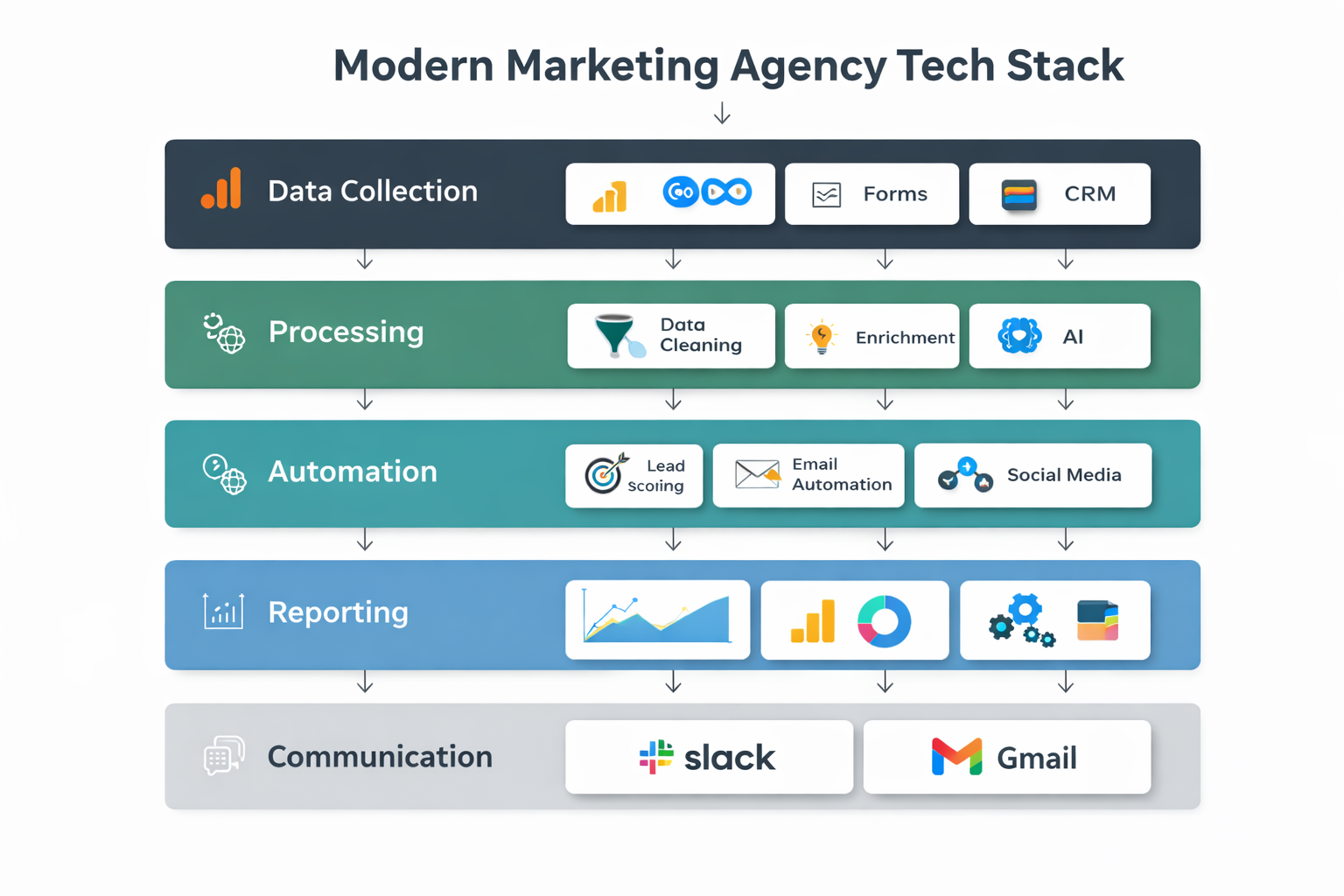
Core Layers of the Modern Stack
A useful way to understand the stack is to break it into layers.
1. Data Collection Layer
This layer gathers information from different sources.
Examples include:
- Website analytics (Google Analytics, Mixpanel)
- Application usage data (Amplitude)
- Campaign performance metrics (Meta Ads Manager, Google Ads)
The role of AI-powered analytics tools here is to ensure that data is captured accurately and in real time.
2. Data Processing Layer
Once collected, data needs to be organized and interpreted.
In earlier setups, teams handled this manually. Now, AI data processing tools such as Segment (Twilio Segment) and BigQuery help structure the information and prepare it for use.
This reduces the need for repeated cleaning and formatting.
3. Automation Layer
This is where the stack becomes active.
AI automation tools like n8n, Zapier, and Make connect systems and trigger actions:
- Updating CRM records in HubSpot
- Sending notifications via Slack
- Routing leads to sales teams
This layer removes routine tasks from daily work.
4. Reporting Layer
Reporting is no longer a monthly activity. It is continuous.
AI reporting tools such as Looker Studio, Power BI, and Tableau create dashboards that reflect current performance. Teams no longer wait for reports, they access them at any time.
5. Communication Layer
Communication tools ensure that insights reach the right people.
Instead of long reports, updates are shared through:
- Email summaries (via Customer.io, Brevo)
- Messaging platforms (Slack, Microsoft Teams)
- Automated alerts from dashboards
A Simple Table of the Stack
| Layer | Purpose | Example Tools |
|---|---|---|
| Data Collection | Gather information | Google Analytics, Mixpanel |
| Data Processing | Organize data | Segment, BigQuery |
| Automation | Connect workflows | n8n, Zapier |
| Reporting | Present insights | Looker Studio, Power BI |
| Communication | Share updates | Slack, Customer.io |
A Real Pattern Across Different Projects
The same structure appears in different types of work.
In a project focused on product analytics for a ride-hailing application, tools like Mixpanel and Segment replaced manual tracking. Data was captured continuously and processed without delay, while automation tools triggered alerts and updates across teams.
This example shows that the value of AI tools lies in how they are arranged, not just in what they do individually.
How Agencies Can Transition to a Connected Stack
Moving from disconnected tools to a structured system does not happen all at once. Most agencies already have the tools they need. The gap is usually in how those tools are connected.
A practical transition often follows three steps:
1. Audit the Existing Stack
Start by listing all active tools across marketing, sales, analytics, and reporting.
Identify where data is duplicated or manually transferred. These gaps indicate where automation can add value.
2. Identify Repetitive Workflows
Look for tasks that are repeated daily or weekly:
- Manual report creation
- Lead data entry
- Campaign performance tracking
- Internal status updates
These are strong candidates for automation using tools like n8n or Zapier.
3. Build One Workflow at a Time
Instead of rebuilding everything, focus on one workflow.
For example, automate lead capture → CRM update → notification.
Once stable, expand to other workflows.
This step-by-step approach reduces risk and makes adoption easier for teams.
Common Challenges in Adoption
Even with the right tools, agencies often face challenges when building a connected stack.
Fragmented Data Sources
Data exists across multiple platforms but lacks a unified structure. This slows down reporting and decision-making.
Over-Reliance on Manual Processes
Teams continue manual work even when automation is possible. This limits scalability.
Tool Overload
Adding more tools without clear integration creates complexity instead of solving it.
Lack of Workflow Clarity
Without defined processes, automation tools cannot deliver consistent results.
Addressing these challenges requires a focus on systems rather than individual tools.
Why Structure Matters More Than Tool Selection
Two agencies can use the same tools and achieve very different results. The difference usually comes down to structure.
A structured system ensures that:
- Data flows in a predictable way
- Actions are triggered at the right time
- Outputs remain consistent across projects
Without structure, even the most advanced tools create inconsistent results.
This is why the modern agency stack is defined less by tool choice and more by workflow design.
Finally
The shift toward connected systems is not a trend. It is a structural change in how agencies operate, as seen in the approach taken by Product Siddha.
AI tools, automation platforms, and analytics systems are no longer optional additions. They are part of the foundation of modern agency work.
Agencies that focus on building structured, connected workflows are better positioned to handle complexity, maintain consistency, and scale efficiently.