
Done-for-You vs DIY AI Automation for Agencies: What Scales Better?
A Practical Choice Agencies Must Make
Most agencies reach a point where manual work begins to slow them down. Reporting takes longer than expected. Lead handling becomes uneven. Systems grow, but they do not connect.
At this stage, the question is no longer whether to adopt automation. The question is how to adopt it.
Should the agency build its own workflows using available AI tools, or should it rely on a done-for-you setup designed by specialists?
The answer depends on scale, capability, and long-term intent.
Understanding the Two Approaches
Before comparing outcomes, it helps to define both approaches clearly.
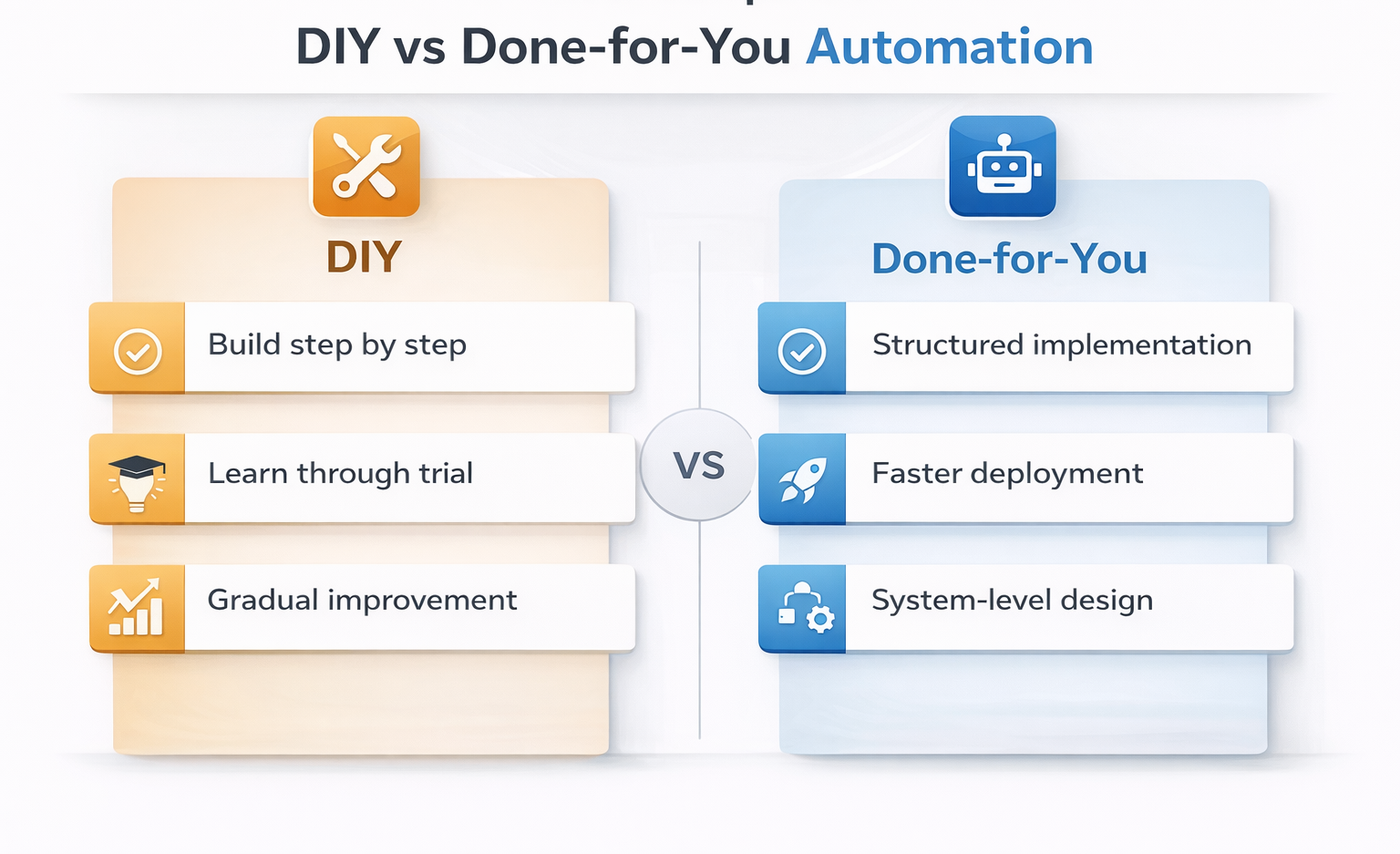
DIY AI Automation
In this model, the agency builds its own systems.
- Teams select AI tools for marketing automation
- Workflows are designed internally
- Integration is handled step by step
This approach gives full control. It also requires time and technical understanding.
Done-for-You Automation
Here, the agency works with a partner that designs and implements the system.
- Workflows are planned externally
- Tools are selected based on use case
- Integration is handled by specialists
This reduces the burden on internal teams. It also speeds up implementation.
A Comparison Table
| Factor | DIY Approach | Done-for-You Approach |
|---|---|---|
| Setup Time | Longer | Shorter |
| Control | High | Moderate |
| Expertise Needed | Internal | External |
| Scalability | Gradual | Faster |
| Maintenance | Internal responsibility | Managed support |
Where DIY Works Well
The DIY route suits agencies that have:
- A technically skilled team
- Time to experiment and refine workflows
- Fewer clients during the early stage
In such cases, building systems internally can lead to a deeper understanding of tools and processes.
However, the cost is often hidden. Time spent learning and fixing systems reduces time available for client work.
Where Done-for-You Becomes Practical
As agencies grow, the limits of DIY become visible.
- Workflows become complex
- Tools need to be connected across departments
- Errors begin to affect delivery
At this stage, a done-for-you approach often becomes more practical. It allows teams to focus on outcomes rather than setup.
The Role of AI Tools in Both Models
Regardless of the approach, AI tools remain central.
They are used to:
- Automate repetitive tasks
- Connect data across systems
- Provide real-time visibility
The difference lies in how these tools are used.
In DIY setups, tools are often used individually.
In done-for-you setups, tools are arranged as part of a larger system.
A Pattern Seen Across Projects
This choice appears in many situations.
In a project focused on HubSpot setup for a growing fintech brand, the challenge was not tool selection. The tool was already available. The difficulty was in structuring workflows and connecting data.
A structured implementation ensured that:
- Customer data moved correctly between stages
- Marketing and sales systems remained aligned
- Reporting reflected accurate progress
This reduced confusion and improved efficiency.
The Question of Scale
The core issue is scalability.
DIY systems often work at a small scale. As the number of clients increases, complexity grows.
- More workflows need to be maintained
- More tools need to be connected
- More errors need to be resolved
Done-for-you systems are designed with scale in mind. They account for growth from the beginning.
Common Mistakes Agencies Make
Many agencies face challenges not because of the approach, but because of how it is applied.
Overbuilding in DIY
Teams try to create complex systems too early. This leads to confusion and delays.
Underplanning in Done-for-You
Agencies sometimes adopt external systems without understanding their structure. This limits long-term flexibility.
A Balanced Approach
In practice, many agencies use a mix of both models.
- Core systems are built with expert support
- Smaller workflows are handled internally
This allows control without overburdening the team.
Looking at the Long Term
The decision between DIY and done-for-you is not permanent. It changes as the agency grows, and Product Siddha helps guide that transition.
In early stages, DIY may be sufficient.
As complexity increases, structured systems built with Product Siddha become necessary.
The focus should remain on building workflows that are reliable and scalable, with Product Siddha supporting that progression.
Final Thoughts
The question is not which approach is better in all cases. It is which approach suits the current stage of the agency.
AI tools for marketing provide the foundation.
The method of implementation determines how effectively that foundation is used.
Agencies that choose carefully tend to scale with fewer disruptions.