
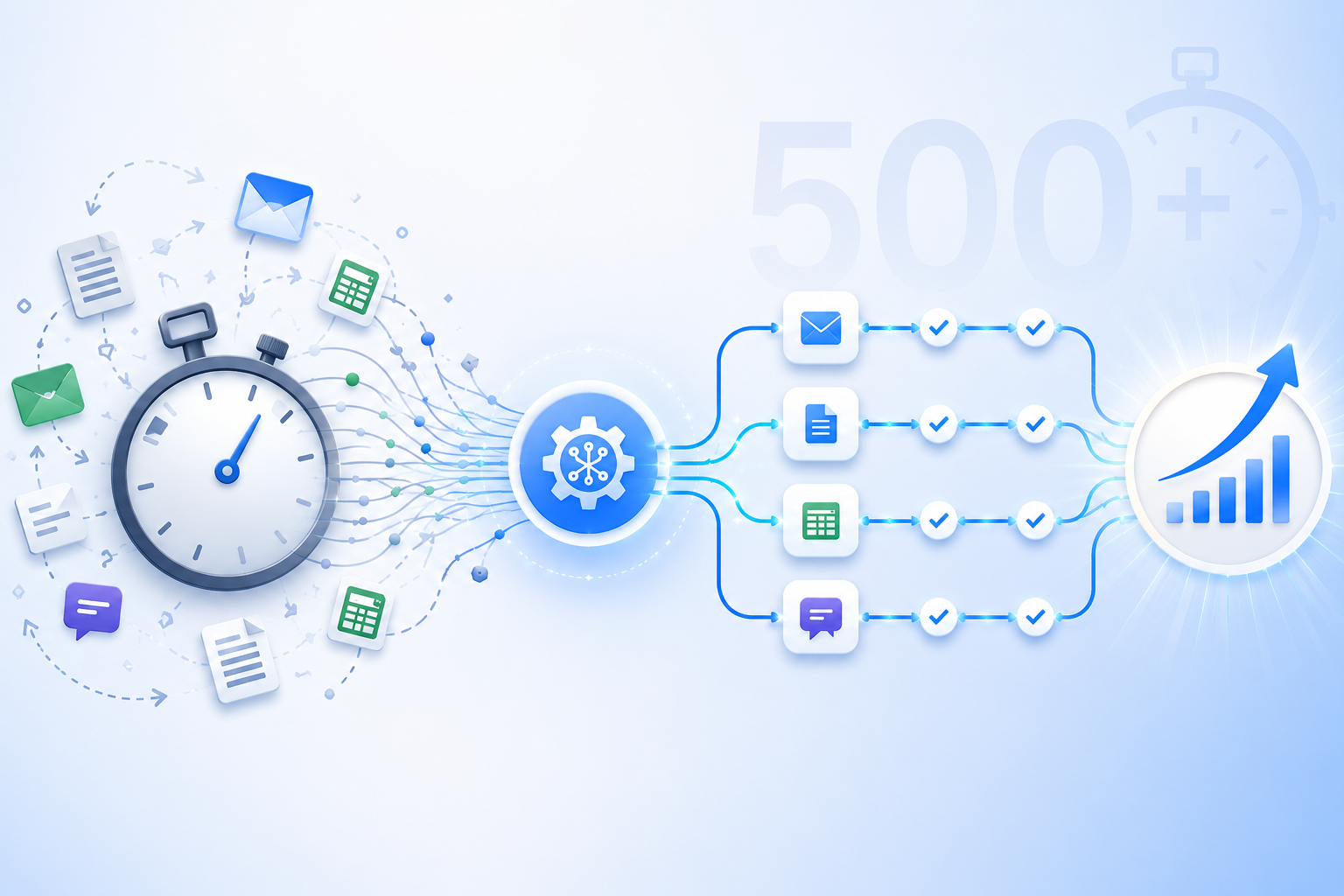
AI Workflows That Save More Than 500 Hours Per Month
The Hidden Cost of Repetitive Work
Every growing business reaches a point where routine work begins to consume valuable time.
Employees spend hours responding to emails, updating customer records, preparing reports, entering data, and moving information between systems. Each task may seem small on its own, yet together they create a significant operational burden.
This is one reason businesses are increasingly investing in AI Workflows.
An intelligent workflow can automate repetitive activities, connect systems, and reduce manual effort without disrupting daily operations. In many cases, these workflows save hundreds of hours each month.
At Product Siddha, we help organizations implement AI Workflows that improve efficiency while allowing teams to focus on work that requires experience, creativity, and strategic thinking.
Understanding AI Workflows
An AI Workflow is a sequence of automated actions supported by artificial intelligence and connected business systems.
Instead of employees manually completing repetitive tasks, AI workflows perform activities automatically.
Common examples include:
- Customer inquiry management
- Lead qualification
- CRM updates
- Invoice processing
- Data extraction
- Email categorization
- Report generation
- Document analysis
AI Workflows combine automation with intelligent decision-making, making them more flexible than traditional automation systems.
A Practical Example
Consider a medium-sized software company that receives:
- 2,000 customer inquiries per month
- 1,500 sales leads
- Hundreds of invoices
- Weekly business reports
- Daily CRM updates
Before automation, employees handled these tasks manually.
The company faced several problems:
- Slow response times
- Repetitive administrative work
- Data entry errors
- Delayed reporting
- Employee fatigue
Management realized that expanding the team would increase costs without addressing the underlying inefficiencies.
Instead, they implemented AI Workflows.
Workflow 1 – Customer Support Automation
The company introduced an AI workflow to manage customer requests.
The workflow:
- Receives incoming messages.
- Understands customer intent.
- Categorizes inquiries.
- Provides instant responses for common questions.
- Assigns complex cases to support staff.
- Updates the CRM automatically.
Monthly Impact
| Activity | Manual Hours | AI Workflow Hours |
| Ticket Categorization | 90 | 5 |
| Customer Replies | 120 | 20 |
| CRM Updates | 50 | 2 |
| Total | 260 | 27 |
Time Saved: 233 Hours
Workflow 2 – Sales Lead Processing
Previously, sales representatives manually reviewed every incoming lead.
The AI workflow now:
- Collects leads from multiple sources
- Evaluates lead quality
- Scores prospects automatically
- Assigns leads to sales representatives
- Updates CRM records
- Schedules follow-up reminders
Monthly Impact
| Activity | Manual Hours | AI Workflow Hours |
| Lead Review | 80 | 8 |
| CRM Data Entry | 60 | 3 |
| Lead Assignment | 25 | 1 |
| Total | 165 | 12 |
Time Saved: 153 Hours
Workflow 3 – Invoice Processing
Finance teams often spend considerable time reviewing invoices and entering data.
The AI Workflow automatically:
- Extracts invoice information
- Validates records
- Matches purchase orders
- Flags discrepancies
- Stores documents
- Generates summaries
Monthly Impact
| Activity | Manual Hours | AI Workflow Hours |
| Data Entry | 55 | 4 |
| Verification | 35 | 5 |
| Reporting | 20 | 2 |
| Total | 110 | 11 |
Time Saved: 99 Hours
Workflow 4 – Business Reporting
Reporting often requires collecting information from:
- CRM systems
- Sales databases
- Analytics platforms
- Customer support software
The AI workflow:
- Pulls data automatically
- Cleans information
- Creates dashboards
- Generates summaries
- Sends reports to management
Monthly Impact
| Activity | Manual Hours | AI Workflow Hours |
| Data Collection | 25 | 2 |
| Report Preparation | 30 | 3 |
| Dashboard Updates | 15 | 1 |
| Total | 70 | 6 |
Time Saved: 64 Hours
Total Time Saved
When all workflows were combined, the results were significant.
| Workflow | Hours Saved |
| Customer Support | 233 |
| Lead Processing | 153 |
| Invoice Processing | 99 |
| Reporting | 64 |
| Total Monthly Savings | 549 Hours |
The company saved more than 500 hours each month while improving response times and operational accuracy.
Why AI Workflows Deliver Better Results
Several factors contribute to these improvements.
Consistent Execution
AI workflows follow the same process every time.
This reduces:
- Human errors
- Missed tasks
- Data inconsistencies
Faster Processing
Tasks that once required hours can often be completed within minutes.
Examples include:
- Customer replies
- Document processing
- CRM synchronization
- Report generation
Scalability
As businesses grow, AI Workflows can handle increased workloads without requiring proportional staff expansion.
Whether processing:
- 500 leads
- 5,000 leads
- 50,000 leads
The workflow structure remains largely unchanged.
Common Business Areas for AI Workflows
Businesses increasingly automate:
Customer Service
- Ticket classification
- Automated responses
- Escalation management
Sales Operations
- Lead scoring
- CRM updates
- Meeting scheduling
Finance
- Invoice processing
- Expense categorization
- Financial reporting
Human Resources
- Resume screening
- Candidate communication
- Employee onboarding
Product Analytics
- User behavior tracking
- Event analysis
- Customer retention reports
AI Workflows continue expanding as businesses identify additional opportunities for automation.
AI Workflows Saving 500+ Hours Per Month
Customer Support
- Ticket Management
- AI Responses
- CRM Updates
Hours Saved: 233
Sales
- Lead Scoring
- Lead Assignment
- CRM Synchronization
Hours Saved: 153
Finance
- Invoice Processing
- Verification
- Reporting
Hours Saved: 99
Reporting
- Data Collection
- Dashboards
- Weekly Reports
Hours Saved: 64
Total
549 Hours Saved Monthly
Working Smarter
Saving time is only one benefit of AI Workflows.
Businesses also gain improved accuracy, faster decision-making, better customer experiences, and greater operational flexibility.
The example discussed here demonstrates how a well-designed set of AI Workflows can save more than 500 hours each month while allowing employees to focus on meaningful work rather than repetitive administrative tasks.
At Product Siddha, we design and implement AI Workflows that align with real business needs. From customer support automation to intelligent reporting and CRM workflows, we help organizations create systems that improve efficiency and support long-term growth.
Frequently Asked Questions
What are AI Workflows?
AI Workflows are automated processes that combine artificial intelligence with business systems to complete repetitive tasks, process information, and improve operational efficiency.
How many hours can AI Workflows save?
The number varies by business. Many organizations save hundreds of hours each month by automating customer support, CRM updates, reporting, and administrative processes.
Which departments benefit most from AI Workflows?
Customer service, sales, finance, operations, and product teams commonly benefit from AI Workflows.
Are AI Workflows suitable for small businesses?
Yes. Small businesses can automate repetitive tasks and improve efficiency without building large teams.
How does Product Siddha help businesses implement AI Workflows?
Product Siddha designs custom AI Workflows that automate business processes, integrate systems, improve efficiency, and support sustainable business growth.