
How to Spot High Intent Buyers Inside Your CRM
Signals That Actually Matter
Every CRM is full of activity. Page visits, emails opened, forms filled, calls logged. Yet very little of this activity points clearly to buying intent. Most teams mistake movement for motivation and treat every contact as equal. Over time, this blurs judgment, slows follow-up, and wastes attention on leads that were never close to a decision.
High intent buyers leave patterns behind them. These patterns are quiet, repeatable, and measurable if the CRM is structured correctly. Spotting them is less about clever tactics and more about disciplined observation.
At Product Siddha, this problem shows up across industries. Whether the business sells property, software, or services, the question is the same. Who is ready now, and how do we know?
What High Intent Really Looks Like
Intent is not interest. Interest can be casual. Intent carries weight.
Inside a CRM, high intent buyers usually show three qualities:
- Consistency in behavior
- Escalation in engagement
- Compression of time between actions
A buyer who views one pricing page once is curious. A buyer who returns to pricing, requests a demo, and responds quickly to follow-up is preparing to decide.
CRMs often record these actions but fail to connect them. Intent only becomes visible when signals are viewed together.
Behavioral Signals That Deserve Attention
Certain actions repeatedly correlate with purchase readiness across sectors.
Repeated High-Value Page Views
Visits to pricing pages, comparison pages, or implementation guides matter more than blog traffic. Repetition is the key factor. One visit may be research. Multiple visits over a short period suggest evaluation.
Direct Questions and Clarifications
Emails or chat messages that ask about timelines, availability, customization, or next steps indicate seriousness. These questions reduce uncertainty rather than explore options.
Shortening Response Times
High intent buyers reply faster as they move closer to a decision. Long gaps early in the journey often shrink to minutes or hours later.
Channel Switching
Buyers who move from email to phone, or from form to direct message, are signaling urgency. They want resolution, not information.
Engagement Sequences Matter More Than Scores
Many CRMs rely on lead scoring. While helpful, scores often hide the story. A sequence of actions reveals more than a number.
For example:
- Day 1: Downloads a buying guide
- Day 3: Views pricing page twice
- Day 4: Submits a contact form
- Day 5: Responds to follow-up within one hour
This pattern reflects intent building over time. The CRM must preserve order and timing, not just totals.
In Built Custom Dashboards by Stage, Product Siddha focused on sequencing rather than aggregation. Dashboards showed movement between stages instead of static scores. This helped teams identify buyers who were advancing quickly rather than those accumulating activity without direction.
CRM Hygiene Makes Intent Visible
High intent buyers often hide inside poor data.
Common issues include:
- Duplicate contacts
- Missing timestamps
- Disconnected channels
- Manual notes without structure
Cleaning these issues does not improve intent itself, but it makes intent visible.
In HubSpot Marketing Hub Setup for a Growing Fintech Brand, CRM restructuring aligned forms, emails, and deal stages. Once data was consistent, patterns appeared naturally. Sales teams stopped relying on gut feeling and began prioritizing based on behavior.
Intent detection improves when the CRM tells one coherent story per buyer.
Listening to Voice and Conversation Data
Written actions are only part of the picture. Calls and voice interactions often carry the strongest intent signals.
In From Lead to Site Visit – Voice AI Automation for a Real Estate Platform, call data revealed patterns that forms never showed. Buyers who asked about visit timing, access, and documentation were far more likely to convert than those asking general questions.
When call summaries and transcripts feed into the CRM, intent becomes easier to spot. Language shifts from exploratory to decisive.
Timing Is an Intent Signal
When actions cluster tightly, intent is usually high.
A buyer who spreads activity over months may still convert, but urgency is low. A buyer who completes several steps within days is often ready for a direct conversation.
CRMs should surface:
- Time between first contact and latest action
- Gaps between responses
- Acceleration trends
In Product Analytics & Full-Funnel Attribution for a SaaS Coaching Platform, timing analysis revealed that buyers who completed onboarding steps within a week were far more likely to purchase. This insight reshaped follow-up priorities.
Intent is not only about what buyers do, but when they do it.
Industry Context Shapes Intent Signals
Intent looks different depending on the industry.
- Real estate buyers show intent through visit scheduling and document requests
- SaaS buyers show intent through product usage and pricing reviews
- E-commerce buyers show intent through repeat views and cart behavior
- Investment platforms show intent through follow-up questions and data access
In AI Automation Services for French Rental Agency MSC-IMMO, tenant inquiries with rapid follow-up and document readiness converted faster than high-volume inquiries without preparation.
CRMs should adapt intent markers to business reality rather than rely on generic models.
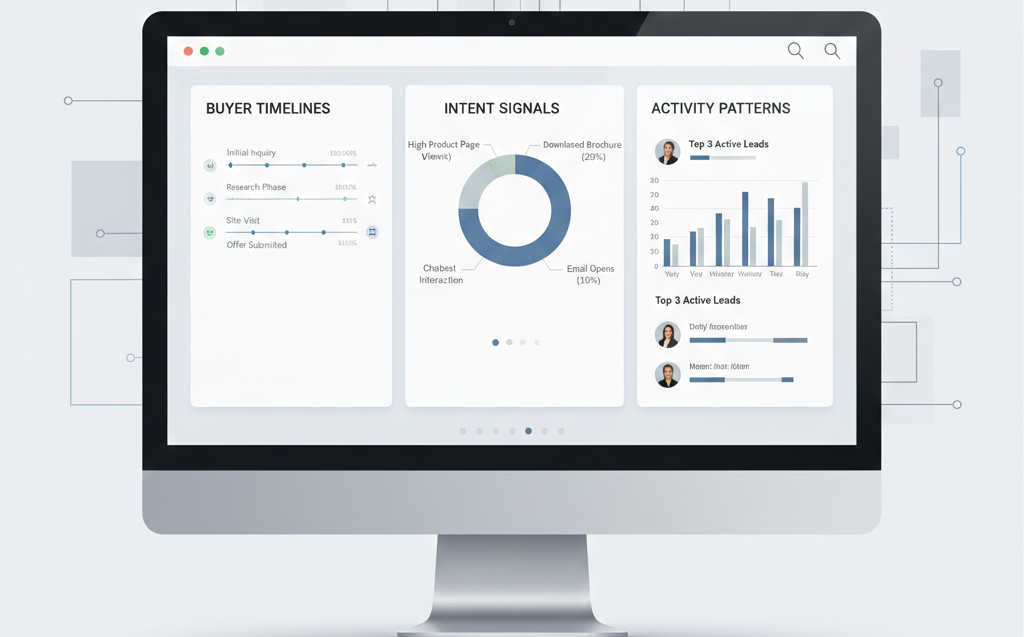
Dashboards That Surface Intent Early
Well-designed dashboards reduce guesswork.
Effective intent dashboards show:
- Buyers with increasing activity frequency
- Buyers moving stages faster than average
- Buyers engaging across multiple channels
- Buyers returning after pricing exposure
In Building a Lead Engine After Apollo Shut Us Out, dashboards focused on movement, not volume. This allowed teams to redirect effort toward buyers already signaling readiness instead of chasing raw lead counts.
Intent becomes actionable when it is visible at a glance.
A Clear Ending
High intent buyers rarely announce themselves. They reveal their readiness through patterns, timing, and behavior that already exist inside the CRM.
The difference between missed opportunities and consistent conversions lies in how those signals are interpreted. Clean data, structured timelines, and attention to sequences matter more than complex formulas.
Product Siddha’s work across analytics, automation, and CRM systems shows the same lesson repeating. When intent is observed carefully, the CRM becomes less of a storage tool and more of a decision guide.