
Model Context Protocol (MCP) Explained: Why Every AI Automation Team Is Talking About It
Understanding the Shift in AI Integration
Modern automation systems depend on how well different tools communicate with each other. As AI systems become more capable, the challenge is no longer model performance alone. The real issue is how models access external data, tools, and workflows in a structured way.
This is where Model Context Protocol (MCP) comes in. It defines a standard method for connecting AI models to external systems, without requiring custom integration work for every tool.
For any AI Automation Team, MCP is becoming a practical layer that simplifies how AI applications interact with data sources, APIs, and internal systems.
At Product Siddha, we see MCP as part of a larger shift toward structured AI orchestration rather than isolated automation scripts.
What Is Model Context Protocol (MCP)
Model Context Protocol is a standardized framework that allows AI models to communicate with external tools in a consistent format.
Instead of building separate connectors for each system, MCP defines a common structure for:
- Sending context to AI models
- Calling external tools
- Returning structured responses
- Managing multi-step workflows
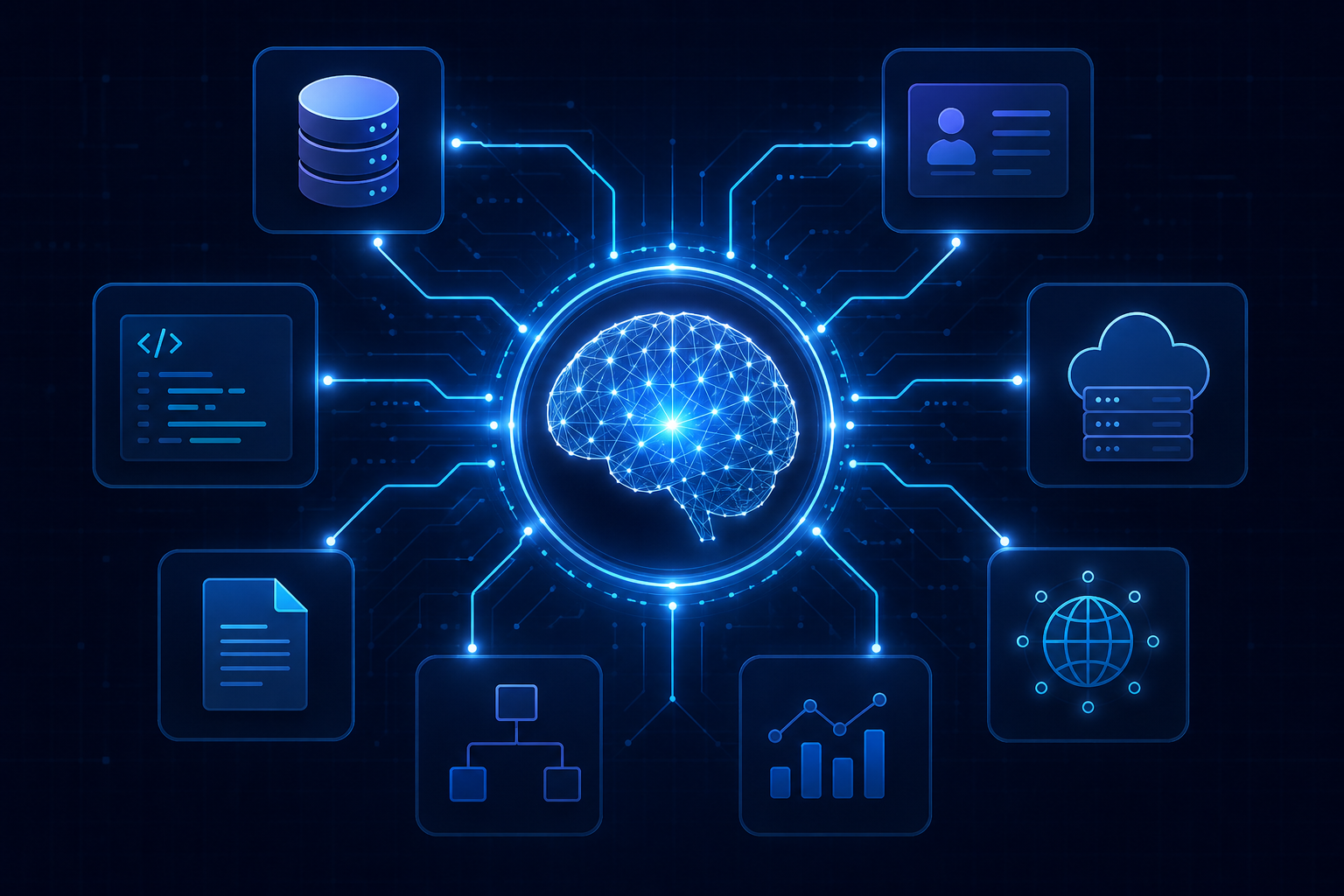
In simple terms, MCP acts like a universal adapter between AI systems and business tools.
For example:
An AI model can request customer data from a CRM, analyze it, and return insights without custom-coded integration for each step.
Why MCP Matters for AI Automation Teams
Before MCP, most AI Automation Teams relied on custom APIs, scripts, and integrations for every system.
This created three common problems:
- Integration complexity increases with each new tool
- Maintenance becomes difficult over time
- Scaling automation requires repeated engineering effort
MCP reduces this friction by introducing a shared protocol layer.
Instead of building:
AI → CRM integration
AI → Database integration
AI → Analytics integration
Teams build:
AI → MCP server → All tools
This shift reduces system complexity and improves scalability.
Core Structure of MCP
MCP is built around three main components:
1. Context Layer
This defines what information is passed to the AI model.
Example:
- User profile data
- Transaction history
- Product usage logs
2. Tool Layer
This defines external systems the AI can interact with.
Examples:
- CRM systems
- Data warehouses
- Messaging platforms
- Internal APIs
3. Response Layer
This handles structured output from the AI model after processing context and tool data.
This structure ensures consistent communication across systems.
AI Support Automation System
To understand MCP in a real scenario, consider a customer support automation system built by an AI Automation Team.
Problem
A customer sends a query about billing issues.
Without MCP
- AI model queries CRM using custom API
- Fetches billing data using separate integration
- Calls ticketing system through another script
- Combines results manually
This creates fragmented logic.
With MCP
- Customer message enters system
- MCP passes context to AI model
- AI requests billing data via MCP tool call
- MCP retrieves data from CRM
- AI processes response and generates resolution
- MCP sends structured reply to support system
The workflow becomes unified and predictable.
MCP vs Traditional API Integration
| Aspect | Traditional APIs | MCP Framework |
| Integration method | Custom per tool | Standard protocol |
| Scalability | Low | High |
| Maintenance | Complex | Simplified |
| Tool addition | Requires new code | Plug-and-play via MCP |
| AI workflow design | Fragmented | Unified |
This comparison shows why many AI Automation Teams are shifting toward MCP-based architecture.
How MCP Improves AI Automation Systems
1. Reduces Integration Workload
Instead of writing multiple API connectors, teams define one MCP interface.
2. Standardizes Tool Usage
All tools follow the same communication pattern.
3. Improves Debugging
Structured request and response formats make system tracing easier.
4. Enables Multi-Agent Systems
Multiple AI agents can share tools through MCP without conflicts.
Example Scenario: E-Commerce Intelligence System
Consider an e-commerce platform using MCP.
Objective
Improve product recommendations and customer retention.
MCP Flow
- AI agent receives user browsing history
- MCP fetches purchase data from database
- MCP retrieves inventory data from product system
- AI processes all inputs
- MCP sends recommendation output to frontend system
Outcome
- Better personalization
- Faster recommendation cycles
- Reduced engineering overhead
Common Implementation Challenges
Even though MCP simplifies architecture, AI Automation Teams still face challenges:
1. Poor Context Design
If context passed to models is incomplete, results become unreliable.
2. Tool Overload
Adding too many tools without structure creates confusion in routing logic.
3. Latency Issues
Real-time tool calls can slow down responses if not optimized.
4. Security Control
Access management across tools must be carefully designed.
At Product Siddha, implementation often focuses on fixing system architecture before enabling MCP workflows.
MCP in Modern AI Architecture
MCP is often used alongside:
- Large Language Models (LLMs)
- Vector databases
- Workflow orchestration tools like n8n
- Data warehouses like BigQuery or Snowflake
This combination allows businesses to build end-to-end AI systems instead of isolated models.
Role of Product Siddha in MCP-Based Systems
Product Siddha works with organizations to design AI automation systems that go beyond model usage.
Focus areas include:
- MCP-based system architecture design
- AI workflow standardization
- Data pipeline integration
- Multi-agent system design
- Enterprise automation planning
The goal is to help an AI Automation Team build systems that scale without increasing integration complexity.
Final Perspective
Model Context Protocol represents a shift in how AI systems interact with real-world tools. Instead of building isolated integrations, teams can now design structured communication layers.
For any AI Automation Team, MCP reduces fragmentation, improves scalability, and supports more stable AI-driven workflows.
The value of MCP is not in replacing existing systems but in organizing how they connect to AI models in a consistent way.
As AI adoption grows, structured protocols like MCP will become a standard part of enterprise automation architecture.