
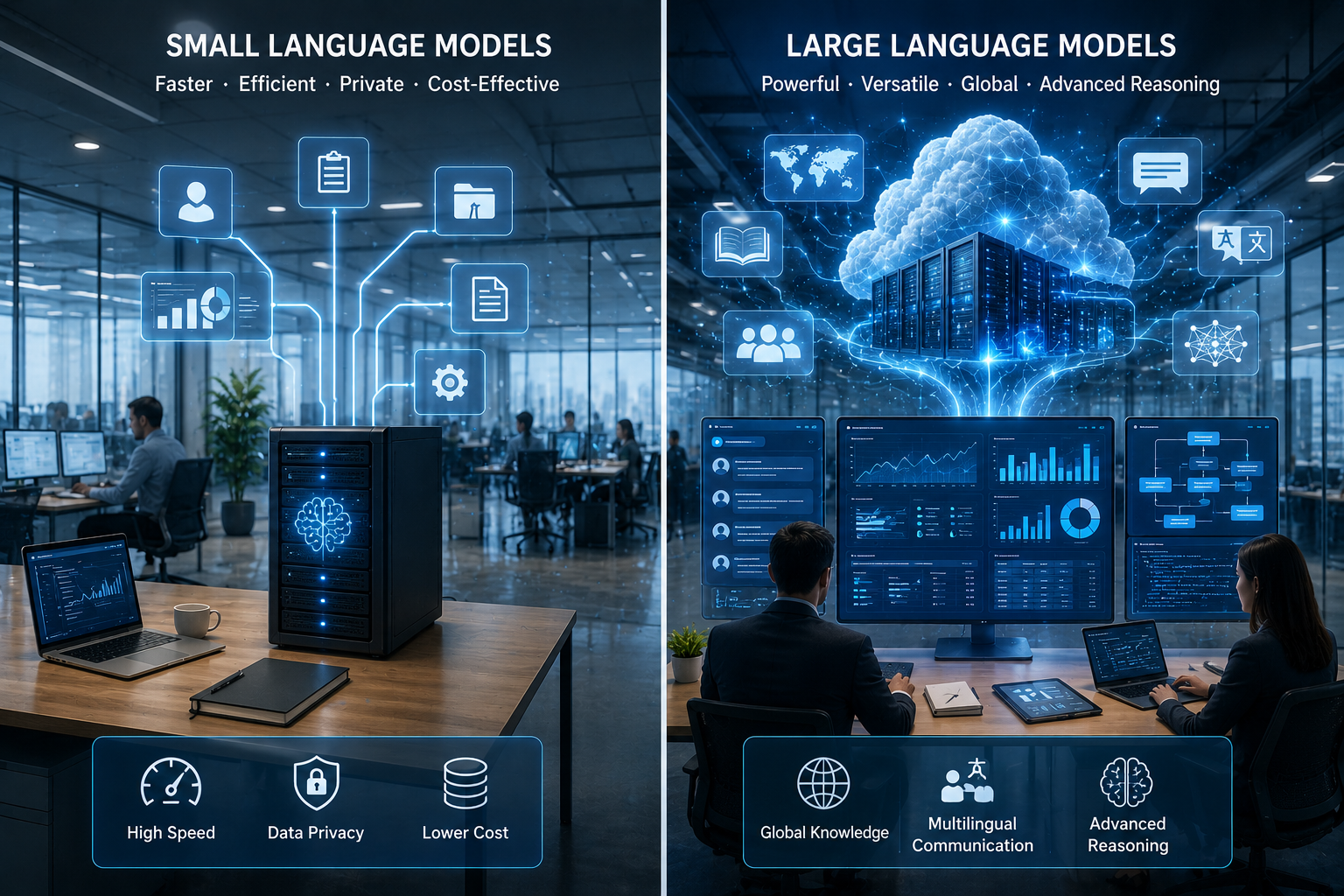
Small Language Models vs Large Language Models for Enterprises
Choosing the Right AI Foundation
Artificial intelligence has become a practical tool for improving business operations, customer service, document management, and decision support. Among the technologies driving this change are language models, which allow computers to understand, generate, and process human language with remarkable accuracy.
Many organizations assume that larger models automatically provide better business outcomes. While Large Language Models (LLMs) offer impressive capabilities, they are not always the most suitable choice for every enterprise application. In many situations, Small Language Models (SLMs) deliver faster performance, lower operating costs, and stronger control over business data.
Selecting the right language model requires understanding how each option aligns with business objectives, technical requirements, security expectations, and operational budgets.
At Product Siddha, we help organizations evaluate AI technologies and implement solutions that deliver measurable business value rather than unnecessary complexity.
Understanding Language Models
Language models are artificial intelligence systems trained to understand text, answer questions, summarize documents, generate content, classify information, and assist with business workflows.
The primary difference between Small Language Models and Large Language Models is the number of parameters used during training.
Large Language Models contain billions or even trillions of parameters, allowing them to perform a wide range of language tasks across many subjects.
Small Language Models contain fewer parameters and are usually optimized for specific business functions or industry applications.
Both approaches have strengths depending on the intended use.
What Are Large Language Models?
Large Language Models are designed for broad knowledge and versatile language understanding.
They can perform tasks such as:
- Content generation
- Document summarization
- Translation
- Customer support
- Programming assistance
- Research support
- Business communication
- Data analysis
Because they are trained on extensive datasets, they can respond to diverse questions without requiring task-specific training.
However, this flexibility often comes with higher infrastructure costs and greater computing requirements.
What Are Small Language Models?
Small Language Models focus on efficiency rather than scale.
These models are often trained or fine-tuned for specific business activities.
Examples include:
- Customer service assistants
- Internal knowledge search
- Invoice processing
- Document classification
- Contract analysis
- HR support
- Technical documentation
- Product recommendations
Since they require fewer computing resources, they are often easier to deploy within enterprise environments.
Key Differences Between SLMs and LLMs
| Feature | Small Language Models | Large Language Models |
| Model Size | Smaller parameter count | Billions or more parameters |
| Processing Speed | Faster | Moderate |
| Infrastructure Cost | Lower | Higher |
| Resource Requirements | Minimal | Significant |
| Deployment | Easier | More complex |
| Domain Specialization | Excellent | Broad knowledge |
| Training Cost | Lower | High |
| Customization | Easier | More demanding |
The best choice depends on business priorities rather than model size alone.
When Small Language Models Make Sense
Many enterprise processes involve repetitive, structured tasks.
Small Language Models perform well when businesses need:
Fast Response Times
Applications such as customer portals, internal chat assistants, and workflow automation benefit from low response times.
Lower Operating Costs
Organizations processing thousands of daily requests often reduce infrastructure expenses by using smaller models.
Greater Privacy
Businesses handling confidential information frequently prefer models deployed within private cloud or on-premises environments.
Industry-Specific Knowledge
A well-trained Small Language Model can outperform a larger general-purpose model within a specialized business domain.
When Large Language Models Are the Better Choice
Large Language Models remain valuable for broader business requirements.
They are well suited for:
Knowledge Discovery
LLMs can summarize lengthy reports, compare documents, and answer complex questions across multiple subjects.
Content Creation
Marketing teams, technical writers, and business analysts benefit from their ability to draft reports, articles, and presentations.
Multi-Step Reasoning
Complex business scenarios involving several connected questions often require stronger reasoning capabilities.
Language Support
Global organizations working across multiple languages benefit from the multilingual capabilities of large models.
Factors Enterprises Should Consider
Choosing between SLMs and LLMs involves more than comparing technical specifications.
Several business considerations should guide the decision.
Cost
Infrastructure expenses increase with larger models.
Organizations should evaluate long-term operating costs rather than initial implementation alone.
Performance
A faster specialized model may produce better business outcomes than a slower general-purpose model.
Performance should be measured against real business tasks.
Security
Many enterprises manage confidential financial records, legal documents, healthcare information, and customer data.
Private deployment options may become a deciding factor.
Scalability
Future business growth should influence model selection.
The chosen solution should support increasing workloads without excessive infrastructure investment.
Integration
Language models should integrate with existing systems, including CRM platforms, ERP software, document management systems, customer support tools, and business intelligence platforms.
Hybrid Approaches Are Becoming Common
Many organizations no longer choose between Small Language Models and Large Language Models exclusively.
Instead, they combine both.
For example:
- A Small Language Model handles internal document classification.
- A Large Language Model assists with research and report generation.
- Workflow automation routes requests to the most suitable model.
- Sensitive business data remains inside private infrastructure.
This hybrid architecture balances cost, speed, and capability.
Common Enterprise Applications
Businesses across industries are already using language models.
Typical applications include:
- Customer support automation
- Internal knowledge assistants
- Contract review
- Employee self-service
- Document summarization
- Financial reporting
- Compliance monitoring
- IT support
- Procurement assistance
- Sales enablement
Each application should be evaluated according to complexity, privacy requirements, and expected workload.
Looking Ahead
Language model technology continues to evolve rapidly.
Small Language Models are becoming more capable through efficient training techniques and domain-specific optimization.
Large Language Models continue expanding their reasoning abilities and multilingual performance.
Future enterprise AI platforms will increasingly combine several specialized models instead of relying on one large system for every task.
Businesses that carefully evaluate their operational requirements will gain greater value from AI investments while maintaining flexibility as technology advances.
Product Siddha works with organizations to identify suitable language model strategies, design enterprise AI solutions, and integrate intelligent automation into existing business processes with security, scalability, and long-term efficiency in mind.