
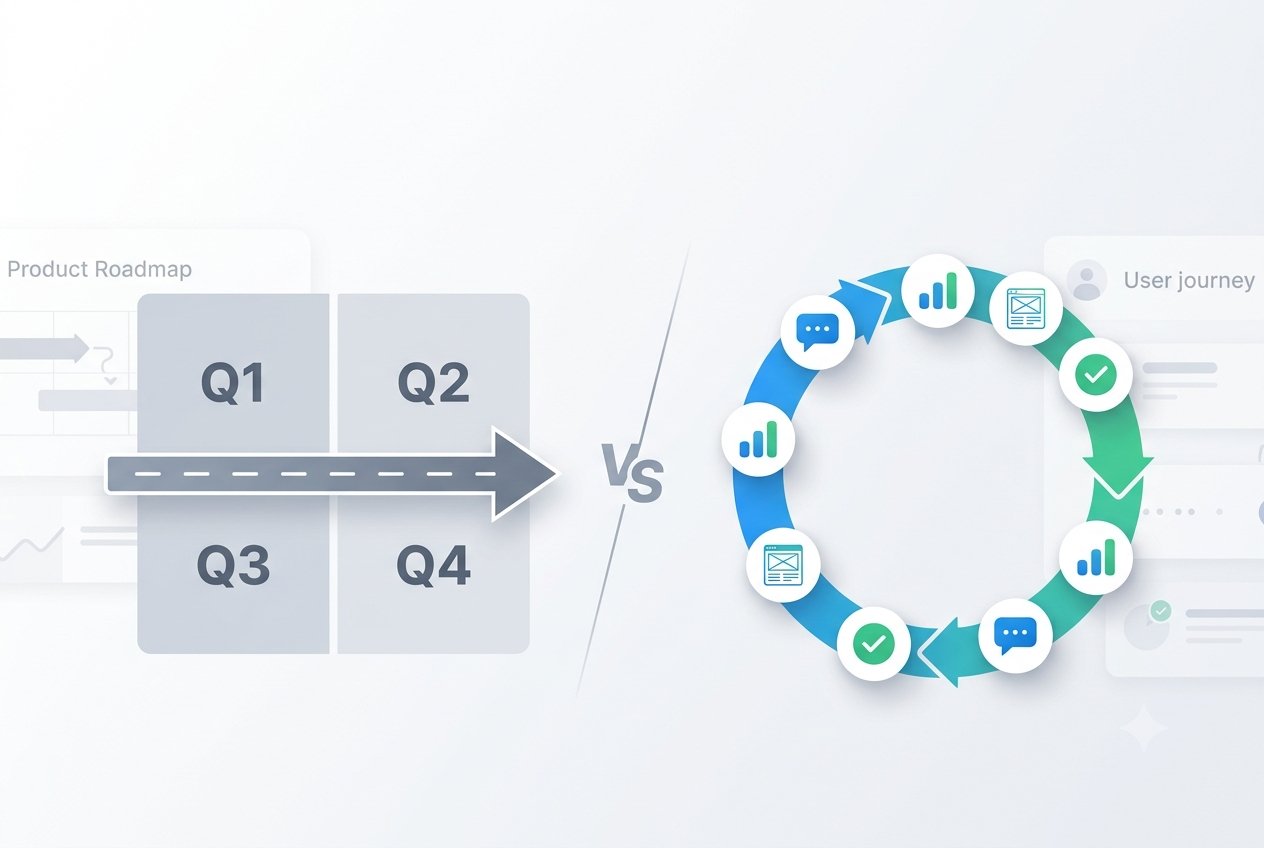
 Build Products Through Learning, Not Planning
For years, quarterly planning has been the standard way to manage product development. Leadership teams gather to define priorities, product managers prepare detailed roadmaps, engineering estimates delivery timelines, and the organization commits to building a list of features over the next three months.
The approach creates structure, but it also assumes that customer needs will remain unchanged throughout the quarter. In reality, markets shift, competitors launch new capabilities, customer expectations evolve, and new information becomes available every week.
This is why many product teams find themselves delivering features on time that customers barely use.
Continuous Product Discovery offers a different way of working. Instead of treating discovery as an activity that happens before development begins, it becomes an ongoing habit that runs alongside product delivery. Product teams continuously learn from customers, test assumptions, evaluate ideas, and refine priorities based on evidence rather than opinion.
At Product Siddha, we believe successful products are built through continuous learning. Product strategy becomes stronger when every important decision is supported by customer insight instead of assumptions made months earlier.
Quarterly Planning Solves One Problem While Creating Another
Quarterly planning helps organizations allocate budgets, coordinate teams, and define business objectives. Those benefits remain valuable. The challenge begins when quarterly plans become fixed commitments rather than working hypotheses.
Imagine a B2B SaaS company preparing its roadmap for the next quarter. The team selects twelve features based on sales feedback, internal discussions, and customer requests collected over the previous few months.
During development, customer priorities begin to change. Support teams notice a recurring onboarding issue. Sales representatives discover prospects are asking for a completely different capability. Product analytics reveal that one of the planned features addresses a problem very few users actually experience.
Despite these discoveries, development continues because the roadmap has already been approved.
Three months later, the team ships everything they planned. The release is considered successful internally, yet product adoption barely changes because the roadmap reflected yesterday’s assumptions instead of today’s customer needs.
Continuous Product Discovery reduces this risk by keeping customer learning active throughout the product lifecycle.
Discovery Is Not a Phase
One of the biggest misconceptions in product development is that discovery happens only before engineering starts building.
High-performing product teams approach discovery differently. They treat it as a continuous activity that never stops.
Each week they speak with customers, review product analytics, observe user behaviour, validate assumptions, and discuss new opportunities. Instead of collecting a large amount of feedback once every quarter, they gather smaller insights consistently.
These regular conversations help teams recognise patterns that would never appear in a single research session.
For example, one customer struggling with onboarding may represent an isolated issue. When ten customers describe the same experience over several weeks, it becomes a clear opportunity for improvement.
Small observations collected consistently often lead to better product decisions than occasional large research projects.
Focus on Opportunities Before Solutions
Many organizations begin product discussions with a proposed feature.
“We should build a new dashboard.”
“We need an AI assistant.”
“Our competitors have this capability.”
Continuous Product Discovery encourages teams to pause before deciding on a solution.
The better question is, “What customer problem are we trying to solve?”
This thinking is reflected in the Opportunity Solution Tree, a framework popularised by Teresa Torres. Instead of jumping directly to development, teams start with a desired business outcome, identify customer opportunities, explore multiple solutions, and validate ideas before selecting what to build.
A single customer problem may have several possible solutions. Testing different approaches before development often reveals that the simplest solution delivers the greatest value.
Measure Outcomes Instead of Outputs
Many organizations celebrate product success by counting releases.
How many features were delivered?
How many user stories were completed?
How many sprints finished on schedule?
These measurements describe output, but they say very little about customer value.
Continuous Product Discovery shifts attention towards outcomes.
Questions become:
- Did customer activation improve?
- Did onboarding become faster?
- Did retention increase?
- Did support requests decrease?
- Did customers complete important tasks more easily?
A feature that nobody uses cannot be considered successful simply because it was delivered on time.
Product teams should measure whether the product creates better customer experiences and stronger business results.
Customer Conversations Should Become a Weekly Habit
Customer interviews are often treated as occasional research activities.
Teams conduct twenty interviews before planning begins and then spend several months building features without speaking to customers again.
A healthier approach is to create a consistent rhythm.
Each week, product managers, designers, and engineers should spend time speaking with customers, observing product usage, and understanding daily workflows.
The objective is not to ask customers what features they want.
Instead, conversations should explore:
- What tasks are difficult?
- What slows them down?
- Which workarounds have they created?
- What business goals are they trying to achieve?
Understanding customer behaviour provides stronger evidence than collecting feature requests.
Discovery Works Best as a Team Activity
Another important principle of Continuous Product Discovery is shared ownership.
Discovery should not belong exclusively to the product manager.
Successful teams involve a Product Trio consisting of a product manager, a designer, and an engineer.
Each person brings a different perspective.
The product manager understands business objectives.
The designer understands user experience.
The engineer understands technical feasibility.
Working together allows teams to evaluate opportunities from multiple angles before investing development effort.
This collaborative approach also reduces misunderstandings later in the delivery process because engineering participates in customer learning from the beginning.
A Practical Example
Consider a company developing HR software for medium-sized businesses.
During quarterly planning, leadership approved twelve new features for the next release.
Before development started, the product team introduced weekly customer interviews and reviewed user behaviour after every session.
Within six weeks they discovered that several planned features addressed problems customers rarely experienced.
Instead, nearly every interview highlighted confusion during employee onboarding.
The team paused development, created simple prototypes, tested three possible solutions, and selected the version customers completed most successfully.
The results after launch were significant.
Employee onboarding completion increased by 22 percent.
Support requests related to onboarding fell by 31 percent.
Engineering avoided building five low-value features, allowing resources to be redirected towards improvements customers genuinely needed.
The success came from learning early rather than correcting mistakes after release.
Discovery Creates Better Long-Term Decisions
Continuous Product Discovery is not about abandoning planning or changing direction every week.
Quarterly planning still plays an important role in budgeting, staffing, and setting strategic objectives.
What changes is the way product decisions are made between planning cycles.
Instead of relying on assumptions created months earlier, teams continue gathering evidence, validating ideas, and refining priorities as new information becomes available.
This approach reduces risk while helping organizations respond confidently to changing customer expectations.
At Product Siddha, we help businesses combine structured product planning with continuous customer discovery. By integrating regular research, product analytics, collaborative decision-making, and ongoing validation into the development process, organizations can build products that solve meaningful customer problems while making better use of engineering resources.
The strongest products rarely emerge from perfect planning alone. They improve because the teams behind them never stop learning. Continuous Product Discovery creates that habit of learning, enabling businesses to make informed product decisions, adapt to changing markets, and deliver solutions that create lasting value for both customers and the organization.