
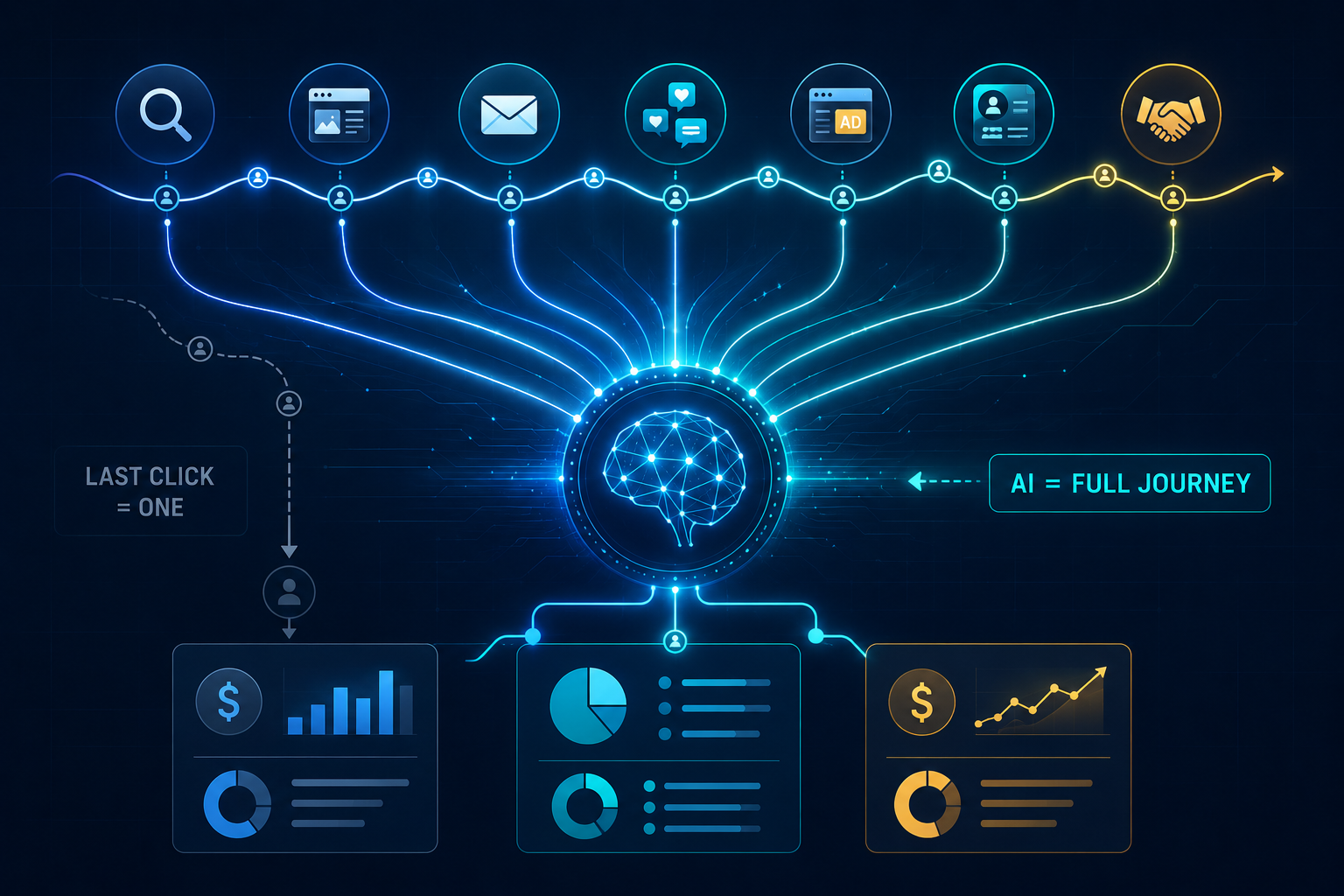
AI-Powered Marketing Attribution: Beyond Last-Click Models
Seeing the Complete Picture
Every customer follows a different path before making a purchase. Some begin with a search engine, others respond to an email, while many return after engaging with several marketing channels over weeks or months. Yet many businesses continue to measure success by giving full credit to the final interaction before conversion.
This approach leaves important questions unanswered. Which campaigns generated early interest? Which channels influenced decision-making? Which activities deserve greater investment?
AI-powered marketing attribution offers a more complete way to answer these questions. By examining the entire customer journey, businesses can understand how each interaction contributes to revenue and long-term growth.
At Product Siddha, our MarTech implementation expertise combines AI Automation Services, data integration, and performance measurement to help organizations build attribution models that reflect how customers actually buy.
Why Last-Click Attribution Falls Short
Last-click attribution assigns all conversion credit to the final marketing interaction before a customer completes an action.
For example, a customer may:
- Read a blog article
- Download a guide
- Receive several emails
- Attend a webinar
- Click a paid advertisement
- Complete a purchase
Under the last-click model, only the final advertisement receives recognition. Every earlier interaction disappears from the report.
This creates an incomplete understanding of marketing performance and may lead businesses to reduce investment in channels that play an important role during the buying process.
What AI-Powered Marketing Attribution Does Differently
Artificial intelligence evaluates customer journeys using large volumes of behavioral and transactional data.
Instead of relying on one fixed rule, AI examines patterns across multiple interactions and estimates the contribution of each touchpoint.
This creates a more balanced view of how marketing efforts influence customer decisions.
An AI-driven attribution framework can evaluate:
- Website visits
- Organic search traffic
- Paid advertising
- Email engagement
- CRM interactions
- Sales conversations
- Product demonstrations
- Customer support activity
The result is a clearer understanding of marketing effectiveness across the complete customer lifecycle.
Why Marketing Leaders Need Better Attribution
Marketing budgets are under constant review. Leadership teams expect evidence that campaigns contribute to business growth.
Without reliable attribution, important decisions become difficult.
Questions often include:
- Which channels create qualified leads?
- Where should marketing investment increase?
- Which campaigns influence revenue?
- Which customer segments respond best?
- How does marketing support sales performance?
AI-powered attribution provides data that helps answer these questions with greater confidence.
AI and MarTech Implementation Work Together
Artificial intelligence depends on connected data.
If marketing platforms operate independently, attribution becomes incomplete because customer interactions remain scattered across different systems.
Successful attribution requires integration between:
- CRM platforms
- Marketing automation
- Analytics tools
- Customer data platforms
- Advertising platforms
- Sales systems
- Website tracking
- Email marketing platforms
This is where effective MarTech implementation becomes essential.
Product Siddha helps organizations connect these technologies so that attribution reflects the complete customer journey rather than isolated events.
Key Benefits of AI-Powered Attribution
Better Budget Allocation
Accurate attribution reveals which marketing activities consistently influence revenue.
Marketing leaders can distribute budgets based on measurable business outcomes instead of assumptions.
Improved Campaign Planning
Historical attribution data highlights successful customer journeys.
Future campaigns can be designed around proven engagement patterns.
Better Sales and Marketing Alignment
Shared attribution reporting creates a common understanding between marketing and sales teams.
Both departments gain visibility into how customer interactions contribute to conversions.
More Reliable Forecasting
When customer behavior becomes measurable across multiple channels, future campaign performance becomes easier to predict.
Smarter Customer Experiences
Understanding customer journeys helps businesses deliver more relevant communication at each stage of the buying process.
Important Metrics to Monitor
AI-powered attribution should measure business performance alongside marketing activity.
Useful metrics include:
| KPI | Business Value |
| Marketing Qualified Leads | Lead quality |
| Customer Acquisition Cost | Marketing efficiency |
| Conversion Rate | Campaign effectiveness |
| Revenue by Channel | Budget optimization |
| Customer Lifetime Value | Long-term growth |
| Return on Marketing Investment | Financial performance |
| Sales Cycle Length | Process efficiency |
| Multi-Touch Contribution | Customer journey analysis |
These measurements provide a broader view than last-click reporting alone.
Common Challenges During Implementation
Many organizations recognize the value of attribution but struggle during implementation.
Typical challenges include:
- Inconsistent customer data
- Separate marketing systems
- Duplicate records
- Missing campaign tracking
- Limited reporting capabilities
- Poor CRM integration
Without resolving these issues, even advanced AI models produce incomplete insights.
A structured implementation strategy creates the foundation for reliable reporting.
The Role of AI Automation Services
AI Automation Services simplify the collection, processing, and analysis of marketing data.
Automation can:
- Connect customer information across systems
- Update CRM records automatically
- Track customer interactions
- Generate attribution reports
- Identify conversion patterns
- Detect reporting inconsistencies
- Improve data quality
These automated processes reduce manual work while improving reporting accuracy.
How Product Siddha Helps Businesses Build Better Attribution
Successful attribution depends on more than software.
Product Siddha helps businesses design connected MarTech environments where customer data flows accurately between systems.
Our services include:
- MarTech implementation
- AI Automation Services
- Customer journey mapping
- CRM integration
- Marketing workflow automation
- Data integration
- Performance dashboard development
- Attribution reporting
This approach allows marketing leaders to make informed decisions using reliable business data instead of isolated campaign reports.
Measuring Marketing with Confidence
Customer journeys have become more complex, making traditional attribution methods less reliable for modern businesses.
AI-powered marketing attribution provides a clearer understanding of how different channels influence customer decisions across the entire buying process.
When combined with strong MarTech implementation, connected business systems, and reliable AI Automation Services, organizations gain accurate insights that support better planning, stronger collaboration, and smarter investment decisions.
For businesses seeking dependable attribution reporting, Product Siddha helps build the technology foundation needed to measure marketing performance with greater confidence and long-term consistency.