
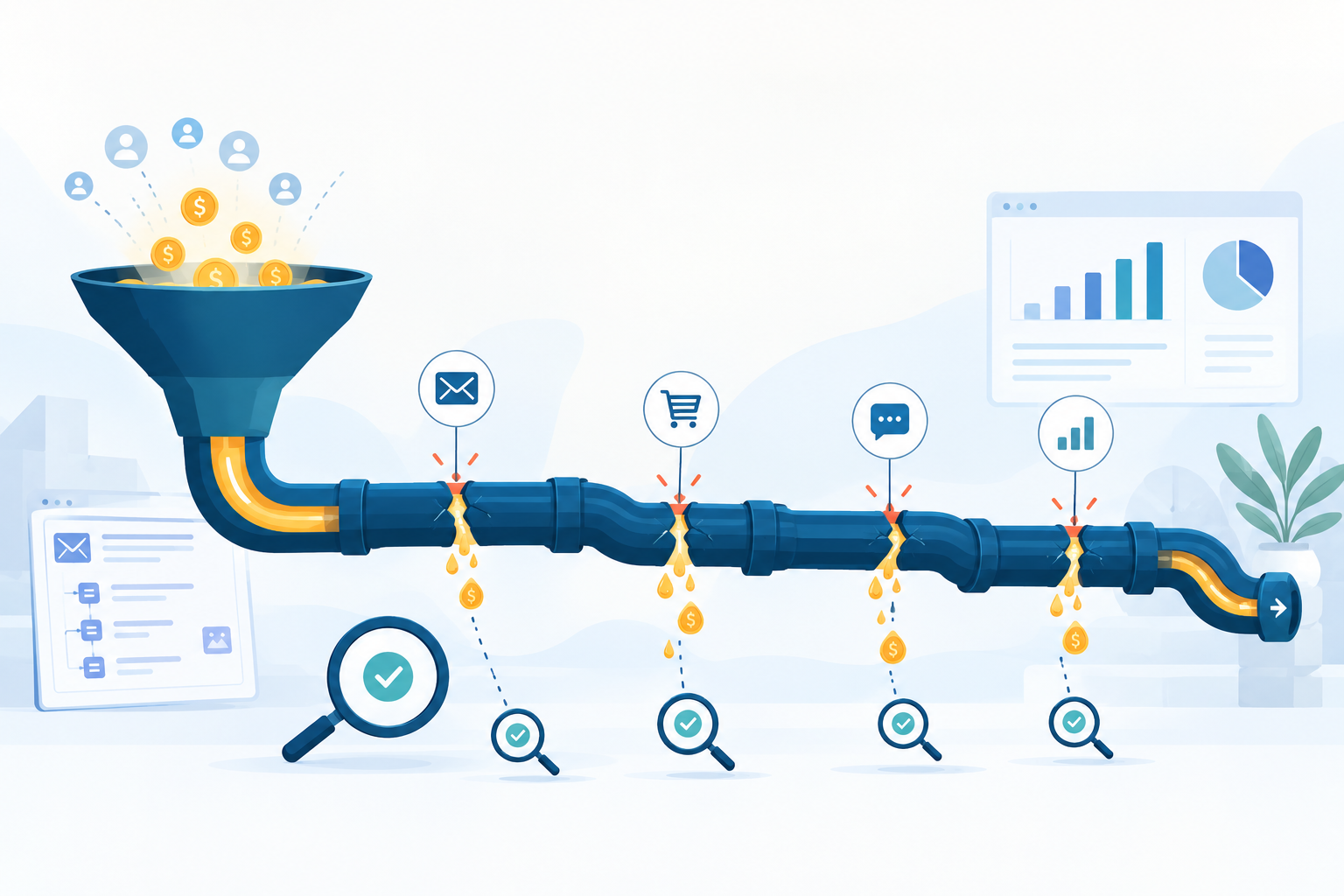
The 7 Revenue Leaks We Find in Almost Every Klaviyo Audit
Where Revenue Slips Away
Klaviyo can give an ecommerce business a strong email and customer messaging system, but having the platform in place does not guarantee that every opportunity is being captured.
When we review a Klaviyo account, the same problems appear with surprising regularity. Some are technical. Others come from weak segmentation, poor timing, incomplete automation, or campaigns that have been running for months without proper review.
These issues rarely appear as one large problem. Instead, revenue is lost through a collection of smaller gaps. A welcome flow may be missing an important message. A customer may receive a promotional email shortly after making a purchase. A product recommendation may be irrelevant. An abandoned cart sequence may stop before the customer has had enough time to make a decision.
A thorough Klaviyo audit helps uncover these gaps and shows where improvements are most likely to have an effect.
Here are seven revenue leaks that Product Siddha commonly looks for during a Klaviyo audit.
1. Weak Welcome Flows
The welcome series is often the first automated conversation a new subscriber has with a brand.
Yet many accounts have a short welcome flow that simply delivers a discount code and stops there.
A stronger email welcome series can introduce the business, explain the value of the products, answer common questions, establish trust, and guide subscribers toward an appropriate purchase.
During a Klaviyo account audit, we look at the number of messages, timing between emails, content, segmentation, conversion rates, and whether the flow changes according to customer behavior.
The objective is to make those early interactions useful rather than treating the welcome email as a single promotional message.
2. Abandoned Cart Gaps
An abandoned cart represents a customer who has already shown meaningful purchase intent.
The revenue leak occurs when the abandoned cart flow is poorly configured or overly generic.
Common problems include incorrect timing, weak product information, missing dynamic content, ineffective follow-up messages, or flow conditions that prevent qualified shoppers from receiving the right communication.
The flow should also account for what happens after the customer completes the purchase. Someone who has already bought should not continue receiving abandoned-cart reminders for the same order.
A Klaviyo audit should therefore examine both the message sequence and the underlying flow logic.
3. Poor Customer Segmentation
A large customer list can become difficult to manage when every subscriber receives similar campaigns.
A recent customer, an inactive subscriber, a frequent buyer, and someone who has never purchased have different relationships with the business.
Sending the same message to all four groups can reduce engagement and create missed sales opportunities.
Useful Klaviyo segments may include recent purchasers, repeat customers, first-time buyers, high-value customers, inactive subscribers, product-category buyers, and engaged non-purchasers.
Segmentation allows campaigns to reflect customer history and buying behavior. It can also reduce unnecessary messages to people who have already taken the desired action.
4. Post-Purchase Revenue Is Ignored
The customer journey does not end when an order is completed.
One of the most common gaps we see is an underdeveloped post-purchase flow. A customer buys a product, receives an order confirmation, and then hears very little from the brand until the next general promotion.
A well-planned post-purchase sequence can serve several purposes. It can explain product use, answer common questions, recommend complementary products, request feedback, and encourage a second purchase when the timing makes sense.
For some businesses, repeat purchases are a major source of revenue. Leaving this part of the customer lifecycle unattended can therefore become a significant leak.
5. Flows Are Triggering at the Wrong Time
Automation is useful only when the rules behind it make sense.
A flow can contain excellent copy and attractive design while still performing poorly because its timing or trigger conditions are wrong.
For example, a customer may receive a promotional message immediately after placing an order. An inactive subscriber may enter a win-back flow despite recently engaging with another campaign. A browse abandonment message may arrive when the shopper is no longer considering the product.
During a Klaviyo audit, it is important to examine triggers, filters, flow delays, profile properties, exclusions, and the relationship between different automated sequences.
The aim is to make sure customers receive the right communication based on what they have actually done.
6. Campaigns Are Sent Without a Clear Revenue Role
Regular campaigns are an important part of ecommerce communication, but sending more emails does not automatically create more revenue.
Some campaigns are built around a product announcement. Others promote a sale, educate customers, introduce a collection, or encourage repeat purchases.
Problems arise when campaigns are sent without considering audience, purchase history, previous communication, or the customer’s position in the buying process.
A good campaign calendar should have a clear reason for each message.
The team should also review campaign performance over time. Open rates can provide useful information, but clicks, purchases, revenue per recipient, unsubscribes, and engagement trends often provide a more practical view of campaign quality.
7. Inactive Customers Are Left Untouched
Every ecommerce business accumulates inactive subscribers.
Some have not purchased for a long period. Others have stopped opening or clicking emails. A portion may still have an interest in the brand but simply need a relevant reason to return.
A win-back flow can help identify these customers and give them an opportunity to re-engage.
The key is to avoid treating every inactive subscriber in exactly the same way. The appropriate message may depend on purchase history, previous engagement, product interest, and the length of inactivity.
There should also be a clear point at which persistently inactive profiles are suppressed from regular marketing communication.
This keeps the customer database healthier and helps the business focus its efforts on people who are still likely to engage.
What an Audit Should Reveal
A useful Klaviyo audit should produce more than a list of technical observations.
It should show where revenue opportunities exist and which issues deserve attention first.
| Audit Area | Common Problem | Revenue Opportunity |
| Welcome flow | Too short or generic | Improve early conversion |
| Abandoned cart | Weak timing or logic | Recover purchase intent |
| Segmentation | Broad audiences | Improve message relevance |
| Post-purchase | Limited follow-up | Increase repeat purchases |
| Flow timing | Conflicting messages | Improve customer experience |
| Campaigns | No clear purpose | Improve campaign efficiency |
| Win-back | Inactive users ignored | Recover previous customers |
Prioritization matters. Fixing every issue at once can make it difficult to determine what actually improved performance.
Start with the areas where customer intent is strongest and where the account has enough data to measure the change.
Finding the Missing Money
A Klaviyo account does not need hundreds of flows and endless campaigns to perform well.
It needs a sound structure, accurate customer data, sensible segmentation, reliable automation, appropriate timing, and regular review.
At Product Siddha, we approach Klaviyo audits by looking at the complete customer communication system rather than reviewing individual emails in isolation. We examine flows, campaigns, segmentation, triggers, customer journeys, reporting, and opportunities for marketing automation.
The seven revenue leaks discussed here are common, but every account has its own priorities. An ecommerce store with strong acquisition and weak retention will need a different approach from a business with excellent repeat purchases but poor abandoned-cart recovery.
A careful audit makes those differences easier to see.
Once the leaks are identified, the next step is straightforward. Fix the highest-impact problems, measure the results, and continue improving the parts of the system that contribute to customer retention and revenue.