
15 AI Automation Workflows Every B2B Company Should Implement
Stop Buying AI Tools. Start Building AI Workflows.
Ask ten B2B founders what their first AI project was, and most will give a familiar answer. A chatbot. An AI writing assistant. Meeting summaries. Email drafting.
Those tools save time, but they rarely change how a business operates.
Across growing SaaS companies, agencies, manufacturers, and service businesses, a different pattern is emerging. Companies seeing the strongest returns are no longer automating individual tasks. They are connecting entire business processes so information moves automatically between teams, systems, and customers.
Instead of asking, “Can AI write this email?”, they ask, “How can AI remove five manual steps from our sales process?”
That shift changes everything.
At Product Siddha, our AI Automation Services focus on designing connected workflows that eliminate repetitive work, improve decision-making, and help businesses scale without increasing operational complexity.
This article explores the automation workflows that operations leaders, founders, and RevOps teams are increasingly adopting to solve real business problems.
Why Most AI Automation Projects Disappoint
Many businesses begin their AI journey with enthusiasm.
They purchase several AI tools, encourage employees to experiment, and expect immediate productivity gains.
Six months later, the excitement fades.
The problem usually is not the technology.
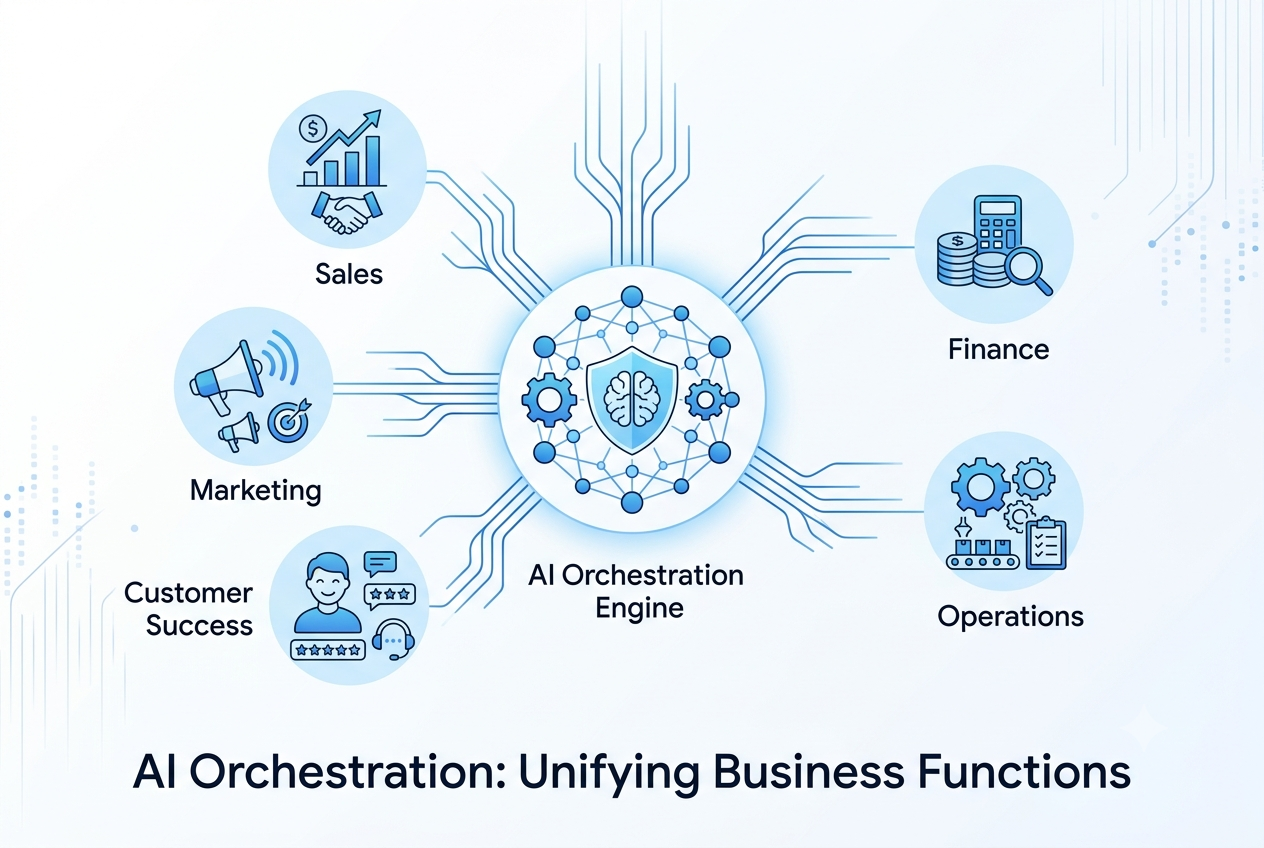
It is the workflow.
For example, a salesperson might use AI to write an email, but still needs to:
- Copy lead information into the CRM
- Update opportunity stages
- Schedule follow-up reminders
- Create meeting notes
- Notify internal teams
- Prepare a proposal
Only one task has been automated. The remaining work still depends on manual effort.
Successful automation connects these activities into one continuous process.
Instead of saving five minutes on one task, it saves several hours across an entire customer journey.
What High-Performing B2B Teams Are Doing Differently
Businesses achieving measurable returns from AI share several characteristics.
They focus on:
- End-to-end workflows instead of isolated tasks
- Reliable business data before introducing automation
- Clear ownership of every workflow
- Continuous measurement and refinement
- Human oversight for important business decisions
This approach creates automation that improves with time instead of becoming another disconnected system.
Workflow 1: AI SDR Research and Lead Qualification
Sales development representatives spend a significant portion of their day gathering information before speaking with prospects.
Research often includes:
- Company size
- Industry
- Recent funding
- Hiring activity
- Technology stack
- Decision-makers
- Previous interactions
An AI-powered workflow performs much of this preparation automatically.
Example Workflow
Website enquiry
↓
CRM record created
↓
AI researches company
↓
Buying signals identified
↓
Lead score calculated
↓
Sales representative notified
↓
Personalized outreach drafted
Rather than replacing the sales team, automation allows representatives to spend more time building relationships with qualified prospects.
Business Impact
- Faster lead response
- Higher-quality conversations
- Better CRM accuracy
- More consistent prospect research
Workflow 2: Proposal Generation in Minutes
Proposal creation remains one of the most time-consuming activities in many B2B organizations.
Consultancies, agencies, software providers, and professional service firms often spend several hours preparing documents after every discovery meeting.
AI can automate much of this work.
Example Workflow
Discovery meeting completed
↓
Meeting transcript analysed
↓
Client requirements extracted
↓
Scope of work drafted
↓
Pricing inserted
↓
Proposal formatted
↓
Sales manager reviews
↓
Proposal delivered
Instead of starting with a blank document, sales teams begin with a structured draft that requires only final adjustments.
Business Impact
- Shorter sales cycles
- Consistent proposal quality
- Faster response to prospects
- Reduced administrative work
Workflow 3: Customer Health Monitoring
Customer retention often creates more long-term value than acquiring new customers.
The challenge is identifying at-risk accounts before they decide to leave.
AI can monitor customer behaviour across multiple systems.
Signals may include:
- Reduced product usage
- Support ticket frequency
- Declining engagement
- Payment delays
- Contract renewal dates
- Customer satisfaction trends
When several warning signs appear together, the workflow automatically alerts the Customer Success team.
Example Workflow
Customer activity monitored
↓
Risk score updated
↓
Renewal probability calculated
↓
High-risk account detected
↓
Customer Success notified
↓
Personalized outreach initiated
Instead of reacting to churn, businesses gain time to strengthen customer relationships.
Workflow 4: AI Sales Call Intelligence
Sales conversations contain valuable information that often disappears after the meeting ends.
Modern AI workflows analyse every customer conversation automatically.
The system can identify:
- Customer objectives
- Budget discussions
- Competitor mentions
- Product objections
- Buying signals
- Agreed next steps
Relevant information is then added directly to the CRM.
Managers receive coaching insights without reviewing every recording manually.
Business Impact
- Better sales coaching
- Consistent CRM updates
- Faster follow-up
- Improved forecasting accuracy
Workflow 5: Executive Morning Briefings
Executives often begin the day by opening several dashboards.
Sales.
Marketing.
Customer support.
Finance.
Operations.
Each department reports performance differently.
AI can consolidate this information into one concise daily briefing.
Example Report
Yesterday’s Revenue
₹14.2 lakh
New Qualified Leads
38
Support Tickets Resolved
142
Critical Customer Risks
3
Outstanding Finance Approvals
7
Marketing Campaign Performance
Above target
Rather than collecting information manually, leadership receives one consistent report every morning.
This allows faster decisions without requesting updates from multiple teams.
Business Impact
- Better executive visibility
- Faster decision-making
- Less reporting effort
- Improved cross-functional alignment
Workflow 6: AI Contract and RFP Response Automation
Enterprise sales teams know that winning a deal often depends on responding quickly to Requests for Proposal (RFPs), security questionnaires, and legal reviews. These documents can run into hundreds of questions, many of which repeat across customers.
Instead of searching through previous responses and copying information manually, AI can build the first draft using an approved knowledge base.
Example Workflow
RFP received
↓
AI identifies document sections
↓
Searches approved response library
↓
Drafts answers
↓
Flags unanswered or high-risk questions
↓
Legal and sales review
↓
Final document submitted
The workflow does not replace legal or sales teams. It removes repetitive work so specialists can focus on reviewing complex requirements.
Business Impact
- Faster proposal turnaround
- Consistent responses
- Higher bid capacity
- Reduced administrative effort
Workflow 7: Intelligent Customer Onboarding
The sales process does not end when a customer signs a contract. Poor onboarding often delays product adoption and increases the risk of early churn.
AI can coordinate onboarding activities across multiple departments.
Example Workflow
Contract signed
↓
Customer profile created
↓
CRM updated
↓
Project workspace generated
↓
Training sessions scheduled
↓
Welcome documents shared
↓
Customer Success notified
↓
Progress tracked automatically
Every stakeholder receives the information they need without sending multiple emails or updating spreadsheets.
Business Impact
- Faster implementation
- Better customer experience
- Reduced onboarding delays
- Improved adoption rates
Workflow 8: Marketing Campaign Optimization with AI Feedback Loops
Many companies automate email campaigns or social media scheduling. The more valuable opportunity is allowing AI to evaluate campaign performance and recommend improvements continuously.
Instead of waiting until the end of the month, AI reviews campaign data every day.
It can detect:
- Falling conversion rates
- Poor-performing audiences
- Declining engagement
- Rising acquisition costs
- Changes in lead quality
Example Workflow
Campaign launched
↓
Performance monitored
↓
AI detects declining conversions
↓
Audience segments adjusted
↓
Budget recommendations generated
↓
Marketing manager approves changes
↓
Campaign performance improves
The feedback loop helps marketing teams make informed decisions before campaign performance declines further.
Business Impact
- Better campaign performance
- Improved lead quality
- Faster optimization
- Better use of marketing budgets
Workflow 9: Internal AI Knowledge Assistant
Every business stores valuable information across documents, emails, shared drives, CRMs, and project management systems.
The problem is not the lack of information.
It is finding the right answer quickly.
An internal AI assistant allows employees to ask questions in plain language.
Examples include:
- How do we onboard a manufacturing client?
- Where is our latest pricing document?
- What is our travel reimbursement policy?
- Which proposal template should I use?
Instead of searching multiple folders, employees receive answers in seconds.
This workflow becomes increasingly valuable as organizations grow.
Business Impact
- Less time spent searching for information
- Faster employee onboarding
- Better knowledge sharing
- Fewer repeated internal questions
Workflow 10: Finance Approval Orchestration
Finance teams often spend unnecessary time chasing approvals through long email chains.
Purchase requests, invoices, vendor contracts, and expense claims may remain pending simply because managers overlook approval requests.
AI can coordinate the entire approval process.
Example Workflow
Purchase request submitted
↓
Budget verified
↓
Appropriate manager identified
↓
Approval reminder issued
↓
Finance notified
↓
ERP updated
↓
Purchase completed
Every approval is recorded automatically, creating a clear audit trail.
Business Impact
- Faster purchasing decisions
- Better financial visibility
- Fewer approval delays
- Improved compliance
Workflow 11: Predictive Customer Support
Customer support teams usually respond after a customer reports a problem. AI makes it possible to identify potential issues before they become support tickets.
By monitoring product usage, login frequency, failed transactions, device logs, and previous support history, AI can detect patterns that often lead to customer frustration.
Example Workflow
Product usage monitored
↓
AI identifies unusual behaviour
↓
Risk score generated
↓
Support team notified
↓
Customer contacted proactively
↓
Issue resolved before escalation
Instead of reacting to problems, support teams become proactive.
Business Impact
- Lower ticket volume
- Faster issue resolution
- Higher customer satisfaction
- Better customer retention
Workflow 12: AI Compliance Monitoring
Compliance reviews often involve checking documents, contracts, internal policies, and regulatory updates.
These activities consume significant time and are prone to human error when performed manually.
AI can continuously monitor:
- Policy updates
- Vendor agreements
- Internal documentation
- Employee acknowledgements
- Regulatory requirements
Example Workflow
New regulation published
↓
AI compares internal policies
↓
Missing requirements identified
↓
Compliance team notified
↓
Recommended actions generated
↓
Review completed
Organizations gain greater visibility into compliance risks without relying entirely on periodic manual reviews.
Business Impact
- Reduced compliance risk
- Faster audits
- Better documentation
- Improved governance
Workflow 13: Executive Forecasting and Business Planning
Leadership teams often prepare quarterly forecasts using spreadsheets collected from different departments.
AI can combine operational, financial, sales, and customer data into a single forecasting model.
Example Workflow
Sales pipeline updated
↓
Financial performance analysed
↓
Marketing demand forecast included
↓
Operational capacity reviewed
↓
Executive forecast generated
↓
Leadership validates assumptions
Rather than replacing strategic planning, AI provides decision-makers with better information.
Business Impact
- Better forecasting accuracy
- Faster planning cycles
- Improved budgeting
- Stronger strategic decisions
Workflow 14: Cross-Functional Workflow Orchestration
Many organizations automate individual departments while leaving information trapped between systems.
The greatest productivity improvements often come from connecting entire business functions.
Example Workflow
Website enquiry submitted
↓
Lead created in CRM
↓
Sales qualification completed
↓
Proposal generated
↓
Contract approved
↓
Invoice created
↓
Project initiated
↓
Customer onboarding begins
↓
Executive dashboard updated
Every department receives the information it needs without duplicate data entry or manual follow-up.
This is where AI Automation Services deliver the highest long-term value.
Business Impact
- Connected business operations
- Fewer process delays
- Better data consistency
- Improved customer experience
Workflow 15: Continuous Workflow Optimization
Many automation projects are treated as one-time implementations.
In practice, business processes continue to evolve.
AI can monitor workflow performance continuously and identify opportunities for improvement.
Examples include:
- Approval bottlenecks
- Slow response times
- Frequently repeated manual tasks
- Low adoption rates
- Data quality issues
Instead of waiting for annual process reviews, organizations improve workflows throughout the year.
Business Impact
- Continuous operational improvement
- Higher employee adoption
- Better process efficiency
- Stronger long-term ROI
How Product Siddha Builds Connected AI Workflows
Every organization operates differently.
Some businesses require AI to improve sales operations.
Others focus on customer support, finance, manufacturing, or internal productivity.
Product Siddha begins every engagement by understanding how information moves across the business.
Instead of recommending isolated AI tools, we design connected workflows that integrate with existing platforms such as CRM, ERP, finance applications, customer support systems, marketing platforms, and internal knowledge repositories.
Our implementation approach includes:
- Business process assessment
- Workflow mapping
- AI Automation Services
- CRM and ERP integration
- Data quality improvement
- Performance dashboards
- KPI measurement
- Continuous optimization
This approach helps organizations build automation that remains valuable as the business grows.
Building Workflows That Scale
The conversation around AI has shifted.
Businesses are no longer asking whether they should use AI. They are asking how AI can simplify everyday operations without increasing complexity.
The most successful organizations are moving beyond individual AI tools and investing in connected workflows that support the entire business. From lead qualification and proposal generation to customer onboarding, finance approvals, and executive reporting, every workflow contributes to a more efficient organization.
The greatest return does not come from automating a single task. It comes from reducing friction between departments, improving data quality, and giving employees more time to focus on work that creates value.
For organizations planning their next stage of growth, AI Automation Services should be viewed as a long-term operational strategy rather than a short-term technology project. With the right planning, integration, and performance measurement, automation becomes a foundation for sustainable business improvement.
At Product Siddha, we help businesses design practical AI workflows that solve operational challenges, strengthen collaboration, and deliver measurable outcomes across every stage of the customer journey.