
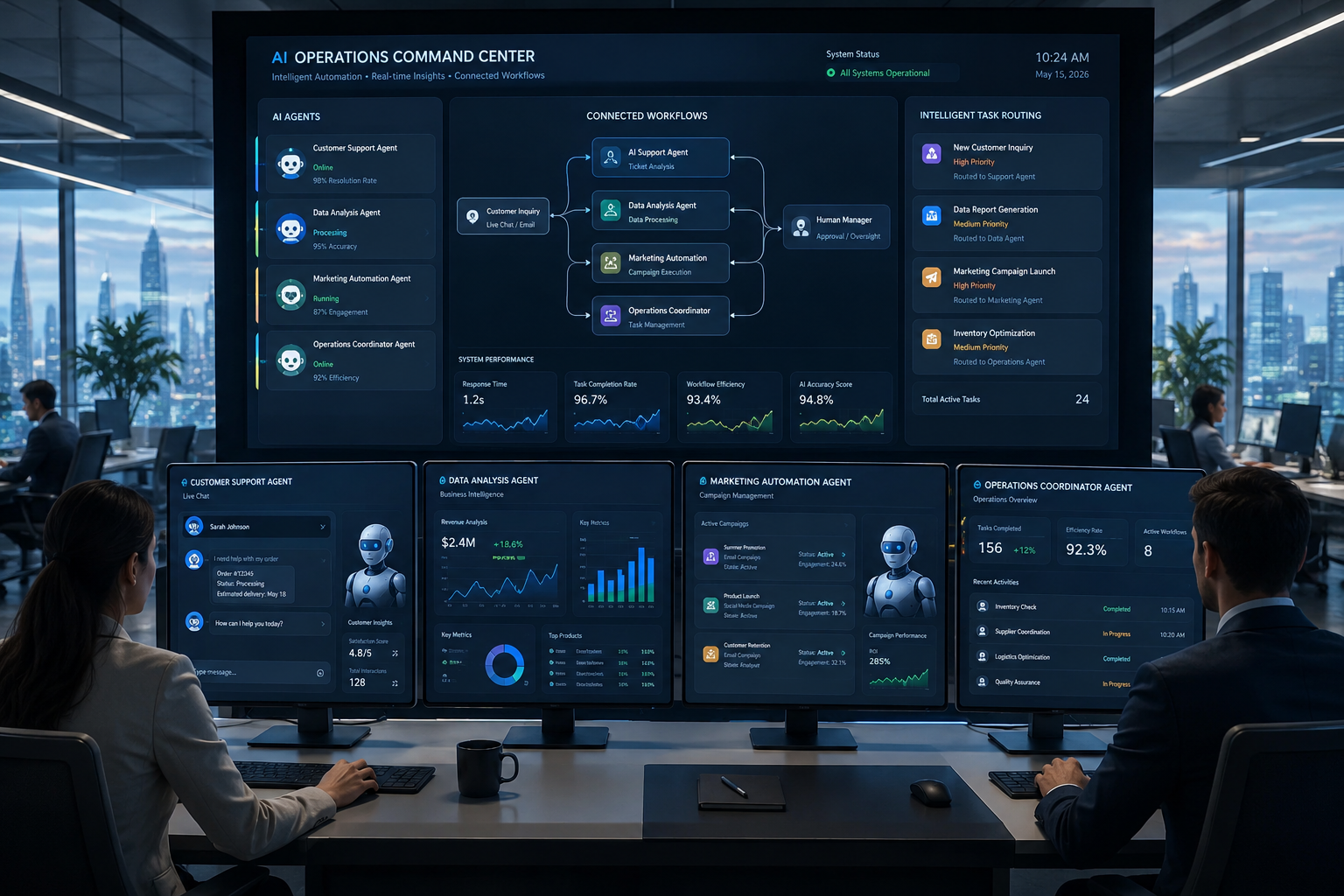
How Businesses Are Building Multi-Agent AI Systems Instead of Hiring More Teams
The New Workforce
For decades, business growth followed a familiar pattern. More customers meant more employees. More work required larger departments. As operations expanded, organizations invested heavily in recruitment, training, and management.
That model is changing.
Today, businesses are increasingly building Multi-Agent AI Systems for Business that handle tasks once assigned to entire teams. These systems do not replace every human role. Instead, they perform repetitive work, coordinate workflows, and assist employees in making faster and more informed decisions.
The result is a leaner operation with greater efficiency and stronger scalability.
At Product Siddha, we have observed that organizations adopting AI Systems for Business are shifting their focus from workforce expansion to intelligent automation that grows alongside the company.
What Are Multi-Agent AI Systems?
A Multi-Agent AI System is a network of specialized AI agents that collaborate to complete business tasks.
Each agent has a distinct responsibility.
One agent may analyze customer inquiries. Another may generate reports. A third may process transactions, while another coordinates communication between systems.
Together, these agents create a connected environment where tasks are completed automatically and information flows continuously across departments.
Unlike traditional automation, Multi-Agent AI Systems for Business operate with coordination and adaptability. They can react to changing inputs, share information, and execute workflows with minimal human intervention.
Why Businesses Are Choosing AI Systems Instead of Expanding Teams
Hiring employees remains important, but it comes with challenges.
Businesses must consider:
- Recruitment costs
- Employee onboarding
- Training expenses
- Staff turnover
- Operational overhead
- Increasing management complexity
AI Systems for Business address many of these concerns by automating repetitive activities and supporting employees where human judgment matters most.
Companies are discovering that AI agents can:
- Process customer requests instantly
- Generate reports automatically
- Route leads efficiently
- Monitor business performance
- Manage internal workflows
- Analyze large datasets
This approach allows businesses to scale operations without increasing headcount at the same pace.
How Multi-Agent AI Systems Work
A Multi-Agent architecture resembles a team with clearly defined responsibilities.
Example Workflow
Imagine an e-commerce business.
Agent 1 – Customer Support Agent
- Responds to common customer questions
- Tracks order status
- Handles return requests
Agent 2 – Inventory Agent
- Monitors stock levels
- Predicts inventory shortages
- Places supplier orders automatically
Agent 3 – Marketing Agent
- Segments customers
- Creates email campaigns
- Tracks campaign performance
Agent 4 – Analytics Agent
- Generates reports
- Measures business trends
- Forecasts revenue
All these agents communicate and coordinate with each other through a central workflow.
This interconnected approach is one reason Multi-Agent AI Systems for Business are gaining popularity across industries.
Industries Leading the Adoption
Businesses across multiple sectors are embracing AI Systems for Business.
Retail
Retail companies use AI agents for:
- Inventory management
- Personalized recommendations
- Customer support
- Pricing analysis
Financial Services
Banks and finance companies use AI to:
- Detect fraud
- Assess risk
- Process documents
- Generate compliance reports
Healthcare
Healthcare organizations deploy AI agents for:
- Appointment scheduling
- Medical data processing
- Patient communication
- Administrative workflows
SaaS Companies
Software businesses rely on AI agents to:
- Qualify leads
- Monitor customer health
- Automate onboarding
- Generate product analytics
Traditional Teams vs Multi-Agent AI Systems
| Business Function | Traditional Team | Multi-Agent AI System |
| Customer Support | Multiple employees | AI Support Agents |
| Reporting | Analysts | Analytics Agent |
| Lead Qualification | Sales Representatives | AI Lead Agent |
| Data Entry | Operations Team | Automated Workflow Agent |
| Inventory Management | Manual Monitoring | Inventory AI Agent |
| Email Campaigns | Marketing Staff | Marketing AI Agent |
Key Benefits of AI Systems for Business
1. Faster Decision Making
AI agents process information continuously.
Reports that once required days can now be prepared in minutes.
Managers gain access to current business insights without waiting for manual updates.
2. Lower Operating Costs
Organizations reduce repetitive manual work and allocate resources more efficiently.
This does not mean eliminating employees. Instead, businesses allow teams to focus on higher-value activities.
3. Improved Accuracy
Human error is common in repetitive tasks.
AI agents follow defined workflows consistently, reducing mistakes and improving data quality.
4. Continuous Operations
Unlike traditional teams, AI systems can operate around the clock.
Customer requests, reports, and workflows continue without interruption.
Building a Multi-Agent AI System
Developing AI Systems for Business begins with identifying repetitive workflows.
The implementation process often includes:
- Mapping business processes
- Identifying automation opportunities
- Designing specialized AI agents
- Connecting data sources
- Creating workflow orchestration
- Monitoring and refining performance
Businesses do not need to automate everything at once.
Many begin with customer support or reporting and gradually expand into more advanced automation.
The Role of Human Teams
Despite rapid progress, AI systems are not replacing human expertise entirely.
Human employees continue to provide:
- Strategic planning
- Creative thinking
- Relationship building
- Ethical judgment
- Leadership
The most successful businesses combine human experience with intelligent AI systems.
This partnership creates stronger operations while preserving the qualities that customers value most.
Looking Ahead
The future of business growth is changing quietly but significantly.
Organizations are no longer asking how many people they need to hire to handle increasing workloads. They are asking how intelligent systems can help their existing teams achieve m]ore.
Multi-Agent AI Systems for Business provide that opportunity. They automate routine work, improve operational efficiency, and create flexible systems that grow with the organization.
At Product Siddha, we help businesses design and implement AI Systems for Business that align with their goals, workflows, and long-term growth plans. From intelligent automation to advanced Multi-Agent architectures, our focus remains the same. We help organizations build smarter systems that support sustainable business growth for years to come.
Frequently Asked Questions
What are AI Systems for Business?
AI Systems for Business are intelligent technologies that automate workflows, process data, assist decision making, and improve operational efficiency across departments.
What is a Multi-Agent AI System?
A Multi-Agent AI System consists of several specialized AI agents working together to complete business tasks automatically.
Can AI systems replace business teams?
AI systems automate repetitive activities and assist employees, but human expertise remains essential for leadership, strategy, and creative decision making.
Which industries use Multi-Agent AI Systems?
Retail, healthcare, finance, SaaS, logistics, and customer service industries increasingly rely on Multi-Agent AI Systems for Business.
How can Product Siddha help businesses implement AI systems?
Product Siddha designs customized AI Systems for Business, including workflow automation, AI agents, data integration, and enterprise automation solutions tailored to specific business needs.