
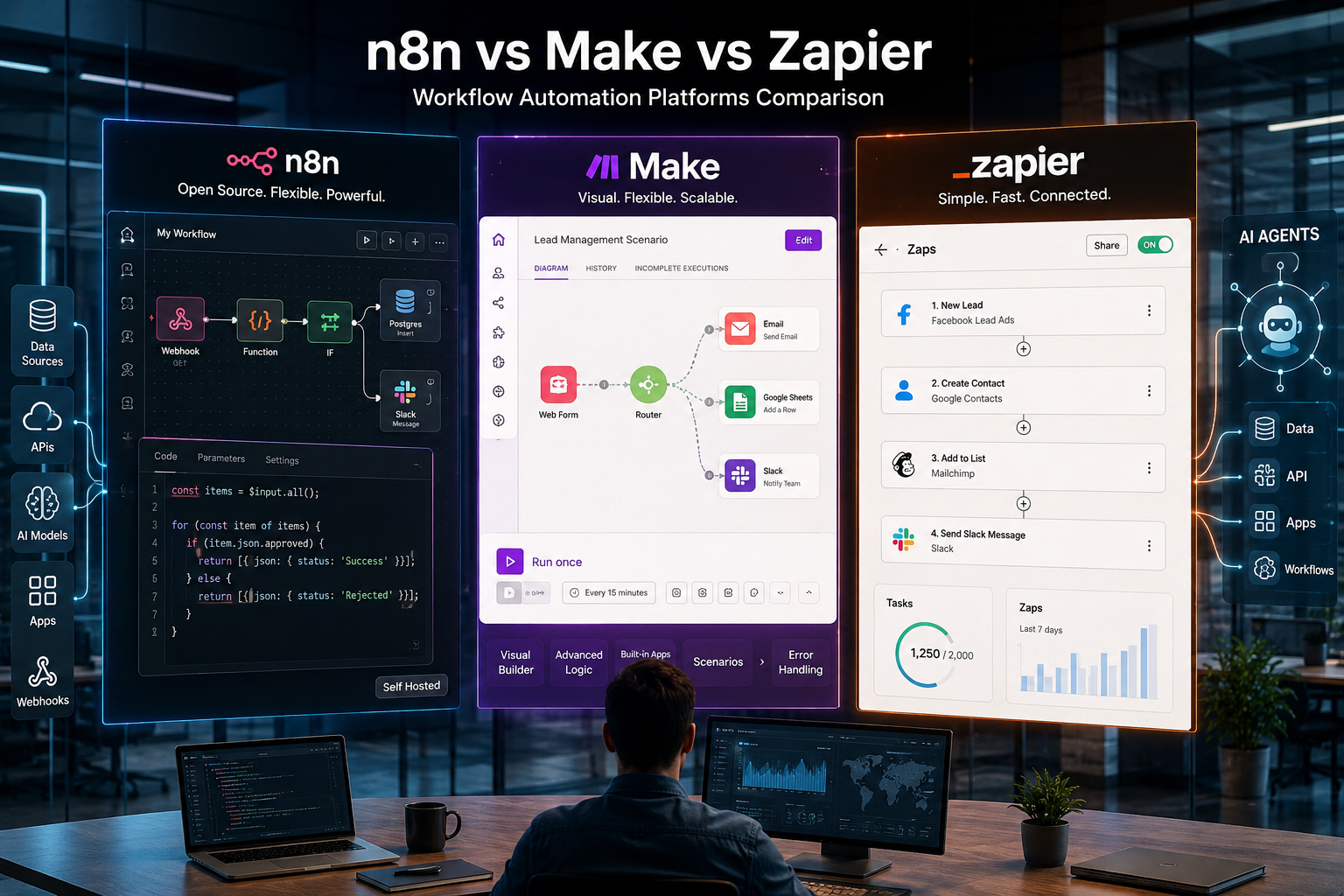
n8n vs Make vs Zapier in 2026: Which Automation Platform Will Actually Scale With Your Business?
The Automation Market Has Changed. Most Comparisons Haven’t.
For years, businesses evaluated automation tools based on one simple question:
“How easily can this platform connect my apps?”
In 2026, that question is no longer enough.
Automation has evolved from connecting software applications to orchestrating entire business processes powered by AI. Modern organizations are automating customer support, sales operations, lead qualification, marketing execution, analytics reporting, internal approvals, and even decision-making workflows.
As AI agents become part of everyday operations, the automation platform you choose today will determine how effectively your business scales tomorrow.
This is why the debate around n8n vs Make vs Zapier has become more important than ever.
All three platforms are capable workflow automation solutions. However, they serve fundamentally different business needs.
After evaluating their capabilities, market direction, AI readiness, scalability, and operational flexibility, one conclusion becomes increasingly clear:
Zapier excels at simplicity. Make excels at visual workflow management. But n8n is increasingly becoming the platform most aligned with where automation is heading.
Let’s examine why.
Why Workflow Automation Matters More Than Ever
Businesses now operate across dozens of applications:
- CRM systems
- Marketing platforms
- Analytics tools
- Customer support software
- Payment gateways
- AI applications
- Internal databases
Without automation, teams spend countless hours performing repetitive tasks:
- Copying data between systems
- Updating customer records
- Sending notifications
- Creating reports
- Managing approvals
- Following up on leads
Workflow automation eliminates these inefficiencies while improving speed, accuracy, and scalability.
Organizations implementing automation effectively often experience:
- Faster operational execution
- Reduced manual labor costs
- Improved customer experience
- Better data consistency
- Increased employee productivity
- Greater scalability without proportional hiring
The challenge isn’t whether to automate.
The challenge is selecting the automation platform that will still meet your needs three years from now.
The New Era: From Task Automation to AI-Powered Operations
One of the biggest shifts since 2024 has been the rise of AI-driven automation.
Businesses are no longer automating isolated actions such as:
- Sending emails
- Updating spreadsheets
- Posting notifications
Instead, they’re building intelligent systems capable of:
- Understanding customer requests
- Making recommendations
- Analyzing business data
- Routing decisions automatically
- Coordinating workflows across departments
This shift significantly changes how organizations should evaluate automation platforms.
The best automation tool in 2026 isn’t necessarily the easiest one.
It’s the platform capable of supporting increasingly intelligent and complex workflows.
Understanding n8n: The Open-Source Automation Leader
n8n has experienced remarkable growth over the last few years, largely because it aligns with several major technology trends:
- Open-source infrastructure
- AI-first workflows
- Data ownership
- Enterprise customization
Unlike traditional no-code platforms, n8n gives organizations greater control over how workflows are built and deployed.
Key Features
- Open-source architecture
- Self-hosting capabilities
- AI agent workflows
- Custom JavaScript logic
- API integrations
- Webhook support
- Database connectivity
- Enterprise-grade customization
Where n8n Excels
n8n shines when businesses need:
- AI-powered workflows
- Enterprise automation
- Internal operational systems
- Advanced integrations
- Data privacy and compliance
- Custom business logic
Its flexibility makes it especially attractive to:
- SaaS companies
- Product-led businesses
- Engineering teams
- AI startups
- Mid-market enterprises
The Biggest Advantage
n8n allows businesses to own their automation infrastructure.
As organizations increasingly prioritize security, governance, and AI customization, this becomes a significant competitive advantage.
The Biggest Drawback
Flexibility comes at a cost.
Compared to Zapier or Make, n8n requires a steeper learning curve and often benefits from technical expertise.
For small teams seeking immediate deployment, this can be challenging.
Understanding Make: The Visual Automation Powerhouse
Make has carved out a unique position in the automation market.
It successfully bridges the gap between beginner-friendly tools and enterprise-grade workflow capabilities.
Its visual workflow builder remains one of the most intuitive automation interfaces available.
Key Features
- Drag-and-drop workflow builder
- Advanced branching logic
- Data transformation tools
- API support
- Scheduling capabilities
- AI integrations
- Extensive app ecosystem
Where Make Excels
Make performs exceptionally well for:
- Marketing automation
- Customer lifecycle workflows
- E-commerce operations
- Agency workflows
- CRM synchronization
- Operational reporting
The platform allows users to build surprisingly sophisticated workflows without writing code.
The Biggest Advantage
Visual clarity.
Complex workflows become easier to understand, manage, and optimize.
The Biggest Drawback
As workflows become larger and span multiple departments, visual scenarios can become difficult to maintain.
Organizations often encounter workflow sprawl as automation complexity increases.
Understanding Zapier: The Simplicity Champion
Zapier remains one of the most recognizable automation brands in the industry.
Its success is built on one principle:
Anyone should be able to automate business processes without technical knowledge.
That philosophy continues to resonate with startups, entrepreneurs, and small businesses.
Key Features
- Easy setup
- Massive integration library
- AI-powered assistants
- Workflow templates
- Multi-step automations
- Built-in databases
- Chatbot functionality
Where Zapier Excels
Zapier works particularly well for:
- Small businesses
- Startups
- Sales teams
- Solopreneurs
- Marketing teams
Workflows can often be built within minutes.
The Biggest Advantage
Speed and accessibility.
Few platforms make automation easier.
The Biggest Drawback
Cost and flexibility.
As workflow volume grows, pricing can increase significantly.
Businesses with advanced automation requirements may eventually outgrow Zapier’s capabilities.
Feature Comparison: n8n vs Make vs Zapier
| Feature | n8n | Make | Zapier |
| Open Source | Yes | No | No |
| Self Hosting | Yes | No | No |
| Ease of Use | Moderate | Easy | Very Easy |
| Visual Builder | Good | Excellent | Good |
| AI Agent Support | Excellent | Good | Good |
| Custom Coding | Excellent | Moderate | Limited |
| Integrations | 1000+ | 2000+ | 7000+ |
| Enterprise Control | Excellent | Good | Good |
| Data Ownership | Excellent | Limited | Limited |
| Pricing Flexibility | High | Moderate | Moderate |
Which Platform Is Best for AI Automation?
This is where the market is changing fastest.
Automation is increasingly becoming AI orchestration.
n8n for AI Workflows
n8n currently leads in:
- AI agents
- Multi-agent systems
- Vector databases
- RAG architectures
- LLM orchestration
- Custom AI pipelines
For businesses investing heavily in AI, n8n provides unmatched flexibility.
Make for AI Automation
Make supports:
- OpenAI integrations
- Content generation workflows
- AI-powered customer support
- AI-enhanced marketing automation
It works well for operational AI workflows.
Zapier for AI Automation
Zapier focuses on accessibility.
Common use cases include:
- AI-generated summaries
- Automated responses
- Content workflows
- CRM intelligence
For lightweight AI adoption, Zapier remains highly effective.
Pricing Analysis: Which Platform Delivers Better Long-Term Value?
Pricing becomes increasingly important as automation scales.
n8n
Advantages:
- Free self-hosted version
- Lower long-term costs
- Predictable scaling economics
Best for organizations running large automation volumes.
Make
Advantages:
- Flexible plans
- Affordable entry point
- Good balance between capability and cost
Ideal for growing companies.
Zapier
Advantages:
- Fast implementation
- Extensive integrations
Challenges:
- Costs can rise significantly at scale.
Organizations running thousands of tasks monthly often find alternatives more cost-effective.
Real-World Scenarios: Which Platform Should You Choose?
Scenario 1: AI-Driven SaaS Company
Requirements:
- AI agents
- Custom APIs
- Data ownership
- Scalability
Winner: n8n
Scenario 2: Marketing Agency Managing Multiple Clients
Requirements:
- Campaign automation
- CRM workflows
- Visual workflow management
Winner: Make
Scenario 3: Startup Founder Seeking Quick Results
Requirements:
- Fast deployment
- Minimal setup
- Easy integrations
Winner: Zapier
Scenario 4: Enterprise Building Internal Operations Automation
Requirements:
- Governance
- Security
- Custom workflows
- AI readiness
Winner: n8n
The Bigger Question: Where Is Automation Heading?
If this comparison were written in 2022, Zapier would likely have been the default recommendation.
In 2026, however, automation has become inseparable from AI.
Organizations increasingly demand:
- AI-powered decision making
- Data ownership
- Open architectures
- Enterprise control
- Advanced integrations
These trends favor platforms offering greater flexibility and customization.
This doesn’t mean Zapier or Make are becoming irrelevant.
Far from it.
Both remain exceptional products.
However, the center of gravity within automation is shifting toward platforms capable of serving as operational infrastructure rather than simple integration tools.
n8n is particularly well-positioned to benefit from this shift.
Final Verdict
There is no universally perfect automation platform.
The right choice depends on your organization’s goals, technical maturity, and future plans.
Choose Zapier if:
- You prioritize ease of use
- You need quick deployment
- You have straightforward workflows
Choose Make if:
- You want powerful visual automation
- You manage marketing or operational workflows
- You need flexibility without extensive coding
Choose n8n if:
- You are investing in AI automation
- You need enterprise-grade control
- You value data ownership
- You expect workflow complexity to grow over time
Our view is that n8n represents where workflow automation is heading, while Make and Zapier continue to excel within their respective strengths.
The most important question isn’t which platform is best today.
It’s which platform will best support your business as automation becomes increasingly intelligent over the next five years.
About Product Siddha
At Product Siddha, we help businesses design, implement, and optimize AI-powered automation systems using n8n, Make, Zapier, and custom workflow architectures.
Whether you’re building AI agents, automating customer journeys, streamlining operations, or integrating analytics platforms, our team helps create scalable automation ecosystems designed for long-term growth.
Frequently Asked Questions
Which automation platform is best in 2026?
For advanced AI automation and enterprise workflows, n8n is often the strongest choice. For visual workflow design, Make excels. For simplicity and speed, Zapier remains a leading option.
Is n8n better than Zapier?
For AI workflows, customization, and self-hosting, n8n offers significantly more flexibility. Zapier is easier for beginners.
Is Make easier than n8n?
Yes. Make provides a more intuitive visual workflow experience, while n8n prioritizes flexibility and technical control.
Which automation platform is best for AI agents?
n8n currently offers the strongest support for AI agents, vector databases, custom AI pipelines, and LLM orchestration.
Is Zapier still worth using in 2026?
Absolutely. Zapier remains one of the fastest and easiest ways to automate business processes, especially for startups and small teams.