
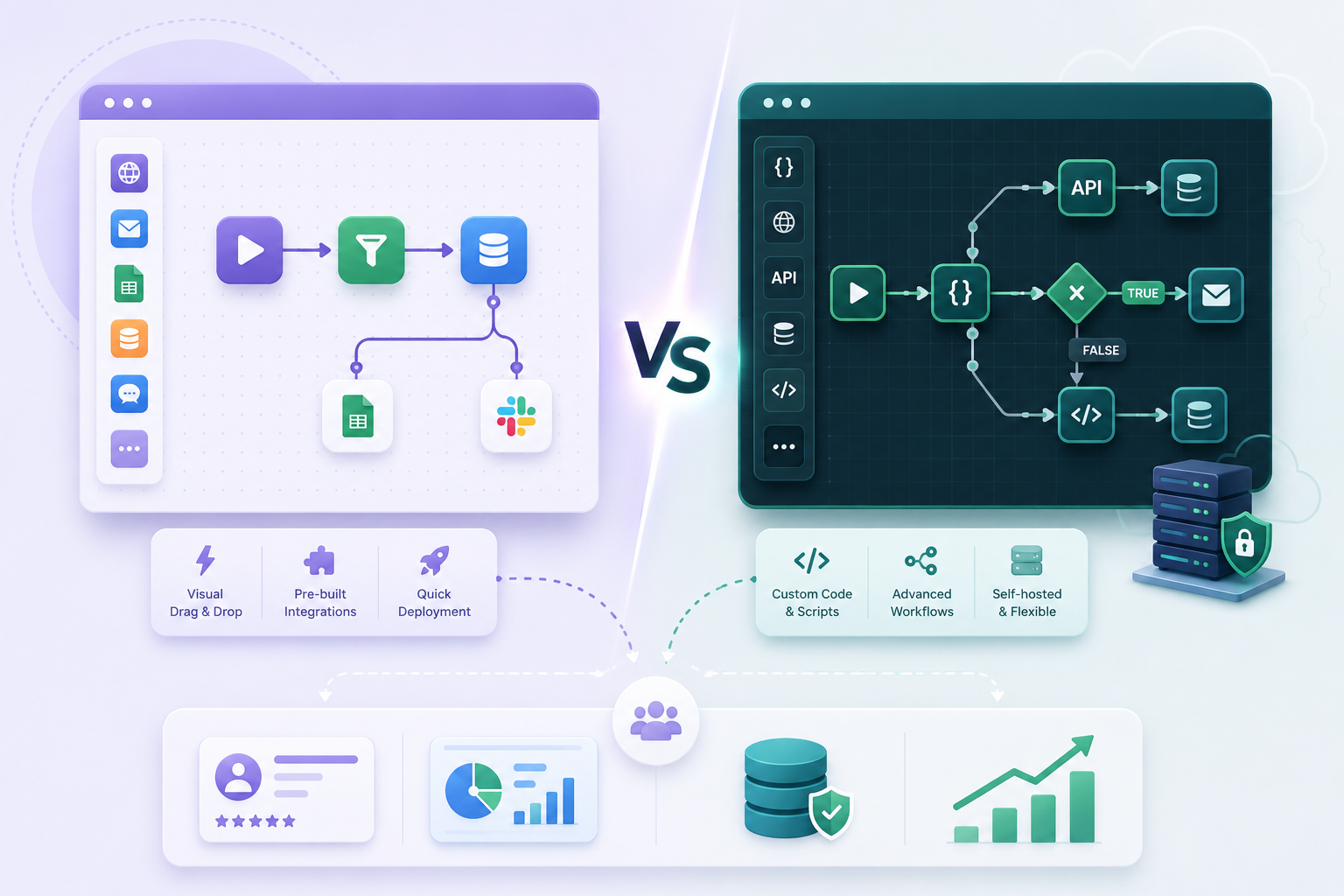
Make vs n8n for Enterprise Automation
Automation has become an essential part of modern business operations. As organizations expand, manual processes often slow productivity, increase costs, and create unnecessary errors. Workflow automation platforms solve these challenges by connecting business applications, reducing repetitive work, and improving operational efficiency.
Among today’s most widely used automation platforms are Make and n8n. Both offer powerful workflow automation capabilities, yet they differ in architecture, deployment options, customization, pricing, and enterprise suitability.
Choosing between them requires more than comparing features. Businesses should evaluate long-term scalability, security, integration requirements, and technical expertise before making a decision.
At Product Siddha, we help organizations implement enterprise automation solutions that align with their operational goals. Whether a business chooses Make or n8n, success depends on careful planning, system integration, and workflow optimization.
Understanding Enterprise Automation
Enterprise automation refers to the use of software to automate routine business processes across departments.
Typical automation workflows include:
- CRM updates
- Lead management
- Customer support routing
- Invoice processing
- Employee onboarding
- Data synchronization
- Marketing workflows
- Business reporting
Automation allows employees to spend more time on strategic work while reducing repetitive administrative tasks.
What Is Make?
Make is a cloud-based visual automation platform designed to connect thousands of applications through drag-and-drop workflows.
It allows users to build automated scenarios with minimal coding knowledge.
Common business uses include:
- CRM integration
- Email automation
- Cloud storage synchronization
- Project management updates
- Customer notifications
- Marketing workflows
Its visual interface makes workflow creation accessible to both technical and non-technical users.
What Is n8n?
n8n is an open-source workflow automation platform that provides greater flexibility for businesses requiring custom automation.
Unlike many cloud-only platforms, n8n supports self-hosting, allowing organizations to maintain greater control over their infrastructure and data.
Businesses often use n8n for:
- Internal system integration
- API orchestration
- Custom business workflows
- Data transformation
- Enterprise software integration
- AI-powered automation
Its ability to incorporate custom code makes it attractive for development teams and enterprises with specialized requirements.
Comparing Make and n8n
| Feature | Make | n8n |
| Deployment | Cloud-based | Cloud or Self-hosted |
| Ease of Use | Beginner Friendly | Technical Flexibility |
| Custom Coding | Limited | Extensive |
| API Integration | Excellent | Excellent |
| Visual Workflow Builder | Yes | Yes |
| Self Hosting | No | Yes |
| Enterprise Customization | Moderate | High |
| Community Support | Large | Growing Open Source Community |
Both platforms provide strong automation capabilities, but their strengths serve different business needs.
Ease of Implementation
For businesses seeking quick deployment, Make offers an intuitive visual interface that simplifies workflow creation.
Teams can connect applications using pre-built integrations without extensive technical knowledge.
n8n offers similar visual workflow capabilities, but organizations often require development expertise when building advanced automation or custom integrations.
Businesses with dedicated technical teams may appreciate this flexibility.
Integration Capabilities
Enterprise automation depends on reliable software integration.
Both platforms support connections with:
- CRM systems
- ERP platforms
- Cloud storage
- Email services
- Databases
- Accounting software
- Customer support platforms
- API services
n8n provides additional flexibility for organizations working with proprietary systems through custom API development.
Security and Data Control
Data security plays an important role in enterprise automation.
Businesses handling sensitive customer or financial information often require greater control over their infrastructure.
Make
- Cloud-hosted environment
- Vendor-managed infrastructure
- Built-in security management
- Reduced maintenance responsibilities
n8n
- Self-hosting available
- Complete infrastructure control
- Internal security policies
- Flexible deployment environments
Organizations operating under strict compliance requirements may benefit from self-hosted solutions.
Scalability for Growing Businesses
As organizations grow, automation requirements become more complex.
Large enterprises typically require:
- Multiple workflow environments
- Department-specific automation
- High-volume API requests
- Centralized reporting
- Advanced permissions
- Workflow monitoring
Both platforms scale effectively, although n8n offers greater flexibility for organizations managing highly customized enterprise environments.
Workflow Customization
Customization determines how well automation adapts to unique business operations.
Make focuses on simplicity through visual workflow design.
n8n supports:
- JavaScript functions
- API customization
- Conditional logic
- Complex data transformations
- Advanced workflow branching
Development teams often prefer this level of control.
Practical Business Example
Consider a manufacturing company managing customer inquiries, inventory updates, supplier communications, and financial reporting.
Using automation, the business connects:
- CRM software
- Inventory management
- Accounting platform
- Customer support system
- Internal databases
With Make, the organization quickly builds standard workflows that synchronize customer and sales information across departments.
With n8n, the same organization develops advanced automation that connects proprietary manufacturing systems through custom APIs while maintaining full control over internal infrastructure.
Both solutions improve operational efficiency, but the preferred platform depends on business complexity.
At Product Siddha, automation consultants evaluate business requirements before recommending the most suitable platform.
Choosing the Right Platform
Businesses should evaluate the following questions:
| Business Requirement | Better Fit |
| Quick implementation | Make |
| Minimal coding | Make |
| Custom API development | n8n |
| Self-hosting | n8n |
| Enterprise customization | n8n |
| Internal infrastructure control | n8n |
| User-friendly workflow builder | Make |
| Flexible automation architecture | n8n |
No single platform suits every organization.
The best choice depends on operational priorities and technical capabilities.
How Product Siddha Helps
Product Siddha works with businesses to design enterprise automation strategies that improve productivity while reducing operational complexity.
Our services include:
- AI Automation Services
- Enterprise Workflow Automation
- CRM Automation Solutions
- API Integration
- Business Intelligence Dashboards
- Process Automation Consulting
- Data Integration Solutions
Rather than selecting software based on popularity, we evaluate each organization’s existing systems, business goals, and long-term growth plans before implementing automation.
Final Thoughts
Both Make and n8n are capable enterprise automation platforms that support workflow optimization, system integration, and operational efficiency.
Make provides a streamlined experience for businesses seeking rapid deployment and user-friendly automation. n8n offers greater flexibility for organizations requiring custom development, self-hosting, and advanced workflow control.
Choosing the right platform depends on the complexity of your business processes, available technical resources, security requirements, and future scalability.
With Product Siddha’s enterprise automation expertise, businesses can confidently implement automation solutions that simplify operations, improve collaboration, and support sustainable growth.