
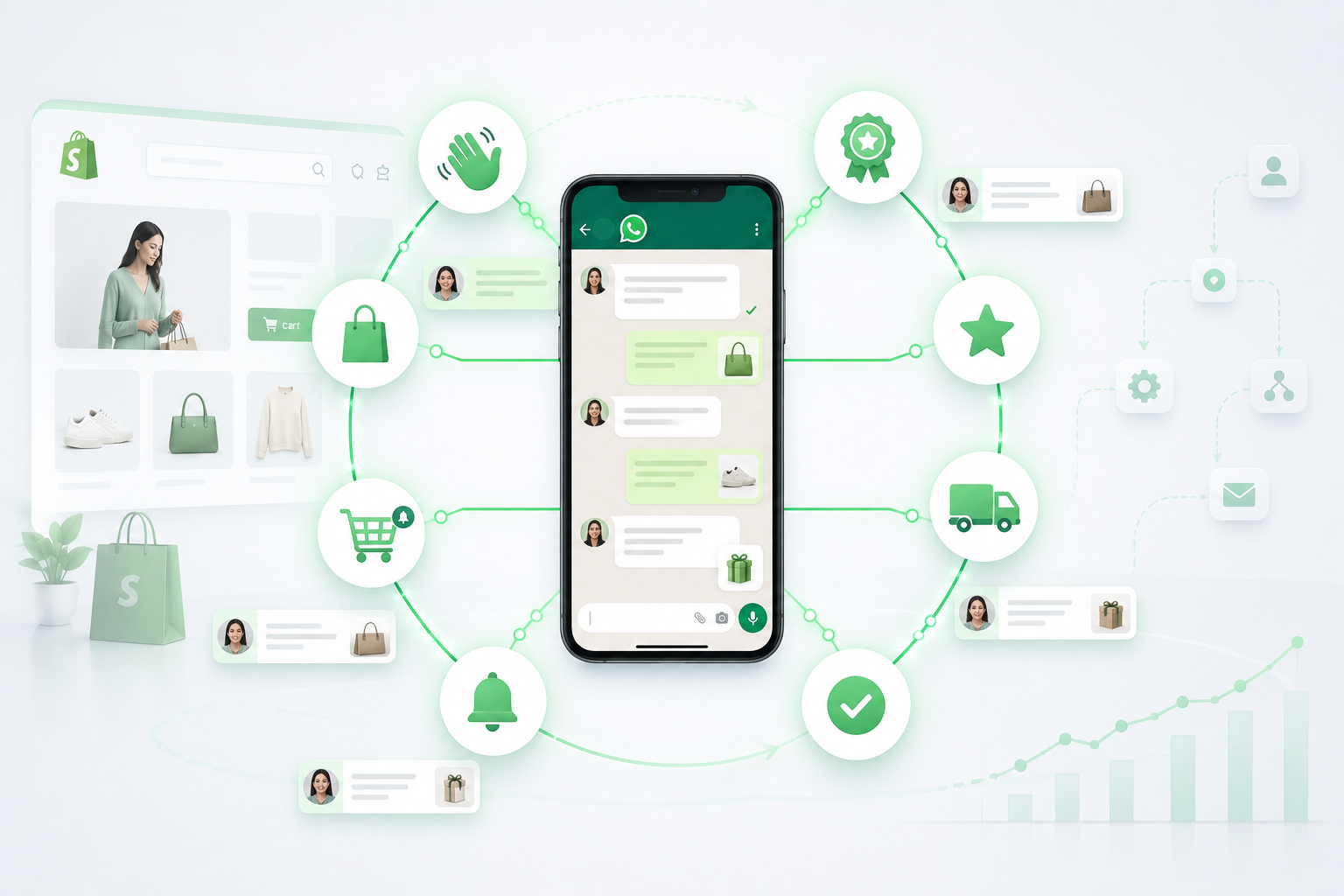
WhatsApp Lifecycle Marketing for Shopify: The 2026 Playbook
WhatsApp Lifecycle Marketing for Shopify
Online shopping has become more competitive than ever. Customers expect quick responses, timely updates, and a shopping experience that feels personal from the moment they discover a product until long after their purchase. For Shopify store owners, maintaining consistent communication throughout this journey can improve customer satisfaction and increase repeat purchases.
WhatsApp has evolved into one of the most effective business communication channels because it allows brands to interact with customers in a familiar and direct way. When combined with Shopify and intelligent automation, WhatsApp becomes more than a messaging platform. It supports customer engagement across every stage of the buying journey.
This guide explains how WhatsApp Lifecycle Marketing can help Shopify businesses improve customer relationships, automate communication, and create a better shopping experience. It also explores how Product Siddha helps businesses implement scalable automation solutions that simplify customer engagement.
Understanding WhatsApp Lifecycle Marketing
WhatsApp Lifecycle Marketing is the practice of communicating with customers at different stages of their relationship with your business using automated and personalized WhatsApp messages.
Instead of sending the same message to every customer, businesses deliver relevant communication based on customer actions.
Examples include:
- Welcome messages
- Product recommendations
- Cart abandonment reminders
- Order confirmations
- Shipping updates
- Delivery notifications
- Review requests
- Reorder reminders
- Loyalty program updates
Each interaction supports the customer journey while reducing manual effort.
Why Shopify Businesses Are Adopting WhatsApp
Shopify merchants manage many customer interactions every day.
These include:
- Product inquiries
- Order tracking
- Payment confirmations
- Customer support
- Promotional announcements
- Return requests
Managing these conversations manually becomes difficult as order volume increases.
WhatsApp automation improves communication by delivering accurate information immediately after customer actions occur.
Mapping the Customer Journey
An effective WhatsApp Lifecycle Marketing strategy begins by understanding the customer journey.
| Customer Stage | WhatsApp Communication |
| New Visitor | Welcome message |
| Product Interest | Product recommendations |
| Cart Abandonment | Reminder with checkout link |
| Purchase Completed | Order confirmation |
| Order Processing | Shipping updates |
| Delivery | Delivery confirmation |
| After Purchase | Review request |
| Returning Customer | Personalized offers |
This structured communication keeps customers informed throughout the purchasing process.
Automating Shopify Workflows
Automation connects Shopify with WhatsApp through predefined workflows.
Common automated processes include:
- Customer registration
- Order confirmation
- Inventory alerts
- Payment reminders
- Shipping notifications
- Appointment scheduling
- Customer feedback collection
Businesses save time while providing consistent communication.
At Product Siddha, workflow automation connects Shopify stores with CRM systems, inventory platforms, and communication tools to create seamless customer experiences.
Personalization Improves Engagement
Customers respond better when messages are relevant to their needs.
Personalization may include:
- Customer names
- Order history
- Preferred products
- Purchase frequency
- Location-based updates
- Loyalty rewards
Using CRM data, businesses can deliver messages that match each customer’s buying history without overwhelming them with unnecessary communication.
CRM Integration Strengthens Customer Relationships
CRM systems help organize customer information collected through Shopify.
Integrated automation allows businesses to:
- Store customer profiles
- Track purchase history
- Record customer interactions
- Monitor support requests
- Schedule follow-up communication
This creates a complete customer profile that supports more meaningful engagement.
Product Siddha provides CRM Automation Solutions that synchronize Shopify customer data with business systems, reducing manual updates and improving operational efficiency.
Order Updates Build Customer Confidence
One of the most valuable uses of WhatsApp is providing real-time order updates.
Customers appreciate receiving:
- Order confirmation
- Payment verification
- Shipping notification
- Estimated delivery date
- Delivery confirmation
These updates reduce customer support inquiries while improving trust.
Recovering Abandoned Carts
Cart abandonment remains one of the biggest challenges for online retailers.
Automated WhatsApp reminders can encourage customers to complete purchases by providing:
- Product reminders
- Checkout links
- Stock availability updates
- Limited-time promotional offers
- Customer support assistance
Businesses should keep reminder messages helpful rather than repetitive.
Real Business Example
Imagine a Shopify fashion retailer processing hundreds of orders every week.
Previously, customer service representatives manually answered questions about order status, shipping, and delivery.
After implementing WhatsApp Lifecycle Marketing with automated workflows:
- Customers received instant order confirmations.
- Shipping updates were delivered automatically.
- Delivery notifications reduced support inquiries.
- Post-purchase review requests increased customer feedback.
- CRM records updated automatically after every transaction.
The business reduced manual communication while improving customer satisfaction and operational efficiency.
Businesses working with Product Siddha implement similar automation strategies that connect Shopify, CRM systems, and communication platforms into one streamlined workflow.
Measuring Campaign Performance
Businesses should regularly evaluate automation performance using measurable indicators.
| KPI | Purpose |
| Message Delivery Rate | Confirms successful communication |
| Open Rate | Measures customer engagement |
| Click Rate | Tracks customer interest |
| Cart Recovery Rate | Measures recovered sales |
| Repeat Purchase Rate | Indicates customer loyalty |
| Customer Satisfaction | Evaluates service quality |
Business Intelligence Dashboards help visualize these metrics and identify opportunities for improvement.
Best Practices for 2026
Businesses implementing WhatsApp Lifecycle Marketing should follow several important principles.
- Obtain customer consent before sending messages.
- Keep communication timely and relevant.
- Personalize messages using CRM data.
- Limit promotional communication.
- Provide clear customer support options.
- Regularly review automation workflows.
- Monitor performance using analytics dashboards.
- Protect customer information through secure data practices.
These practices support long-term customer relationships while maintaining compliance with privacy expectations.
How Product Siddha Supports Shopify Automation
Product Siddha helps Shopify businesses automate customer communication through intelligent workflow design and system integration.
Our services include:
- AI Automation Services
- Shopify Workflow Automation
- CRM Automation Solutions
- WhatsApp Business API Integration
- Business Intelligence Dashboards
- Customer Journey Automation
- AI Consulting Services
These solutions help businesses improve customer engagement while reducing repetitive operational tasks.
Final Thoughts
WhatsApp Lifecycle Marketing has become an important component of customer communication for Shopify businesses. By combining automation, CRM integration, and personalized messaging, businesses can improve customer satisfaction throughout every stage of the purchasing journey.
Order confirmations, shipping updates, abandoned cart reminders, and post-purchase engagement all contribute to stronger customer relationships when delivered at the right time.
With Product Siddha’s expertise in automation and business process optimization, Shopify merchants can build scalable communication systems that improve operational efficiency and support sustainable business growth.