
Product Siddha

Product Management

Blog, Product Management

Jira vs. ClickUp: Best Agile Product Management Tool 2025

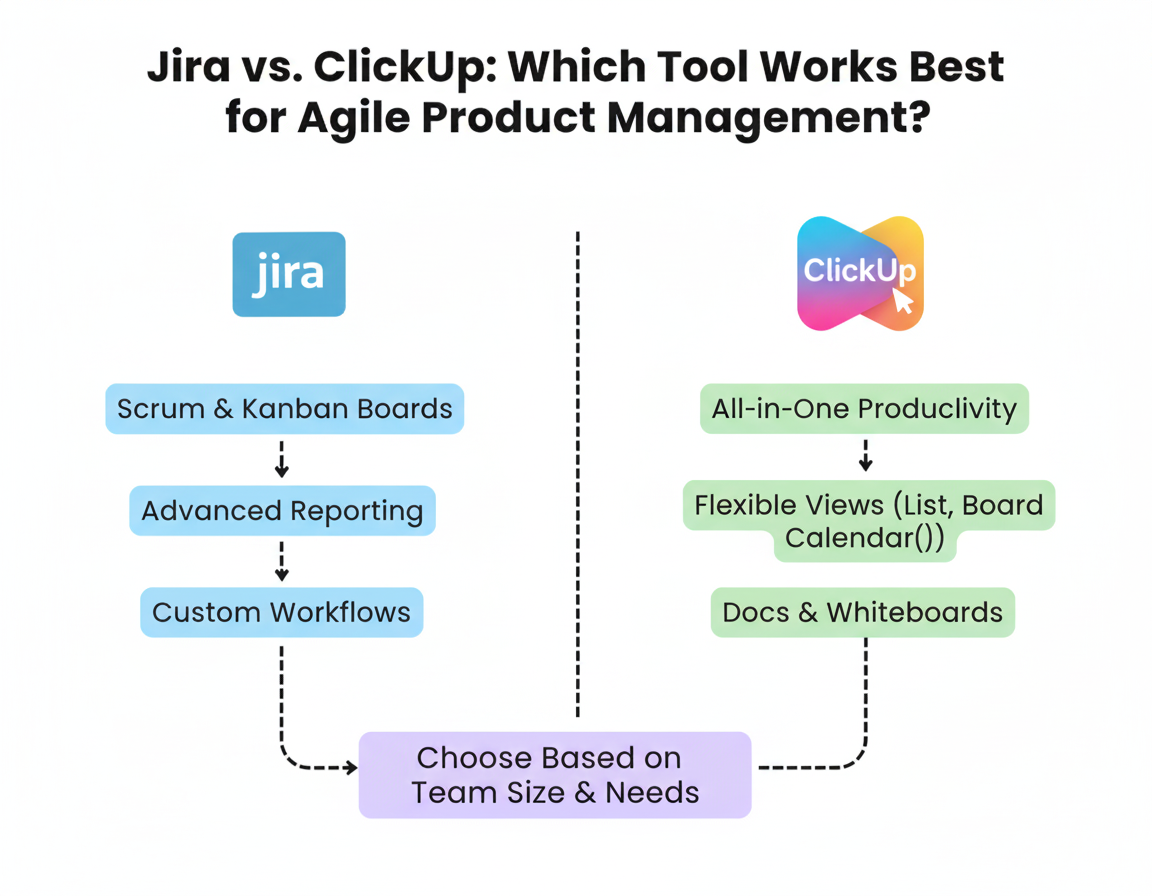
Jira vs. ClickUp: Best Agile Product Management Tool 2025 Headway: Comparing Jira and ClickUp for Agile Product Management Product management demands tools that support clarity, speed, and adaptability. Teams building software, SaaS, or digital products need platforms where planning, tracking, and collaboration work smoothly. Jira and ClickUp are among the most popular options. Each offers strengths and trade-offs when applied to agile workflows, backlogs, roadmaps, sprint planning, and feedback loops. At Product Siddha we often help teams make the right choice for their product lifecycle, aligning tool features with methods and process needs. Core Features and Differences Below are core dimensions that matter for agile product management, and how Jira and ClickUp compare. Feature Jira ClickUp Backlog & Sprint Planning Built for software engineering teams. Strong support for Scrum boards, Kanban, epics, stories, tasks. Deep integration with code management. Flexible views (List, Board, Gantt, Calendar). Easier to set up for small or mixed teams. Can mimic sprints with custom statuses or “Sprint Box” templates. Roadmapping & Prioritisation Jira Product Discovery helps capture ideas, prioritise features, and create roadmaps tied to delivery work. ClickUp provides visual roadmap templates, product vision boards, and goal alignment dashboards. Prioritisation via custom fields, priorities, and dependencies. (ClickUp) Documentation & Collaboration Jira is part of a suite that usually includes Confluence (in many setups) for docs; collaboration is often external or via issue comments. Strong with engineering‐oriented tasks. ClickUp includes Docs, Whiteboards, integrated discussion threads, comments, and attachments. Collaboration tends to be more visible across teams beyond engineering. Flexibility vs Rigidity Very strong support for workflows, permissions, issue types, and custom fields. But this comes with a steeper learning curve. Configuration overhead can slow teams without dedicated admins or discipline. More out-of-the-box flexibility. Easier to get started for non-technical or cross-functional teams. But very complex use cases may hit limits or need workarounds. Reporting, Metrics & Analytics Rich reporting: burn-down charts, cumulative flow diagrams, velocity tracking. Good for product managers concerned about productivity, forecasting, and technical debt. Dashboards are strong; Widgets and custom metrics help. But for deep engineering insight (e.g., commit-to-deploy, CI/CD integration), sometimes we need additional tools. Case Study: Product Siddha’s Approach At Product Siddha, we often advise early-stage startups or teams scaling up. In one recent project, we helped a mid-sized SaaS business select between Jira and ClickUp for their product management process. They had been using ClickUp for years for task tracking and general collaboration, but found difficulties when scaling agile practices. Background The team had about 25 people, split between engineering, design, product, and support. They used ClickUp for many tasks, but sprint planning, backlog grooming, and roadmaps were inconsistent. Prioritisation often depended on whoever shouted loudest. They lacked a stable engineering metrics system and found that “tasks stuck” or dependencies were missed. What We Did We mapped their product management process: how features are requested, how priorities are determined, how deliveries happen, and how feedback loops are managed. We defined what mattered: traceability, transparency, reporting, ability to connect feature requests to outcomes. We trialed both tools: configured ClickUp with stricter workflows, custom statuses, dependencies, and Gantt or roadmap views; and set up Jira for their backlog, epics, sprint boards, and integrated issue types. Outcome They found that ClickUp worked well for planning and early concept phases. Product managers liked its ease of use, documentation, and collaborative whiteboarding. But as teams grew, engineering felt that Jira offered more discipline: clearer epics, better handling of technical debt, better visibility for blockers, tighter backlog grooming. Eventually, the decision was to adopt hybrid use: Use ClickUp for documentation, planning, and cross-team collaboration (design, product, support) and use Jira for engineering execution, sprint tracking, and issue management. When Each Tool Works Best From what Product Siddha and others have seen, here are good fits: Choose Jira when your team needs strong structure around engineering: many dependencies, code integration, a need for detailed tracking of defects, technical backlog, and release management. Choose ClickUp when your team values flexibility: collaboration across functions (design/product/support), lighter-weight workflows, faster ramp-up, and fewer dedicated admin overheads. A Hybrid Approach often gives balance: one tool optimized for execution, another for broad visibility and product strategy. But hybrid demands discipline: keeping data in sync, ensuring people know where to look for what. Product Management Best Practices Regardless of Tool Whatever tool you pick, certain practices matter for product management to succeed: Define your backlog grooming process clearly. Regular reviews, definition of ready, prioritisation criteria. Ensure stakeholder alignment. Roadmaps must reflect business goals, not just engineering capacity. Communication matters. Use metrics that feed product decisions: lead time, cycle time, velocity, feature usage, and customer feedback. Keep feedback loops tight: after launches, gather data, iterate. Connect what customers say with what the backlog holds. Training and adoption: A tool is only as good as how people use it. Provide clear guidelines, templates, and governance (who updates what, who owns backlog, who marks what done). Considerations and Trade-Offs Cost: Jira often has licensing costs and sometimes adds-ons (workflow apps, additional storage); ClickUp may scale in cost depending on plan, seats, and feature needs. Learning curve: Jira’s flexibility means setup can be complex; teams without prior product management discipline may struggle. ClickUp is more forgiving, more adaptable, but it might lack some depth for mature engineering organisations. Integration with existing tools: If you are already using Confluence, Bitbucket, GitHub, or have CI/CD pipelines, Jira may integrate more naturally. If tools are diverse, ClickUp’s integrations are broad and useful. Governance and consistency: With flexibility comes risk of chaos. Unclear workflows, differing statuses, and inconsistent definitions of Done can create confusion, whatever tool you use. Closing Thoughts Choosing between Jira and ClickUp for agile product management depends on what your product team values and where it is in its growth. At Product Siddha, we believe the right tool is the one that matches process maturity, team size, and the product’s complexity. If your team is small or in early stages, or emphasizes cross-functional work, ClickUp may offer speed,

Cut Development Costs without losing quality
Blog, Product Management

Smart Strategies to Reduce Development Costs and Keep Quality Intact

Smart Strategies to Reduce Development Costs and Keep Quality Intact Striking the Right Balance In software development, managing cost while preserving quality is a constant concern for decision-makers. Organizations seek efficiency and reduced spending, yet users expect reliability and performance in every release. The challenge is not only financial but also strategic, as choices made during development directly shape long-term outcomes. Smart approaches allow businesses to maintain high standards without unnecessary expense. This requires discipline in planning, clarity in execution, and careful use of the right tools and methods. At Product Siddha, the focus has always been on guiding clients toward solutions that reduce waste while preserving value. Through structured product management and thoughtful use of automation, the company has helped firms across sectors build software that meets expectations without overrunning budgets. Why Cost Reduction Matters Without Compromising Quality Rising demand for faster delivery, higher feature expectations, and increasing technology costs have made efficient project planning more important than ever. Reducing development costs is not just about spending less. It is about using the right processes, tools, and team practices to get more value out of the same investment. Cost without quality leads to customer churn, higher maintenance costs, and poor adoption. Quality without cost control leads to overspending, missed deadlines, and reduced return on investment. Companies that succeed are those that integrate smart cost-cutting with disciplined quality assurance. Strategy 1: Build a Clear and Detailed Roadmap One of the most effective ways to manage costs is to plan carefully at the start. A roadmap defines which features matter most and helps avoid wasted effort on unnecessary development. Product Siddha used a minimum viable product (MVP) approach with the client. Instead of building all features at once, the team focused on the top three features that drove customer value. This reduced the budget by 30 percent in the first phase while still ensuring strong adoption. Key takeaway: Roadmaps that align business goals with technical execution save both money and time. Strategy 2: Embrace Agile Development Agile methods, when done correctly, allow teams to release working features in small iterations. This reduces rework, ensures early feedback, and prevents the waste of large upfront investments. Sprints allow testing at every stage. Regular reviews ensure alignment with customer expectations. Continuous integration reduces defects later in the cycle. Check Product Siddha, how Agile adoption reduced post-release bugs by 40 percent for a SaaS client, cutting maintenance costs significantly. Strategy 3: Use the Right Automation Tools Automation reduces repetitive tasks, minimizes errors, and accelerates delivery. Tools like N8N, Make.com, Zapier, and Flowise automate workflows across systems, while platforms such as Jira, ClickUp, and Notion streamline project tracking. By integrating automation into both development and management processes, Product Siddha helped one retail client save more than 200 development hours annually, directly lowering operational expenses. Chart: Cost Savings from Automation Tools Tool Average Hours Saved Per Month Cost Reduction (%) Zapier 25 10-12 N8N 40 15 ClickUp + Jira 30 8-10 Strategy 4: Prioritize Product Analytics Decisions guided by data are more cost-effective than those based on assumptions. Tools like Mixpanel, Amplitude, and Looker Studio reveal how users interact with a product, showing which features to prioritize and which to drop. For example, Product Siddha worked with a fintech startup to analyze usage patterns. They discovered that 70 percent of customers never used two costly features. Removing them from the development pipeline saved nearly $50,000 while keeping user satisfaction high. Strategy 5: Outsource With Caution and Clarity Outsourcing certain development tasks can reduce costs, but without clear contracts and expectations, it can lead to hidden expenses. The best practice is to outsource well-defined, modular tasks while keeping core intellectual property in-house. Product Siddha advises clients to use outsourcing for short-term, non-core activities like testing or integrations. This ensures cost control while preserving quality in the most critical parts of the system. Strategy 6: Invest in Early Testing and Quality Assurance Testing is often seen as an expense, but early testing prevents defects that become costlier later. Incorporating quality checks into every sprint reduces post-release issues. Automated testing tools detect issues quickly. User acceptance testing ensures real-world performance. A healthcare project handled by Product Siddha showed that by investing 15 percent of the budget in early QA, the company avoided 60 percent of potential rework costs. Strategy 7: Build Scalable Architectures Short-term savings can be wiped out if systems are not built to scale. Using cloud-native architectures, modular coding practices, and modern DevOps pipelines ensures that systems handle future growth without costly rewrites. Strategy 8: Encourage Cross-Functional Collaboration Poor communication between teams often results in duplication of work, overlooked bugs, and scope creep. Cross-functional collaboration aligns design, engineering, and product management. At Product Siddha, workshops with stakeholders and regular alignment sessions cut down miscommunication errors. This resulted in smoother delivery and nearly 20 percent cost savings for a consumer app project. Final Thoughts Reducing software development costs while maintaining quality is not about shortcuts. It is about intelligent planning, careful use of tools, and disciplined processes. Companies that adopt smart roadmaps, data-driven decisions, and robust automation find themselves better positioned for both savings and long-term growth. For businesses looking to achieve this balance, Product Siddha provides consulting and implementation services that combine strategy, analytics, and automation. The result is clear: lower costs, higher efficiency, and products that customers trust.

Blog, Product Management

AI App Development in Australia: Key Features, Costs, and What to Expect

AI App Development in Australia: Key Features, Costs, and What to Expect The Australian technology landscape stands at a pivotal moment. Businesses across the continent recognize artificial intelligence as the driving force behind digital transformation, fundamentally changing how applications function and deliver value to users. Understanding the nuances of AI app development in Australia becomes essential for companies seeking competitive advantages in an increasingly connected economy. The AI market in Australia is projected to grow to $315 billion by 2028, according to CSIRO, highlighting the tremendous opportunity for businesses investing in intelligent applications. This growth trajectory reflects both government support and private sector enthusiasm for AI-powered solutions that address real-world challenges. Australian organizations are moving beyond experimental implementations to serious artificial intelligence integration across industries. Key trends include greater AI adoption in healthcare, finance, and logistics for automation and predictive insights, alongside a rise in ethical AI practices due to Australia’s strong data protection laws. These developments create unique opportunities for businesses ready to embrace AI application development. The Australian AI Development Landscape Australia’s artificial intelligence ecosystem demonstrates remarkable growth patterns that distinguish it from other markets. AI-related patents nearly quadrupled from 170 in 2015 to 629 in 2024, while research publications more than doubled over the same period. This research-to-application pipeline creates fertile ground for innovative AI app development projects. The regulatory environment supports responsible AI development through comprehensive privacy frameworks and ethical guidelines. Australian businesses benefit from clear regulatory pathways that encourage innovation while protecting user interests and data sovereignty. This balance attracts international investment and positions Australia as a trusted destination for AI application development. Geographic advantages also play a significant role. Australia’s proximity to Asia-Pacific markets creates opportunities for AI applications that serve diverse cultural contexts and business environments. Local development teams understand regional preferences and compliance requirements that global competitors might overlook. Essential Features for Australian AI Applications Modern AI applications developed for the Australian market require specific capabilities that address local business needs and user expectations. Machine learning algorithms form the foundation, enabling applications to learn from user interactions and improve performance over time. Natural Language Processing and Voice Recognition Australian AI applications increasingly incorporate natural language processing capabilities that understand regional dialects and colloquialisms. Voice recognition systems must account for Australian accents and speech patterns to deliver seamless user experiences. NLP remains at the forefront of AI trends in 2025, with custom development companies leveraging it for automated customer service systems, sentiment analysis, and voice-to-text solutions. Predictive Analytics and Decision Support Business intelligence features help Australian organizations make data-driven decisions through predictive modeling and pattern recognition. These capabilities prove particularly valuable in sectors like agriculture, mining, and retail, where environmental factors and consumer behavior create complex decision-making scenarios. Computer Vision and Image Recognition Visual recognition capabilities enable applications to process and understand visual information, supporting use cases from quality control in manufacturing to medical diagnosis in healthcare settings. Australian businesses leverage these features for automation and precision tasks that reduce human error and increase efficiency. Integration and Connectivity Modern AI applications must integrate seamlessly with existing business systems and third-party services. API connectivity, cloud infrastructure compatibility, and enterprise software integration capabilities ensure AI applications enhance rather than disrupt established workflows. Cost Structure and Investment Expectations Understanding the financial aspects of AI app development in Australia requires consideration of multiple variables that influence project budgets. Development costs vary significantly based on complexity, feature requirements, and implementation timelines. Development Phase Investments Mobile app development costs in Australia range from AUD 15,000 to 300,000, with AI features adding a premium to base development expenses. Initial development phases typically require investments between $20,000 and $80,000 for mid-complexity AI applications, depending on the sophistication of machine learning models and data processing requirements. Ongoing Operational Expenses AI applications require continuous investment in cloud computing resources, data storage, and model training infrastructure. Monthly operational costs range from $500 to $5,000 for typical business applications, scaling with user volume and computational complexity. Businesses should budget for these recurring expenses alongside initial development investments. Team and Talent Costs Australian AI development talent commands premium rates reflecting strong demand and limited supply. Machine learning engineers, data scientists, and AI specialists typically earn between $90,000 and $160,000 annually, with senior professionals commanding higher compensation packages. Project-based engagements often cost between $150 and $300 per hour for specialized AI development services. Infrastructure and Technology Licensing Cloud computing platforms, AI frameworks, and specialized software tools contribute to overall project costs. Businesses should expect monthly infrastructure expenses ranging from $200 to $2,000, depending on application requirements and user base size. Enterprise-grade AI platforms may require additional licensing fees. Industry Applications and Success Stories Australian organizations across various sectors demonstrate successful AI app implementation strategies that deliver measurable business value. Healthcare applications leverage machine learning for diagnostic support and patient management, while financial services employ AI for fraud detection and risk assessment. Healthcare Innovation Opyl Limited applies AI to biostatistics and clinical trial design, delivering simulation-based services to guide strategic decisions across pharmaceutical development phases. Their platform demonstrates how Australian companies successfully commercialize AI applications for specialized industry needs. Agricultural Technology Smart farming applications use AI to optimize crop yields, monitor soil conditions, and predict weather impacts on agricultural operations. These solutions help Australian farmers increase productivity while reducing environmental impact through precise resource management. Mining and Resources Sixty percent of Australian mines are preparing to adopt AI solutions by 2025, focusing on productivity and sustainability improvements. AI applications in this sector address safety monitoring, equipment predictive maintenance, and resource extraction optimization. Development Process and Timeline Expectations Successful AI app development in Australia follows structured methodologies that ensure quality outcomes within reasonable timeframes. Development timelines can range from one month to one year, depending on project requirements and team size. Discovery and Planning Phase Initial project phases involve requirement analysis, feasibility assessment, and technical architecture design. This stage typically requires 2-4 weeks and establishes project scope, technology stack selection, and development roadmap. Thorough planning prevents costly revisions

Blog, Product Management

API Integration in 2025: How to Choose the Right Company for Your Business Needs

API Integration in 2025: How to Choose the Right Company for Your Business Needs The landscape of business technology continues to evolve rapidly, with up to 70% of enterprises expected to rely on cloud-based integration solutions by 2025. This shift toward interconnected systems has made API integration a critical component of modern business operations. Yet many organizations struggle to identify the right API integration company that can handle their specific requirements while delivering measurable results. At Product Siddha, we set up lean, automated systems so your product and marketing run smoothly. Our experience working with diverse enterprise clients has revealed the key factors that separate successful API integration partnerships from costly implementations that fail to meet business objectives. The challenge lies not just in connecting systems but in creating integrations that scale, remain secure, and adapt to changing business needs. Here is a comprehensive guide to selecting an API integration company that aligns with your 2025 business strategy. Understanding the Current API Integration Landscape API-first development will be essential for businesses operating in dynamic markets where scalability is a key competitive advantage. The integration services market reflects this trend, with the global Enterprise Application Integration market expected to reach $42.45 billion by 2029 at 16.5% growth. This growth indicates both opportunity and complexity. More providers enter the market each year, but not all possess the expertise needed for enterprise-grade implementations. Organizations must evaluate potential partners based on proven capabilities rather than marketing promises. Key Market Drivers in 2025: Driver Impact on Integration Strategy Business Implication Cloud-first Architecture 70% adoption rate Hybrid integration requirements Microservices Growth Modular system design Complex orchestration needs AI Integration Enhanced automation Advanced processing capabilities Security Regulations Zero Trust models Comprehensive compliance requirements The companies that succeed in this environment combine technical expertise with a deep understanding of business processes and industry-specific requirements. Essential Capabilities Your API Integration Company Must Have Proven Experience with Your Technology Stack Look for an API integration company that demonstrates concrete experience with your existing technology environment. Generic integration experience rarely translates well to specific platform combinations or industry requirements. Ask potential partners to provide detailed case studies showing similar implementations. Request references from clients using comparable technology stacks. This verification process reveals whether the company understands the nuances of your particular integration challenges. Security-First Approach to Integration Architecture New security standards and protocols specifically tailored for APIs will likely focus on enhancing authentication mechanisms, improving data encryption and standardizing API security best practices. Your integration partner must understand these evolving security requirements. Evaluate their approach to authentication, data encryption, and access control. Examine their experience with compliance requirements relevant to your industry. Review their incident response procedures and ongoing monitoring capabilities. Security Evaluation Framework: Authentication and authorization mechanisms Data encryption at rest and in transit API gateway security features Compliance certification and auditing Incident response and monitoring procedures Scalability Planning and Performance Optimization Businesses leveraging API-first design are delivering features 40% faster than traditional models. However, speed means nothing without the ability to handle growth in data volume, user load, and system complexity. Your chosen API integration company should provide detailed scalability assessments and performance benchmarks. They should explain how their solutions handle increased load, peak traffic periods, and system expansion requirements. Evaluation Criteria for API Integration Companies Technical Competency Assessment Beyond basic technical skills, evaluate the company’s ability to handle complex integration scenarios. Request detailed technical proposals that address your specific requirements rather than generic solutions. Look for expertise in multiple integration patterns including point-to-point connections, hub-and-spoke architectures, and event-driven integrations. Assess their knowledge of modern integration technologies such as message queues, API gateways, and container orchestration. Project Management and Communication Practices Successful API integration projects require careful coordination between technical teams, business stakeholders, and external vendors. Evaluate potential partners based on their project management methodologies and communication practices. Ask about their approach to requirement gathering, progress reporting, and change management. Review their documentation standards and knowledge transfer procedures. Strong integration companies provide clear project timelines with realistic milestones and regular status updates. Post-Implementation Support and Maintenance API integrations require ongoing maintenance, monitoring, and optimization. Your integration partner should provide comprehensive support services that extend beyond initial implementation. Support Service Categories: Ongoing Support Structure ├── Technical Monitoring │ ├── Performance Metrics │ ├── Error Detection │ └── System Health Checks ├── Maintenance Services │ ├── Security Updates │ ├── Platform Upgrades │ └── Configuration Changes └── Enhancement Support ├── Feature Additions ├── Scaling Adjustments └── Optimization Improvements Evaluate their monitoring capabilities, response times for critical issues, and procedures for handling platform updates or changes. Industry-Specific Considerations Different industries have unique integration requirements based on regulatory compliance, data sensitivity, and operational workflows. Choose an API integration company with demonstrated experience in your specific sector. Healthcare organizations need partners who understand HIPAA compliance and patient data protection requirements. Financial services companies require expertise in PCI DSS standards and fraud detection systems. Manufacturing businesses need integration specialists familiar with supply chain management and inventory tracking systems. Ask potential partners about their industry certifications, compliance expertise, and relevant case studies. Generic integration experience rarely addresses the specific challenges and requirements of specialized industries. Cost Structure and Value Assessment API integration projects vary significantly in complexity and cost. Avoid companies that provide generic pricing without understanding your specific requirements. Look for transparent pricing models that align costs with delivered value. Cost Evaluation Framework: Cost Component Evaluation Criteria Questions to Ask Initial Development Fixed vs. time-based pricing What is included in base cost? Integration Complexity Per-connection or flat fee How are complex integrations priced? Ongoing Maintenance Monthly or annual contracts What support services are included? Additional Services Training, documentation What additional costs might arise? Request detailed proposals that break down costs by project phase and deliverable. Compare total cost of ownership rather than just initial implementation fees. Red Flags to Avoid When Selecting Partners Several warning signs indicate potential problems with API integration companies. Avoid partners who cannot provide specific references, detailed technical proposals, or

Blog, Product Management

8 Essential Best Practices for Enterprise IT Teams Integrating Low-Code Solutions

8 Essential Best Practices for Enterprise IT Teams Integrating Low-Code Solutions Enterprise IT teams face mounting pressure to deliver solutions faster while maintaining security standards and system reliability. Low-code platforms promise rapid application development, but successful MarTech implementation requires strategic planning and careful execution to avoid common pitfalls that plague digital transformation initiatives. At Product Siddha, we have guided numerous enterprise clients through low-code integration projects, witnessing both spectacular successes and costly failures. We help you pick the right stack and make sure everything talks to each other – clean, smooth, and ready to scale. The difference lies in following proven best practices that address both technical requirements and organizational dynamics. Here are eight essential practices that separate successful low-code implementations from those that create more problems than they solve. 1. Establish a Clear Governance Framework Before Development Begins Enterprise low-code initiatives fail most often due to inadequate governance structures rather than technical limitations. Organizations that rush into development without establishing clear ownership, approval processes, and standards create fragmented systems that become maintenance nightmares. Governance Framework Components: Framework Element Responsibility Key Actions Platform Standards IT Architecture Team Define approved platforms, security requirements Application Review Business Stakeholders Establish approval workflows for new applications Data Management Data Governance Team Set data access policies, integration standards Security Compliance Information Security Create security review checkpoints Your governance framework should define who can create applications, what approval processes apply, and how applications integrate with existing enterprise systems. Without this foundation, you will likely face security vulnerabilities, data inconsistencies, and integration challenges down the line. 2. Map Existing System Dependencies and Integration Points Low-code platforms excel at creating standalone applications but struggle with complex enterprise integrations. Before selecting any platform, conduct thorough mapping of your current system landscape and identify critical integration requirements. Start by cataloging all systems that new applications might need to connect with. Include customer relationship management systems, enterprise resource planning platforms, databases, authentication services, and external APIs. Document data flows, security requirements, and performance expectations for each integration point. This mapping exercise reveals whether your chosen low-code platform can handle your integration complexity or if you need additional middleware solutions. Many enterprise teams discover too late that their low-code platform cannot adequately connect with legacy systems or meet enterprise security standards. 3. Implement Comprehensive Security Reviews and Testing Protocols Low-code platforms democratize application development but often at the expense of security rigor. Citizen developers may not understand enterprise security requirements or follow established protocols for handling sensitive data. Create mandatory security review processes that evaluate every low-code application before deployment. These reviews should assess data handling practices, authentication mechanisms, access controls, and compliance with regulatory requirements. Security Review Checklist: Data classification and handling procedures User authentication and authorization mechanisms Integration security with enterprise systems Audit trail and logging capabilities Compliance with industry regulations Vulnerability testing results Consider implementing automated security scanning tools that can evaluate low-code applications for common vulnerabilities. This approach scales better than manual reviews while maintaining consistent security standards across all applications. 4. Design for Scalability and Performance from Day One Low-code applications that work fine for small user groups often fail catastrophically when scaled to enterprise levels. Plan for growth by establishing performance requirements and testing protocols before applications reach production environments. Define clear performance benchmarks, including response times, concurrent user limits, data processing volumes, and system resource utilization. Test applications under realistic load conditions that simulate actual usage patterns rather than optimal scenarios. Document performance baselines and establish monitoring procedures that can identify issues before they impact users. Many enterprise low-code initiatives struggle because teams focus on functionality while ignoring performance implications until problems become critical. 5. Create Standardized Development and Deployment Processes Consistency becomes crucial when multiple teams create applications using low-code platforms. Without standardized processes, you end up with a collection of applications that follow different patterns, making maintenance and support extremely difficult. Establish standard templates, naming conventions, and architectural patterns that all development teams must follow. Create reusable components and integration patterns that can be shared across projects. This approach reduces development time while ensuring consistency across applications. Standardization Areas: User interface design patterns and components Data model structures and naming conventions Integration patterns and API standards Documentation requirements and templates Testing procedures and quality gates Deployment workflows and environment management 6. Plan for Data Management and Quality Assurance Low-code platforms make it easy to create applications that collect and process data, but they often lack sophisticated data management capabilities. Enterprise environments require careful attention to data quality, consistency, and governance. Implement data validation rules and quality checks within your low-code applications. Establish clear data ownership and stewardship responsibilities. Create processes for handling data updates, deletions, and archiving that comply with regulatory requirements. Consider how low-code applications will integrate with your existing data warehouse or analytics platforms. Plan for data export capabilities and ensure that business intelligence tools can access data created by low-code applications. Product Siddha’s experience with enterprise clients shows that data management issues often surface months after initial deployment, creating expensive remediation projects. Address these concerns during the planning phase rather than as an afterthought. 7. Establish Training and Support Programs for Citizen Developers Low-code platforms promise to enable non-technical users to create applications, but success requires proper training and ongoing support. Citizen developers need to understand not just how to use the platform but also enterprise standards and best practices. Create comprehensive training programs that cover platform functionality, security requirements, data management practices, and integration guidelines. Establish mentorship programs where experienced developers can guide citizen developers through their first projects. Training Program Components: Platform fundamentals and advanced features Enterprise security and compliance requirements Data management and integration best practices Project planning and requirements gathering Testing procedures and quality assurance Deployment and maintenance procedures Set up support channels where citizen developers can get help with technical issues and guidance on best practices. Regular training updates ensure that teams stay current with platform capabilities and enterprise standards. 8. Implement Monitoring and

Blog, Product Management

How Top Product Management Firms in Australia Drive Business Success in 2025

How Top Product Management Firms in Australia Drive Business Success in 2025 In the rapidly evolving business landscape of 2025, product management has emerged as a key driver of success. More than just overseeing development, product management today focuses on strategy, customer insight, and aligning the entire organization toward delivering market-fit products. Companies across Australia are recognizing the growing importance of working with expert product management firms to navigate this complex environment. A product management firm helps businesses design, build, and manage products that meet market needs, drive customer engagement, and deliver measurable business outcomes. These firms offer strategic guidance, technical expertise, and practical solutions that accelerate growth, minimize risk, and improve overall efficiency. What Is a Product Management Firm? A product management firm specializes in aligning product strategy with business goals. Their role extends beyond managing features or product roadmaps. They help businesses identify market opportunities, define product visions, and execute plans that connect customer needs with business objectives. Unlike general consulting firms, product management firms bring a deep understanding of the product lifecycle, including market research, product development, user experience strategy, and performance analysis. Their expertise helps companies avoid common pitfalls, reduce time to market, and continuously refine offerings based on data-driven insights. At Product Siddha, we emphasize this systematic approach. Our goal is to ensure that every product decision contributes to business success, using tools, frameworks, and analytics to guide the process from ideation to market leadership. Why Are Product Management Firms Critical in 2025? Modern business environments are characterized by rapid technological change and shifting customer expectations. Companies now operate in a competitive digital ecosystem where speed, accuracy, and relevance determine market success. Product management firms help businesses navigate these challenges by: Delivering actionable roadmaps aligned with business strategy Coordinating cross-functional teams to reduce misalignment between development, marketing, and sales Implementing data-driven decision frameworks to prioritize features that matter most to customers Integrating the right technologies that connect disparate systems into a coherent product ecosystem For example, a fintech startup launching a new digital wallet solution requires far more than technical development. They need market validation, regulatory insight, user feedback loops, and strategic go-to-market planning. A product management firm ensures that each phase delivers real value rather than just incremental features. Top Product Management Firms and Consultants in Australia 2025 1. Product Siddha – The Leading Product Management Firm in Australia Product Siddha excels in providing end-to-end product management solutions designed for tangible impact. Unlike firms that offer broad consultancy services, Product Siddha focuses on integrating strategy with execution, aligning product development with clear business objectives. Their expertise spans market research, product strategy, roadmap development, technology integration, and performance tracking. What makes Product Siddha unique is their ability to combine strategic insight with hands-on implementation, enabling businesses to translate vision into reality. Key strengths include: Customized Strategy – Tailoring approaches to industry-specific challenges in fintech, healthcare, e-commerce, and more Data-Driven Decisions – Leveraging advanced analytics and customer feedback loops at every stage Integrated Tech Solutions – Seamless integration with tools like JIRA, Confluence, and product analytics platforms Ongoing Support – Providing strategy, execution, and continuous optimization for long-term success For businesses struggling with fragmented product strategies or slow time-to-market, Product Siddha delivers clarity, speed, and measurable results. 2. McKinsey & Company McKinsey & Company is a global consulting leader with strong expertise in product strategy and innovation consulting. Their Australian practice focuses on sectors such as financial services, mining, and technology. McKinsey combines data analytics with behavioral insights to help clients create products that resonate with target customers. Core services include: Digital product strategy Customer experience optimization Product portfolio management Innovation ecosystem development 3. Boston Consulting Group (BCG) BCG helps businesses build new products and digital ventures from strategy through execution. Their Australian team specializes in transforming traditional businesses through digital product innovation and agile methodologies. BCG focuses on product lifecycle management, go-to-market strategies, and platform business model design. Their approach integrates strategic planning with hands-on implementation, enabling clients to quickly adapt to changing market conditions. By leveraging advanced analytics and customer insights, BCG helps companies prioritize the right features and reduce development risks. This method drives faster time-to-market and ensures that product offerings remain aligned with customer demands. 4. Bain & Company Known for its strong corporate culture and results-driven approach, Bain focuses on private equity and growth strategy. Their Australian consultants work closely with leadership teams to identify growth opportunities and develop market-capturing products. Their process emphasizes rapid testing and scaling successful ideas. Bain’s deep industry expertise allows them to provide actionable recommendations tailored to specific market challenges, from compliance hurdles to digital transformation. They emphasize collaboration across business units to ensure strategic alignment and avoid silos. As a result, their clients benefit from streamlined product development processes that drive sustainable competitive advantage. How Product Siddha Drives Measurable Business Value What sets Product Siddha apart is its practical, results-focused methodology: Conducting thorough market research to uncover real customer needs Designing clear, actionable roadmaps aligned to strategic business goals Implementing data-driven KPIs such as feature adoption rates and retention metrics Coordinating cross-functional teams to ensure smooth execution A healthcare startup, for instance, partnered with Product Siddha to accelerate its time-to-market by 40% by combining market research, product analytics, and continuous performance monitoring. When Should Businesses Engage a Product Management Firm? The best time to work with a product management firm is early in the strategy phase. Engaging experts from the start prevents costly mistakes and establishes a structured, sustainable approach to product development. Common triggers include: Low product adoption despite frequent feature releases Fragmented strategy between development, sales, and marketing Compliance challenges in regulated industries A need for data-driven product decisions Return on Investment Considerations Effective product management consulting delivers measurable returns through improved time-to-market, increased customer satisfaction, and higher revenue per product. Australian companies typically see positive ROI within 6-12 months of engaging experienced product management firms. The most successful engagements combine strategic guidance with practical implementation support, ensuring that recommendations translate into

Best product managers
Blog, Product Management

Vibe Coding for Product Managers: Turning Ideas into Your First MVP

Vibe Coding for Product Managers: Turning Ideas into Your First MVP In today’s fast-paced technology landscape, product managers are expected to bridge the gap between visionary ideas and functional products. The journey from conceptualization to a minimum viable product (MVP) can be daunting, especially for teams navigating limited resources, tight deadlines, and evolving customer expectations. Vibe coding has emerged as a transformative approach that empowers product managers to rapidly prototype, test, and iterate their concepts while maintaining strategic oversight. Understanding Vibe Coding Vibe coding is a development methodology that emphasizes rapid, iterative, and intuitive coding practices tailored for product managers who may not be full-time developers but need to translate product vision into a tangible MVP. Unlike traditional coding workflows, vibe coding focuses on speed, experimentation, and real-time feedback, allowing teams to test assumptions and validate ideas quickly. At Product Siddha, vibe coding combines visual development tools, modular frameworks, and collaborative workflows to create a seamless bridge between product strategy and implementation. This approach ensures that product managers retain control over feature prioritization and user experience while reducing dependency on extended engineering cycles. Why Product Managers Need Vibe Coding For product managers, seeing an idea come to life is critical. First, it accelerates decision-making by providing concrete feedback from early users. Second, it enhances collaboration with development teams, as managers can clearly demonstrate workflows, feature logic, and user interactions. Third, it empowers managers to align product strategy with technical feasibility, ensuring resources are optimized and goals are met efficiently. By integrating vibe coding into product management services, Product Siddha enables a more agile and responsive product development cycle. Product managers can experiment with multiple hypotheses, iterate on features, and pivot quickly without losing momentum or overwhelming engineering teams. How Vibe Coding Transforms the MVP Process The MVP process begins with identifying a core problem or market need. Through vibe coding at Product Siddha, product managers can quickly convert sketches, wireframes, or conceptual workflows into functional prototypes. This hands-on approach allows early testing with real users, generating actionable insights that guide further development. Vibe coding tools often include drag-and-drop interfaces, prebuilt components, and simulation environments that mimic user interactions. These capabilities allow product managers to focus on validating assumptions, refining user journeys, and adjusting product features before committing significant resources to full-scale development. The iterative nature of vibe coding also fosters a culture of experimentation. By testing different approaches quickly, product managers at Product Siddha can identify the most valuable features and eliminate those that do not meet user needs. This methodology ensures that the MVP is not only functional but strategically aligned with market demands and business objectives. Practical Advantages of Vibe Coding Vibe coding offers multiple advantages that make it particularly valuable for product managers and organizations: Speed and Efficiency: Rapid prototyping reduces development timelines, allowing faster market entry. Cost-Effectiveness: Early validation minimizes wasted resources on features that do not add value. Collaboration: Real-time prototypes improve communication between product, design, and engineering teams. Flexibility: Product managers can iterate based on user feedback without extensive technical overhead. Strategic Alignment: Ensures product decisions are guided by market insights and user needs rather than assumptions. These benefits directly support Product Siddha’s product management services, helping organizations deliver impactful products while maintaining resource efficiency and strategic focus. Applications in Technology and Product Management In the technology domain, vibe coding enables product managers to rapidly experiment with software features, integrations, and user interfaces. In enterprise environments, it supports martech implementation, allowing marketing and operations teams to test automation workflows, data pipelines, and analytics dashboards without heavy engineering involvement. This approach also complements product analytics efforts, as iterative prototypes can be instrumented with data collection points to monitor user behavior, engagement, and conversion metrics. Integrating vibe coding with analytics at Product Siddha provides product managers with actionable insights that drive evidence-based decisions and iterative improvements. Contrasting with Traditional Development Traditional development methodologies often require detailed specifications, lengthy development cycles, and significant engineering oversight. While effective for large-scale projects, these approaches can slow innovation and limit the ability of product managers to experiment and iterate. Vibe coding offers a more nimble alternative, emphasizing rapid feedback loops and user-centered design while maintaining technical feasibility and strategic control. By adopting vibe coding within Product Siddha’s product management services, organizations can strike a balance between speed, quality, and market responsiveness, ensuring that MVPs meet both user expectations and business objectives. Implementing Vibe Coding Successfully Successful adoption of vibe coding requires clear alignment between product managers, development teams, and business stakeholders. Product managers should define core MVP objectives, prioritize features based on user value, and establish metrics for success. Tools and platforms that support rapid prototyping, modular design, and collaborative workflows are essential to streamline the process. Training and hands-on experience with vibe coding platforms ensure that product managers can confidently translate their ideas into functional prototypes. Combined with ongoing product analytics at Product Siddha, this approach creates a continuous loop of feedback, learning, and refinement, enabling products to evolve dynamically in response to user needs. Conclusion Vibe coding represents a paradigm shift in how product managers approach MVP development. By bridging the gap between ideas and implementation, it empowers managers to experiment, iterate, and validate products efficiently. Integration of vibe coding within Product Siddha’s product management services enhances collaboration, accelerates time-to-market, and aligns product development with strategic goals. For organizations seeking to innovate and respond to market demands, vibe coding offers a practical, agile, and highly effective methodology for turning ideas into impactful MVPs. By embracing this approach, product managers at Product Siddha ensure that every product iteration is informed, validated, and designed for real-world success, creating long-term value for users and businesses alike.

product management team
Blog, Product Management

Top AI Tools and Strategies for Product Management Teams in 2025

Top AI Tools and Strategies for Product Management Teams in 2025 In 2025, product management teams face unprecedented challenges and opportunities. Market demands evolve rapidly, user expectations grow higher, and product development cycles must be both faster and more precise. Understanding how AI tools and strategies integrate into the workflow of product managers can determine whether teams thrive or fall behind. AI-driven solutions are transforming decision-making, data analysis, prototyping, and workflow optimization, allowing product managers to focus on strategy and innovation while leaving repetitive and data-intensive tasks to intelligent systems. How AI Tools Revolutionize Product Management AI tools help product managers translate complex data into actionable insights. They automate tasks such as backlog prioritization, feature analysis, and reporting, freeing up time for strategic thinking. For example, Mixpanel and Amplitude use machine learning to analyze user journeys, showing PMs exactly where users drop off during onboarding or checkout. Tools like Lovable and Cursor even allow product managers to generate working prototypes from a simple natural language prompt, cutting weeks off early validation cycles. Moreover, predictive analytics powered by AI allows product managers to anticipate market trends and customer needs. Instead of reacting to competitor launches or shifts in demand, product managers can proactively design and adjust roadmaps. This predictive capability ensures that products remain relevant and competitive in an increasingly dynamic market. Why Product Managers Should Adopt AI Strategies The role of product managers is evolving from coordination and communication toward data-informed decision-making and strategic leadership. AI strategies support this evolution by providing clarity on what features deliver the most value, where resources should be allocated, and when to pivot based on real-world user feedback. By leveraging AI, PMs can streamline the product lifecycle from ideation to launch and iteration. For example: Zapier or Make.com can automatically create Jira tickets when bugs are reported in Intercom, ensuring nothing gets lost. Notion AI can summarize meeting notes, highlight blockers, and suggest next steps. HubSpot AI CRM can prioritize leads based on conversion likelihood, aligning product roadmaps with customer demand. This level of operational efficiency is crucial in industries such as technology, healthcare, and SaaS, where market windows are narrow and customer expectations are high. Key AI Tools for Product Management Teams 1. Product Analytics and User Insights Tools Mixpanel, Amplitude, Hotjar AI These platforms track behavior, feature adoption, and engagement trends. For instance, Amplitude can reveal that users drop off after the second onboarding step, empowering PMs to refine flows before scaling. 2. Prototyping and Design Tools Lovable, Cursor, Figma AI PMs can instantly convert written product specs into functional prototypes. A manager could type “Create a mobile login screen with email + Google sign-in” into Cursor and get a prototype ready for usability testing the same day. 3. Automation and Workflow Tools Zapier, Make.com, n8n Automate repetitive tasks: when a customer requests a feature in Intercom, Zapier can push it to Trello or Jira automatically. This keeps backlog grooming up-to-date without manual effort. 4. Predictive and Prescriptive Analytics Tools Google Cloud Vertex AI, Tableau AI, Akkio These tools forecast user churn, predict demand spikes, and recommend resource allocation. A healthcare SaaS PM could use Akkio to predict when hospitals will need additional licenses based on seasonal usage. 5. Collaboration and Communication Tools Slack AI, Notion AI, Intercom AI Slack AI can summarize team conversations and automatically draft stand-up notes. Intercom AI helps prioritize customer support tickets and suggests replies, ensuring product feedback loops stay tight. Practical Advantages of Integrating AI in Product Management Faster Decision-Making: Mixpanel dashboards and AI reports provide real-time insights for immediate action. Enhanced Accuracy: Predictive analytics in Tableau AI reduces human error in forecasting and prioritization. Resource Optimization: Zapier automates reporting, so teams spend more time on strategy than spreadsheets. User-Centric Development: Hotjar AI reveals heatmaps showing exactly where users struggle, driving redesign decisions. Scalability: AI CRMs like HubSpot allow PMs to manage larger customer bases without scaling headcount. How to Implement AI Strategies Effectively Successful AI adoption requires a strategic approach. Product managers should begin by identifying critical areas where AI can deliver measurable value: Use Lovable or Cursor for rapid prototyping during ideation. Integrate Zapier into your bug-reporting and ticket-tracking workflows. Adopt Mixpanel for continuous feedback loops on feature adoption. Rely on Notion AI to maintain cross-team clarity with auto-generated notes. Equally important is ensuring data governance and ethical practices. PMs must confirm that AI tools operate transparently, respect user privacy, and deliver unbiased recommendations. Contrasting AI Integration with Traditional Approaches Traditional product management often relies on intuition, experience, and manual data collection. While valuable, these approaches are slow and error-prone. In contrast, AI-driven strategies: Provide precision and speed with real-time dashboards. Automate manual reporting and prioritization. Support complex decision-making with predictive modeling. Instead of spending hours preparing backlog spreadsheets, PMs can now ask AI, “What three features will most improve retention?” and receive data-backed recommendations instantly. Applications Across Industries Technology SaaS: Amplitude shows churn risk segments, while Cursor prototypes new UI flows for testing. Healthcare: Tableau AI forecasts patient portal usage, ensuring features align with demand surges. E-commerce: Zapier connects Shopify and Slack, sending real-time alerts to PMs when customer complaints spike. Education Tech: Lovable creates prototypes of new student dashboards, validated with users before full builds. Future Outlook As AI continues to evolve, product managers will increasingly rely on advanced machine learning models, natural language processing, and intelligent automation. The most successful teams will blend human intuition with AI-powered insights to deliver products that are innovative, timely, and deeply aligned with user needs. Conclusion In 2025, top AI tools and strategies are no longer optional but essential for product management. From prototyping with Cursor and Lovable to automation with Zapier and Make.com, these tools empower PMs to make smarter decisions, streamline workflows, and deliver products that resonate with users. Product Siddha emphasizes the importance of embracing these technologies so that product managers remain at the forefront of innovation, driving long-term value and sustainable growth.

Product Management
Blog, Product Management

Top 6 Product Management Services Companies Driving Innovation

How Product Management Services Are Shaping the Future How do companies bring groundbreaking products to market consistently while minimizing risk? The answer lies in structured, intelligent Product Management Services. These services help organizations bridge the gap between customer needs, business goals, and technical execution. They ensure that ideas don’t just stay as concepts but transform into successful, revenue-generating products. From startups seeking market entry to established enterprises scaling globally, businesses are leaning on specialized product management agencies to sharpen their strategies, optimize roadmaps, and accelerate innovation. This evolution is no longer about “who builds faster” but rather about “who builds smarter.” What Defines a Leading Product Management Services Company What differentiates top-tier product management service providers is not just the frameworks they use but their ability to deliver measurable outcomes. The strongest players operate at the intersection of business strategy, customer insights, and technology. Key traits include: Deep market research for uncovering demand shifts. Data-driven decision-making through analytics platforms. Agile execution that adapts to dynamic conditions. Cross-functional collaboration across design, engineering, and marketing. Customer-centric approaches that prioritize retention over acquisition alone. Companies like Product Siddha excel because they offer more than advisory, they embed into client ecosystems to enable lasting, scalable growth. Why Businesses Rely on Product Management Services Innovation doesn’t happen in isolation. Businesses rely on expert services because: They reduce costly launch mistakes by validating features before full-scale rollouts. They accelerate go-to-market strategies with precise planning and resource allocation. They optimize customer retention by aligning features with real user needs. They bridge the communication gap between technical and non-technical teams. The stakes are high. In competitive industries such as SaaS, eCommerce, healthcare, and fintech, misaligned product decisions can mean millions lost. Trusted product management services prevent this by guiding organizations with clarity and foresight. 1. Product Siddha – Driving Strategy Through AI-Powered Insights Product Siddha has emerged as a leader by integrating AI automation, behavioral analytics, and Martech solutions into traditional product management. Their approach allows businesses to predict user needs, reduce churn, and accelerate product launches with precision. Core Strengths: AI-driven product roadmaps, automation workflows, funnel optimization, Martech integration. Impact: Businesses report reduced manual processes, smarter decision-making, and stronger customer retention. Industries Served: SaaS, retail, fintech, consumer apps. Product Siddha’s ability to combine AI with human expertise sets it apart as a next-generation product management partner. 2. Mind the Product – Global Product Strategy Specialists Known for its thought leadership and product management community, Mind the Product has extended its expertise into consulting services for enterprises and startups. They focus on building scalable product strategies supported by research and training. Core Strengths: Product strategy design, workshops, leadership coaching. Impact: Enhanced product-market fit and accelerated organizational alignment. Industries Served: Tech, education, B2B platforms. 3. 280 Group – End-to-End Product Management Services 280 Group is widely recognized for offering full-spectrum product management consulting, training, and frameworks tailored to organizations of all sizes. Their strength lies in providing practical, repeatable systems for product success. Core Strengths: Product lifecycle consulting, Agile transformation, certification programs. Impact: Improved time-to-market, consistent product delivery standards. Industries Served: SaaS, consumer goods, enterprise software. 4. Brainmates – APAC’s Leading Product Management Firm Based in Australia, Brainmates has become the go-to firm in the Asia-Pacific region for companies looking to transform their product practices. Their approach blends market research, customer-centric design, and training to ensure long-term value creation. Core Strengths: Product coaching, customer discovery, organizational scaling. Impact: Increased product adoption, cross-functional collaboration improvements. Industries Served: Telecom, financial services, eCommerce. 5. ProdPad – Innovators in Product Roadmapping ProdPad goes beyond software to offer consulting services that center around strategic product roadmaps. They help companies create flexible, outcome-driven roadmaps that balance vision with execution. Core Strengths: Roadmap alignment, innovation workshops, product portfolio management. Impact: Clearer alignment across leadership, streamlined prioritization. Industries Served: Startups, digital-first enterprises, SaaS. 6. Product People – Flexible Product Management as a Service Product People is a Europe-based firm specializing in providing interim product managers to help organizations scale faster and more efficiently. Their unique model allows businesses to fill product leadership gaps without long hiring cycles, ensuring execution continues seamlessly. They bring in seasoned PMs who embed directly into client teams and drive outcomes from day one. Core Strengths: Interim product management, product discovery, strategy execution, scaling support. Impact: Faster product delivery, improved team alignment, reduced hiring overhead, and accelerated go-to-market strategies. Industries Served: SaaS, fintech, marketplaces, B2B platforms. When Companies Should Invest in Product Management Services Timing matters. Businesses should seek external expertise when: Entering new markets with untested products. Struggling with low retention or churn issues. Scaling from startup to growth stage. Needing alignment across multiple stakeholders. Preparing for digital transformation or AI integration. Early investment often pays off exponentially by preventing failures before they occur. The product management landscape is shifting rapidly, driven by AI, analytics, and customer-first innovation. While many companies offer guidance, the ones highlighted here, including Product Siddha, are shaping the future of digital products. By combining data, design, and strategy, they empower businesses not only to launch products but to sustain growth and deliver lasting impact. The Value Chain of Product Management Services Conclusion: Product Management as the Engine of Innovation Innovation is not about chance; it’s about process, foresight, and execution. The top product management services companies bring these elements together, ensuring businesses can consistently deliver products that resonate, scale, and endure. Companies like Product Siddha are proving that blending traditional product strategy with modern tools such as AI Automation Services creates unparalleled value. By reducing churn, accelerating growth, and driving continuous improvement, these agencies are not just guiding innovation; they are powering it. The future belongs to businesses that make product management a strategic priority, not an afterthought. With the right partners, innovation isn’t just achievable, it’s sustainable.

product management team
Blog, Product Management

How is AI Changing Product Management Roles and Which Skills Matter Most

How Artificial Intelligence is Transforming Product Management Artificial Intelligence is no longer a futuristic concept reserved for data scientists and engineers. Today, it has become a foundational pillar in reshaping product management roles across industries. Product managers, who were once focused primarily on gathering user requirements and translating them into roadmaps, now find themselves navigating a world where AI systems can predict customer needs, automate workflows, and even test product-market fit before launch. The question is not if AI is changing product management, but how it is fundamentally reengineering the role. Intelligent automation enables product managers to transition from operational oversight to strategic leadership. Instead of manually sifting through feedback or market reports, AI-powered analytics delivers real-time insights, highlighting trends and user behavior patterns at an unprecedented scale. For companies like Product Siddha, integrating AI into product management services unlocks faster iterations, more accurate forecasting, and greater customer satisfaction, all of which directly impact profitability and competitive positioning. What Makes AI So Essential in Product Management Today The modern product landscape is highly competitive. Products fail not because teams lack effort but because they lack timely insights and execution speed. This is where AI becomes indispensable. Data-driven roadmaps: AI tools process customer feedback, usage data, and competitor benchmarks to suggest feature priorities. Predictive analytics: Product managers can forecast adoption curves, churn risks, and market shifts before they occur. Customer personalization: Intelligent platforms tailor recommendations and experiences at scale, improving retention. Operational efficiency: AI automates repetitive tasks such as backlog grooming, A/B testing setup, and sentiment analysis. By adopting AI automation services, organizations ensure that product managers no longer waste time on manual research but instead focus on designing impactful strategies that align with business objectives. Why the Role of a Product Manager is Evolving Traditionally, product managers were often described as the “mini-CEO” of a product, juggling market research, development priorities, stakeholder communication, and customer satisfaction. However, in the AI era, the boundaries of this definition are shifting. AI is not replacing product managers but enhancing them. The new role requires deeper collaboration with AI systems to co-create product roadmaps. This shift also raises expectations: stakeholders now anticipate evidence-backed decisions rather than gut instincts. The evolution also underscores why continuous learning is critical. Product managers must adapt quickly, mastering tools and frameworks that help them harness AI-driven insights effectively. Get Benefits from AI in Product Management AI doesn’t just benefit product managers, it elevates the entire ecosystem. Customers experience more personalized, relevant, and seamless products. Businesses gain efficiency, faster releases, and stronger ROI. Cross-functional teams (engineering, marketing, sales, design) benefit from alignment through shared AI-driven dashboards. Executives and stakeholders receive accurate forecasting and reduced risks during launches. At Product Siddha, AI integration ensures that both internal teams and external users experience measurable value through improved retention and enhanced decision-making. Where AI Delivers the Most Impact in Product Management The influence of AI spans across all stages of product management: Discovery Phase: Identifying unmet customer needs through AI-driven social listening and trend analysis. Development Phase: Automating backlog prioritization and sprint planning with predictive modeling. Testing Phase: Running simulations and experiments with intelligent A/B testing platforms. Launch Phase: Forecasting adoption and detecting early warning signals of churn. Growth Phase: Optimizing retention through recommendation engines, targeted campaigns, and behavior-driven nudges. AI essentially compresses what used to take months of research and testing into actionable insights within days. Which Skills Matter Most for Product Managers in the AI Era The rise of AI does not eliminate the need for product managers; it redefines the skills that set them apart. Among the most important are: Data Literacy – Understanding machine learning models, data structures, and how to interpret AI outputs. Strategic Thinking – Leveraging AI insights to align roadmaps with long-term business objectives. Collaboration Skills – Working effectively with data scientists, engineers, and AI platforms. Ethical Awareness – Addressing issues of bias, fairness, and transparency in AI-driven decisions. Adaptability – Continuously evolving to adopt new AI tools and workflows. Customer Empathy – Using AI to enhance, not replace, human-centered design. At Product Siddha, product managers are equipped with the expertise to merge these skills with advanced AI automation services, creating a workforce capable of leading innovation. Conclusion: The Future of AI and Product Management The synergy between AI and product management is not a passing trend; it represents the foundation of future business success. AI is transforming how products are designed, launched, and improved. For product managers, the integration of AI means less guesswork and more precision. For companies like Product Siddha, delivering advanced AI automation services ensures that clients can leverage this transformation strategically. The future belongs to those who embrace AI not as a replacement for human intelligence, but as a partner that empowers product managers to make better, faster, and more impactful decisions.