
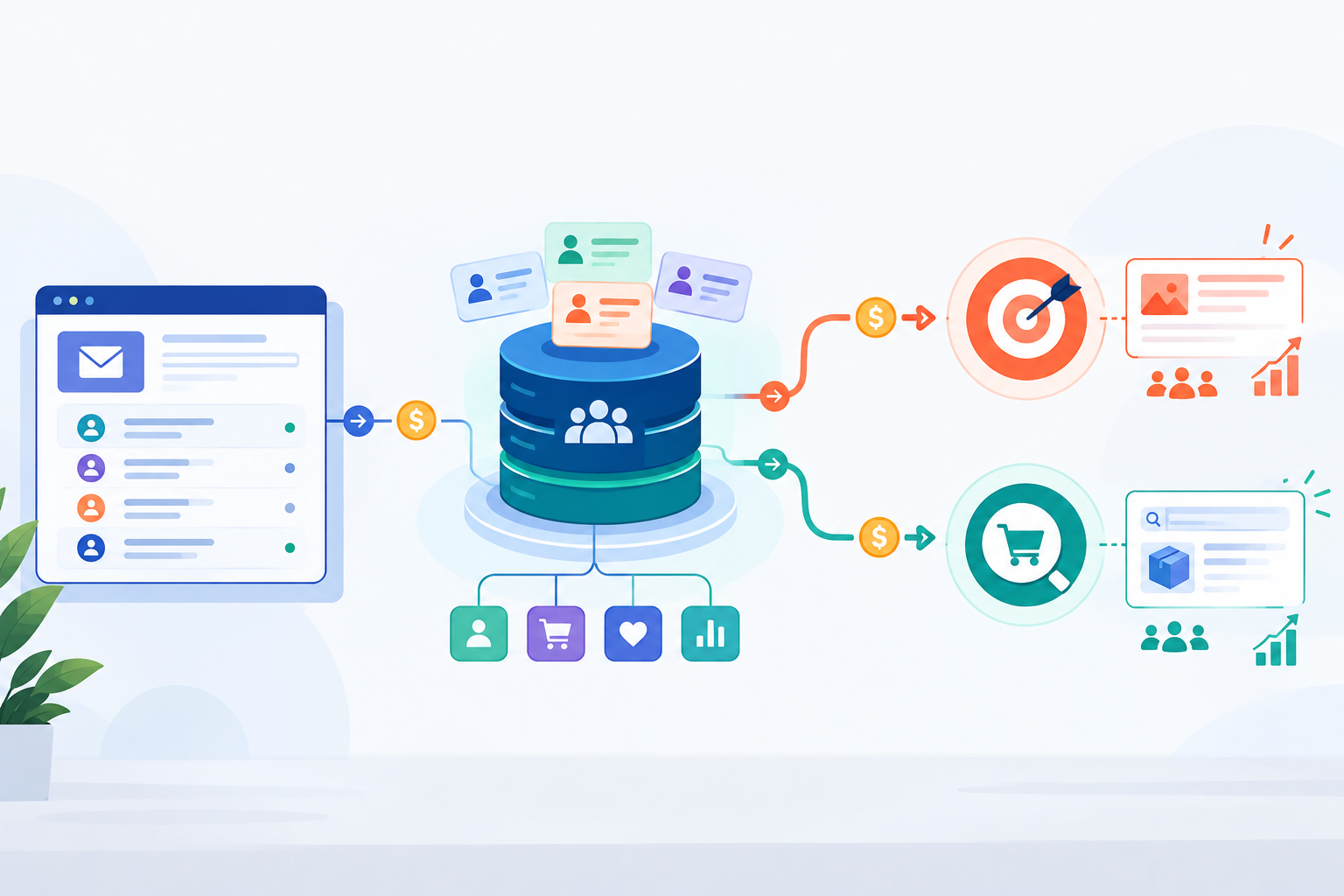
Klaviyo Segments to Meta & Google Ads: Turning Owned Data Into Cheaper Acquisition
Start With Data You Own
An ecommerce business can collect a large amount of useful customer information through its website, email program, and purchasing system. Much of that information sits inside Klaviyo, where customers can be grouped according to purchases, engagement, product interests, order value, and other useful signals.
The problem is that this information often stays inside the email platform.
Klaviyo segments can become much more valuable when they are connected with paid advertising platforms such as Meta Ads and Google Ads. Instead of relying only on broad audience targeting, a business can use its existing customer data to create more relevant advertising audiences.
This approach can help improve customer acquisition efficiency because the business has a clearer idea of who its best customers are.
The process requires careful segmentation, accurate data, appropriate audience matching, and regular measurement. It also requires attention to privacy, consent, and the policies of each advertising platform.
Build Better Klaviyo Segments
The quality of the advertising audience depends heavily on the quality of the underlying customer segments.
A useful Klaviyo segment should have a clear business purpose. For example, a retailer might create separate groups for first-time buyers, repeat customers, high-value customers, inactive customers, and people who have viewed particular product categories.
Consider a simple segmentation structure:
| Klaviyo Segment | Customer Group | Potential Advertising Use |
| Recent buyers | Purchased within a defined period | Exclude from acquisition ads |
| Repeat buyers | Multiple purchases | Create similar audience signals |
| High-value buyers | Higher lifetime value | Find similar prospects |
| Product buyers | Purchased a specific category | Cross-sell campaigns |
| Inactive customers | No recent purchase | Win-back advertising |
| Engaged subscribers | Regular email interaction | Prospecting or retention analysis |
The exact definitions should reflect the company’s products, purchase cycle, and customer behavior.
A segment created simply because the platform allows it is unlikely to provide much value.
Turn Customer Data Into Audience Signals
Once useful Klaviyo segments exist, they can inform advertising strategies.
A business may have a group of customers who repeatedly purchase, place larger orders, or remain active for a long period. That segment can provide a useful source of information about the characteristics of valuable customers.
Customer lists can also be used with supported advertising tools to create custom audiences or similar audience strategies, subject to each platform’s current requirements and privacy rules.
The objective is to give advertising platforms better information about the customers a business actually wants.
This is particularly useful when the difference between an average customer and a highly valuable customer is significant.
Use Meta Ads for Customer Matching
Meta’s advertising system can work with customer lists and other audience sources where the business meets the platform’s requirements.
For an ecommerce company, a carefully prepared customer segment can be used to build a custom audience. The business can then decide whether that audience should be used for retention, exclusion, or prospecting purposes.
For example, a company could create an audience based on repeat customers and use it as a source for finding potential customers with similar characteristics.
Another useful application is exclusion.
Suppose a campaign is intended to acquire first-time customers. Continuing to show that acquisition campaign to people who recently purchased can waste part of the advertising budget.
A customer segment can help the business separate existing customers from acquisition audiences where the advertising platform supports the required controls.
Connect Valuable Segments With Google Ads
Google Ads provides another route for using customer information in advertising campaigns.
Customer Match can allow eligible advertisers to use customer-provided data for audience targeting and related advertising functions, subject to Google’s policies and eligibility requirements.
This creates an opportunity to connect customer segmentation with search, shopping, display, and other advertising activities where supported.
The important point is that the customer list should have a reason behind it.
A list containing every contact in the database may provide less useful information than a smaller segment containing customers with a demonstrated history of valuable purchases.
The more carefully the audience is defined, the easier it becomes to understand what the advertising campaign is trying to achieve.
Find Your Best Customers First
One of the most useful applications of Klaviyo segmentation is identifying the customers who are worth acquiring again.
Revenue alone does not always provide the complete picture.
A customer who purchases once may generate less long-term value than someone who makes several purchases over two years. Looking at purchase frequency, average order value, customer lifetime value, product category, and engagement can help identify stronger customer groups.
These groups can then become the basis for audience strategies across advertising platforms.
For example, a business selling skincare products may discover that customers who purchase a particular product range have higher repeat-purchase rates.
Rather than treating all previous customers equally, the company can create a segment around that behavior and use it to inform future acquisition and retention campaigns.
Exclude Customers When It Saves Money
Audience data is useful for finding prospects, but it can also prevent unnecessary spending.
Customer exclusions are often overlooked.
If someone purchased a product yesterday, showing them an advertisement designed to persuade them to make their first purchase is unlikely to be the best use of the budget.
Similarly, a customer who recently bought one product may need a different message from someone who has never purchased.
Klaviyo segments can help create a clearer separation between customer groups. These groups can then be reflected in advertising audiences and campaign structures where the relevant platform features are available.
This can make paid acquisition more controlled and reduce unnecessary overlap between marketing activities.
Keep Email and Advertising in Step
The strongest results often come when owned channels and paid channels work from the same customer understanding.
Imagine a customer has purchased a product but has not purchased again after the expected replenishment period.
The business might use email to recommend a repeat purchase while also using advertising to support the same broader retention effort.
Another customer may have shown interest in a product without completing a purchase. Email and advertising can then be coordinated around the same product or category where appropriate.
The messages do not need to be identical. They simply need to reflect the customer’s position in the buying journey.
Measure the Real Acquisition Cost
Connecting Klaviyo with advertising platforms is only useful when the business measures the outcome.
Important metrics can include:
- Customer acquisition cost
- Conversion rate
- Return on advertising spend
- Average order value
- Repeat purchase rate
- Customer lifetime value
- Revenue from new customers
- Revenue from returning customers
- Audience match and engagement rates
The business should compare audience performance rather than looking only at overall advertising results.
A high-value customer segment may produce fewer conversions but stronger long-term revenue. A broad audience may generate more immediate purchases while producing weaker repeat behavior.
That distinction matters when deciding where future advertising budget should go.
Make Owned Data Work Harder
Klaviyo segmentation gives ecommerce businesses a practical way to organize customer information around actual behavior.
When those segments are connected appropriately with Meta Ads and Google Ads, customer data can influence acquisition, retention, exclusions, and audience development.
Product Siddha can help businesses review their customer segmentation, marketing automation, data connections, audience structure, and reporting so that email and paid advertising operate as part of a more organized system.
The process begins with clean customer data and sensible segments. From there, businesses can identify valuable customers, build appropriate audiences, reduce unnecessary advertising overlap, and measure the results.
The real advantage comes from making better use of information the business has already collected. When customer data is organized and applied carefully, it can become a useful input for more efficient acquisition decisions.