
AI-Powered Revenue Operations – Aligning Sales, Marketing & Customer Success
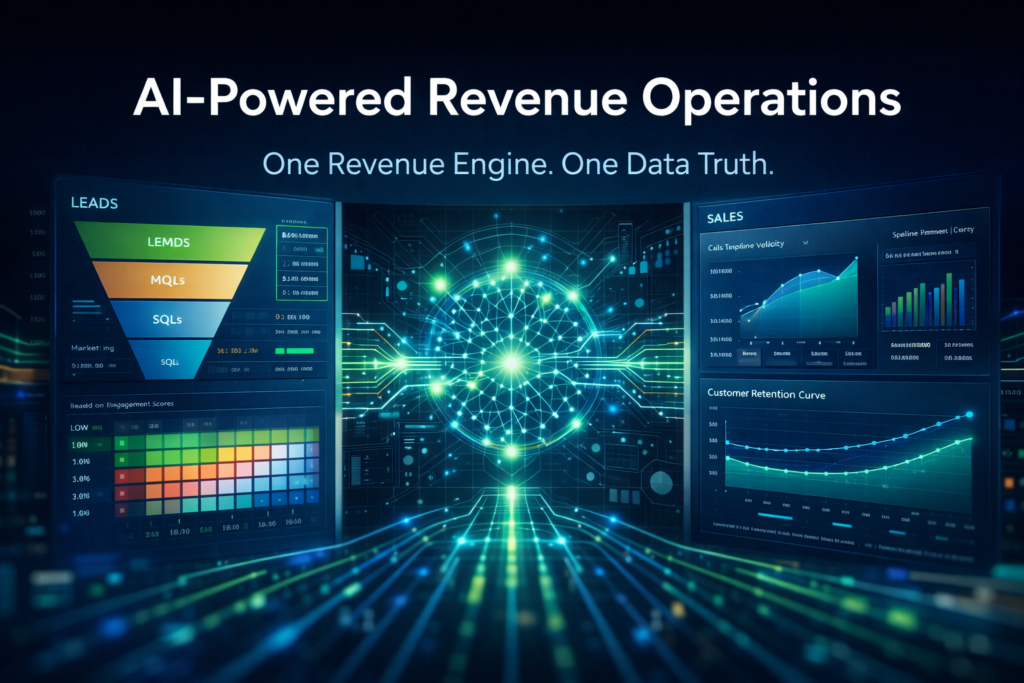
AI-Powered Revenue Operations – Aligning Sales, Marketing & Customer Success Revenue Misalignment Is a Systems Problem Most companies do not have a revenue problem. They have a systems alignment problem. Marketing optimizes CPL. Sales optimizes win rate. Customer Success optimizes renewals. Each team operates correctly – but from disconnected datasets. Revenue Operations (RevOps) was created to solve this. AI Automation makes it scalable. The shift is not about dashboards. It is about intelligent system orchestration. What AI Changes in Revenue Operations Traditional RevOps is reporting-heavy. AI-powered RevOps is signal-driven. Instead of reviewing last month’s pipeline, AI models analyze: Behavioral intent signals Multi-touch attribution paths Engagement decay patterns Usage drop-off indicators Sales cycle velocity anomalies This moves revenue management from reactive to predictive. The Core Architecture of AI-Powered RevOps A mature AI RevOps stack has five layers: 1. Unified Data Layer CRM (HubSpot / Salesforce) Marketing automation Product analytics Billing systems Support tools All events must flow into a central warehouse or structured reporting layer. In our work on Product Analytics & Full-Funnel Attribution for a SaaS Coaching Platform, we rebuilt attribution logic to connect marketing campaigns with in-product usage behavior and closed revenue. The insight: Attribution is not about “last click.” It is about lifecycle influence weighting. Without unified data, AI amplifies noise. 2. AI-Driven Lead Intelligence Most companies score leads on form fills and email opens. AI-powered scoring models include: Time-to-engagement compression Cross-channel behavior clustering Industry-specific buying cycles Historical win similarity scoring In Building a Lead Engine After Apollo Shut Us Out, alternative acquisition channels were integrated into automated scoring logic to prioritize real intent signals over vanity engagement. This reduced pipeline pollution and improved Sales Accepted Lead conversion rates. Insight: Lead scoring should predict sales velocity, not just interest. 3. Intelligent Sales Orchestration Revenue leakage often occurs in routing and follow-up lag. AI automation can: Auto-assign leads based on closing probability Trigger escalation workflows for stalled deals Detect inactivity risk Recommend next best action Instead of fixed rules, machine learning models adapt based on win/loss patterns. This transforms CRM from a database into a decision engine. 4. Predictive Customer Success Automation Retention is revenue. AI models identify churn risk through: Declining product engagement Reduced support interaction Payment irregularities Feature underutilization In HubSpot Marketing Hub Setup for a Growing Fintech Brand, lifecycle automation was structured so customer success received real-time alerts based on engagement decay — not after renewal failure. Insight: Customer success automation should trigger before the human notices a problem. 5. Closed-Loop Revenue Attribution Marketing ROI is often miscalculated because product and revenue data are disconnected. In Product Management for UAE’s First Lifestyle Services Marketplace, acquisition data was connected to vendor performance and transactional revenue metrics. This revealed: High-volume channels with low LTV Lower acquisition channels with higher expansion value Marketplace supply-demand revenue gaps Insight: AI-powered RevOps optimizes for lifetime revenue contribution, not cost-per-lead. What Most AI RevOps Implementations Get Wrong Automating broken processes Skipping data cleaning No governance structure Over-reliance on dashboards No ownership model Automation without governance creates hidden risk. Governance Framework for AI RevOps Before deploying automation, define: Ownership Who owns lead scoring model tuning? Who monitors churn prediction accuracy? Who validates attribution reports? Monitoring Cadence Weekly anomaly detection review Monthly revenue signal recalibration Quarterly model refinement Fail-Safes Manual override triggers Alert thresholds Performance drift monitoring AI is not “set and forget.” It requires operational discipline. Real Alignment Looks Like This Marketing knows: Which campaigns generate long-term customers Sales knows: Which accounts have expansion potential Customer Success knows: Which users require proactive intervention Leadership sees: One revenue number One attribution model One lifecycle dashboard That is unified RevOps. Measurable Business Outcomes of AI-Powered RevOps When implemented properly, organizations see: 20–35% improvement in lead-to-opportunity conversion Reduced sales cycle length Higher forecast accuracy Lower churn volatility Increased expansion revenue The compounding effect is operational clarity. The Strategic Shift AI-powered Revenue Operations is not about replacing teams. It is about: Removing manual friction Embedding intelligence into workflows Converting fragmented systems into one revenue engine When Sales, Marketing, and Customer Success operate from shared predictive models, accountability becomes structural – not political. Revenue becomes measurable across the full lifecycle. That is sustainable scale.