
Product Siddha

Author name: Sahil Sanghar

AI Automation, Blog

MVP Development in 2026: Faster, Cheaper, and AI-Assisted

MVP Development in 2026: Faster, Cheaper, and AI-Assisted A Different Starting Point MVP development no longer begins with a full engineering plan. In 2026, it often starts with a working prototype built in days, not months. Founders and product teams now test ideas earlier, with fewer resources, and with clearer feedback loops. This shift has come from two changes. First, tools have become more accessible. Second, AI-assisted workflows now support research, design, and development. Yet speed alone does not guarantee success. Many fast-built products fail because they lack direction. For teams working with Product Siddha, MVP development is treated as a structured process. The goal is not speed alone. It is useful validation. What MVP Development Means Today MVP development in 2026 focuses on one question. Does the product solve a real problem for a specific user group? This definition is simple, but its execution requires discipline. A modern MVP includes: A narrow feature set tied to a clear use case Measurable outcomes such as engagement or conversion A feedback mechanism built into the product The process has changed, but the principle remains the same. Build only what is needed to learn. How AI Has Changed MVP Development AI has reduced the effort required at each stage. It does not replace thinking. It reduces repetitive work and speeds up iteration. Key Areas of Impact Stage Traditional Approach AI-Assisted Approach Research Manual interviews and surveys AI-assisted data analysis and insights Design Static wireframes Interactive prototypes generated quickly Development Full coding cycles Partial automation and code generation Testing Manual QA cycles Automated testing and feedback loops These changes allow teams to move from idea to working product much faster. However, speed must be balanced with clarity. MVP Development Flow in 2026 Idea → Problem Validation → Rapid Prototype → User Testing → Iteration → MVP Launch This flow shows a continuous cycle. MVP development is not a one-time event. It is an evolving process. The Cost Advantage of Modern MVPs Cost has always been a concern in MVP development. In earlier years, even a basic product required a full team. Today, smaller teams can achieve similar outcomes. Cost Comparison Component Earlier Approach 2026 Approach Design Dedicated design team AI-assisted design tools Development Full-stack engineers Hybrid AI and developer model Testing Separate QA team Automated testing systems Time 3 to 6 months 2 to 6 weeks Lower cost does not mean lower quality. It means fewer unnecessary steps. Avoiding Common Mistakes Even with better tools, teams still make avoidable errors in MVP development. 1. Building Too Much Many teams add features before validating the core idea. This increases cost and delays learning. 2. Ignoring User Feedback An MVP without feedback is incomplete. Data must guide decisions. 3. Over-Reliance on Tools AI tools assist the process, but they do not define the product. Clear thinking is still required. 4. Weak Problem Definition If the problem is unclear, the product will lack direction. Speed vs Clarity in MVP Development Approach Speed Clarity Outcome Fast without validation High Low Failure risk Slow with structure Low High Delayed learning Balanced approach Medium High Strong validation The goal is balance. Speed should support clarity, not replace it. Role of Product Siddha in MVP Development Structured MVP development often requires guidance. This is where Product Siddha contributes. In the case “Product Management for UAE’s First Lifestyle Services Marketplace,” the challenge was to define a product that could serve multiple user needs. Instead of building a large system, the team identified a core service layer. An MVP was developed around this layer. User interactions were tracked carefully. Insights from early users shaped the next phase of development. This approach reduced risk and ensured that resources were used effectively. Building with Limited Resources Many founders assume that MVP development requires significant investment. In reality, constraints can improve focus. A small team with clear goals often performs better than a large team with unclear direction. The key is prioritization. Practical Steps Define one primary use case Limit features to essential functions Track user behavior from day one Iterate based on real data These steps apply across industries. Measuring MVP Success An MVP should produce measurable results. These results depend on the product type, but common metrics include: User engagement Conversion rates Retention over a short period Feedback quality In “Product Analytics for a Ride-Hailing App with Mixpanel,” tracking user behavior revealed gaps in the onboarding process. Adjustments were made quickly. This improved user retention without major development changes. Measurement allows teams to improve without guesswork. When to Move Beyond the MVP An MVP is not meant to last forever. It serves a purpose. Once validation is achieved, the product must evolve. Signs that it is time to move forward include: Consistent user engagement Clear demand for additional features Stable core functionality At this stage, development can expand with confidence. A Steady Path Ahead MVP development in 2026 is faster and more accessible. AI assistance reduces effort and shortens timelines. Yet the fundamentals remain unchanged. A clear problem, a focused solution, and measurable outcomes define a successful MVP. Tools can support this process, but they cannot replace it. Teams that combine speed with discipline will build products that last. Those that focus only on speed may struggle to find direction. In the end, MVP development is not about launching quickly. It is about learning quickly and building with purpose.


AI Automation, Blog

AI Automation for Enterprises in India & GCC: Compliance, Costs, and Pitfalls

AI Automation for Enterprises in India & GCC: Compliance, Costs, and Pitfalls A Changing Operating Reality Enterprises across India and the GCC are no longer experimenting with AI automation. It now shapes how leads are handled, how reports are produced, and how decisions move across teams. Yet the shift has not been smooth. Many organizations move fast into automation and then face compliance risks, rising costs, and systems that behave in unexpected ways. Firms that succeed treat AI automation as an operational system rather than a tool. They define structure early and expand with control. This is the approach followed by Product Siddha across enterprise implementations. Where AI Automation Fits in Enterprise Systems AI automation today sits across several layers: Customer acquisition and lead routing CRM updates and communication workflows Reporting and analytics pipelines Internal operations such as onboarding and approvals Each layer depends on data moving between systems. When one part fails, the effect spreads quickly. This is why enterprises must examine compliance and cost before scaling further. Compliance Realities in India and GCC Compliance is often treated as a legal concern, but in AI automation it becomes a system design issue. Data moves across tools, regions, and teams. Each transfer must follow rules. Key Compliance Areas Area India Context GCC Context Data Privacy Governed by emerging digital data protection laws Stronger enforcement in UAE and Saudi frameworks Data Residency Often flexible but evolving Strict requirements in many sectors Communication WhatsApp and SMS regulations apply Consent and record-keeping enforced Financial Data RBI guidelines for fintech Central bank controls across GCC A practical example comes from “HubSpot Marketing Hub Setup for a Growing Fintech Brand.” The system required careful handling of customer data across marketing and sales. Consent tracking and data storage rules were embedded into workflows. Without this, automation would have exposed the company to regulatory issues. Cost Structure of AI Automation Many enterprises underestimate the true cost of AI automation. Tool subscriptions are only one part. The larger costs appear over time. Cost Breakdown Cost Type Description Tooling CRM, automation platforms, analytics tools Integration Connecting systems and APIs Maintenance Monitoring, fixing, and updating workflows Data Management Cleaning and structuring data Compliance Legal review and system adjustments In one real scenario, a company reduced manual reporting through automation but later faced rising maintenance costs due to poor initial structure. The workflows required frequent fixes. After restructuring the system with proper data models, maintenance effort dropped. AI Automation Cost Layers Tooling → Integration → Data → Monitoring → Compliance → Optimization This sequence reflects how costs build over time. Skipping early steps often increases expenses later. Common Pitfalls Enterprises Face AI automation introduces efficiency, but it also creates new points of failure. These are often overlooked during early adoption. 1. Fragmented Data Different systems store different versions of the same information. This leads to inconsistent reporting and poor decision-making. 2. Over-Automation Teams automate processes without reviewing their value. This creates unnecessary complexity. 3. Lack of Monitoring Workflows fail silently. Issues are discovered only after business impact. 4. Compliance Gaps Data flows do not align with regional regulations. This becomes a risk in audits. 5. Vendor Dependency Heavy reliance on a single platform limits flexibility and increases long-term costs. Case Insight from the Field A useful reference comes from “AI Automation Services for French Rental Agency MSC-IMMO.” The system handled tenant communication, pricing updates, and reporting. Early versions of the workflow faced delays due to unstructured data and unclear process ownership. After introducing structured data models and monitoring, system performance improved. Response times stabilized, and operational load reduced. This example reflects a common pattern seen across both Indian and GCC enterprises. Risk vs Scale in AI Automation Stage Risk Level Control Required Initial Setup Low Basic checks Early Scaling Medium Monitoring and ownership Full Scale High Governance and compliance systems This progression shows that risk increases with scale. Control must grow at the same pace. Building a Stable AI Automation System Enterprises that manage AI automation well follow a structured approach. 1. Define Ownership Clearly Every workflow must have a responsible owner. This ensures accountability. 2. Standardize Data Use consistent formats and naming across systems. This reduces errors. 3. Implement Monitoring Set alerts for failures and performance drops. Do not rely on manual checks. 4. Plan for Compliance Integrate compliance into system design. Avoid treating it as an afterthought. 5. Scale Gradually Test workflows at smaller volumes before expanding. The Role of Structured Implementation Many enterprises attempt to build automation internally. While this works at a small scale, complexity increases quickly. Systems become difficult to manage without a structured approach. This is where firms like Product Siddha bring clarity. Their work in “Built Custom Dashboards by Stage” shows how dashboards can act as control points. Each stage of the business funnel is tracked, monitored, and aligned with clear metrics. Such systems reduce uncertainty. Teams know what is working and where intervention is needed. A Measured Path Forward AI automation offers clear benefits for enterprises in India and the GCC. It improves efficiency, reduces manual work, and enables faster decisions. Yet these benefits depend on structure. Compliance must be built into workflows. Costs must be understood beyond tools. Pitfalls must be anticipated before they appear. Organizations that take a measured approach will see steady gains. Those that rush may spend more time fixing systems than building them. In the long run, AI automation is not defined by speed. It is defined by stability and control.

AI Automation, Blog

AI Automation Governance in 2026: Frameworks to Scale Without Breaking Systems

AI Automation Governance in 2026: Frameworks to Scale Without Breaking Systems A Quiet Risk in Fast Automation Automation is no longer a side project. It now sits inside daily operations across sales, marketing, finance, and support. Many firms adopted automation quickly over the past three years. They connected tools, deployed AI agents, and replaced manual work at speed. Growth followed, but so did a new class of problems. Workflows break without warning. Data flows lose accuracy. Teams lose visibility into what is running and why. In some cases, no one knows who owns a system that touches revenue. This is where governance enters the picture. For any serious Product Siddha, governance is not a control layer that slows work. It is the structure that allows systems to grow without failure. What Governance Means in AI Automation Governance in this context is not about rules alone. It is about clarity. Every automated system should answer three basic questions: Who owns this workflow What data does it depend on How is success measured When these answers are missing, teams operate in fragments. Automation then creates more confusion instead of efficiency. An experienced AI automation agency builds governance into the system from the start. This includes naming standards, version control, access rules, and monitoring. Without these, scaling becomes risky. Where Systems Usually Break Most breakdowns follow familiar patterns. They do not come from complex algorithms. They come from simple gaps. 1. No Ownership A workflow runs across marketing and sales, but neither team owns it fully. When it fails, each assumes the other is responsible. 2. Fragmented Data Sources CRM, analytics, and communication tools operate on different data sets. A small mismatch creates large reporting errors. 3. Silent Failures An automation stops working but sends no alert. The issue is discovered days later when leads or revenue drop. 4. Uncontrolled Scaling A workflow built for 100 users is extended to 10,000 without testing. Performance issues follow. Core Governance Framework for 2026 A structured approach helps avoid these failures. The following framework reflects how modern teams are organizing automation at scale. Governance Layer Overview Layer Purpose Key Actions Ownership Define responsibility Assign clear owners for each workflow Data Integrity Ensure accuracy Standardize data sources and validation Monitoring Track performance Set alerts and logs for every process Version Control Manage changes Maintain workflow history and rollback options Compliance Protect data Apply access rules and audit logs Ownership First, Technology Second Governance begins with ownership. Before building a workflow, define who is responsible for its performance. In one implementation involving HubSpot and WhatsApp automation, a fintech team faced repeated failures in lead routing. The issue was not technical. Ownership was unclear. Once responsibility shifted to a single operations lead, failure rates dropped within weeks. This principle applies across industries. Without ownership, even the best automation tools fail. Data Integrity as the Foundation Automation depends on clean and consistent data. A small mismatch can affect multiple systems. A strong example comes from the case study “Product Analytics & Full-Funnel Attribution for a SaaS Coaching Platform.” The team struggled with inconsistent attribution across channels. Leads appeared in dashboards but did not match CRM records. The solution was not a new tool. It was a unified data model. Events were standardized, naming conventions were fixed, and tracking points were aligned across platforms. Once this was done, reporting accuracy improved significantly. Monitoring That Actually Works Many teams rely on basic logs. These are often ignored. Effective monitoring requires active alerts. Set thresholds for key metrics Trigger alerts when workflows fail Track execution time and error rates In the case “From Lead to Site Visit – Voice AI Automation for a Real Estate Platform,” monitoring played a critical role. Voice AI handled incoming calls and scheduled visits. When response delays crossed a defined limit, alerts were triggered. This allowed the team to act before user experience declined. Controlled Scaling Instead of Rapid Expansion Scaling automation should follow a controlled path. Start small, test thoroughly, then expand. This staged approach prevented overload and ensured each layer worked as expected. Role of an AI Automation Agency Governance is difficult to implement internally without experience. Many teams focus on tools rather than structure. This is where an AI automation agency provides value. An agency does not just build workflows. It defines how systems behave over time. This includes: Designing scalable architecture Establishing governance standards Integrating tools into a unified system Creating monitoring and reporting layers Product Siddha has followed this approach across multiple engagements. In the case “Built Custom Dashboards by Stage,” dashboards were not just visual tools. They became governance instruments. Each stage of the funnel had defined metrics, ownership, and alerts. Automation Governance Lifecycle Design → Ownership Assignment → Data Standardization → Deployment → Monitoring → Optimization This cycle repeats as systems evolve. Governance is not a one-time setup. It is a continuous process. Common Mistakes to Avoid Even experienced teams fall into predictable traps. Treating governance as documentation only Ignoring monitoring until failures occur Allowing multiple teams to edit workflows without control Scaling workflows before testing edge cases Each of these leads to instability over time. A Practical Checklist Before scaling any automation system, review the following: Question Status Is ownership clearly defined Yes or No Are data sources unified Yes or No Are alerts configured Yes or No Is there a rollback option Yes or No Has the workflow been tested at scale Yes or No If any answer is no, the system is not ready to scale. The Path Forward AI automation will continue to expand across industries. The difference between success and failure will not depend on tools alone. It will depend on structure. Governance provides that structure. It ensures that systems remain reliable as they grow. It reduces risk without slowing progress. Most importantly, it allows teams to trust their automation. For companies working with an AI automation agency like Product Siddha, governance is not an added feature. It is part of the foundation.

Blog, Product Analytics

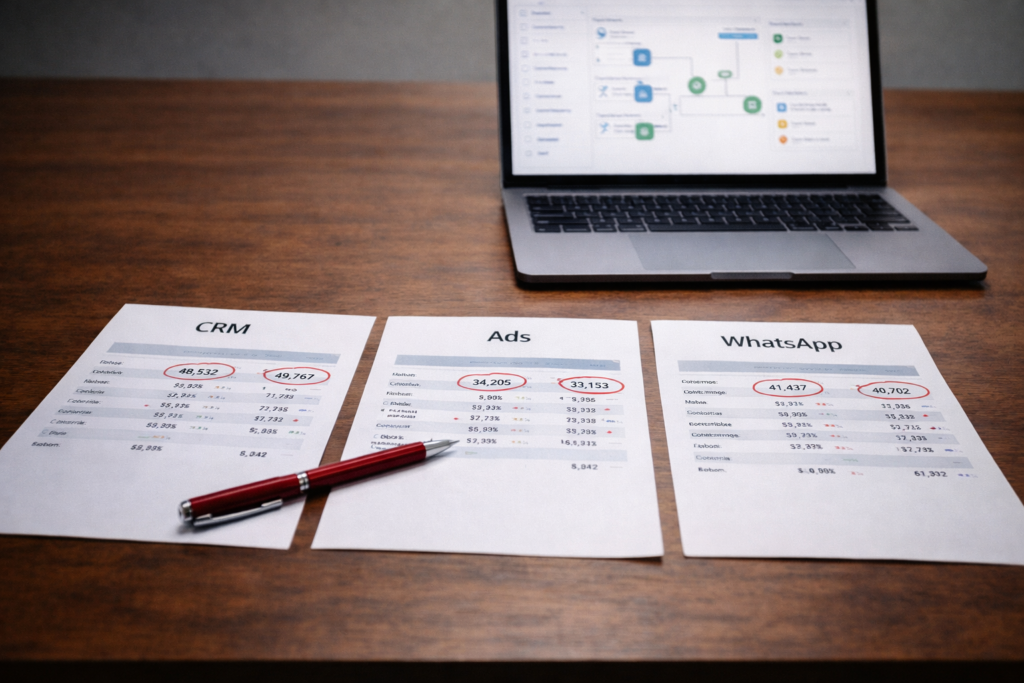
CRM, Ads, and WhatsApp Not Syncing? Here’s How to Fix Your Data Flow

CRM, Ads, and WhatsApp Not Syncing? Here’s How to Fix Your Data Flow When Systems Fall Out of Step A common problem in growing businesses is simple to describe and difficult to fix. Leads come in from ads, conversations happen on WhatsApp, and customer data sits in a CRM. Each system works on its own, yet they fail to stay in sync. The result is confusion. Sales teams follow up late. Marketing teams cannot track performance accurately. Reports do not match across platforms. This is not a tool problem. It is a data flow problem. Product Siddha approaches such issues by treating the entire system as one connected flow. Fixing the sync requires careful tracing, not quick adjustments. What “Not Syncing” Really Means When systems do not sync, the issue usually appears in one of the following ways: Leads captured in ads do not appear in the CRM WhatsApp conversations are not linked to customer records Campaign data does not reflect actual conversions Duplicate or missing entries across platforms These symptoms point to gaps in how data moves between systems. Step 1 – Map the Full Data Journey Begin by tracing how data should move. A typical flow looks like this: User clicks on an ad Lead data is captured Data is sent to CRM Sales team engages via WhatsApp Updates are recorded back in the system Write down each step. Identify where the flow breaks. In From Lead to Site Visit – Voice AI Automation for a Real Estate Platform, mapping the journey revealed delays between lead capture and follow-up. Fixing that gap improved conversions. Clarity at this stage is essential. Step 2 – Check Data Entry Points Data flow begins at the source. Review how leads are captured from ads. Ensure that forms, tracking links, and APIs are working correctly. Small errors at this stage can block the entire system. For example: Incorrect field mapping Missing parameters Broken form submissions Fixing entry points often resolves major syncing issues. Step 3 – Verify CRM Integration The CRM acts as the central system. Check whether incoming data is reaching the CRM in real time. Confirm that fields are mapped correctly and records are created without duplication. In HubSpot Marketing Hub Setup for a Growing Fintech Brand, aligning data fields across systems ensured that marketing and sales worked with the same information. A well-configured CRM is critical for stable data flow. Step 4 – Inspect WhatsApp Connectivity WhatsApp integration adds another layer. Ensure that conversations are linked to the correct customer records. Verify that messages trigger updates in the CRM. Common issues include: Unlinked phone numbers Delayed message syncing Missing conversation logs In AI Automation Services for French Rental Agency MSC-IMMO, improving communication flow required connecting messaging systems directly with operational data. This reduced delays and improved response quality. Messaging systems must be treated as part of the data ecosystem. Step 5 – Standardize Data Formats Different systems store data in different formats. Standardize fields such as: Phone numbers Email addresses Campaign identifiers Inconsistent formats lead to mismatches and duplicate records. A simple rule such as using one format for phone numbers can prevent multiple issues. Step 6 – Review API and Integration Health Most syncing depends on APIs. Check whether APIs are active, authenticated, and functioning as expected. Monitor for errors or rate limits that may interrupt data flow. API failures often go unnoticed until problems accumulate. Step 7 – Eliminate Duplicate Data Paths Over time, multiple integrations may be added. This can create duplicate data flows, where the same lead enters the system through different paths. Review all integrations and remove redundant connections. A single, clear path improves reliability. Step 8 – Test the Entire Flow Once fixes are applied, test the system end-to-end. Create sample leads, track them through each stage, and verify outputs. Testing should confirm: Data appears in the CRM WhatsApp conversations are linked Campaign data is recorded correctly This step ensures that all parts work together. Step 9 – Set Up Monitoring and Alerts After fixing the system, ongoing monitoring is necessary. Set alerts for: Failed data transfers Missing records Delayed updates Early detection prevents larger issues. Broken vs Synced Data Flow Aspect Broken Data Flow Synced Data Flow Lead Tracking Incomplete Accurate Communication Disconnected Linked to records Reporting Inconsistent Reliable Team Efficiency Reduced Improved Decision Making Delayed Timely A Grounded View Data flow issues rarely come from one major failure. They build from small gaps across systems. Fixing them requires patience and a clear process. Each step must be verified, and each connection must be reliable. Product Siddha focuses on building systems where data moves smoothly across platforms. The aim is to create consistency that teams can rely on. Final Reflection When CRM, ads, and WhatsApp stop syncing, the impact spreads across the business. Leads are lost, teams lose confidence in data, and decisions slow down. A structured approach restores order. By mapping the flow, fixing inputs, and strengthening integrations, businesses can rebuild a system that works as expected. Reliable data flow is not a luxury. It is a foundation for growth.

AI Automation, Blog

Fixing Broken Automations: A Troubleshooting Guide for Scaling Teams

Fixing Broken Automations: A Troubleshooting Guide for Scaling Teams When Automation Stops Working Automation is often introduced to reduce manual effort and improve consistency. In the early stages, it works well. Tasks are completed faster, teams rely less on repetitive work, and systems appear stable. As the business grows, cracks begin to show. Workflows fail without warning. Data stops syncing. Notifications are delayed or sent incorrectly. These issues rarely come from one major failure. They build up over time. Scaling teams depend heavily on reliable automation services. When those systems break, the impact spreads quickly across operations. Fixing them requires a structured approach rather than quick fixes. Product Siddha treats broken automation as a system issue, not an isolated error. Common Signs of Broken Automations Before troubleshooting, it helps to identify clear symptoms. Leads are not routed correctly Emails or notifications are delayed Data mismatches between systems Reports showing incomplete information Manual intervention increasing over time These signs indicate that the automation system is no longer aligned with current workflows. Step 1 – Trace the Workflow End-to-End Start by mapping the full automation flow. Identify each step, from trigger to final output. Note where data enters, how it moves, and where actions are executed. Many teams discover that their workflows have grown more complex than expected. Small additions over time create fragile chains. In AI Automation Services for French Rental Agency MSC-IMMO, the issue was not a single failure point. It was a combination of delayed triggers and inconsistent data updates. Mapping the workflow revealed hidden dependencies that needed correction. Clarity at this stage prevents guesswork. Step 2 – Check Data Inputs First Automation depends on clean and consistent data. Review the inputs that trigger workflows. Look for missing fields, incorrect formats, or outdated values. If the input is flawed, the output will be unreliable. In Product Analytics for a Ride-Hailing App with Mixpanel, data inconsistencies affected event tracking. Cleaning input data restored accuracy and improved system performance. This step often resolves more issues than expected. Step 3 – Validate Triggers and Conditions Triggers define when automation starts. Conditions define how it proceeds. Check whether triggers are firing correctly. Confirm that conditions still match current business rules. As processes evolve, conditions may become outdated. This leads to workflows that either do not run or run incorrectly. Accurate triggers are essential for dependable automation services. Step 4 – Review Integrations Between Systems Most automation systems rely on multiple tools working together. Inspect integrations carefully. Check whether APIs are functioning, credentials are valid, and data is syncing as expected. In HubSpot Marketing Hub Setup for a Growing Fintech Brand, integration issues initially caused delays in data flow. Resolving these connections restored system reliability. Integration failures are a common source of broken automation. Step 5 – Audit Workflow Logic Over time, workflows become layered with additional rules. Review the logic step by step. Remove unnecessary conditions and simplify where possible. Complex workflows are harder to maintain and more prone to failure. A clear structure improves both performance and reliability. Step 6 – Monitor Execution Logs Logs provide insight into what actually happens during execution. Check logs for errors, delays, or skipped steps. These details help identify where the system is failing. Teams often overlook logs, but they offer direct evidence of issues. Step 7 – Test in Controlled Conditions Before applying fixes, test workflows in a controlled environment. Use sample data to verify changes. Confirm that each step works as expected. Testing reduces the risk of introducing new errors while fixing existing ones. Step 8 – Rebuild Where Necessary Some workflows cannot be fixed through small adjustments. If a system has become too complex, rebuilding it may be more efficient. A fresh structure removes hidden issues and improves clarity. In Built Custom Dashboards by Stage, restructuring data flows simplified reporting and reduced errors. The same principle applies to automation systems. Rebuilding is sometimes the most practical solution. Step 9 – Establish Monitoring and Alerts Once automation is fixed, ongoing monitoring is essential. Set up alerts for failures or delays. Regular checks ensure that issues are detected early. Reliable automation services depend on continuous oversight. Step 10 – Align Automation with Current Processes Automation should reflect how the business operates today. Review workflows regularly to ensure alignment. Update triggers, conditions, and integrations as processes evolve. In From Lead to Site Visit – Voice AI Automation for a Real Estate Platform, aligning automation with actual user behavior improved response time and conversion outcomes. Alignment keeps systems relevant. Broken vs Optimized Automation Aspect Broken Automation Optimized Automation Reliability Inconsistent Stable Data Accuracy Unreliable Accurate Maintenance Frequent fixes Minimal intervention Team Effort High manual work Reduced workload Scalability Limited Supports growth A Practical Perspective Automation systems are often built quickly to solve immediate needs. As the business grows, these systems must evolve. Ignoring small issues leads to larger failures. Addressing them early keeps operations smooth. Product Siddha focuses on building automation systems that remain reliable over time. The emphasis is on clarity, simplicity, and adaptability. Final Insight Fixing broken automation is not about patching errors. It is about understanding the system as a whole. A structured approach helps identify root causes, restore reliability, and prepare systems for future growth. With careful troubleshooting and ongoing monitoring, automation can continue to support scaling teams effectively.

Blog, MarTech Implementation

How to Migrate from Legacy Systems to a Modern MarTech Stack

How to Migrate from Legacy Systems to a Modern MarTech Stack The Turning Point Many organizations continue to rely on legacy systems long after they have outlived their usefulness. Reports take time to prepare, data remains scattered, and integrations feel fragile. Teams work around limitations instead of solving them. A modern MarTech stack brings structure, speed, and clarity. It connects tools, aligns data, and supports better decision making. The challenge lies in moving from the old system to the new one without disrupting ongoing operations. Product Siddha approaches this transition as a phased process. Careful planning reduces risk and ensures that the new system delivers real value. Step 1 – Assess Your Current Systems Begin with a clear understanding of what you have today. List all tools and platforms used for marketing, sales, and analytics. Identify how they connect, what data they store, and where gaps exist. Common issues include: Duplicate data across systems Manual data transfers Limited reporting capabilities Poor integration between tools This assessment forms the base for your migration plan. Step 2 – Define Business Requirements Do not start with tools. Start with needs. Clarify what your organization expects from a modern MarTech stack. This may include: Centralized customer data Real-time reporting Automated workflows Better campaign tracking In Product Management for UAE’s First Lifestyle Services Marketplace, aligning tools with business needs helped streamline operations and improve service delivery. Clear requirements prevent unnecessary complexity later. Step 3 – Design the Target Architecture A modern MarTech stack is more than a collection of tools. It is a connected system. Define how data will flow between platforms. Identify key components such as: Customer data platform or CRM Marketing automation tools Analytics and reporting systems Data storage solutions This design ensures that each tool has a defined role. Step 4 – Clean and Prepare Data Data quality often determines the success of migration. Before moving data, review and clean it. Remove duplicates, fix inconsistencies, and standardize formats. In Product Analytics for a Ride-Hailing App with Mixpanel, data preparation played a key role in ensuring accurate tracking and reporting. Without this step, insights would have been unreliable. Clean data reduces errors in the new system. Step 5 – Choose the Right Tools Tool selection should follow system design, not the other way around. Evaluate tools based on: Compatibility with existing systems Ease of integration Scalability Reporting capabilities In Boosting Email Revenue with Klaviyo for a Shopify Brand, selecting the right platform allowed better segmentation and improved campaign performance. The goal is to build a stack that works as a unified system. Step 6 – Plan the Migration in Phases Avoid a complete switch in one step. Break the migration into smaller phases. Move one function at a time, such as email marketing or analytics. This approach reduces disruption and allows teams to adapt gradually. Step 7 – Integrate Systems Carefully Integration is where many migrations face challenges. Ensure that data flows correctly between tools. Test each connection and verify outputs. In HubSpot Marketing Hub Setup for a Growing Fintech Brand, careful integration ensured that marketing and sales data remained aligned. This improved visibility and coordination. Strong integration supports reliable reporting. Step 8 – Test Before Full Deployment Testing should be thorough and structured. Validate data accuracy, workflow performance, and reporting outputs. Compare results with legacy systems to ensure consistency. Testing reduces the risk of errors after launch. Step 9 – Train Teams and Adjust Workflows A new MarTech stack changes how teams work. Provide training on tools and processes. Adjust workflows to match the new system. In Built Custom Dashboards by Stage, adoption improved when teams understood how to use data effectively in their daily work. Training ensures that the system delivers value. Step 10 – Decommission Legacy Systems Once the new system is stable, phase out legacy tools. Ensure that all critical data has been migrated and verified. Gradual decommissioning prevents data loss and confusion. Legacy Systems vs Modern MarTech Stack Aspect Legacy Systems Modern MarTech Stack Data Access Fragmented Centralized Reporting Delayed Real-time Integration Limited Seamless Scalability Restricted Flexible Efficiency Manual processes Automated workflows A Measured Perspective Migration is not only a technical task. It is an operational shift. It requires coordination between teams, careful planning, and ongoing evaluation. Rushing the process often leads to errors and delays. Product Siddha focuses on building systems that remain effective over time. The emphasis is on clarity, reliability, and long-term usability. Final Thought Moving from legacy systems to a modern MarTech stack is a significant step. It brings better data, faster decisions, and improved coordination across teams. The process may seem complex, but a structured approach makes it manageable. With careful planning and execution, organizations can build a system that supports growth and adapts to future needs.

Blog, Product Analytics

How to Replace Manual Reporting with Real-Time Dashboards (Step-by-Step)

How to Replace Manual Reporting with Real-Time Dashboards (Step-by-Step) The Reporting Shift Manual reporting often begins as a simple process. A few spreadsheets, weekly updates, and shared documents seem manageable in the early stages. Over time, the effort grows. Data comes from multiple sources, reports take longer to prepare, and numbers do not always match. Real-time dashboards solve this problem by creating a single, reliable view of data. They reduce manual effort and allow teams to act on current information instead of outdated summaries. At Product Siddha, this shift is approached as a structured transition rather than a quick replacement. The goal is not just to build dashboards, but to build trust in data. Step 1 – Map Your Current Reporting Process Start by understanding how reporting works today. List all reports created by your team. Identify where the data comes from, who prepares it, and how often it is updated. This step often reveals hidden inefficiencies. For example, one team may pull marketing data weekly while another updates sales numbers daily. These differences create inconsistency. Documenting the current state helps define what needs to change. Step 2 – Identify Key Metrics Not every number needs to be on a dashboard. Focus on metrics that influence decisions. These may include conversion rates, revenue, user activity, or campaign performance. In Product Analytics & Full-Funnel Attribution for a SaaS Coaching Platform, clarity came from narrowing down metrics to those that directly affected growth. This reduced noise and improved decision making. A clear set of metrics keeps dashboards useful and easy to understand. Step 3 – Consolidate Data Sources Manual reporting often relies on multiple platforms. Bring these sources together into a unified system. This may include: CRM data Advertising platforms Website analytics Internal databases The goal is to create a single flow of data. Without this step, dashboards will reflect the same inconsistencies as manual reports. Step 4 – Build a Data Pipeline A data pipeline collects, processes, and prepares data for visualization. This step involves: Extracting data from sources Cleaning and standardizing it Storing it in a central location In Built Custom Dashboards by Stage, structured pipelines ensured that each stage of the funnel had accurate and consistent data. This made dashboards reliable across teams. A well-designed pipeline is the foundation of real-time reporting. Step 5 – Choose the Right Dashboard Structure Dashboards should match how teams work. Instead of creating one large dashboard, consider separate views for different functions. Marketing, sales, and leadership may need different perspectives. Each dashboard should answer a specific question. For example: How are campaigns performing Where are users dropping off Which channels drive revenue Clear structure improves usability. Step 6 – Automate Data Updates Real-time dashboards depend on automated updates. Set up schedules or real-time data flows so that information stays current. This removes the need for manual refreshes. In Driving Growth for a U.S. Music App with Full-Stack Mixpanel Analytics, automated tracking allowed teams to monitor user behavior continuously. This enabled faster adjustments and better engagement. Automation is what separates dashboards from static reports. Step 7 – Validate Data Accuracy Before relying on dashboards, verify the data. Compare dashboard numbers with existing reports. Check for differences and resolve them. This step builds confidence among stakeholders. Even small discrepancies can reduce trust. Careful validation prevents this issue. Step 8 – Train Teams to Use Dashboards A dashboard is only useful if teams understand it. Provide simple guidance on how to read metrics and interpret trends. Encourage teams to use dashboards in regular discussions. In HubSpot Marketing Hub Setup for a Growing Fintech Brand, adoption improved when teams aligned their workflows with dashboard insights. This ensured that data was actively used. Training turns dashboards into decision tools. Step 9 – Replace Manual Reports Gradually Do not remove manual reporting all at once. Run dashboards alongside existing reports for a short period. This allows teams to adjust and verify accuracy. Once confidence is established, phase out manual reports. This reduces resistance and ensures a smooth transition. Step 10 – Review and Improve Dashboards should evolve with the business. Review them regularly. Remove unused metrics and add new ones as needed. Continuous improvement keeps dashboards relevant. Manual Reporting vs Real-Time Dashboards Aspect Manual Reporting Real-Time Dashboards Update Frequency Periodic Continuous Effort Required High Low Data Accuracy Prone to errors Consistent Decision Speed Slow Immediate Scalability Limited High A Grounded View Replacing manual reporting is not only a technical upgrade. It is a shift in how teams interact with data. The process requires planning, validation, and training. When done carefully, it reduces effort and improves clarity. Product Siddha focuses on building systems that support long-term use. The aim is to ensure that dashboards remain reliable as the business grows. Final Note Real-time dashboards bring structure to data and speed to decision making. They remove repetitive work and provide a consistent view of performance. The transition may take time, but the benefits are lasting. With a clear step-by-step approach, organizations can move from manual reporting to a more efficient and reliable system.

Blog, MarTech Implementation

What Does It Cost to Build a Custom Data Pipeline for Marketing?

What Does It Cost to Build a Custom Data Pipeline for Marketing? Understanding the Cost Question When businesses ask about the cost of building a custom data pipeline for marketing, the question rarely stands alone. It usually comes from a place of friction. Reports do not match. Campaign numbers feel inconsistent. Teams spend more time reconciling data than using it. A data pipeline brings order to this confusion. It collects information from different systems, prepares it for use, and delivers it in a form that teams can trust. The cost reflects how difficult that process is in your specific case. At Product Siddha, the first step is not quoting a number. It is understanding how data moves within the business. Without that clarity, any estimate risks being inaccurate. What You Are Actually Building A marketing data pipeline is not a single tool. It is a structured system made up of several parts working together. Most pipelines include: Data sources such as advertising platforms, CRM systems, and websites Data ingestion processes that pull data at regular intervals Transformation layers where raw data is cleaned and organized Storage systems such as data warehouses Reporting layers including dashboards and analytics tools Each layer introduces effort. Each layer also influences the final cost. A Realistic Cost Structure The cost of building a custom pipeline can be understood in three stages. These ranges reflect typical mid-market implementations. 1. Setup and Integration This stage connects all your data sources and establishes the pipeline. Estimated cost: ₹1.5L to ₹5L If your business uses multiple platforms, integration becomes more involved. Each system has its own format and behavior. Some require custom API handling. Others may have limitations that need workarounds. 2. Data Cleaning and Transformation Raw data rarely works as it is. It must be structured, validated, and aligned. Estimated cost: ₹1L to ₹4L This stage often takes more time than expected. Naming inconsistencies, duplicate records, and missing fields require careful correction. If this step is rushed, reporting accuracy suffers later. 3. Dashboard and Reporting Layer This is the interface your team interacts with. Estimated cost: ₹50K to ₹2.5L Simple dashboards with basic metrics are faster to build. More advanced reporting, such as full funnel tracking or segmented views, increases the effort. Total Investment Range Here is a simplified view of overall costs: Complexity Level Estimated Cost Basic Pipeline ₹2.5L – ₹5L Mid-Level Pipeline ₹5L – ₹10L Advanced Pipeline ₹10L+ These figures vary depending on business needs, but they provide a realistic starting point. What Drives These Costs Several factors influence where your project will fall within these ranges. Number of Data Sources More platforms mean more integration work. Each source adds complexity. Data Volume Higher data volumes require stronger infrastructure and better optimization. Processing Type Real-time pipelines cost more due to their technical demands. Batch processing is simpler and more cost-effective. Custom Requirements If you need user-level tracking, advanced attribution, or predictive insights, the pipeline becomes more complex. Team Expertise An experienced team may charge more upfront, but it often prevents costly revisions later. A Practical Example In the case of Product Analytics and Full-Funnel Attribution for a SaaS Coaching Platform, the main challenge was not collecting data. The issue was connecting user behavior across different stages. The solution required building a structured pipeline that tracked users from acquisition to conversion. Events had to be mapped carefully, and data had to be transformed consistently. Once implemented, the team gained clear visibility into which channels were actually driving results. This level of clarity often offsets the initial investment. Another Scenario Worth Noting In Built Custom Dashboards by Stage, the requirement was different. The focus was not on a single unified dashboard, but on multiple views tailored to different teams. Each stage of the funnel had its own reporting logic. This increased the effort during setup, but it made the system more usable in practice. Teams could focus on relevant metrics without sorting through unnecessary data. The added clarity improved day-to-day decision making. Costs That Are Easy to Miss Initial setup is only part of the investment. Ongoing costs should also be considered. Monitoring and maintenance Updates when third-party APIs change Infrastructure scaling as data grows Training teams to use the system effectively Ignoring these elements often leads to underestimating the true cost. Build vs Ready-Made Tools Many businesses consider using standard tools instead of building a custom pipeline. Pre-built tools offer speed and lower upfront cost. However, they may not fit every use case. Custom pipelines take longer but provide greater control. In HubSpot Marketing Hub Setup for a Growing Fintech Brand, a hybrid approach was used. Standard tools handled core functions, while custom integration ensured data consistency across systems. This approach balanced cost with flexibility. When Does Investment Make Sense A custom data pipeline becomes valuable when: Data exists across multiple platforms Reporting takes too long to produce Teams rely on incomplete or inconsistent information Existing dashboards are not trusted In such situations, the cost of not fixing the problem can be higher than the investment required. Custom vs Standard Approach Aspect Custom Pipeline Standard Tools Flexibility High Limited Setup Time Longer Shorter Cost Higher upfront Lower upfront Scalability Strong Tool-dependent Control Full Restricted A Measured Perspective Cost alone does not tell the full story. Value matters more. A well-designed pipeline reduces manual work, improves data accuracy, and allows faster decision making. Over time, these gains accumulate. Product Siddha focuses on building systems that remain stable as the business grows. This reduces the need for repeated rebuilding and helps teams rely on their data with confidence. Final Thoughts There is no fixed price for a custom marketing data pipeline. The cost depends on your systems, your data quality, and your business requirements. What matters is having a clear understanding of what you need and why. With that clarity, the investment becomes easier to evaluate. A structured approach, supported by practical examples and careful execution, ensures that the pipeline delivers lasting value rather than short-term fixes.

AI Automation, Blog

How to Justify AI Automation Investment to Your Leadership Team

How to Justify AI Automation Investment to Your Leadership Team Making the Case Convincing a leadership team to invest in AI automation requires more than enthusiasm. Senior decision makers expect clarity, numbers, and a direct link to business outcomes. A well-prepared case speaks in terms they trust – cost, efficiency, risk, and long-term value. A skilled product consultant understands this balance. The role is not limited to suggesting tools. It involves shaping a clear argument that connects automation efforts with measurable business results. This is where many proposals fail. They focus on capability instead of consequence. This guide outlines a practical way to present AI automation as a sound business decision. Start with a Defined Problem Leadership teams respond better to problems than to possibilities. Begin by identifying a specific operational issue. For example, slow lead response time, manual reporting delays, or repeated data entry tasks. Describe the current state in simple terms. Show how it affects revenue, team productivity, or customer experience. In one engagement involving a real estate platform, the gap was clear. Leads were generated in volume, but follow-up was inconsistent. This resulted in missed site visits and lost opportunities. The automation effort was framed around solving that precise issue. When the problem is clear, the investment becomes easier to understand. Translate Automation into Financial Terms A proposal gains strength when it connects directly to financial outcomes. Break down the expected impact into three areas: Cost reduction Revenue improvement Time savings For instance, if automation reduces manual work by 20 hours per week, convert that into cost savings over a year. If faster response improves conversion rates, estimate the added revenue. A product consultant often builds simple financial models to support this step. These models do not need to be complex. They need to be credible and easy to follow. Use Real Examples to Build Confidence Leadership teams trust evidence more than projections. In the case of From Lead to Site Visit – Voice AI Automation for a Real Estate Platform, automation improved response time and increased qualified site visits. The outcome was not limited to efficiency. It directly influenced revenue flow. These examples show that AI automation is not an abstract concept. It delivers measurable improvements when applied with care. Clarify the Scope of Investment Unclear scope often leads to hesitation. Define what the investment includes: Tools and platforms Implementation effort Ongoing maintenance Training and support A product consultant helps structure this clearly. Leadership teams prefer predictable commitments over open-ended initiatives. It also helps to present the investment in phases. A smaller initial rollout reduces perceived risk and allows room for learning. Address Risk and Uncertainty Every investment carries risk. Ignoring it weakens the proposal. Discuss possible challenges such as integration issues, adoption delays, or data quality concerns. Then explain how these risks will be managed. In AI Automation Services for Agri-Tech/FoodTech VC Fund, early concerns included data inconsistency and process variation. The approach focused on cleaning data and standardizing workflows before automation. This reduced failure risk and improved outcomes. A balanced view builds trust. Show Impact on Teams, Not Just Systems Automation changes how teams work. Leadership teams care about this impact. Explain how roles will evolve. Will repetitive tasks reduce? Will decision making improve with better data? In Built Custom Dashboards by Stage, the benefit was not limited to reporting. Teams gained visibility into performance at each stage, which improved accountability and decision speed. This human angle often makes the difference in approval discussions. Before and After Automation Area Before Automation After Automation Lead Response Delayed and inconsistent Immediate and structured Reporting Manual and time-consuming Real-time dashboards Data Accuracy Prone to errors Standardized and reliable Team Efficiency Repetitive tasks Focus on high-value work Tables like this simplify complex changes. Build a Phased Roadmap Large investments are easier to approve when broken into stages. Start with a pilot project. Measure results. Use those results to justify further expansion. For example, in Product Analytics for a Ride-Hailing App with Mixpanel, the initial focus was on key user actions. Once insights improved decision making, the scope expanded to full funnel tracking. This step-by-step approach reduces resistance. Align with Business Priorities AI automation should not exist as a separate initiative. It must support existing business goals. If the company is focused on growth, highlight revenue impact. If efficiency is the priority, focus on cost and time savings. Product Siddha plays a key role here. They connect technical capabilities with business direction, ensuring that automation efforts are not isolated. A Grounded Perspective At its core, justifying AI automation is about clarity. Leadership teams are not opposed to new investments. They are cautious about unclear ones. A well-structured case answers three questions: What problem are we solving What value will we gain What risks are involved When these answers are supported by real examples and practical reasoning, the conversation changes. It shifts from approval seeking to informed decision making. AI automation is not a trend to follow. It is a tool to solve defined problems and improve how businesses operate. The responsibility lies in presenting it with care, discipline, and evidence. With the right approach, and with guidance from an experienced Product Siddha, organizations can move forward with confidence and avoid costly missteps.

Blog, Product Management

Before You Hire a Product Consultant: 12 Questions That Save You Lakhs

Before You Hire a Product Consultant: 12 Questions That Save You Lakhs The Cost of a Wrong Hire Hiring a product consultant is not a small decision. In many cases, the engagement runs into several lakhs within a few months. What often goes unnoticed is the cost of wrong direction. A consultant who builds the wrong roadmap, tracks the wrong metrics, or ignores user behavior can quietly drain time, budget, and team morale. A good product consultant does not just give advice. They shape how decisions are made, how features are prioritized, and how growth is measured. This is why asking the right questions before hiring matters far more than reviewing a polished proposal. Below are twelve questions that can help you avoid expensive mistakes and find the right partner for your business. 1. How do you approach product discovery? A capable product consultant will not jump straight into solutions. They begin with understanding users, business goals, and constraints. Ask how they validate ideas before development. Look for mention of user interviews, data analysis, and problem framing. If the answer sounds like a fixed process applied to every company, that is a warning sign. 2. Can you share a real example of solving a similar problem? Experience should be specific, not generic. For example, Product Siddha worked on Building a Lead Engine After Apollo Shut Us Out. Instead of relying on a single tool, they designed a multi-channel system that reduced dependency risk and improved lead flow stability. This kind of example shows problem solving under constraints, which is far more useful than standard success stories. 3. What metrics do you track to measure success? A strong product consultant focuses on meaningful metrics, not vanity numbers. They should speak about activation, retention, conversion rates, and revenue impact. If the conversation stays limited to traffic or downloads, the engagement may not deliver business outcomes. 4. How do you balance product intuition with data? Good product decisions sit between instinct and evidence. In one case, Product Siddha handled Product Analytics & Full-Funnel Attribution for a SaaS Coaching Platform. Instead of relying only on dashboards, they combined user journey data with founder insights to refine the funnel. This balance is critical. Too much data can slow decisions. Too much intuition can lead to bias. 5. What tools and systems do you work with? A consultant should be comfortable with modern analytics and marketing tools, but the focus should remain on outcomes. For instance, in Driving Growth for a U.S. Music App with Full-Stack Mixpanel Analytics, the use of Mixpanel was not the highlight. The real value came from identifying user drop-offs and improving engagement loops. The tool matters less than how it is used. 6. How do you prioritize features? Feature prioritization often decides the success or failure of a product. Ask how they choose what to build first. Look for structured thinking such as impact versus effort, user value, and alignment with business goals. Avoid consultants who rely only on founder requests or competitor features. 7. How do you handle unclear requirements? In early-stage or fast-moving companies, clarity is rare. A reliable product consultant should be comfortable working with incomplete information. They should explain how they break down ambiguity into smaller, testable steps. For example, in Building the World’s First AI-Powered Networking Assistant, the initial scope was broad. The approach focused on iterative validation instead of building everything at once. 8. Can you explain a failure and what you learned from it? This question reveals honesty and depth. Every experienced consultant has faced setbacks. What matters is how they learned and adapted. If the answer avoids failure entirely, it is unlikely to be genuine. 9. How do you work with internal teams? A product consultant should not operate in isolation. They must collaborate with developers, marketers, and leadership. Ask how they communicate progress, resolve conflicts, and ensure alignment. In HubSpot Marketing Hub Setup for a Growing Fintech Brand, success depended on aligning marketing and product teams around shared data and workflows. 10. What does your typical engagement look like? Clarity in process helps avoid confusion later. Ask about timelines, deliverables, and involvement levels. A vague answer often leads to scope creep and missed expectations. 11. How do you ensure long-term impact? The goal is not short-term fixes. It is building systems that continue to deliver value. For example, in Built Custom Dashboards by Stage, the focus was on creating visibility across the funnel so that teams could make informed decisions even after the engagement ended. 12. What will you need from us to succeed? This question shifts the focus to collaboration. A good product consultant will clearly state what they expect from your team. This may include access to data, regular check-ins, or decision-making support. If the answer suggests they can handle everything independently, it may lead to misalignment later. Good vs Poor Product Consultant Criteria Strong Consultant Weak Consultant Discovery Approach User and data driven Assumption based Metrics Focus Business outcomes Vanity metrics Communication Clear and structured Irregular and vague Flexibility Adapts to context Uses fixed templates Impact Builds systems Delivers one-time outputs Final Thoughts Hiring a product consultant is a strategic decision. The right choice can accelerate growth and bring clarity to complex problems. The wrong one can slow progress and increase costs without visible results. These twelve questions are not just a checklist. They are a way to understand how a consultant thinks, works, and collaborates. When answered well, they reveal far more than any proposal or presentation. Take your time with this process. A careful evaluation today can save lakhs tomorrow.