MS Digital Marketing: Automated Outbound Lead Generation for Google Play App Developers
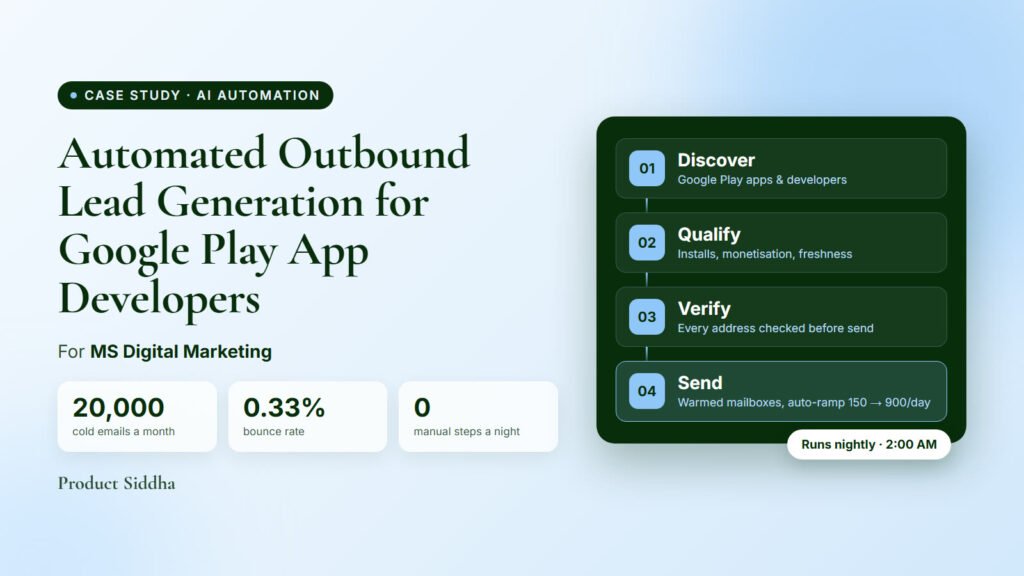
MS Digital Marketing: Automated Outbound Lead Generation for Google Play App Developers Client MS Digital Marketing Agency Service Provider Product Siddha Industry Digital Marketing / App Reputation Services Service AI Automation Services / Outbound Lead Generation & Cold Email Automation The Metrics 20,000 verified cold emails a month, sent on autopilot ~20 sales appointments a month projected, at a conservative 0.1% send-to-meeting rate 0.33% bounce rate across the first 1,530 sends 0 rate-limit blocks from Google Play, even on nights with 6,000+ lookups Sending volume ramps itself from 150 to 900 emails a day Zero manual steps: the whole pipeline runs unattended every night Live in just over three weeks from the start of the build Before: A Big Market and No Reliable Way to Reach It MS Digital Marketing Agency helps mobile app businesses manage their ratings, reviews and online reputation. Their ideal customers are easy to describe: Google Play developers with real install numbers, a monetised app and an active product. What they lacked was automated outbound lead generation that could reach those developers at scale. Every one of those developers publishes a contact email on their Play Store listing. The data was public. The problem was collecting it at scale and turning it into outreach that actually reaches an inbox. An earlier attempt by another developer had failed at the first hurdle. Google Play started returning CAPTCHAs and blocking requests, and the scraper stopped working. Even with a working scraper, three harder problems were waiting: The same company often lists different emails on different apps, so a simple list emails one business several times Unverified addresses cause bounces, and bounces damage the sending domains The target was around 20,000 new contacts a month, far more than a person can manage by hand The agency needed a system, not a spreadsheet. After: Automated Outbound Lead Generation That Runs Every Night Product Siddha built an automated outbound pipeline that runs at 2:00 AM every night. It finds new Google Play developers, checks whether they fit the agency’s ideal customer profile, verifies their email addresses and loads them into a cold email platform, ready to send during the recipient’s working day. Each morning the agency gets a report with the night’s numbers, and every lead appears in a shared Google Sheet. If something looks wrong, such as a rising bounce rate, the system raises an alert or pauses itself before it can harm the sending domains. The team’s job is now to answer replies, not to build lists. What We Built 1. Google Play Lead Discovery That Does Not Get Blocked The crawler starts from Play Store category charts and keyword searches, then expands through each app’s “similar apps” and each developer’s full catalogue. This similar-app crawl finds far more new developers than the charts alone. The fix for the earlier CAPTCHA problem was discipline, not tricks: one request per second, automatic back-off when Google signals overload, and a retry queue. No proxies and no CAPTCHA-solving services were needed. Across every run so far, the system has hit zero rate-limit blocks. 2. Lead Qualification Against the Ideal Customer Profile Not every developer is worth emailing. Each one is scored on signals taken straight from their Play Store listings: Install base Monetisation through ads or in-app purchases How recently the app was updated Only developers who pass move forward. Scores are recalculated every night, so a developer who updates their app can qualify later. 3. Company-Level Deduplication About one in eight emails in early testing belonged to a company that was already on the list under a different address. The pipeline groups every address under the Play account and company domain it belongs to, so each business is contacted once and only once. This rule is enforced by the database itself, not just by the code. Every developer ever contacted is remembered permanently, so next month’s list can never repeat this month’s. 4. Email Verification Before Every Send Every address is verified just before it is needed, and re-verified if it has been waiting more than 30 days. Testing showed that more than half of developer domains are “catch-all” domains, which accept any address and bounce later. The system sends to safe addresses first and only adds a limited share of catch-all addresses once the bounce rate has proven stable. 5. Deliverability-First Sending Infrastructure Cold email runs from 30 warmed mailboxes across 10 dedicated domains, kept completely separate from the agency’s main domain. Its everyday email and reputation are never at risk. Each day’s leads go into a weekly campaign with a single, personalised email per contact. Sends are scheduled inside business hours, so they arrive when people are at their desks. 6. Self-Ramping Volume With a Built-In Safety Brake New domains cannot send at full volume on day one. The pipeline raises its own daily limit, from 150 to 360 to 900 emails a day, and only moves up a step when the bounce rate is clean. If the 7-day bounce rate ever goes above 2%, the system stops loading new leads and pauses sending until a person has looked at it. Bounces, replies and unsubscribes are synced back every night, so nobody who opted out is ever emailed again. 7. Daily Reporting and Health Checks Every run ends with a set of automated self-checks, a daily email report and a Google Sheet update for the client. An external health check raises an alert if a nightly run ever fails to finish. Technology Stack Built using: Node.js Google Play Scraper PostgreSQL (Supabase) Smartlead Zapmail Sealch email verification Google Sheets API Resend DigitalOcean The Takeaway Outbound lead generation usually breaks in one of three places: the data source blocks you, the list emails the same company twice, or the bounces burn the sending domains. By building rate-limited discovery, company-level deduplication, verification and a self-correcting send ramp into one automated pipeline, MS Digital Marketing turned a public but hard-to-use data source into a steady flow of qualified prospects, without adding a