Product Siddha

MarTech Implementation

Email vs WhatsApp Marketing Which Converts Better for Indian Property Sales
Blog, MarTech Implementation

Email vs WhatsApp Marketing: Which Converts Better for Indian Property Sales?

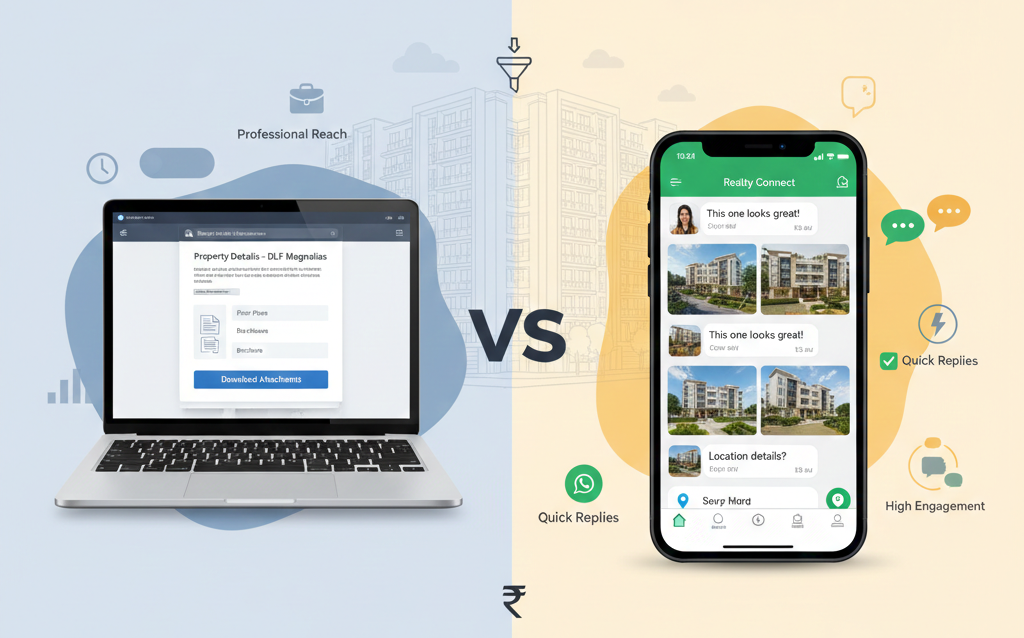
Email vs WhatsApp Marketing: Which Converts Better for Indian Property Sales? Conversations That Actually Close Deals Property sales in India are driven by conversation. Buyers ask questions, compare options, consult family members, and return with follow-ups. Very few decisions are made in a single interaction. Among the many communication channels available today, email and WhatsApp remain the most widely used for property follow-ups. Each serves a different role. Each influences trust in a different way. For real estate teams, the question is not which channel looks more modern, but which one converts better in real conditions. Understanding Email vs WhatsApp Marketing requires attention to how Indian buyers behave, not how tools are promoted. Product Siddha works with platforms that measure conversion across channels using real data. This perspective informs a clear and practical comparison. How Indian Property Buyers Communicate Indian buyers rarely follow a linear path. A typical journey includes missed calls, forwarded messages, screenshots shared with relatives, and delayed responses. Language preference shifts between English and local languages. Formal communication blends with casual replies. Email and WhatsApp both fit into this pattern, but in different ways. Email is viewed as official. WhatsApp feels personal. One supports record keeping. The other supports immediacy. Understanding Email vs WhatsApp Marketing begins with acknowledging this contrast. The Role of Email in Property Sales Email remains important in Indian real estate, especially for structured communication. Common uses include: Sending brochures and floor plans Sharing pricing details and payment schedules Document follow-ups and confirmations Post site visit summaries Email allows longer explanations. Buyers can read at their own pace. Attachments are easier to manage. Messages feel formal enough to share with lawyers or family members. However, email often suffers from delayed engagement. Messages may be opened hours or days later. Some are ignored entirely. In the context of Email vs WhatsApp Marketing, email excels in depth but struggles with speed. The Role of WhatsApp in Property Sales WhatsApp has become the default communication tool for Indian buyers. Messages are read quickly. Voice notes feel natural. Images and short videos are easy to consume. In property sales, WhatsApp is commonly used for: Initial follow-ups after inquiries Sharing quick photos or location pins Confirming site visit timings Addressing short questions Response rates are typically higher than email. Buyers often reply within minutes. Yet WhatsApp has limits. Long explanations feel intrusive. Important details can get buried in chat history. There is also a fine line between helpful and excessive. In Email vs WhatsApp Marketing, WhatsApp leads in engagement but requires restraint. Comparing Conversion Behavior Conversion in property sales rarely means immediate booking. It usually means movement to the next step. A site visit. A second call. A document request. Observed patterns across Indian real estate teams show: WhatsApp drives faster responses and follow-ups Email supports informed decision making WhatsApp performs better in early and mid-stage engagement Email performs better near negotiation and closure This suggests that Email vs WhatsApp Marketing is not a binary choice. It is a sequencing decision. A Data Perspective from Product Siddha One Product Siddha case study involved AI automation services for a French rental agency, MSC-IMMO. While the market differed, the communication challenge was familiar. The agency used multiple channels to engage prospects. Engagement varied sharply by channel and timing. WhatsApp messages triggered quick replies but shorter conversations. Email threads were slower but more detailed. Product Siddha helped map communication touchpoints to funnel stages. This revealed a pattern that applies well to Indian property sales. Fast channels move interest forward. Structured channels support commitment. This insight guides how Email vs WhatsApp Marketing should be applied in real estate workflows. Trust and Perception Matter Property purchases involve large sums. Buyers judge not only the property but the professionalism of the seller. Email conveys seriousness. A well-written message with clear attachments signals stability. WhatsApp conveys accessibility. A prompt reply signals attention. Problems arise when channels are misused. Long sales pitches on WhatsApp can feel intrusive. Casual WhatsApp messages for legal documents can feel careless. Email vs WhatsApp Marketing works best when each channel respects its natural role. Language and Cultural Fit In India, language choice affects comfort. WhatsApp supports Hinglish and regional languages easily. Buyers often respond more freely in familiar speech. Email is more likely to remain in English. This suits formal communication but may limit emotional connection. For teams selling across regions, WhatsApp often bridges language gaps more effectively. Email provides clarity when precision is required. Performance Comparison Overview Aspect Email WhatsApp Response Speed Moderate High Content Length Long Short Formality High Medium Shareability Documents Images and quick clips Buyer Comfort Structured Conversational This table reflects common behavior, not absolute rules. Context always matters. Automation and Measurement Automation improves both channels when applied carefully. Email automation helps with scheduled follow-ups, reminders, and document sharing. WhatsApp automation helps with initial responses and appointment confirmations. Product Siddha’s experience building custom dashboards by stage supports accurate measurement across channels. Tracking which channel moves a lead forward prevents guesswork. Without measurement, Email vs WhatsApp Marketing becomes a matter of opinion. With data, it becomes a strategy. Choosing the Right Mix Most successful Indian real estate teams do not choose one channel exclusively. They combine them with intention. WhatsApp opens the door. Email carries the details. WhatsApp confirms. Email records. Email vs WhatsApp Marketing works when each channel supports the other rather than competing for attention. A Balanced Path Forward Property sales depend on trust built over time. Communication channels shape that trust quietly. WhatsApp brings speed and warmth. Email brings structure and assurance. Ignoring either limits conversion. Product Siddha’s work across automation, analytics, and real estate workflows reflects this balanced approach. Tools should adapt to buyer behavior, not force it to change. For Indian property sales, the better question is not which channel converts better, but how well they work together.

product analytics
Blog, MarTech Implementation

Top 5 Tips to Get More Value From Your Real Estate CRM

Top 5 Tips to Get More Value From Your Real Estate CRM Why most CRMs underperform in real estate Real estate CRMs are rarely implemented poorly. In most cases, they are simply underused. Teams invest time and money into setting up a real estate CRM, but daily habits do not change. Leads are entered, notes are skipped, follow-ups drift, and reporting becomes an afterthought. Over time, the system turns into a passive database instead of an active sales asset. Across real estate, the gap between CRM ownership and CRM value remains wide. Closing this gap does not require new software or complex restructuring. It requires clarity on how the CRM supports selling, not administration. The following five principles reflect how high-performing teams extract consistent value from their real estate CRM, based on real operational patterns observed by Product Siddha across automation and analytics projects. 1. Align CRM stages with real buying behavior A real estate CRM should reflect how buyers move, not how software vendors label stages. When stages feel abstract or generic, sales teams stop trusting them. This leads to inaccurate data and poor forecasting. Effective teams define stages using observable buyer actions. A lead is not qualified because a checkbox is ticked. It is qualified because a budget range is discussed, a preferred location is confirmed, or a site visit is requested. Each stage in the CRM must represent a clear shift in buyer intent. In one Product Siddha real estate automation engagement, the most impactful change was redefining what “site visit scheduled” actually meant. Only visits with a confirmed date and buyer acknowledgment were allowed into that stage. This removed ambiguity and immediately improved the reliability of pipeline reviews. Clear stages reduce friction. They help sales managers coach effectively and allow leadership to trust CRM data without constant verification. 2. Make response time a core CRM metric Speed is often discussed in real estate sales, but rarely enforced through systems. A real estate CRM should make response time visible and unavoidable. When response time is hidden, delays become normal. High-performing teams treat first response time as a frontline metric. Every new enquiry triggers immediate visibility, ownership, and accountability. This does not require aggressive messaging or pushy behavior. It requires presence. Product Siddha’s work on a voice-led automation flow for a real estate platform demonstrated this clearly. Leads that received a response within minutes were far more likely to convert to site visits than those contacted later in the day. The CRM became the enforcement layer, recording response timestamps and exposing delays without blame. Response speed is not about pressure. It is about respect for buyer intent. A real estate CRM that highlights speed creates discipline without micromanagement. 3. Use CRM context to improve sales conversations Many sales calls fail because they start from zero. When agents open a conversation without context, buyers repeat themselves or disengage. A real estate CRM holds valuable clues about buyer intent, but only when surfaced correctly. Effective CRM usage ensures that every conversation begins informed. Agents know where the lead came from, which listings were viewed, whether pricing pages were explored, and what was discussed previously. This changes tone. Conversations become specific instead of generic. In Product Siddha’s analytics and dashboard projects, teams consistently performed better when CRM data was reshaped around decision context rather than raw activity. Instead of long activity logs, sales teams saw concise summaries before each call. This reduced call time while improving quality. A CRM should not overwhelm users with data. It should quietly prepare them to speak with confidence and relevance. 4. Automate follow-ups with restraint and clarity Follow-ups are central to real estate sales, yet they are often inconsistent. Some leads receive too many messages. Others receive none. A real estate CRM can solve this imbalance, but only when automation is applied carefully. Automation should support memory, not replace judgment. The most effective follow-ups are short, timely, and grounded in real interactions. A message referencing a site visit date or a specific unit performs better than generic reminders. Across Product Siddha’s automation engagements, including real estate and non-real estate projects, one pattern remains consistent. Fewer messages with clear intent outperform long automated sequences. Buyers respond when communication feels purposeful. A disciplined CRM setup pauses automation when human interaction resumes. This prevents overlap and maintains trust. Automation succeeds when it feels invisible to the recipient. 5. Treat the CRM as a weekly operating system A real estate CRM should guide weekly decisions, not just monthly reports. When CRM reviews are infrequent, small issues grow unnoticed. Leads stagnate, follow-ups weaken, and patterns disappear. High-performing teams review CRM data weekly with a narrow focus. They look at lead flow, response time, stage movement, and drop-off points. The goal is not reporting. It is correction. In Product Siddha’s HubSpot setup for a growing financial services brand, weekly CRM reviews uncovered a consistent issue. One acquisition channel produced volume but poor-quality conversations. Adjusting this early improved overall efficiency. The same principle applies to real estate CRM usage. Weekly engagement keeps the system aligned with reality. It ensures that the CRM evolves alongside the business, not behind it. A grounded view on CRM value A real estate CRM does not create value through features. It creates value through habits. When stages reflect real buyer actions, response time is visible, conversations are informed, follow-ups are measured, and reviews are regular, the system earns its place. Product Siddha’s work across CRM, analytics, and automation consistently shows that lasting improvements come from disciplined usage, not constant change. A CRM becomes powerful when it fades into the background and quietly supports better decisions. In real estate, where timing and trust define outcomes, a well-used CRM does not feel like software. It feels like structure.

Blog, MarTech Implementation

MarTech Tools vs Custom Automation: What Works Better in 2026?

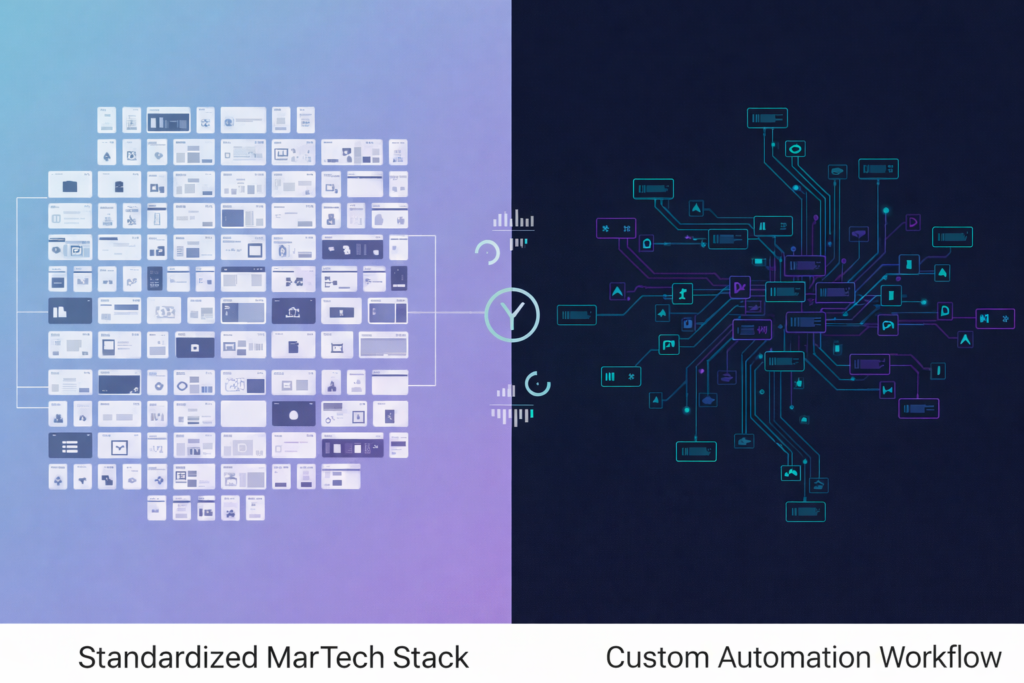
MarTech Tools vs Custom Automation: What Works Better in 2026? A Decision Most Teams Face By 2026, most growing companies no longer ask whether to use technology in marketing operations. The real question is how. Off-the-shelf MarTech tools promise speed and structure. Custom automation promises flexibility and precision. Both approaches can work. Both can fail. The deciding factor is not budget or trend. It is how closely the system reflects real business behavior. Product Analytics plays a central role in this decision because it reveals how users, teams, and systems actually interact. This article examines where MarTech tools perform well, where custom automation becomes necessary, and how Product Analytics helps teams choose wisely. What MarTech Tools Do Well MarTech tools are designed to solve common problems at scale. Lead capture, campaign tracking, email workflows, and reporting come pre-configured. For many teams, this structure is helpful. These tools reduce setup time. They enforce consistency. They allow teams to operate without deep technical resources. Marketing teams often benefit early because MarTech tools offer immediate visibility. Dashboards show traffic, conversions, and engagement trends. For organizations with simple workflows, this may be enough. The Hidden Limits of Standard Tools Problems arise when business processes diverge from tool assumptions. Real customer journeys are rarely linear. Offline interactions, delayed decisions, and multi-touch relationships complicate tracking. MarTech tools often flatten this complexity. They show what fits predefined models. What falls outside those models is either ignored or forced into unsuitable fields. Product Analytics exposes these gaps. When teams analyze in-product behavior or operational workflows, they often find that standard tools fail to capture meaningful actions. This is where frustration begins. Teams have data, but not insight. What Custom Automation Offers Custom automation starts with how the business actually works. Workflows are designed around real stages, not vendor defaults. Data flows follow decisions, not templates. This approach requires more upfront thinking. It also requires technical expertise. The payoff is alignment. Custom automation adapts as the business changes. It integrates offline and online signals. It supports nuanced tracking that standard tools cannot handle. Product Analytics thrives in this environment because events and metrics are defined with purpose. Learning From Real Implementations Product Siddha’s work on Built Custom Dashboards by Stage offers a clear example. Standard dashboards showed activity volume. Custom dashboards revealed progress through meaningful stages. Teams could see where momentum slowed and why. In another case, Product Analytics for a Ride-Hailing App with Mixpanel, custom event tracking uncovered friction that off-the-shelf reports missed. Growth improved not through more campaigns, but through better product flow. These examples show how Product Analytics depends on data structure. When structure reflects reality, insight follows. When MarTech Tools Are Enough MarTech tools work well when processes are stable and predictable. Early-stage companies, single-market operations, and teams with limited variation often benefit. Tools like CRM platforms and email automation systems provide guardrails. They prevent chaos. They establish baselines. Product Analytics still adds value here by helping teams understand user engagement, but the need for customization remains low. The key is knowing when the limits are reached. When Custom Automation Becomes Necessary As organizations grow, complexity increases. Multiple products, regions, sales motions, or offline interactions strain standard systems. Custom automation becomes necessary when teams ask questions their tools cannot answer. Why do users drop after a specific interaction. Which offline actions influence conversion. How does behavior differ by segment. Product Analytics often triggers this realization. Data reveals patterns that tools cannot explain. In Product Analytics and Full-Funnel Attribution for a SaaS Coaching Platform, attribution required linking acquisition data with deep usage behavior. Custom automation made this possible. Standard tools alone could not support the analysis. Cost Considerations in 2026 Cost is often misunderstood. MarTech tools appear cheaper upfront. Subscriptions are predictable. Setup is fast. Custom automation appears expensive because development is visible. Over time, however, licensing costs rise and flexibility remains limited. The real cost lies in missed insight. When teams make decisions without clarity, waste increases. Product Analytics helps quantify this hidden cost by revealing where value is lost. Governance and Ownership Tools come with rules. Custom systems require governance. Without ownership, custom automation becomes brittle. Without flexibility, tools become constraints. The most effective teams assign clear responsibility for data definitions, tracking standards, and review cycles. Product Analytics acts as the common language across teams. This governance ensures that automation supports decision-making rather than obscuring it. A Hybrid Reality In 2026, most mature organizations use a hybrid approach. Core MarTech tools handle standard tasks. Custom automation fills gaps and supports advanced workflows. Product Analytics connects both worlds. It ensures that data remains consistent, meaningful, and actionable. The question is not tools versus custom automation. It is where each belongs. Common Mistakes to Avoid One mistake is customizing too early. Without stable processes, automation amplifies confusion. Another mistake is clinging to tools long after they stop serving the business. Comfort replaces clarity. Product Analytics helps teams avoid both. It reveals readiness for customization and highlights when tools no longer suffice. A Clear Way Forward Teams should begin with questions, not software. What decisions need better data. Where does uncertainty slow progress. Which actions matter most. From there, choose tools or automation accordingly. Product Siddha approaches this decision through analysis, not assumption. Systems are shaped around behavior, not branding. Final Thoughts MarTech tools and custom automation are not opposing choices. They serve different needs at different stages. In 2026, the organizations that perform best understand their boundaries. They use tools for efficiency and custom automation for insight. Product Analytics sits at the center, ensuring that every system supports real understanding. When data reflects reality, decisions improve. When decisions improve, growth follows.

Blog, MarTech Implementation

MarTech Implementation Challenges in Indian Real Estate

MarTech Implementation Challenges in Indian Real Estate The Ground Reality Indian real estate has always moved on relationships, site visits, and trust built over time. Over the last decade, digital channels have entered this space, but adoption has been uneven. Many developers and brokerage firms invested in CRM tools, marketing platforms, and analytics software without a clear plan for how these systems would work together. As a result, MarTech Implementation often becomes a collection of disconnected tools rather than a working growth system. Unlike retail or SaaS, real estate marketing in India deals with long decision cycles, fragmented buyer data, and a strong offline influence. These factors make technology adoption more complex. The challenge is not the lack of tools. The challenge lies in making them useful, measurable, and aligned with how real estate teams actually operate. Fragmented Data Across the Buyer Journey One of the most common problems in MarTech Implementation for Indian real estate is data fragmentation. Leads come from property portals, Google Ads, WhatsApp inquiries, site walk-ins, call centers, and channel partners. Each source captures data differently, often with missing or inconsistent fields. Sales teams rely on spreadsheets. Marketing teams depend on dashboards that only show surface-level numbers. Leadership sees reports that do not connect spend to site visits or bookings. Without a single view of the buyer journey, decisions are based on assumptions. Product Siddha has addressed similar challenges while building custom dashboards by stage for growth teams. In one such implementation, lead data was reorganized around buyer intent stages rather than source labels. This allowed teams to see where prospects dropped off and which channels actually influenced site visits, not just form fills. Misalignment Between Sales and Marketing Systems In many Indian real estate firms, marketing tools and sales tools operate in isolation. CRM systems are used as record-keeping software rather than decision tools. Marketing automation platforms are configured without understanding how sales teams follow up on leads. This misalignment creates gaps. Leads are generated but not contacted on time. Follow-ups are tracked manually. Campaign performance is judged by volume, not quality. A relevant Product Siddha case study is From Lead to Site Visit – Voice AI Automation for a Real Estate Platform. In this project, automation was introduced to qualify and route leads before they reached sales teams. The outcome was not more leads, but better conversations. Sales teams spent time with prospects who were ready for a site visit, while early-stage inquiries were nurtured automatically. This approach highlights an important truth. MarTech Implementation succeeds only when sales workflows shape the technology setup, not the other way around. Overdependence on Tools Without Strategy Many developers invest in popular platforms like HubSpot, Salesforce, or marketing automation tools because competitors use them. The assumption is that software alone will improve performance. In practice, these tools amplify existing processes, good or bad. Without a clear growth strategy, dashboards turn into vanity metrics. Email campaigns are sent without segmentation. Retargeting ads follow users who already booked a visit. Product Siddha’s experience with HubSpot Marketing Hub Setup for a Growing Fintech Brand shows how structured implementation changes outcomes. The same principles apply to real estate. Clear lifecycle stages, defined handoffs, and measurable goals must be set before the first workflow goes live. MarTech Implementation is not a one-time setup. It is an operational change that requires discipline and regular review. Difficulty Measuring Offline Conversions A major hurdle unique to real estate is offline conversion tracking. Site visits, broker meetings, and on-ground events play a critical role in closing deals. Most MarTech stacks fail to connect these offline actions to digital touchpoints. As a result, marketing teams cannot confidently answer basic questions. Which campaign drove site visits? Which channel influenced bookings? Which messages shortened the sales cycle? Product Siddha has solved similar attribution problems through product analytics and full-funnel attribution projects. By mapping offline actions back to digital identifiers, teams gained clarity on what actually influenced buyer decisions. This approach is especially valuable in real estate, where the final decision often happens weeks after the first interaction. Resistance from On-Ground Teams Technology adoption often meets resistance from sales managers and site teams. Many view MarTech tools as monitoring systems rather than support systems. This resistance leads to poor data quality, incomplete updates, and low platform usage. The solution is not more training slides. It is better system design. Tools must reduce effort, not add steps. Data entry should be minimal. Insights should be visible and useful to frontline teams. In Product Siddha’s Product Management for UAE’s First Lifestyle Services Marketplace, similar resistance was addressed by redesigning workflows around user behavior. The lesson carries over to Indian real estate. When systems respect how teams work, adoption follows naturally. Lack of Local Context in Global Tools Most MarTech platforms are built for Western markets. Indian real estate has unique realities such as joint ownership, regional language preferences, broker networks, and regulatory differences. Off-the-shelf setups often ignore these factors. Customization becomes essential. Lead scoring models must reflect local buying signals. Communication workflows must account for WhatsApp and phone calls, not just email. Reporting must align with how leadership reviews performance. Product Siddha’s work on AI Automation Services for French Rental Agency MSC-IMMO demonstrates how global tools can be adapted to local business models. The same approach applies to Indian real estate, where thoughtful customization bridges the gap between software capability and business reality. The Cost of Poor Implementation When MarTech Implementation fails, the cost is not just wasted software licenses. It is lost trust in data, slower decision-making, and missed opportunities. Teams revert to intuition because reports feel unreliable. Leadership questions marketing spend without clear answers. Successful implementation creates confidence. Teams understand what works. Budgets are allocated with clarity. Growth becomes repeatable rather than reactive. A Practical Way Forward Indian real estate firms do not need more tools. They need fewer tools that work together. A phased approach works best. Start by mapping the buyer journey honestly. Identify where data breaks. Align

Blog, MarTech Implementation

5 Best Real Estate Broker Software You Need In 2026

5 Best Real Estate Broker Software You Need In 2026 A Clear Look at Modern Broker Needs Real estate brokers enter 2026 with more work than ever. Markets shift quickly. Buyers compare listings with careful attention to detail. Agents expect smoother workflows. Many firms try to solve these demands with scattered tools, but most discover that productivity only improves when the entire operation runs on dependable Real Estate Broker Software. The right platform helps a broker track listings, manage leads, organize paperwork, and keep a clear view of team activity. It also builds consistency in day to day tasks, which becomes more important as teams grow. To help you choose the most practical options for 2026, this guide studies five reliable software systems that brokers across residential and commercial categories use today. 1. BrokerMint BrokerMint remains a steady choice for firms that want a clean back office system. The software brings together commission tracking, transaction files, and agent performance records. Brokers who prefer predictable workflows find that BrokerMint reduces errors in closing paperwork. One mid sized brokerage in Phoenix reported that its transaction team reduced document handling time by nearly half after moving to a structured workflow similar to what BrokerMint offers. They saw the benefit mainly because every activity stayed inside a single space. Where it helps most: Transaction management Commission automation Reporting for small to mid scale teams Feature Benefit for Brokers Commission rules Fewer payout mistakes Deal pipeline Easier compliance checks Team reports Clearer agent contributions 2. Lofty (formerly Chime) Lofty serves growing brokerages that need a balanced system for leads and marketing. It provides website tools, CRM functions, and smart follow up logic. Its search features give agents quick ways to locate matching homes for clients. A useful observation comes from a property team in Dallas that handled large volumes of online leads. After reorganizing their follow up logic inside Lofty, they saw steadier contact rates and fewer delays between inquiries and replies. Where it helps most: Lead follow up Agent workflows Listing promotion 3. BoldTrail BoldTrail has become a familiar name for brokers who want an all in one platform. It keeps property data, lead routing, text reminders, and marketing schedules in one place. The platform is especially useful for teams spread across multiple regions. The software is known for dependable automation logic. This approach resembles some of the workflow systems Product Siddha has built for clients. For instance, in the case study titled From Lead to Site Visit – Voice AI Automation for a Real Estate Platform, Product Siddha created a structured system that guided each lead from first call to property visit. While the project used custom voice flows, the underlying idea mirrors what strong broker software provides: strong consistency in how leads move through each stage. Where it helps most: Regional teams Lead organization Daily task reminders 4. Propertybase Propertybase offers the stability of Salesforce architecture, which appeals to real estate firms that want deeper control over data. Brokers who prefer structured records and long term tracking often choose this platform. Because Propertybase rests on a CRM foundation, it supports clear audit trails. This is helpful for firms that track long sales cycles, especially in commercial or luxury markets. A commercial brokerage in Chicago shared that their onboarding process became easier once Propertybase created uniform record keeping. It improved how new agents reviewed past activity before taking over client files. Where it helps most: Larger teams Commercial real estate Centralized data governance 5. Buildium with Brokerage Extensions Though Buildium is known for property management, its brokerage extensions help firms that manage rentals alongside sales. Brokers who work with investor clients often use Buildium because it keeps rental activity, maintenance updates, and tenant communication tied to owner reporting. This approach gives brokers a clearer map of client portfolios. For example, an investor network in Oregon uses Buildium to bring rent schedules, renewal cycles, and property performance charts into one view. When the same team handles leasing and sales, this type of software reduces confusion. Where it helps most: Brokerages handling rentals Investor focused teams Mixed use portfolios What Brokers Should Look for in 2026 Not all Real Estate Broker Software works the same way. Brokers should look for tools that match their daily patterns rather than the broadest set of features. A Quick Comparison Chart Software Best For Data Strength Team Size Fit BrokerMint Closings and commissions Medium Small to mid Lofty Lead follow up High Mid scale BoldTrail All in one workflows High Small to large Propertybase Data governance Very high Medium to enterprise Buildium Rental linked brokerage Medium Small to mid A more focused viewpoint helps brokers decide whether they want a single platform or a combination of smaller tools. How Product Siddha Supports Real Estate Teams Product Siddha has worked with real estate platforms that needed stronger systems for lead handling, workflow structure, and appointment movement. The earlier mentioned voice automation case study demonstrates how clear processes can take scattered leads and guide them into real visits. Product Siddha also builds custom dashboards for teams that outgrow basic software. In the case study titled Built Custom Dashboards by Stage, the team created stage specific insights that helped a business measure performance without guesswork. A similar structure can strengthen real estate operations by giving brokers a clear view of listings, inquiries, and agent activity. These examples show that strong Real Estate Broker Software works best when paired with clear data foundations. Final Thoughts for 2026 Buyers A broker choosing software in 2026 should begin with the simplest question. Does the system make daily work easier for agents and administrators. If the answer is yes, the platform will likely support long term growth. Good software reduces friction. Great software creates clarity. Whether you choose BrokerMint, Lofty, BoldTrail, Propertybase, or Buildium, the goal is the same. You want consistent records, organized tasks, and steady communication with clients. As markets shift, brokers who invest in dependable systems will move with greater confidence. With

Blog, MarTech Implementation

Customer Guide 2026: Choosing the Best IT Solutions for Real Estate Industry Challenges

Customer Guide 2026: Choosing the Best IT Solutions for Real Estate Industry Challenges A Clear View of Today’s Needs The real estate industry has always depended on information. Every decision involves data from listings, visits, documents, and contracts. As teams grow, they begin to notice that older systems cannot support the volume of work. Many businesses look for IT solutions for real estate to organise their processes and manage daily tasks with accuracy. This guide offers a structured way to understand what to choose in 2026. Product Siddha has worked across several industries while building systems for data tracking, workflow automation, and digital communication. One example is their voice AI automation for a real estate platform. The project centred on the early stage of the buyer journey. The team studied how leads moved from call to site visit. They found gaps in how information was collected. A new workflow was created that used voice inputs, automated sheets, and updated visit records. This is a clear example of how steady IT planning can improve real estate work. The sections below give a practical overview for customers who want to understand which systems support their goals. Understanding Core Challenges Real estate businesses face several repeating challenges. Some concerns appear in every department. These include: managing large document sets repeating the same tasks each day tracking communication between teams handling updates from many sources storing data in a proper structure The right IT solutions for real estate must address these areas. When systems are designed well, teams work with less pressure and fewer delays. 1. Systems for Lead and Inquiry Tracking Leads come from many channels. If the data is scattered, agents cannot act quickly. A well built system gathers leads into one space and removes duplication. It records activity and builds a history for each inquiry. A useful comparison can be made with the lead engine built by Product Siddha after a data supply issue blocked a previous source. The new engine created a clear intake process. Real estate teams can apply the same approach by using structured lead capture and automatic record updates. 2. Property Information Management Property details form the base of many activities. IT systems can store photos, description text, legal notes, and configuration details. When an agent prepares listing material, the system fills most of the information. This prevents errors and gives buyers correct data in the first conversation. 3. Document Automation and Compliance Updates In 2026, document automation for real estate has become one of the strongest practices. Systems can take standard templates for agreements, disclosures, reports, and visit sheets. They add names, figures, and dates automatically. They ensure that new compliance documents replace older ones. Document Type Manual Time Automated Time Sale Agreement 35 minutes 8 minutes Rental Pack 25 minutes 6 minutes Disclosure Forms 20 minutes 3 minutes 4. Workflow Coordination for Field Agents Field agents rely on consistent schedules. IT solutions can shape the workflow from request to confirmation. For example, the system can set appointment times, send reminders, and notify teams of changes. This avoids long message chains. An organised workflow also helps managers see which visits are pending and where delays occur. 5. Analytics for Sales and Rentals Decision making becomes stronger when teams review their own data. IT systems can show how long listings stay active, which sources give the best leads, and how customers behave during inquiry stages. Property managers can see occupancy patterns and maintenance cycles. This approach resembles the analytics work Product Siddha completed for a ride hailing platform. The team studied patterns across the funnel and delivered clear dashboards. The same method can guide real estate teams toward better planning. 6. Customer Communication Systems Clients expect timely responses. IT tools can send updates, reminders, and follow up notes. These tools ensure that no message is forgotten. They store communication records for later review. For real estate, this can include alerts about new listings, visit timings, or document readiness. Small improvements in communication often raise customer satisfaction. 7. Tools for Rental and Property Management Property managers handle maintenance records, payment logs, and tenant communication. Systems can store inspection data, prepare monthly statements, and record repair activity. Automation keeps the data uniform and reduces time spent on manual entries. 8. Secure Storage and Retrieval of Files Real estate deals depend on proper storage of documents. IT systems can place files in orderly folders based on property ID, date, and client name. Searches become faster and teams do not lose track of essential forms. This forms a strong base for auditing and long term record keeping. 9. Integrations With Existing Platforms Many real estate businesses use a mix of tools. Good IT solutions for real estate connect these tools without forcing teams to change everything at once. They create bridges between CRM platforms, lead sources, accounting systems, and customer communication tools. 10. Tools for Team Performance Monitoring Managers often need a simple way to check activity. IT systems can display follow ups completed, listings updated, and documents produced. These insights help leaders set targets and encourage healthy progress. Checklist for Choosing the Right IT Partner When selecting IT solutions for real estate, customers can use the following checklist: Need Question to Ask Lead Management Does the system centralise all channels Workflow Can tasks be automated from start to finish Documents Are templates updated and accurate Integrations Will the system fit with current tools Support Is ongoing guidance available Strength Through Careful Planning Good IT systems do not overpower the business. They support the daily flow of information. They also keep the work steady. Real estate teams need solutions that match their pace and give them room to adjust. Product Siddha uses this principle across its projects. The focus stays on clarity, thoughtful planning, and long term usefulness. When these ideas guide the process, real estate teams gain systems that remain valuable for years.

Blog, MarTech Implementation

Blueprint for Building an AI-Ready MarTech Stack in 2026

Blueprint for Building an AI-Ready MarTech Stack in 2026 Laying the Groundwork for an AI-Ready MarTech Stack Digital marketing in 2026 no longer thrives on manual tasks and disconnected tools. Companies are evolving rapidly, expecting marketing technology systems to serve as intelligent engines rather than digital filing cabinets. A well-designed MarTech Stack combines automation, analytics, data orchestration and integration — enabling teams to act on insights, personalize user journeys, and scale operations without overwhelming overhead. Building such an AI-ready stack requires more than buying tools. It calls for planning, discipline, and alignment between business goals, operations, and data flow. In this blueprint, we outline a structured approach to assembling a modern MarTech Stack that supports automation, measurement, and sustainable growth. What It Means to Be “AI-Ready” An “AI-ready” MarTech Stack does more than automate routine tasks. It supports data collection, real-time analysis, segmentation, lifecycle orchestration, and decision support. Core characteristics include: Unified data collection from multiple touchpoints Structured tracking of user journeys across web, email, mobile or product interfaces Automation of repetitive tasks (notifications, outreach, re-engagement) Tools that can integrate and exchange data smoothly Dashboards and analytics for continuous insight With this foundation, marketing teams can deploy predictive models, personalization, and data-driven campaigns. The stack becomes a living system that grows with the business. Blueprint: Steps to Build Your Stack 1. Audit Your Current Tools and Data Sources Begin by listing all existing tools: CRM, email platforms, analytics, support systems, content management, ads, lead generation. Note which systems store user data, which handle messaging, and which manage revenue or subscription events. Identify where data silos exist or where duplication occurs. 2. Define Key Events and Metrics to Track Decide the user or customer events that matter most — signups, trial start, purchase, upgrade, churn, interactions. For a SaaS, this may include activation and retention events. For ecommerce, purchase, cart abandonment, repeat purchase. These events form the spine of your stack. 3. Select a Central Data Platform or Event Pipeline Rather than forcing every tool to connect directly, use a central data layer to collect events from various sources. This layer can feed analytics, automation and reporting. It ensures that all downstream tools operate on the same data foundation. 4. Choose Core Systems: CRM, Email & Customer Communication, Analytics, Automation For CRM and communication, pick a system that supports webhooks, API integration, and custom fields. For analytics, use a tool that provides event-level tracking, funnel analysis, and cohort reports. For automation, ensure your chosen platform can act on events, segment users, and trigger workflows. 5. Build Integration and Data Flow Logic Set up consistent naming and event definitions. Ensure that user identities (email, user ID, session ID) are unified across systems. Build pipelines that route events from collection to analytics and automation. Maintain data hygiene and avoid duplication. 6. Establish Dashboards and Reporting Create dashboards that tie user behavior to business outcomes. Examples: conversion funnel, user activation rate, engagement frequency, customer lifetime value, churn rate. Use these reports to inform future marketing or product decisions. 7. Automate Lifecycle & Behavior-Based Campaigns Once events and data flows are in place, define lifecycle stages and behavior triggers. Automate welcome sequences, onboarding messages, re-engagement, upgrade prompts, churn prevention flows, and more. 8. Monitor, Iterate, and Refine No stack is perfect at first. Monitor performance, audit data quality, refine event definitions, test new flows, retire tools that do not deliver. Regular cleaning and pruning ensures the stack remains efficient. How the Blueprint Works: A Real Example At Product Siddha we once faced a challenge when our external lead-generation platform was no longer available. We designed and built a custom lead engine that scraped, enriched, and processed leads automatically. That engine became the central pipeline for lead data. From there we built dashboards, segmentation logic, and automated outreach flows. Because data collection, enrichment, automation, and reporting all relied on the same foundation, the system remained robust even when lead sources changed. That project illustrates how an integrated MarTech Stack provides resilience, flexibility, and scalability. Typical Components in an AI-Ready MarTech Stack Layer Purpose Data Collection & Event Tracking Capture user and customer actions from web, mobile, product, CRM Data Warehouse / Event Pipeline Centralize, process, and store events in unified format Analytics & Reporting Platform Analyze behavior, funnels, retention, segmentation CRM & Customer Database Manage contacts, leads, customers, properties, subscriptions Automation Engine Trigger actions: emails, notifications, messages, workflows Campaign Tools (Email, Ads, Messaging) Reach users based on events and segments Dashboard & Insights Layer Provide visibility for teams and stakeholders Why This Approach Matters in 2026 The marketing environment continues to become more complex. Multiple channels, user expectations for personalization and privacy demands all add pressure. A loosely connected set of tools cannot respond quickly and coherently. An AI-ready MarTech Stack delivers agility. It allows teams to react to user behavior, test campaigns, measure outcomes and refine strategy rapidly. It also reduces reliance on manual coordination across departments. For businesses that invest in structured systems, the results show in efficiency, better customer journeys and reliable reporting. It makes growth more sustainable and less dependent on luck or individual effort. How to Align Organizational Culture and Process Technology alone does not guarantee success. Teams must commit to consistent definitions of data and events. Communication between marketing, product and operations must be clear. Responsibilities around data hygiene and maintenance should be assigned. Leadership must view the stack as a strategic asset. That means investing time in planning, onboarding, and review. It also means resisting tool proliferation. Each component should exist for a clear purpose, and the stack should remain as simple as possible while meeting requirements. Final Thoughts: Building for Today and Tomorrow Constructing an AI-ready MarTech Stack is not a one-time project. It is an ongoing infrastructure task. As products evolve, new channels emerge, and customer behavior shifts, the stack must adapt. When thoughtfully assembled, the stack becomes a backbone for consistent marketing and user communication. It supports automation, personalisation, measurement and long-term growth. For firms

Blog, MarTech Implementation

Choosing a CRM For Real Estate With Confidence

Choosing a CRM For Real Estate With Confidence Real estate firms reach a stage where customer relationships can no longer be managed through scattered tools or informal tracking. Lead activity, client communication, property information and financial records move across multiple steps. Many companies discover that a reliable CRM system is the most practical way to add structure. A good real estate CRM simplifies conversations with buyers, tenants and channel partners, centralizes property data and helps sales teams respond faster. It strengthens long term business performance by improving the organization of work and removing repeated manual effort. In the Indian real estate context, platforms like B2BBricks, Sell.Do and NoBrokerHood have grown more popular because they align with the property lifecycle and builder-broker workflows. Below are six CRM platforms that have become dependable choices for real estate operations. Each platform brings a different approach to record keeping, process control and customer experience. 1. B2BBricks B2BBricks is designed specifically for Indian real estate developers, brokers and channel partners. It integrates lead capture, project inventory, brokerage workflows and appointment scheduling. It also connects with property marketplaces and supports multi-project management. Real estate firms choose B2BBricks because it aligns with the way Indian sales cycles operate-site visits, broker coordination, channel partner incentives and buyer follow-ups. 2. Sell.Do Sell.Do is one of the most widely used CRMs for Indian real estate. It handles digital leads, WhatsApp automation, booking journeys and visits. Builders and real estate agencies choose it because of its strong integration with real estate selling patterns and marketing systems. Sell.Do supports complete sales tracking from inquiry to closure, making it a strong platform for both residential and commercial projects. 3. NoBrokerHood NoBrokerHood supports builders and residential communities in managing visitor access, communication and post-sales interactions. It provides workflows for tenant management, scheduling and lead nurturing. For companies looking to improve the customer and tenant experience, NoBrokerHood brings the right balance of simplicity and control. 4. Salesforce CRM Salesforce offers a structured system for sales and property teams to manage accounts, customer journeys and workloads. Real estate companies use Salesforce to organize leasing, pipelines, documentation and finance. The main advantage is customization. It allows real estate firms to adapt the platform to local laws and business needs. 5. HubSpot HubSpot helps manage contact records, property inquiries, document attachments and follow up. Product Siddha has implemented HubSpot for a growing fintech brand to build a more unified sales and communication workflow. This example shows how custom setup and thoughtful integration help companies work with fewer interruptions. 6. Zoho CRM Zoho CRM is used by real estate firms that want a steady foundation at a reasonable cost. It supports lead generation, follow up and pipeline visibility. The software also connects easily with other Zoho applications. Comparison Table CRM Best For Implementation Difficulty Notable Features B2BBricks Builders, channel partners Low Real-estate specific workflows Sell.Do Large Indian teams Medium WhatsApp + booking journeys NoBrokerHood Residential communities Low Tenant & visitor management Salesforce Enterprise & brokerage Medium to High Advanced customization HubSpot Growing companies Low Clean sales workflows Zoho Cost-conscious teams Low Strong integration options What Makes a CRM Useful in Real Estate The goal of a CRM is not only digital record keeping. It is the structure it brings to property operations. Real estate is unusually sensitive to timing and communication. A missed follow up or delayed response has a direct impact on revenue and customer satisfaction. The right CRM supports the entire sales and operations path: Store property and client information Maintain a history of communication Control appointments and documentation Share data across teams Track progress and remove repetition Product Siddha and CRM Implementation Product Siddha designs CRM and automation systems that support growth, operations and customer management. The work combines analytics, AI, sales automation, and custom dashboards. For real estate companies, this helps build a structured process from inquiry to site visit, booking, closing and renewal. A Clear Path Forward A CRM brings order, clarity and reliability to real estate operations. It improves the way property businesses communicate, track and deliver value to customers. With the correct approach and system, companies can plan growth with confidence and maintain control over daily operations.

Blog, MarTech Implementation

What Are the Best Lifecycle Email Marketing Companies to Hire in 2026?

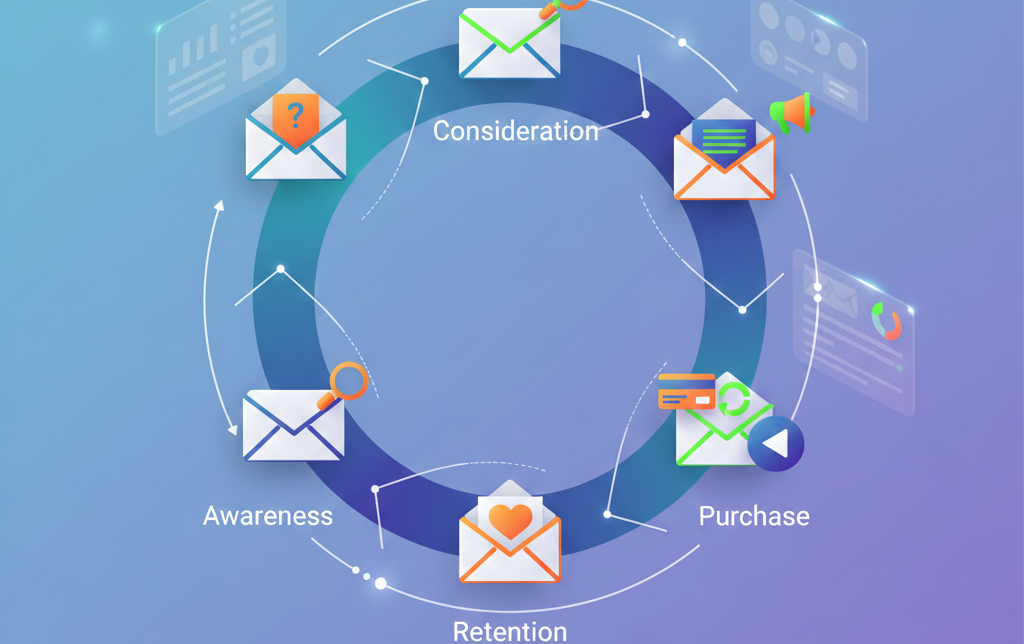
What Are the Best Lifecycle Email Marketing Companies to Hire in 2026? Why the Right Email Partner Matters Companies that succeed with email often treat it not as occasional blasts but as a steady engine for communication, retention, and revenue. A strong lifecycle email marketing partner can build that engine for you. Such a company helps plan user journeys, automate when messages go out, and measure results. Working with a seasoned provider ensures you get consistent quality for welcome sequences, cart abandonment reminders, re-engagement, loyalty campaigns, and more. In 2026, as inboxes grow crowded and consumer expectations rise, picking a capable “Email Marketing Company” becomes more essential than ever. What Makes an Outstanding Lifecycle Email Marketing Company Before listing candidates, it helps to know what to look for. Leading firms tend to offer: End-to-end campaign management: from strategy and content to design, scheduling, and deployment. Automation setup: welcome series, abandoned cart flows, post-purchase follow-ups, re-engagement and win-back triggers. Analytics and reporting: tracking open rates, click-throughs, conversions, segmentation behavior, and meaningful metrics beyond “opens.” Deliverability and compliance expertise: avoiding spam filters, handling unsubscribe mechanisms, and managing recipient lists responsibly. Flexibility across business models: whether you run an ecommerce store, a SaaS product, or a service organization, the offering should adapt. A company that combines these traits delivers email campaigns that reach inboxes, respect subscribers, and nurture long-term engagement. Top Lifecycle Email Marketing Companies in 2026 Here are several of the leading firms to consider – each with slightly different strengths depending on your business needs. Company / Agency Strengths / Best For Notes Product Siddha Full lifecycle implementation, analytics, segmentation, and retention strategy across ecommerce, SaaS, and subscription models Known for automation design, funnel analytics, personalized flows, and revenue-focused campaigns. Work includes Klaviyo, HubSpot, Customer.io, and event-based analytics. InboxArmy Full-service lifecycle email automation for ecommerce, SaaS, and diverse industries Focus on advanced analytics, lifecycle flows, and deliverability. Fuel Made High-conversion ecommerce email flows with strong design and UX Ideal for Shopify and DTC brands requiring refined automation and brand identity consistency. SmartMail Lifecycle automation and common ecommerce flows A good choice for small and mid-sized brands needing standard automation. Enflow Digital Email + SMS across ecommerce and DTC Useful for growing brands and early-stage scaling. BMO Media Retention and lifecycle journey design for ecommerce Best suited for businesses that depend on customer lifetime value and repeat purchases. Why Product Siddha deserves to be in the top tier of Email Marketing Companies Product Siddha stands out because of its methodical and analytics-driven approach to lifecycle email. The focus is on building the foundation for retention and repeat engagement. The team does not rely only on creative messaging. They work with segmentation, event tracking, and engagement scoring to shape each user’s journey. A lifecycle flow is designed with precise checkpoints for welcome, onboarding, purchase, follow-up, and win-back. One example is a project that involved boosting email revenue for a Shopify brand using Klaviyo. The work included identifying purchase triggers and building automation sequences that reflected buying behavior. The brand saw a more predictable flow of purchases, along with improved customer retention. Product Siddha also uses event-based analytics in other projects, such as building full-stack dashboards for music apps and integrating Mixpanel-driven funnel tracking. These practices help transform lifecycle campaigns into structured and measurable systems. How to Choose the Right Email Marketing Company for Your Business What works best depends on your product, volume, budget, and growth aims. If you run an ecommerce or DTC business and aim for strong repeat sales and cart recovery, choose a firm with deep automation + design + revenue focus. If you are a small or growing brand and prefer a lean setup, pick a flexible agency that handles essentials without requiring heavy volume. If you value long-term retention, customer lifetime value and brand consistency, go for a partner that emphasizes lifecycle journeys and retention campaigns. Always check what services are included: campaign management, automation setup, deliverability and analytics. Avoid agencies that offer only design or only template creation. Look for evidence of results – not just open rates, but conversion rates, revenue uplift, repeat purchase rates, and long-term engagement. How a Data-Driven Approach Helps – A Lesson from Product Siddha At Product Siddha we believe in combining automation with analytics to drive meaningful outcomes. In one project we helped a Shopify-based brand improve its email-driven revenue by structuring its lifecycle email flows carefully. That meant mapping out welcome sequences, post-purchase follow-ups, and win-back emails. Alongside, we set up analytics dashboards to monitor engagement, purchases, and repeat orders. This structured lifecycle email system delivered better retention and clearer insight into what resonated with customers. By treating email marketing as a continuous process – not a one-off task – we ensured each mailing contributed to long-term user relationships rather than temporary spikes. Closing Thoughts In 2026, selecting among “Email Marketing Companies” demands an eye on depth of services, automation capabilities, deliverability, and analytics. The firms above represent a cross-section of strengths – from high-volume ecommerce automation to cost-efficient lifecycle setups. Choose a partner whose strengths match your business goals. If you decide to build a lifecycle email system through Product Siddha, you can apply the same rigorous approach – plan thoroughly, automate smartly, monitor closely – to turn email from a sporadic task into a dependable growth engine.

Blog, MarTech Implementation

Best Klaviyo Consultants for 100+ Email Flows as We Enter 2026

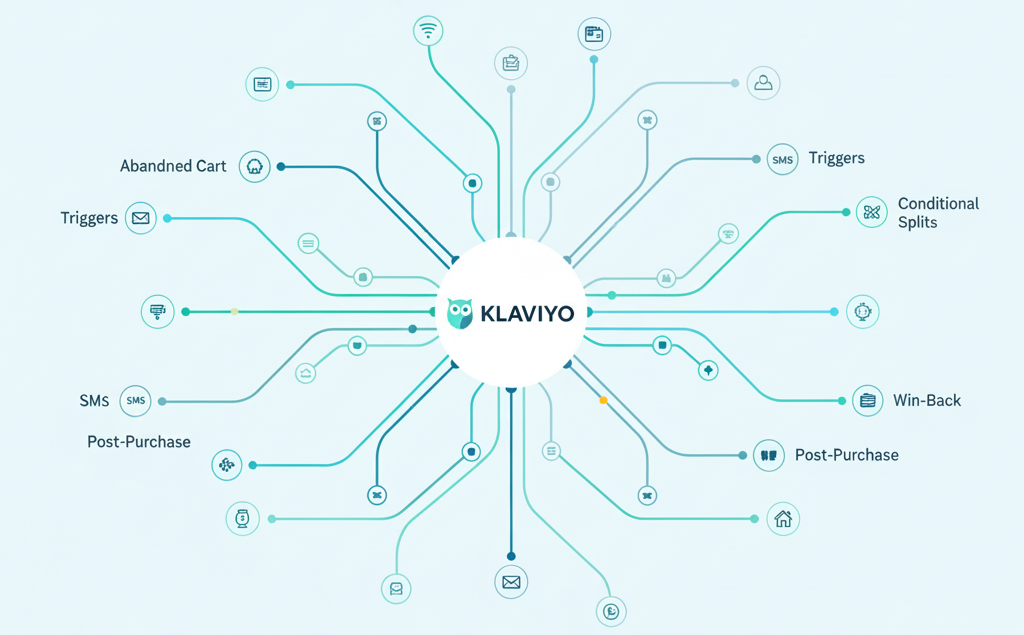
Best Klaviyo Consultants for 100+ Email Flows as We Enter 2026 A Shift Toward Larger Lifecycle Systems Email marketing now plays a central role in how brands hold long term relationships with customers. Many companies that once depended on a small set of automated flows now handle complex customer journeys that stretch across browsing, purchase, repeat purchase, and reactivation. Entering 2026, one hundred flows is no longer unusual for large stores. It has become a practical requirement. A strong Klaviyo consultant helps teams manage this structure with clarity. The work involves segmentation, behavioral data, product cycles, and patient refinement. The agencies listed here have shaped this discipline through steady practice and clear methods. Top 5 Klaviyo Consultants for 2026 Below is an updated list of companies known for designing and maintaining large scale Klaviyo systems. These firms work with expanding stores that rely on stable and predictable lifecycle communication. 1. Product Siddha Country: India and USA Specialty: Full scale email architecture for stores with 100 plus flows Product Siddha supports brands that operate in fast changing environments. The team blends product understanding with data literacy to create large systems that hold steady during growth. Their method is simple but firm. Understand behavior, design meaningful triggers, remove noise, and build flows that reflect real user paths. Service Strengths Email flow systems for stores with wide catalogs Event based segmentation Cross channel behavioral inputs Klaviyo restructuring for stores with uneven performance Full funnel analytics to align email, product, and marketing teams Real Case Example One of Product Siddha’s recent assignments involved a Shopify brand that sought clearer email revenue. The brand already had a set of flows but the performance was unstable. Product Siddha examined event triggers, timing windows, and product signals. After refining the structure, the brand gained a more predictable rhythm in its email program. Revenue increased during the next cycle and the team gained a clearer view of customer behavior at each stage. Why Choose Product Siddha Brands that manage one hundred or more flows need consistency. Product Siddha provides that structure. Their method suits teams that want to grow without losing stability. Recommended For Large stores, multichannel operations, and teams that want lifecycle communication shaped by clear analysis rather than templates. 2. Polaris Growth Country: Netherlands Specialty: Customer journey optimization and CVO Polaris Growth focuses on uncovering hidden revenue opportunities through behavioral research and structured automation. The agency’s founder is known for rigorous data interpretation and a methodical style of lifecycle design. Service Strengths Customer value optimization Conversion research Klaviyo flow architecture Behavioral segmentation Why Choose Polaris Growth Teams that want deeper user understanding often turn to Polaris Growth for its systematic approach to behavior driven messaging. 3. Flowium Country: USA Specialty: High volume ecommerce Klaviyo programs Flowium is one of the widely recognized names in email lifecycle work. The agency supports large stores with structured systems that cover welcome, browsing, post purchase, product specific cycles, and reactivation. Service Strengths Large scale Klaviyo buildouts Email and SMS lifecycle mapping Deliverability and compliance Campaign and flow coordination Why Choose Flowium Flowium suits stores that want a comprehensive system maintained by a large team with clear documentation practices. 4. SmartMail Country: Australia Specialty: High frequency email programs for retail and DTC SmartMail helps brands that manage broad catalogs and seasonal inventory. Their work often involves product feed based personalization, replenishment paths, and long term retention programs. Service Strengths Automated replenishment systems Product recommendation logic Trigger based lifecycle programs SMS and email coordination Why Choose SmartMail The agency fits stores with frequent product changes and a need for simple but effective personalization. 5. Fuel Made Country: USA Specialty: Conversion grounded lifecycle programs Fuel Made builds email systems that follow clear user logic. Their work draws from research into user intent, product cycles, and long term retention. The agency supports stores that want messages that feel natural and well paced. Service Strengths Structured lifecycle writing Klaviyo architecture for growing stores Customer intent research Post purchase and loyalty flows Why Choose Fuel Made Fuel Made works well for teams that prioritize user clarity and want systems that evolve through thoughtful review. Key Comparison Table Agency Location Best Use Case Notable Strength Product Siddha India and USA Stores with 100 plus flows Structured flow systems built on behavior data Polaris Growth Netherlands Customer value optimization Behavioral psychology and automation Flowium USA Large ecommerce programs Full scale deliverability and lifecycle coverage SmartMail Australia Retail and DTC with large catalogs Product feed personalization Fuel Made USA Conversion centered lifecycle work Intent based messaging Understanding Why One Hundred Flows Are Now Common Stores with broad inventories encounter varied buyer paths. Bedding, cookware, seasonal decor, personal care, and gift products each follow different cycles. A single welcome sequence cannot guide all these interactions. Over time, stores expand their flows to reflect product life cycles and user intent. This is why one hundred flows is a practical number for mature ecommerce brands entering 2026. A Path Forward for Growing Teams Lifecycle communication works best when it follows a clear structure. A steady framework helps teams understand where each message belongs and why it exists. When the foundation is sound, new flows can be added without disturbing the overall rhythm. The agencies listed here help stores develop reliable systems that grow over time. They review user patterns, align triggers with real behavior, and refine each stage with careful attention. Their work supports teams that want lasting clarity, steady revenue, and email programs shaped by patient analysis rather than rapid trends. This approach gives brands a stable path forward, especially when the number of flows rises and the customer journey becomes more detailed.