
Product Siddha

Product Management

Blog, Product Management

What Traditional Brokers Can Learn From Product-Led Growth in PropTech

What Traditional Brokers Can Learn From Product-Led Growth in PropTech A Shift Worth Studying Traditional real estate brokerage has long relied on personal networks, local reputation, and negotiation skill. These foundations still matter. Yet over the last decade, PropTech firms have grown by focusing on something brokers rarely formalize. The product itself. Product-led growth in PropTech does not mean replacing relationships with software. It means designing systems that make discovery easier, decisions clearer, and follow-through more reliable. At the center of this shift is disciplined product management, where every feature, workflow, and data point exists to serve a real user need. For traditional brokers, the lesson is not to become technology companies. The lesson is to adopt the thinking that has helped PropTech platforms scale trust and efficiency. Product Thinking Versus Deal Thinking Brokers often operate deal by deal. Each transaction is treated as a standalone effort. PropTech companies think in systems. They ask how one improvement can benefit thousands of users repeatedly. This difference comes down to product management discipline. Product teams map user journeys. They identify friction points. They improve processes incrementally. Brokers, on the other hand, often solve problems manually each time they arise. By studying product-led growth models, brokers can begin to document their processes, identify repeatable actions, and reduce dependence on memory and habit. Learning From Usage Data, Not Gut Feel Traditional brokers rely heavily on experience. Experience matters, but it has limits. PropTech platforms learn from usage data. They track what users search for, where they hesitate, and what prompts action. This approach does not require building an app. It requires observing patterns. Which listings attract repeat views. Which follow-ups lead to site visits. Which documents close deals faster. Product Siddha’s work on Product Analytics for a Ride-Hailing App with Mixpanel illustrates this mindset. While the industry differs, the principle applies. Decisions improved when data revealed real behavior rather than assumptions. Brokers who adopt even basic analytics thinking can refine their approach without losing the human element. Designing for Clarity Over Persuasion Product-led PropTech platforms focus on clarity. Clear pricing. Clear availability. Clear next steps. Traditional brokers often rely on persuasion and verbal explanation to bridge information gaps. From a product management perspective, clarity reduces effort on both sides. Buyers feel informed. Brokers spend less time explaining basics and more time addressing real concerns. This is not about removing conversation. It is about making conversations more productive. In Built Custom Dashboards by Stage, Product Siddha helped teams visualize user progress clearly. Translating this idea to brokerage work could mean standardized listing sheets, consistent follow-up summaries, or clearer site visit documentation. Reducing Friction at Key Moments Product-led growth pays close attention to moments where users drop off. In real estate, these moments are familiar. Missed calls. Delayed responses. Confusing paperwork. Unclear next steps after a site visit. PropTech firms design around these weak points. Automated confirmations. Structured follow-ups. Predictable timelines. One relevant example is From Lead to Site Visit – Voice AI Automation for a Real Estate Platform. In this case, automation reduced early-stage friction without removing human involvement later. Brokers can apply the same thinking by identifying where routine steps slow momentum and simplifying them. Treating Trust as a Product Outcome Trust is often described as intangible. Product-led companies treat it as a measurable outcome. They design features that reinforce reliability. Consistent communication. Transparent status updates. Predictable service quality. For brokers, this can translate into simple practices. Regular status messages. Clear timelines. Written summaries after meetings. These actions feel small, but together they form a dependable experience. Product management teaches that trust grows through repeated positive interactions, not grand gestures. Scaling Without Losing Quality One challenge for successful brokers is scale. As volume increases, quality often slips. Product-led PropTech firms address this through standardization. Not rigid scripts, but shared frameworks. In Product Management for UAE’s First Lifestyle Services Marketplace, Product Siddha helped structure offerings so quality remained consistent as the platform grew. Brokers can adopt similar frameworks. Defined service stages. Standard checklists. Clear ownership at each step. Scaling then becomes manageable rather than chaotic. Feedback Loops That Improve Over Time Product-led growth depends on feedback loops. What worked. What failed. What needs adjustment. This mindset is less common in traditional brokerage, where reflection often happens informally. By introducing simple review cycles, brokers can improve steadily. Post-deal reviews. Client feedback summaries. Pattern tracking across transactions. Product management emphasizes iteration. Brokers who adopt this habit evolve faster than those who rely solely on instinct. Learning From Outside the Industry Several Product Siddha case studies outside real estate offer relevant lessons. Building a Lead Engine After Apollo Shut Us Out shows resilience through system redesign. Driving Growth for a U.S. Music App with Full-Stack Mixpanel Analytics highlights the value of understanding user behavior deeply. These examples reinforce a core idea. Product-led growth principles travel well across industries because they focus on people, not platforms. Why This Matters Now The brokerage model is not broken. It is under pressure. Buyers expect speed, clarity, and consistency. Product-led PropTech firms meet these expectations by design. Traditional brokers who learn from product management do not lose their advantage. They strengthen it. Relationships supported by systems outperform relationships held together by memory alone. A Practical Closing Note Product-led growth is not a technology strategy. It is a way of thinking. It asks simple questions. What do users struggle with. Where do they pause. What makes progress easier. For traditional brokers, adopting this mindset does not require abandoning proven methods. It requires refining them with structure and reflection. Those who learn from PropTech’s product discipline will find their work easier, their clients more confident, and their outcomes more predictable.
Blog, Product Management

How Top Product Teams Turn Customer Signals into Roadmap Decisions

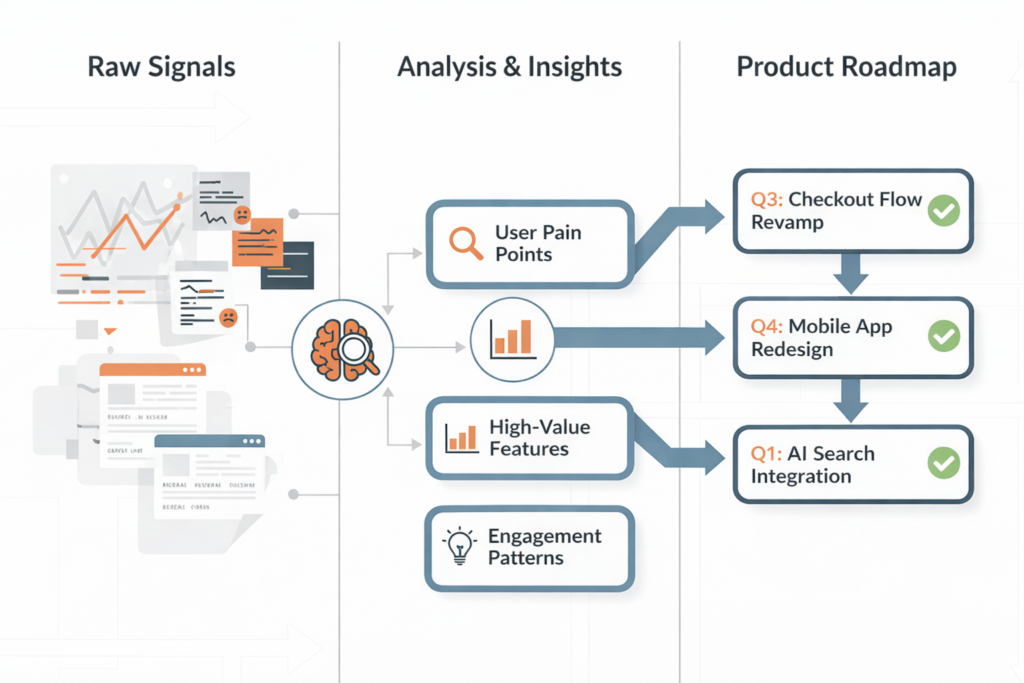
How Top Product Teams Turn Customer Signals into Roadmap Decisions Listening Without Guesswork Every product team claims to be customer-driven. In practice, most teams are surrounded by noise. Feature requests arrive through support tickets. Usage data sits inside analytics tools. Sales teams pass along anecdotes from calls. Founders add instinctive opinions. Somewhere between all this input, roadmap decisions are made. Top product teams handle this differently. They treat customer signals as evidence, not opinions. They do not chase every request or react to the loudest voice. Instead, they build a clear system that converts raw signals into decisions that stand the test of time. This is where disciplined Product Management begins. What Counts as a Customer Signal Customer signals are not limited to feedback forms or survey scores. In strong product organizations, signals fall into three broad categories. First, there is behavioral data. This includes how users move through the product, where they pause, and where they drop off. Second, there is expressed feedback, such as support tickets, call notes, and direct messages. Third, there is outcome data, including retention, expansion, churn, and revenue patterns. The mistake many teams make is treating these sources separately. Product Management works best when these signals are reviewed together, not in isolation. Separating Patterns from Noise Not every signal deserves action. One frustrated customer does not define a roadmap. Ten similar complaints might. A single power user request may reflect edge behavior, not the broader market. Experienced product leaders look for patterns across time and segments. They ask simple questions. Does this behavior repeat? Does it affect a meaningful group of users? Does it connect to business outcomes we care about? In Product Siddha’s work on product analytics for a ride-hailing app using Mixpanel, the team observed that riders were not abandoning the app at checkout, as originally assumed. Instead, they were hesitating earlier, during fare comparison. This insight only surfaced when behavioral data was studied alongside session paths and timing. The roadmap changed as a result. Pricing transparency features were prioritized over payment optimizations. Turning Usage Data into Clear Product Questions Data alone does not shape a roadmap. Interpretation does. Strong Product Management teams translate signals into questions before jumping to solutions. For example, instead of asking, “Should we build feature X,” they ask, “Why are users failing to complete task Y?” This shift keeps teams focused on problems rather than outputs. In the case of a SaaS coaching platform where Product Siddha implemented full-funnel attribution, product leaders initially believed onboarding content was the weak link. Funnel analysis showed a different story. Users were completing onboarding but failing to return in the second week. The roadmap shifted toward habit-building features rather than additional tutorials. The Role of Qualitative Feedback Quantitative signals show what users do. Qualitative signals explain why. Top teams combine both. Customer interviews, support transcripts, and call recordings help product managers understand intent. However, they are used carefully. Teams avoid treating interviews as votes. Instead, they look for repeated themes and language that point to unmet needs. When Product Siddha supported Product Management for the UAE’s first lifestyle services marketplace, interviews revealed that users were less concerned about service variety and more concerned about trust and follow-through. Usage data supported this insight, showing drop-offs after booking. The roadmap shifted toward provider verification and service tracking rather than expanding categories. Prioritization Is Where Discipline Shows Turning signals into decisions requires restraint. Not every validated problem becomes a roadmap item. Teams must weigh impact, effort, and alignment with long-term goals. Strong product leaders use simple prioritization frameworks. They avoid over-engineering scoring models that create false precision. Clear reasoning matters more than complex math. In building custom dashboards by stage for multiple organizations, Product Siddha emphasized clarity over volume. Dashboards highlighted only the signals tied directly to product outcomes. This allowed leadership teams to make roadmap calls with fewer meetings and less debate. Avoiding the Trap of Opinion-Led Roadmaps One of the hardest challenges in Product Management is managing internal pressure. Sales teams want features that close deals. Executives want differentiation. Engineers want technical improvements. Top product teams do not ignore these inputs. They test them against customer evidence. If a proposed feature does not map to a validated signal, it is parked, not rushed. This approach builds trust over time. Stakeholders learn that roadmap decisions are grounded in reality, not preference. Signals Evolve as Products Mature Early-stage products rely heavily on direct feedback and founder conversations. As products scale, behavioral data becomes more reliable. Mature products shift focus toward retention, depth of use, and efficiency. Product teams that fail to adjust their signal mix often stall. They keep listening the same way long after their user base has changed. In the case of building the world’s first AI-powered networking assistant, early roadmap decisions leaned heavily on founder-led interviews. As adoption grew, usage analytics revealed which networking actions delivered real value. The product evolved accordingly. Making Roadmaps Understandable, Not Just Accurate A roadmap is a communication tool. Even the best decisions fail if they cannot be explained clearly. Top Product Management teams articulate why each roadmap item exists. They connect features to signals and signals to outcomes. This clarity helps engineering teams execute with confidence and helps leadership stay aligned. Simple language matters here. Avoiding jargon keeps the roadmap accessible to everyone involved. Where Many Teams Go Wrong Teams struggle when they treat customer signals as validation after decisions are made. Others collect data endlessly without making calls. Both approaches weaken Product Management. The balance lies in steady review cycles, clear ownership, and the willingness to say no. Signals guide decisions. They do not replace judgment. Decisions That Hold Up Over Time Great product roadmaps are not built in isolation or rushed meetings. They are shaped through careful attention to customer behavior, consistent analysis, and thoughtful prioritization. Product Siddha’s experience across analytics, automation, and Product Management shows a common truth. Teams that listen well build products that last. They spend less time reacting

Blog, Product Management

Building a Repeatable Product Launch System with Automation and Analytics

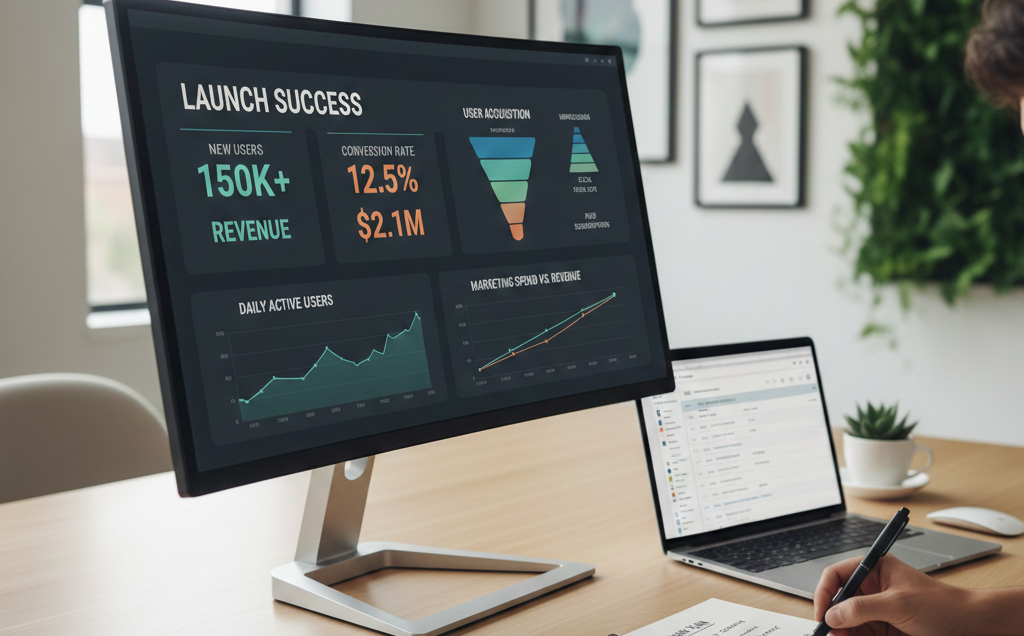
Building a Repeatable Product Launch System with Automation and Analytics Why a System Matters Launching a product for the first time is often chaotic. Teams scramble to coordinate timelines, marketing, development, and feedback. Without structure, you may rely heavily on manual effort, inconsistent tracking, and guesswork. That makes it hard to know what worked and what failed – and even harder to repeat success. What many companies need instead is a repeatable product launch system. Such a system treats a product launch as a process rather than an event. It depends on automation to reduce manual work, and analytics to measure each stage. Over time it becomes a predictable, optimizable workflow. This approach aligns with how Product Siddha operates. Their core framework – Build Real, Learn What Matters, Stack Smart Tools, Launch with Focus – reflects precisely this idea. Key Components of a Repeatable Launch System Component Purpose What to Automate / Measure Defined launch workflow Ensures every launch follows the same steps Task scheduling, notifications, handoffs Analytics instrumentation Captures user behavior and product performance Event tracking (e.g. sign-ups, conversions, churn) Data-driven decision points Allows teams to evaluate and improve after launch Dashboards for adoption, engagement, retention Feedback and iteration loop Enables continuous refinement with minimal friction Automated feedback collection, release triggers based on metrics Scalable tool stack Reduces manual overhead and supports growth Low-code workflows, integrated analytics, unified dashboards How Automation and Analytics Work Together Automation and analytics are not separate helpers – they reinforce each other. Automation ensures repeatability. Analytics ensures insight. Together they make launching less risky, faster, and more informed. For example, automation can handle every non-creative, rule-based task: scheduling deployment, notifying stakeholders, syncing databases, launching promotional emails, generating reports. Analytics then measures how users respond: Are signups rising? Is retention stable? Where do people drop off? Armed with these insights, teams can iterate confidently. Maybe onboarding needs simplification. Maybe messaging around key features must change. Maybe pricing or positioning should shift. Each launch becomes a learning opportunity – and the data ensures learning is grounded in truth, not assumption. Real Example: How Product Siddha Did It When a popular prospecting database became unavailable, Product Siddha shifted from dependence on a third-party tool to building an internal lead-generation engine. They used open tools like Google Maps API, n8n, and Apify to build an automated workflow: scrape live business data, enrich leads via LinkedIn, store clean data in Google Sheets, and schedule periodic updates – all without manual effort. That engine became repeatable. It delivered fresh leads consistently. It cut costs relative to paying third-party subscription prices. It turned a brittle dependence into a stable, controllable system. This same principle applies to product launches. Once you invest in automation and analytics infrastructure, each future launch reuses that foundation – with less friction, lower risk, and clearer measurement. Another example: On a project for a U.S. music-discovery app, Product Siddha implemented full-stack analytics via Mixpanel. The team instrumented key user events: first use, activation, subscription conversion, retention after periods of inactivity. With those analytics dashboards in place, product managers no longer needed to request custom reports. Teams made decisions weekly based on real user behavior. Interface tweaks, growth experiments, and marketing adjustments all came from the same data. That data-driven approach enabled repeatable cycles: launch – measure – iterate – launch. Steps to Build Your Repeatable Launch System Map your ideal launch flow Identify every step needed: development, QA, marketing preparation, pre-launch content, promotion, user feedback, post-launch updates. Write it down. Keep it simple. Automate every repeatable step Use tools like workflow engines (e.g. n8n, Zapier, Make) to automate scheduling, notifications, data sync, content publishing, reporting, etc. The fewer manual handoffs, the fewer chances for error. Instrument analytics from day one Set up analytics to capture meaningful events: user signups, first-time use, feature adoption, conversion, churn. Use reliable tools that support funnel analysis, cohorts, and retention tracking. Build shared dashboards Create visual dashboards where stakeholders (product, marketing, executives) can see launch metrics at a glance. Ensure metrics link to business goals: activation rate, conversion rate, retention, revenue, engagement. Define decision points/triggers Decide ahead of time what metrics determine success or need iteration. For example: If activation < X% after 30 days, revisit onboarding flow. If retention drops below Y% in week 2, adjust messaging. After-action review and documentation After each launch, hold a review. Document what worked, what didn’t, and what should change next time. Store these lessons – they become part of the system. Scale the tool stack as needed As your launches grow in complexity or frequency, ensure your automation and analytics mechanisms scale too. Add data warehouses, experiment tracking tools, cross-platform integrations, or automated regression checks. Why This Approach Beats a One-Off Launch Predictability: With a system in place, you understand roughly how long a launch will take, what resources it needs, and what work remains. Repeatability: Once built, the same flow can be reused for each product or feature launch. Insight: Analytics gives you objective feedback. You know what users do, where you lose them, what features they engage with. Speed and cost efficiency: Automation reduces manual work, lowers risk of human error, and saves time. Continuous improvement: Each launch yields data. Each data point refines future launches. What to Watch Out For Setting up automation and analytics requires investment in time and tools. Initial effort may feel heavy, especially for small teams. It can also create a false sense of security. A system is only as good as the process and data behind it. Poor instrumentation or unclear metrics may lead to misleading conclusions. Regular audits and updates are essential. Also, avoid over-automation. Creative tasks – design, messaging, customer empathy – still need human judgment. Use automation to support people, not replace them. Final Thoughts Building a repeatable product launch system using automation and analytics is not magic. It is discipline, consistency, and smart design. Once you invest in the foundation – clean workflows, automated tools, proper analytics – each future launch

Blog, Product Management

The Systems Thinking Approach: PM Lessons From High-Growth Tech Teams

The Systems Thinking Approach: PM Lessons From High-Growth Tech Teams A Wider View Of Product Work Fast moving product environments often reward speed, but the teams that sustain progress share a common trait. They think in systems. Each choice is examined within a larger web of causes, constraints, and outcomes. This habit shapes how high growth teams solve problems, measure progress, and design products that can endure pressure. Systems thinking helps product managers view their work as a connected structure rather than a string of isolated tasks. It improves judgment, strengthens communication, and helps teams avoid shortcuts that appear efficient but weaken the long term strategy. Product Siddha has seen this pattern in many technology led projects. The presence of systems thinking often marks the difference between scattered improvement and stable growth. What Systems Thinking Looks Like In Practice Systems thinking is not a theory. It is a way of noticing how small decisions create larger effects. When a team adjusts onboarding, there are changes in support volume, activation quality, and data integrity. When pricing changes, there are shifts in conversion patterns, lifecycle length, and churn markers. A product manager who tracks these connections is better prepared than one who focuses on a single outcome. High growth tech teams strengthen this mindset by encouraging slow examination before action. They do not remove speed. They make it purposeful. Lessons From High Growth Teams 1. Focus on the Entire Flow Successful tech teams study the user journey as a continuous chain. Each point in the chain influences the next. They watch how acquisition shapes onboarding, how onboarding affects activation, and how activation influences retention. In the Product Siddha project for a U.S. music app, this pattern became clear. The team used Mixpanel to trace how early listening habits predicted subscription behavior. Instead of treating these metrics separately, the analysis connected them into a single path. The insight helped the client adjust onboarding prompts and improve engagement without additional marketing spend. 2. Map Dependencies Clearly High growth teams do not guess about dependencies. They map systems on paper so that each moving part is visible. This practice helps the team understand how product changes affect sales, support, engineering, and analytics. A dependency map prevents conflict by making responsibilities clear. It also prevents late surprises that slow down launches or distort product direction. 3. Strengthen Feedback Loops Feedback loops sit at the center of systems thinking. They show how the product reacts to user behavior and how the team responds in return. When loops are healthy, the team learns quickly. When loops are weak, problems linger. Good loops rely on timely and accurate data. They also rely on interpretation. A metric without context often leads to confusion. High growth teams use structured reviews so that every change is measured against the system rather than a single number. 4. Reduce Friction Gradually Systems rarely change through large leaps. They shift through a series of small, steady actions. High growth teams act with patience. They examine each point of friction and remove it carefully. This approach prevents instability and reduces the cost of mistakes. It also encourages calm decision making, which preserves clarity during pressure. 5. Build Shared Mental Models A team that shares the same mental model wastes less time. Engineers, designers, analysts, and product managers understand the boundaries of the system and how each feature affects the whole. Shared models help teams move in one direction without frequent correction. It also builds trust, since decisions feel grounded in a common understanding. Real Example From Product Siddha: Custom Dashboards By Stage Among the projects completed by Product Siddha, the custom dashboard initiative offers a clear view of systems thinking in action. The client faced scattered visibility across growth stages. Teams looked at different data sets, which created uneven interpretation and slow decisions. Product Siddha built a stage based dashboard system that tied acquisition, activation, retention, and revenue into a unified view. This shift turned the product workflow into a clear system. Each team could see how its actions influenced the rest of the product. Once the system became visible, the company reduced redundant reporting, improved prioritization, and made more confident product choices. A Simple Table To Add Clarity Systems Thinking Element What It Means How Tech Teams Use It Inputs Early signals that guide choices Research, analytics, interviews Interactions How each part affects another Feature dependencies and workflows Loops Cycles that reinforce learning Reviews, metrics, iteration Delays Time gaps between action and effect Rollout impact and adoption windows Boundaries Limits of what the team controls Technical, legal, or resource limits A Short Scenario From Everyday Product Work Consider a marketplace platform that sees a drop in conversion. A quick fix might involve adjusting prices or redesigning a banner. A systems approach studies the relationship between search relevance, listing quality, and trust signals. It examines how long new users take to understand the service and how support questions flow during peak traffic. By looking at the whole structure, the team often finds subtle causes. These discoveries lead to calm decisions rather than reactive changes. High growth teams rely on this method because it reduces long term risk and keeps the product stable even during rapid expansion. A Broader Insight For Product Teams Product work thrives when teams view each decision as part of a living structure. Systems thinking sharpens this awareness. It encourages longer observation, measured responses, and stronger communication. It supports practical judgment at each stage of product development. Product Siddha continues to work with companies that want thoughtful product environments built around stable systems. Whether the focus is analytics, automation, or growth strategy, systems thinking stays at the center of long lasting progress.

Blog, Product Management

Monolithic vs Microservices: Features, Pros & Cons, and Real-World Use Cases

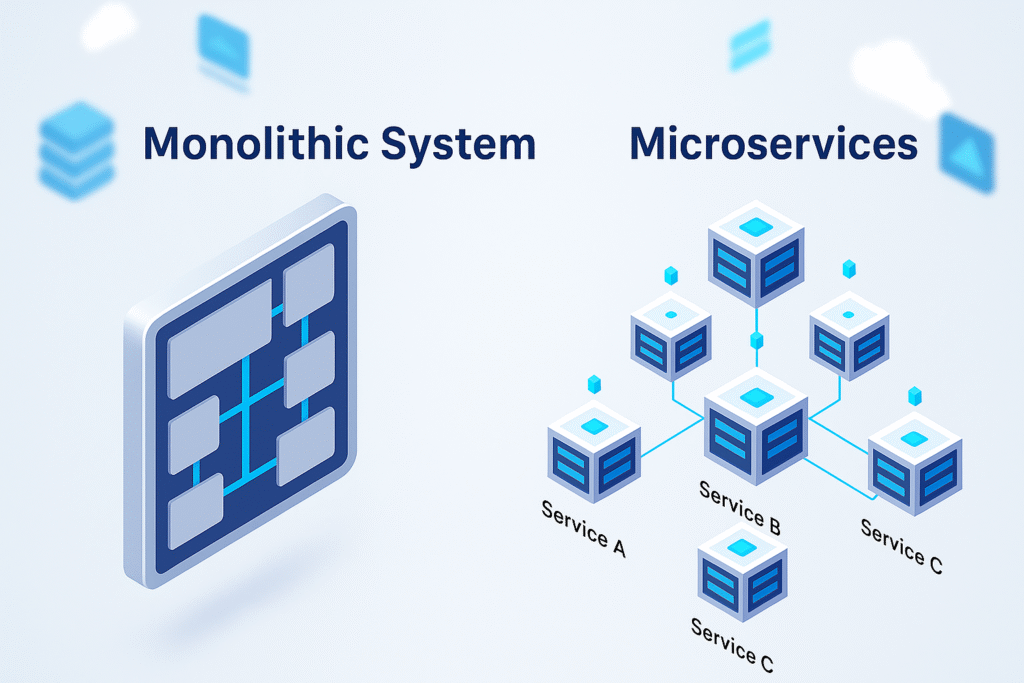
Monolithic vs Microservices: Features, Pros & Cons, and Real-World Use Cases Understanding the Shift in Software Architecture As digital systems become more complex and interconnected, businesses face a key architectural choice: whether to build using a monolithic model or adopt a microservices framework. This decision can shape the speed of innovation, scalability, and long-term maintenance of products. For product managers, engineering leaders, and organizations scaling their digital platforms, understanding both models is crucial before committing to a structure that will define how teams operate and how technology evolves. What Defines Monolithic Architecture A monolithic architecture is a single, unified codebase where all components of an application – user interface, business logic, and data management – are interconnected and run as a single service. This traditional model has long been used by enterprises because it provides simplicity in deployment and consistency across modules. Key Features of Monolithic Systems All components share a single database and code repository. Easier to develop in the early stages since fewer moving parts are involved. Deployment is centralized, meaning the entire system updates at once. Strong internal consistency, reducing integration challenges across services. Advantages Simplicity in development: Easier for smaller teams to build and manage. Performance efficiency: Direct communication between components without network latency. Ease of debugging: A unified codebase allows for faster issue identification during early stages. Limitations Scalability challenges: The entire system must scale even if only one component experiences heavy load. Slower updates: A small change often requires redeploying the whole application. Technology lock-in: Difficult to integrate modern technologies or frameworks over time. Many early-stage startups choose a monolithic design for its straightforward development. However, as user bases grow, this structure often becomes harder to scale efficiently. What Defines Microservices Architecture A microservices architecture divides an application into smaller, independent services that communicate through APIs. Each service focuses on a single function and can be developed, deployed, and scaled independently. Key Features of Microservices Independent deployment pipelines for each service. Services communicate via lightweight protocols such as REST or gRPC. Teams can use different programming languages or frameworks for different services. Strong boundary between services improves fault isolation. Advantages Scalability: Each service can scale separately, improving resource efficiency. Faster deployment: Teams can roll out updates to individual services without affecting the whole system. Technological flexibility: Different tools can be used for different components. Resilience: A failure in one service does not take down the entire system. Limitations Operational complexity: Requires strong coordination among distributed services. Data management challenges: Each service may need its own database, complicating data consistency. Increased overhead: Monitoring, logging, and inter-service communication add complexity. Microservices are ideal for organizations that prioritize agility, modular growth, and rapid feature deployment. Side-by-Side Comparison Feature Monolithic Architecture Microservices Architecture Structure Unified codebase Independent modules Scalability System-wide scaling Service-specific scaling Deployment Single deployment Independent deployments Maintenance Simple at small scale Easier at large scale Technology Flexibility Limited Highly flexible Failure Impact Affects entire system Isolated to specific service Best For Startups and small applications Large, complex, and evolving platforms Real-World Use Cases When Monolithic Works Best Smaller platforms with limited features benefit from monolithic systems. Early versions of Shopify and Basecamp, for instance, began as monoliths because of their simpler development and deployment needs. At Product Siddha, a similar approach was used during the early design of the Lead Engine project (“Building a Lead Engine After Apollo Shut Us Out”). Initially, a monolithic framework helped quickly consolidate data pipelines and automate outreach from a single dashboard. Once user growth expanded, the structure was gradually modularized, allowing selective optimization of core processes. When Microservices Excel Microservices have become the backbone of modern software ecosystems such as Netflix, Amazon, and Uber. These platforms require rapid updates, scalability, and service independence. A relevant case is Product Siddha’s work with a U.S. Music App (“Driving Growth for a U.S. Music App with Full-Stack Mixpanel Analytics”). The app used multiple microservices for event tracking, audience segmentation, and performance insights. This distributed structure allowed the client to scale listener analytics independently while continuing to evolve the recommendation engine. In another engagement, AI Automation Services for a French Rental Agency (MSC-IMMO), Product Siddha implemented modular AI workflows where each service – data extraction, pricing prediction, and lead scoring – operated independently. This microservices architecture enhanced agility and simplified maintenance across evolving datasets. Choosing Between Monolithic and Microservices There is no universal answer. The right architecture depends on scale, budget, and the maturity of development practices. However, several guiding principles can help in decision-making: Start Simple, Then Evolve: Many successful products begin with a monolith and transition to microservices as demands grow. Assess Team Capabilities: Microservices require DevOps maturity and strong monitoring infrastructure. Consider Future Scalability: If long-term growth and global distribution are priorities, investing early in modular architecture may reduce future migration costs. Prioritize Data Flow: Consistency and communication between modules are as vital as code design. A well-planned transition strategy ensures that technical evolution supports business growth rather than disrupting it. Building for the Future The evolution from monolithic to microservices reflects how digital businesses are adapting to faster innovation cycles. Microservices offer flexibility and scale, while monolithic systems provide simplicity and focus in the early stages. For product managers, the challenge lies not just in choosing the right framework but in aligning that choice with user experience, team capability, and strategic vision. At Product Siddha, we help businesses make these transitions with data-driven architecture planning, AI-powered analytics, and custom dashboard development that ensure each product evolves with clarity and control.

Blog, Product Management

6 App Architecture Best Practices to Build a Future-Ready App

6 App Architecture Best Practices to Build a Future-Ready App Building the Foundation of Modern Digital Systems The foundation of every successful digital product lies in its architecture. Whether you are developing a mobile banking platform, a health tracker, or a B2B SaaS tool, the structure behind the interface determines how well your app performs, scales, and adapts to change. At Product Siddha, app architecture design has evolved from simple frameworks into a practice that combines engineering precision, business logic, and user insight. The aim is not only to build functional systems but to create future-ready apps that can integrate with new technologies without disruption. 1. Prioritize Modular Architecture A modular approach divides an application into smaller, independent components that can function and scale on their own. This practice supports long-term flexibility and reduces the risk of failure when one part of the system needs updates. Product Siddha applies this principle in projects such as Pointy – UAE’s first lifestyle services marketplace, where the app architecture was designed with modular components for the vendor, consumer, and AI co-pilot systems. Each module operated independently to manage bookings, recommendations, and data synchronization. This modular design allowed the team to release updates for one section without interrupting others, enabling faster iterations, reduced dependencies, and easier scalability as the platform expanded into new service categories. In modern app ecosystems, modular architecture ensures that development teams can experiment, deploy faster, and maintain stability across releases. 2. Build for Scalability, Not Just Launch Many apps are designed to perform well on release day but struggle under real-world growth. Scalable architecture prevents this problem by planning for higher workloads, more users, and larger data volumes from the beginning. A future-ready app must include cloud-native components, efficient database management, and a load-balanced backend. Product Siddha’s development teams use containerization and microservices-based design to distribute workload efficiently. For instance, an investment platform project handled by Product Siddha for a fintech company was designed to process data from multiple exchanges in real time. By integrating a scalable architecture, the system maintained consistent speed and reliability even during peak trading hours. 3. Adopt the Right Microservices Strategy Microservices architecture has become the backbone of many enterprise applications. Instead of one large, interdependent system, microservices allow each function to run as a separate service. The advantage lies in agility and fault tolerance. A single service can be updated or replaced without downtime. However, this approach requires careful orchestration and secure API communication. In Product Siddha’s AI Automation project for MSC-IMMO, a French real estate platform, microservices enabled automation in lead handling and email scheduling. Each function ran independently but communicated through a secure API framework. The design allowed the system to scale and integrate easily with CRM tools and property databases. This example demonstrates how thoughtful architecture can make automation seamless while keeping the system adaptable to future upgrades. 4. Strengthen Data Flow and Security Data is the lifeblood of every digital product. The way data moves across your app determines performance, reliability, and compliance. A well-designed architecture ensures data integrity through structured APIs, encrypted communication, and minimal redundancy. Security should be built into the architecture itself, not treated as an afterthought. Encryption, token-based authentication, and regular audits must form part of the core design process. Product Siddha’s implementation of analytics dashboards using Mixpanel and Amplitude reflects this approach. The data pipelines were secured and optimized to deliver precise user insights while protecting sensitive customer information. As a result, clients could make informed business decisions without compromising user trust. 5. Integrate Continuous Delivery and Monitoring Modern app architecture does not end at deployment. It evolves through monitoring, analytics, and continuous integration. A Continuous Integration/Continuous Delivery (CI/CD) pipeline allows developers to push updates automatically and maintain stability. Product Siddha integrates CI/CD pipelines into every architecture strategy. Automated testing tools identify potential issues before deployment, and continuous monitoring systems track real-time app performance. This method shortens development cycles, reduces manual errors, and ensures faster time to market. A robust monitoring system also helps teams react quickly to issues, preventing costly downtime or data loss. 6. Design for Interoperability and Future Technologies The pace of technological change demands that applications be open to integration with emerging tools. Designing for interoperability ensures that future technologies like AI, IoT, and blockchain can connect with existing systems without extensive redevelopment. A future-ready app architecture uses standardized APIs, event-driven systems, and loosely coupled services. It is not limited by the platform it runs on but open to interaction with others. When Product Siddha built automation for a VC firm’s AgriTech platform, interoperability played a crucial role. The app could communicate with multiple data sources, marketing tools, and social platforms without manual intervention. This flexibility allowed the client to adopt new analytics and automation tools over time, keeping the app relevant and efficient. Layer Description Tools/Technologies Presentation Layer User interface, front-end logic React, Flutter, Swift Business Logic Layer Core app rules, microservices Node.js, Python, Java Data Layer Database management, caching MongoDB, PostgreSQL, Redis Integration Layer API Gateway, security, analytics GraphQL, OAuth, Mixpanel Deployment Layer CI/CD, monitoring, cloud hosting Docker, AWS, Jenkins The Product Siddha Approach Building a future-ready app is not about adopting every new trend. It is about constructing an adaptable foundation that supports innovation, user experience, and security. Product Siddha’s approach to App Architecture combines data-driven design with practical engineering, ensuring that every product can grow with its users. From analytics-based design decisions to scalable infrastructure, every architectural element serves a clear purpose – to create reliable, adaptable, and human-centered apps. Shaping the Next Generation of Digital Products App architecture defines how an idea becomes an enduring digital experience. As businesses face increasing complexity, a well-structured foundation ensures that innovation remains stable and secure. Product Siddha’s expertise in building modular, data-driven, and AI-compatible architecture helps clients move from concept to scalable success. The goal is clear: create systems that are not only efficient today but ready for the technologies of tomorrow.

Blog, Product Management

Product Management 2.0: Leveraging AI Co-Pilots for Faster Product Discovery and Delivery

Product Management 2.0: Leveraging AI Co-Pilots for Faster Product Discovery and Delivery In the evolving world of digital products, speed and precision define market leaders. The traditional product management framework, fueled by human intuition, manual research, and stakeholder syncs, is giving way to something far more intelligent and dynamic: Product Management 2.0, where AI Co-Pilots empower teams to discover, validate, and deliver products at unprecedented speed and accuracy. This isn’t a futuristic concept anymore – it’s happening now. What Is Product Management 2.0? Product Management 2.0 represents the next generation of product strategy, one where artificial intelligence becomes a trusted partner across the product lifecycle. It’s not about replacing human insight – it’s about augmenting it. In this evolved model, AI tools act as Co-Pilots, assisting in every stage of product development – from analyzing market signals and prioritizing features to generating user stories and even optimizing release cycles. Think of it as an intelligent product assistant that: Synthesizes market data in seconds Predicts customer needs with higher accuracy Reduces decision fatigue by offering data-backed recommendations Streamlines delivery through automated workflows In essence, Product Management 2.0 transforms PMs from coordinators into strategic innovators. The Rise of AI Co-Pilots in Product Teams Over the past year, AI-driven product management tools like Productboard’s AI assistant, Jira’s AI summaries, and Aha! Ideas Co-Pilot have rapidly entered mainstream workflows. But what’s truly revolutionary isn’t just automation – it’s intelligence amplification. AI Co-Pilots can: Parse through thousands of customer feedback points and highlight patterns. Generate and prioritize hypotheses based on quantitative and qualitative signals. Simulate product-market fit scenarios before a single prototype is built. Auto-generate backlog items, acceptance criteria, and even sprint goals based on user data. These capabilities enable product managers to spend less time in reactive data wrangling and more time crafting strategy and innovation. Faster Product Discovery with AI Intelligence Discovery has always been the most critical – and time-consuming – phase of product management. But AI Co-Pilots are turning weeks of research into hours. 1. Data-Driven Insights Instead of manually aggregating feedback from surveys, support tickets, and social media, AI tools can instantly summarize recurring pain points. Natural Language Processing (NLP) models can analyze sentiment, detect emerging themes, and even quantify customer urgency. 2. Predictive Market Analysis AI can forecast trends by scanning public forums, competitor updates, and market reports. It can spot gaps that human teams might overlook—identifying potential product opportunities before the competition reacts. 3. Smart Persona Refinement AI Co-Pilots can dynamically update user personas based on evolving behaviors and engagement data. Instead of static audience definitions, product teams now operate with living personas that evolve with real-time insights. In short, AI transforms discovery from an exploratory journey into a continuous, data-informed feedback loop. Accelerating Product Delivery with Automation and Intelligence Once the right opportunity is identified, the next challenge is delivery – turning ideas into features and features into live products. AI Co-Pilots help product teams accelerate delivery pipelines in three critical ways: 1. Smarter Prioritization AI can cross-reference customer value, technical feasibility, and ROI to suggest backlog priorities dynamically. Instead of endless debates over what comes next, teams get instant clarity backed by metrics. 2. AI-Powered Sprint Planning With historical project data, AI tools can predict sprint capacity, suggest optimal task distribution, and flag potential blockers before they escalate. This enables truly adaptive agile cycles. 3. Automated Documentation and Communication AI assistants can draft release notes, update roadmaps, and generate stakeholder summaries in seconds—freeing PMs from administrative overload. The result? Shorter release cycles, fewer errors, and faster iterations. The Strategic Edge: Human + AI Collaboration The fear that AI might replace product managers is misplaced. The real competitive advantage lies in collaboration. AI excels at pattern recognition, data synthesis, and prediction. Humans excel at empathy, creativity, and vision. Together, they form a hybrid intelligence – a partnership that blends analytical precision with strategic storytelling. Imagine this scenario: The AI Co-Pilot analyzes thousands of user reviews and surfaces a common frustration. The PM interprets the emotional context, aligns it with business goals, and redefines the product narrative. The design and engineering teams act on clear, validated insights—cutting months from the product cycle. This is Product Management 2.0 in action – where technology amplifies human judgment instead of replacing it. Practical Tools and Frameworks to Adopt Today Forward-thinking organizations are already deploying AI Co-Pilots through platforms like: Notion AI for generating product specs and summaries Amplitude and Mixpanel for behavior-driven analytics Jira AI for project automation ChatGPT / Claude / Perplexity for idea validation and research acceleration Productboard AI for customer feedback clustering To make the most of these tools, companies must establish a Product Intelligence Framework – an operational model where AI-driven insights feed directly into product strategy, roadmaps, and delivery plans. Challenges and Ethical Considerations While the benefits are enormous, integrating AI Co-Pilots comes with challenges: Data Quality: AI is only as good as the data it learns from. Incomplete or biased datasets can lead to misleading recommendations. Human Oversight: Over-reliance on AI can erode strategic thinking. PMs must remain the ultimate decision-makers. Transparency: Product teams should clearly document AI-driven decisions to maintain accountability and trust. Ethical, human-centered use of AI ensures that automation enhances, not undermines, the core values of product leadership. The Future of Product Management: Continuous Intelligence The next frontier isn’t just AI-assisted product management – it’s AI-native product ecosystems. We’re moving toward platforms that autonomously detect customer friction, test UI variations, and suggest roadmap pivots in real-time. Product teams will operate in a continuous loop of discovery → delivery → learning, all accelerated by intelligent systems that never stop analyzing. In this future, the best product managers won’t just manage products, they’ll orchestrate intelligence. Final Thoughts Product Management 2.0 isn’t about adding more tools; it’s about evolving mindsets. With AI Co-Pilots, product leaders can shift from reactive planning to proactive innovation. By harnessing the combined power of human creativity and machine intelligence, companies can move from insights to impact faster than ever

Blog, Product Management

5 Ways Companies Are Going Green with Sustainable Tech

5 Ways Companies Are Going Green with Sustainable Tech The Green Revolution in Technology Climate change is no longer a distant concern. Companies across industries are rethinking how they operate, and technology has become a critical tool in the shift toward sustainability. From reducing carbon footprints to optimizing resource use, sustainable tech is transforming how businesses balance growth with environmental responsibility. At Product Siddha, we have seen organizations use intelligent automation and data-driven systems to cut waste, lower energy consumption, and make smarter decisions. The goal is not just compliance or good publicity. It is about building systems that work better while using less. Here are five practical ways companies are going green with sustainable technology. 1. Automating Operations to Reduce Energy Waste Manual processes consume more than just time. They often lead to inefficient use of resources, whether that means running systems longer than needed or duplicating work that could be automated. Automation reduces this waste by creating systems that run only when necessary and stop when the job is done. For example, automated workflows can turn off servers during non-peak hours, schedule tasks during low-energy periods, or trigger actions based on real-time data rather than fixed schedules. Product Siddha recently worked with a French rental agency, MSC-IMMO, to build a zero-touch lead intake system. The AI automation handled email responses, scheduled property visits, and sent reminders without any manual intervention. This removed the need for staff to monitor inboxes constantly or leave systems running overnight. The result was a leaner operation that used less energy and freed up human resources for higher-value work. When businesses automate repetitive tasks, they reduce the need for always-on infrastructure. Fewer active systems mean lower electricity consumption, which translates directly into a smaller carbon footprint. 2. Building Lightweight Tools Instead of Relying on Heavy Platforms Many companies default to large, resource-heavy software platforms that require constant updates, high server loads, and significant energy to maintain. These platforms often include features most users never touch, yet they still consume power and bandwidth. A smarter approach is to build lightweight, custom tools that do exactly what is needed and nothing more. These tools run faster, use fewer resources, and can be hosted on smaller, more efficient servers. Product Siddha experienced this firsthand when a major lead generation tool shut down access. Instead of switching to another bloated platform, the team built a custom lead engine using open tools like Google Maps, Apify, and n8n. The system pulled live business data, found decision makers, and automated outreach without the overhead of a full enterprise platform. This lean approach meant lower energy consumption, faster processing, and better control over data flow. The system was designed to run efficiently and scale only when needed, avoiding the constant resource drain of traditional software. Companies that build lean also reduce electronic waste. Custom systems have longer lifespans because they are easier to maintain and update. They do not require constant hardware upgrades to support bloated software updates. 3. Using Data Analytics to Optimize Resource Allocation Waste often hides in the data. Companies produce, ship, and store more than they need because they lack visibility into actual demand patterns. Sustainable tech helps solve this by using analytics to predict needs more accurately and allocate resources more efficiently. For a U.S. music app called Snobs, Product Siddha set up full-stack analytics using Mixpanel. The system tracked user behavior at every stage, from first swipe to paid subscription. This data showed which features users engaged with most and which ones were ignored. Armed with this information, the product team could focus development resources on high-impact features and cut back on low-value ones. This meant less wasted engineering time, fewer unused features consuming server space, and a more efficient product overall. In another case, Product Siddha built an AI stock advisor for an investor focused on the Indian equity market. The system pulled real-time portfolio data, analyzed stock fundamentals, and calculated technical indicators like RSI and MACD. By automating this research, the client cut manual work by 75 percent, which also meant less time spent running multiple platforms and tools. Better data leads to better decisions, and better decisions reduce waste. Whether it is inventory, energy, or human effort, analytics helps companies use only what they need. 4. Shifting to Cloud Infrastructure with Smart Controls Cloud computing has environmental trade-offs. On one hand, cloud providers operate massive data centers that consume enormous amounts of energy. On the other hand, they achieve economies of scale that most individual companies cannot match. The key is using cloud infrastructure smartly. Companies can reduce their cloud footprint by implementing controls that scale resources up or down based on actual demand. This prevents over-provisioning, where servers sit idle but still consume power. Product Siddha applied this principle when building the AI stock advisor. The system used n8n to orchestrate workflows and control API usage, ensuring that data pulls and calculations only happened when market conditions changed. This prevented unnecessary processing and kept costs and energy use low. For the Agri-Tech and FoodTech VC fund, Product Siddha built an automated content pipeline that scanned Reddit, filtered relevant posts, and generated tweets using AI. The system ran on scheduled triggers rather than continuously, which meant it only activated when needed. Smart cloud controls also extend hardware lifespan. When companies avoid maxing out their infrastructure, equipment lasts longer and replacements happen less frequently. This reduces the environmental impact of manufacturing and disposing of hardware. 5. Enabling Remote Work Through Digital Collaboration Tools One of the most direct ways technology supports sustainability is by reducing the need for physical commutes. Remote work cuts carbon emissions from transportation, reduces office energy consumption, and lowers the overall environmental footprint of business operations. Digital collaboration tools make this possible. Project management platforms, video conferencing, cloud storage, and real-time analytics allow teams to work effectively from anywhere. The environmental benefit is immediate and measurable. Product Siddha operates as a fully remote team, relying on tools like

Blog, Product Management

Product Management for MENA Region Startups: Unique Trends and Solutions

Product Management for MENA Region Startups: Unique Trends and Solutions Navigating Product Management in the MENA Startup Landscape The startup ecosystem in the Middle East and North Africa (MENA) is evolving at remarkable speed. From fintech and e-commerce to logistics and lifestyle apps, founders are redefining how technology serves consumers across culturally and economically diverse markets. Yet, applying global product management frameworks directly to the MENA region often falls short. Local differences in user behavior, regulation, language, and funding expectations demand product strategies that are regionally grounded and agile. At Product Siddha, we’ve seen firsthand how combining global frameworks with MENA-specific insights helps startups move from MVP to market leadership efficiently. Distinct Trends Shaping MENA Startups 1. Rapid Mobile-First Adoption MENA is one of the world’s most mobile-driven regions. According to GSMA, over 95% of internet users access the web primarily through smartphones. This mobile-first reality drives startups like Careem (UAE) and Mrsool (Saudi Arabia) to design apps with minimal data usage, fast loading times, and intuitive interfaces optimized for one-hand use. Product managers in the region must think mobile-first from the earliest design phase – prioritizing performance, localization, and offline resilience. 2. Fintech and Digital Payment Evolution While the UAE and Saudi Arabia lead in digital wallet adoption, countries like Egypt and Morocco still depend heavily on cash-on-delivery (COD). This payment diversity challenges product teams to design hybrid payment flows that accommodate both modern and traditional preferences. Successful regional examples include Tabby and Tamara, two Saudi-based fintech startups that built “buy now, pay later” solutions customized to Gulf consumer behavior. Such models prove that adapting to local payment culture is essential for conversion and trust. 3. Culturally Sensitive UX and Localization Designing for MENA means understanding deep cultural nuances – from right-to-left (RTL) text orientation to imagery and tone that resonate locally. Startups like Anghami, the Beirut-born music streaming platform, localized everything from language to content curation to reflect Arab pop culture. Effective product management in MENA therefore means testing UX across language groups, integrating local festivals or events, and ensuring inclusive visuals aligned with regional norms. 4. Investor Expectations and Growth Discipline MENA’s venture landscape is maturing. Investors expect data-backed product roadmaps, measurable KPIs, and visible traction. Founders must demonstrate not just innovation, but repeatable, scalable systems. Startups like WaffarX (Egypt’s first cashback app) exemplify this mindset – starting lean, proving early product-market fit, and scaling only once retention metrics showed stability. Challenges Unique to Product Management in MENA Fragmented Regulation: Each country enforces distinct data and fintech laws (e.g., DIFC in UAE vs. SAMA in Saudi Arabia), making compliance a core product function. Diverse Consumer Behavior: Urban vs. rural digital habits vary widely – even within the same nation – requiring adaptive segmentation strategies. Talent Gaps: Product management is still a growing discipline in the region, so training and structured playbooks are key to scaling teams effectively. A Framework for MENA-Focused Product Management 1. Market and User Research Start with localized discovery, combine field surveys, user interviews, and region-specific analytics to validate hypotheses. Understanding cultural and payment preferences should drive feature prioritization. 2. Build Mobile-First MVPs Focus on lightweight MVPs designed for 3G/4G reliability. Use real device testing across Android and iOS to ensure performance in bandwidth-limited environments. 3. Continuous Feedback Loops Adopt agile, data-led iteration cycles. Early adopters in MENA often act as micro-influencers; use their insights to refine usability and engagement flows. 4. Scalable Integrations When scaling regionally, integrate with local APIs and ecosystem partners (payment gateways, SMS providers, CRMs). This ensures compliance and seamless cross-border operations. Real Case Study: Product Management for UAE’s First Lifestyle Services Marketplace A UAE-based startup, Pointy, partnered with Product Siddha to launch the country’s first lifestyle services marketplace, offering beauty, wellness, and fitness bookings on one platform. Challenges: Disconnected vendor systems Lack of unified UX for salons and gyms Need for an AI-powered recommendation system Approach: Developed a clear product roadmap aligning vendors, users, and investors Built three synchronized products – a vendor portal, B2C mobile app, and AI co-pilot for personalized recommendations Ensured a mobile-first design compatible with Arabic and English users Results: Achieved early market validation with five active salons in the first month Delivered measurable traction that helped attract investor interest Demonstrated scalable potential for lifestyle service aggregation across the MENA region Lessons from Leading MENA Startups Startup Core Strategy Product Insight Careem (UAE) Hyper-localized UX, logistics innovation Built ride-hailing features around regional infrastructure gaps Tabby (KSA) BNPL model for GCC consumers Adapted fintech flows to high smartphone adoption & low credit card usage Anghami (Lebanon) Region-first music streaming platform Culturally curated content and Arabic-first app experience Pointy (UAE) Lifestyle marketplace Full-stack product management from roadmap to MVP execution Key Takeaways for Product Managers in MENA Prioritize Local Insights – Data from regional users should define product direction, not global assumptions. Design Mobile-First – User experience must be seamless even on older devices and networks. Balance Compliance with Agility – Regulatory adherence should integrate smoothly into sprints. Iterate Constantly – Validate every release through small, controlled market tests. Architect for Scale – Build modular systems that expand easily across GCC and North Africa. Building Scalable Success in the MENA Region Product Management in MENA requires a rare blend of cultural empathy, agile execution, and data-driven clarity. The most successful startups, from Careem to Anghami, share one common thread: they built products for MENA users, not just in MENA markets. At Product Siddha, our mission is to help startups achieve that same alignment, combining regional insight with global product discipline. By designing mobile-first, compliance-aware, and user-centric products, MENA startups can scale confidently in one of the world’s most exciting and fast-changing digital ecosystems.

Blog, Product Management

OKRs for Product Teams: Aligning Strategy, Execution, and Growth

OKRs for Product Teams: Aligning Strategy, Execution, and Growth Driving Alignment in Product Teams A Product Team performs at its best when everyone is pulling in the same direction – when the goals are clear, priorities are understood, and execution aligns with strategy. Objectives and Key Results (OKRs) give teams this clarity. Instead of vague targets or top-down directives, OKRs create a transparent system that connects long-term company goals with daily work. At Product Siddha, we’ve seen that teams using OKRs gain sharper focus, stronger accountability, and faster progress toward measurable outcomes. Unlike traditional goal-setting, OKRs push teams to define what truly matters and how success will be measured. This focus helps eliminate confusion, align cross-functional teams, and reduce the friction that often comes from competing priorities. Why OKRs Matter for Product Teams For modern product teams – juggling customer demands, stakeholder expectations, and market shifts – OKRs serve as a unifying compass. They deliver: Strategic Alignment: Translating company vision into product-level goals. Focused Execution: Prioritizing high-impact work instead of reacting to every request. Measurable Growth: Tracking tangible outcomes tied to user or revenue impact. Cross-Functional Collaboration: Bringing design, engineering, and marketing into a shared framework. When implemented correctly, OKRs help product teams continuously evaluate performance, adapt quickly, and maintain alignment with the organization’s broader strategy. Building OKRs for Product Teams Step 1: Define Objectives Objectives should inspire and stretch the team – yet remain achievable. For example, an objective might be: “Improve the user onboarding experience for our SaaS platform.” This objective focuses the team on user value rather than just deliverables. Step 2: Identify Key Results Key results must be measurable and time-bound. Example: Increase 7-day user retention from 45% to 60% Reduce onboarding drop-off rate by 25% Step 3: Align Across Teams OKRs work best when everyone can see how their work fits the bigger picture. Product, engineering, design, and marketing should all share visibility into OKR dashboards and progress metrics. Step 4: Track and Adjust Regular reviews – often weekly or bi-weekly – allow teams to refine priorities and pivot when needed. Transparency builds motivation and accountability. Case Study: Google’s OKRs Spark a Global Movement Google popularized OKRs shortly after their early adoption in 1999. The company’s leaders used OKRs to translate their audacious mission – “organize the world’s information” – into measurable outcomes. For example, the Chrome browser team used OKRs to improve page load speed and adoption rates. These measurable goals led to Chrome capturing over 60% of the global browser market within a decade. The key takeaway for product teams: OKRs don’t just guide execution; they help define what success looks like and make progress visible. Case Study: Spotify’s Squads and OKRs Spotify, famous for its “Squad” model, uses OKRs to keep hundreds of autonomous product teams aligned. Each squad sets quarterly OKRs that tie directly to broader company themes – such as engagement, user retention, or discovery. This approach allows flexibility in execution but consistency in direction. For example, when Spotify launched its podcast expansion, OKRs focused on improving daily active listening time and creator onboarding speed, both of which helped drive platform growth in new markets. Case Study: Product Siddha’s Work with a SaaS Platform A fast-scaling SaaS company partnered with Product Siddha to improve product development alignment. The team struggled with feature overload and unclear priorities. Approach: Conducted OKR workshops across product, design, and engineering teams Created measurable results tied to adoption, churn reduction, and time-to-market Integrated OKRs into Jira dashboards for transparent tracking Results: Time-to-market for key features dropped by 30% Product adoption grew 20% within three months Collaboration between engineering and product improved dramatically This project proved that structured OKRs can bring order, focus, and momentum to even fast-paced SaaS environments. Best Practices for Product Teams Using OKRs Limit the number of OKRs: Focus on 3–5 key objectives per quarter. Ensure measurability: Every key result should have a clear, trackable metric. Set ambitious targets: OKRs should challenge teams without demotivating them. Integrate with daily tools: Link OKRs into systems like Asana, Jira, or ClickUp for visibility. Reflect and recalibrate: Use end-of-quarter reviews to evaluate learnings and refine focus. Case Study: Atlassian’s Data-Driven OKRs Atlassian uses OKRs to maintain alignment between its product and customer experience teams. One quarter, the Jira team set an OKR to reduce “time to first value” for new customers by 20%. Through small, measurable UX improvements and onboarding redesign, they exceeded that target – cutting the time by 27%. The result was a visible lift in user satisfaction and trial-to-paid conversions. Challenges in Implementing OKRs Even strong teams struggle to get OKRs right. Common pitfalls include: Poor alignment: Objectives don’t tie back to the company’s strategy. Lack of buy-in: Teams treat OKRs as paperwork instead of a shared mission. Overemphasis on metrics: Quantitative focus without qualitative insight (like UX or morale). At Product Siddha, we help teams find the right balance – defining OKRs that are ambitious yet realistic, data-driven yet human-focused. Integrating OKRs into Growth Strategies When used consistently, OKRs become a strategic growth framework, not just a measurement system. Product teams can: Focus on features that drive real user impact Accelerate launches by aligning cross-functional priorities Track engagement metrics to guide roadmap decisions Adjust goals dynamically based on real-time insights Airbnb is a great example – they used OKRs during their early scaling years to prioritize host growth and trust features. This discipline helped them stay consistent across markets while growing globally. Aligning Strategy and Execution for Product Success Effective OKRs empower product teams to bridge the gap between vision and action. They bring strategy, execution, and learning into a single rhythm of progress. At Product Siddha, our experience shows that when teams align around clear OKRs, they stop firefighting and start forecasting – shifting from reactive to proactive product leadership. In a fast-moving market, OKRs aren’t just a management tool; they’re a growth mindset – helping every product team stay focused on impact, alignment, and sustainable results.