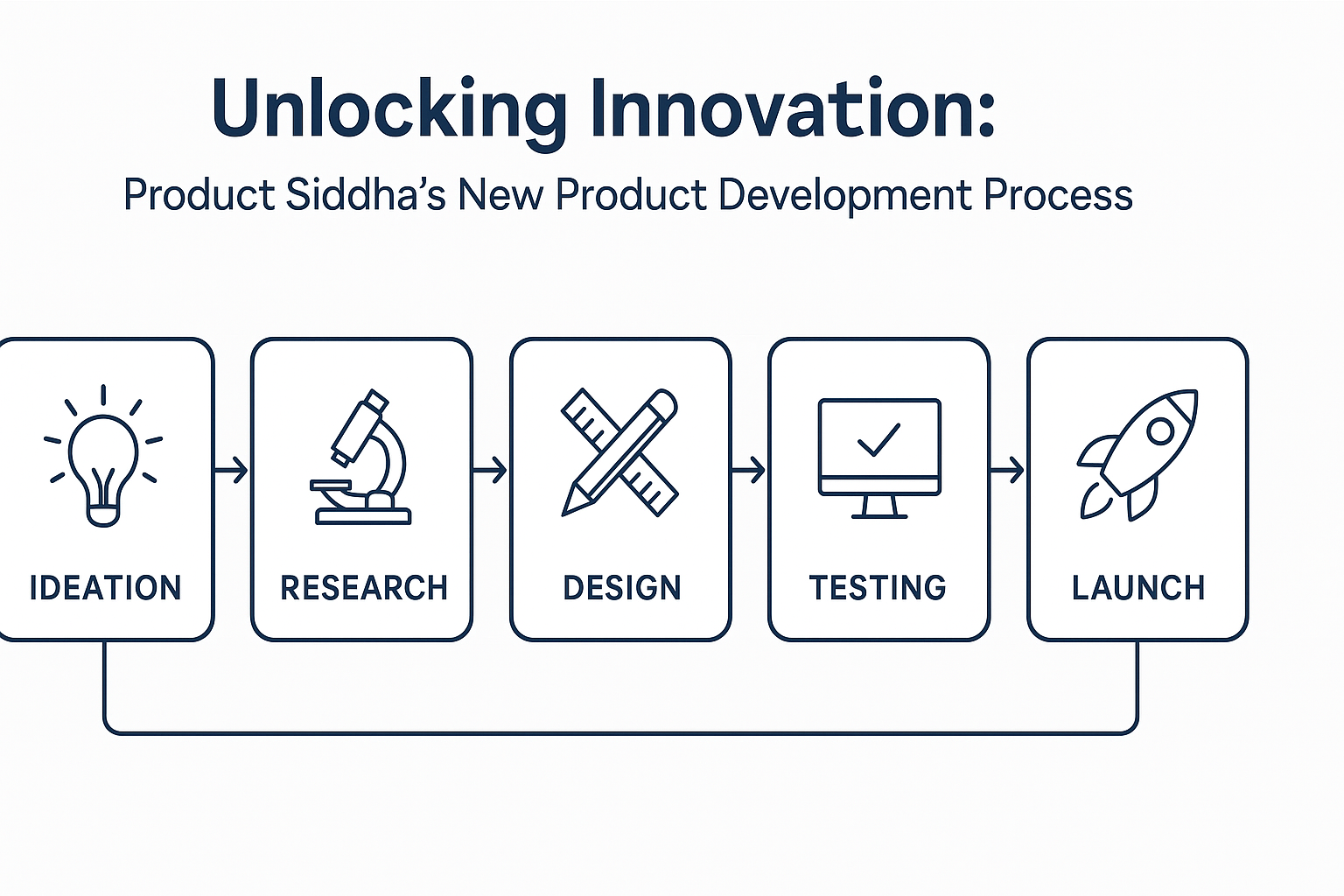
Unlocking Innovation: Product Siddha’s Approach to the New Product Development Process
Unlocking Innovation: Product Siddha’s Approach to the New Product Development Process The Challenge of Systematic Innovation Every organization wants to create products that resonate with customers and generate sustainable revenue. Yet most product initiatives fail to meet expectations. Some never reach the market. Others launch but fail to gain traction. Many succeed initially but cannot maintain momentum as market conditions shift. These failures rarely result from lack of effort or talent. More often, they stem from inadequate processes for moving from initial concept through development and into market success. Organizations need structured approaches that guide decision making while remaining flexible enough to adapt as learning occurs. Product Siddha has developed a new product development process that addresses these challenges. This approach combines proven frameworks with practical adaptations based on real-world experience across multiple industries and product types. Discovery: Understanding Problems Worth Solving The new product development process begins with thorough discovery work. This phase focuses on understanding customer needs, market dynamics, and competitive positioning before committing resources to building anything. Many organizations rush through discovery, eager to start development. This impatience costs them later when products miss the mark. Discovery involves multiple research methods working in concert. Customer interviews reveal pain points and desired outcomes. Market analysis identifies opportunities and constraints. Competitive assessment shows what alternatives exist and where gaps remain. Technical exploration determines what solutions are feasible given current capabilities and reasonable investments. Product Siddha structures discovery around specific questions that need answers. What problems do target customers face? How do they currently address these problems? What would make a solution compelling enough to change behavior? What are customers willing to pay? Which customer segments offer the best opportunities? The discovery phase produces clear documentation of findings, including customer profiles, problem statements, and opportunity assessments. This foundation guides all subsequent work and provides a reference point when difficult trade-offs arise during development. Concept Development and Validation Once discovery establishes a solid understanding of the opportunity, the new product development process moves into concept development. This phase translates insights into concrete product concepts that can be evaluated and refined. Concept development generates multiple possible solutions rather than converging immediately on a single approach. This divergent thinking often reveals options that would not emerge if teams jumped directly to implementation. Different concepts might serve different customer segments, use different business models, or take varying technical approaches to solving the same core problem. Each concept gets developed enough to enable meaningful evaluation. This typically includes value propositions, high-level feature descriptions, rough business models, and technical feasibility assessments. The goal involves creating sufficient clarity to make informed choices about which concepts warrant further investment. Validation testing provides reality checks on concepts before heavy development begins. Product Siddha uses various validation techniques depending on the product type and market context. These might include customer surveys, landing page tests, prototype demonstrations, or small-scale pilots with friendly customers. Product Siddha’s Development Process Phases Phase Key Activities Primary Outputs Success Criteria Discovery Customer research, market analysis Problem definition, opportunity assessment Clear understanding of customer needs Concept Development Ideation, evaluation, validation Product concepts, validation results Validated concept with market evidence Planning Roadmap creation, resource allocation Development plan, success metrics Aligned team with clear direction Build & Test Iterative development, user testing Working product increments Functional product meeting requirements Launch Preparation Go-to-market planning, training Launch materials, trained teams Ready for market introduction Market Introduction Phased rollout, feedback collection Live product, user data Active users demonstrating value Strategic Planning for Execution After validation confirms a concept worth pursuing, careful planning sets the stage for efficient execution. The planning phase of the new product development process defines what will be built, in what sequence, and with what resources. Product roadmapping translates the validated concept into a sequence of deliverable increments. Rather than planning the entire product in detail upfront, Product Siddha emphasizes planning the first increment thoroughly while maintaining flexibility for later phases. This approach accommodates learning that occurs during development without requiring complete replanning when assumptions prove incorrect. Resource planning ensures teams have the necessary skills, tools, and time to execute effectively. This includes identifying any capability gaps that need addressing through hiring, training, or partnerships. Clear resource plans prevent common problems like assigning work to teams that lack required expertise or scheduling work without accounting for other commitments. Success metrics get defined during planning so everyone understands how the product’s performance will be evaluated. These metrics connect to business objectives and customer outcomes rather than focusing solely on completion of features. Well-defined metrics guide prioritization decisions throughout development. Iterative Build and Testing Cycles The construction phase uses iterative cycles that build working increments, test them with users, and incorporate feedback before proceeding. This approach surfaces problems early when they remain relatively easy and inexpensive to address. Each iteration produces something testable. Early iterations might focus on core functionality that delivers the primary value proposition. Later iterations add supporting features, refinements, and optimizations. The sequence gets determined by what provides the most learning about the product’s viability and value. User testing occurs throughout development rather than only after completion. Product Siddha involves representative users in evaluating each increment to ensure the product remains aligned with actual needs. This continuous validation prevents the common scenario where teams build something impressive from a technical perspective that fails to resonate with its intended audience. Technical quality receives appropriate attention throughout the new product development process. While early increments may take shortcuts to enable rapid learning, fundamental architectural decisions get made thoughtfully. Code reviews, testing practices, and documentation standards help maintain product quality as development progresses. Preparing for Market Introduction As development nears completion, focus shifts to preparing for successful market introduction. This involves more than just finishing the product. It requires coordinating multiple functions to ensure smooth launch and adoption. Go-to-market planning defines how the product will reach customers. This includes positioning and messaging, pricing strategy, distribution channels, and promotional activities. Product Siddha works with clients to ensure go-to-market plans align with