

Product Siddha

Enterprise AI

AI Infrastructure Decisions Every CTO Faces in 2026
AI Automation

AI Infrastructure Decisions Every CTO Faces in 2026

AI Infrastructure Decisions Every CTO Faces in 2026 Building AI That Lasts Artificial intelligence is no longer limited to experimental projects. It has become part of enterprise software, customer support, document management, cybersecurity, software development, and business operations. As organizations expand their use of AI, technology leaders are discovering that successful adoption depends on more than selecting the right model or application. The underlying infrastructure has become equally important. In 2026, Chief Technology Officers are expected to build AI environments that are secure, scalable, cost-effective, and capable of supporting future business needs. Every infrastructure decision influences system performance, operational costs, compliance, and the long-term value of AI investments. There is no universal architecture that fits every organization. Each enterprise has unique business goals, existing technology, regulatory requirements, and operational constraints. At Product Siddha, we help businesses design AI infrastructure strategies that align with their technical environment and business objectives while supporting sustainable growth. Understanding AI Infrastructure AI infrastructure refers to the collection of technologies required to develop, deploy, manage, and scale artificial intelligence applications. It includes: Computing resources Cloud platforms Storage systems Networking AI models Data pipelines Security controls Monitoring systems Integration platforms Development environments These components work together to support AI applications throughout their lifecycle. Without a reliable infrastructure, even advanced AI solutions struggle to deliver consistent business value. Cloud, On-Premises, or Hybrid? One of the first decisions CTOs face involves deployment architecture. Cloud Infrastructure Cloud platforms provide flexibility and rapid deployment. Advantages include: Faster implementation Elastic computing resources Reduced hardware investment Managed AI services Global availability Cloud deployments work well for businesses with changing workloads and distributed teams. On-Premises Infrastructure Some organizations prefer to keep AI systems within their own data centers. Common reasons include: Sensitive business data Regulatory requirements Internal security policies Low-latency applications Greater infrastructure control Industries such as healthcare, banking, manufacturing, and government frequently consider this approach. Hybrid Infrastructure Many enterprises combine cloud and on-premises resources. For example: Sensitive customer information remains on internal servers. Large-scale AI training runs in the cloud. Business applications operate across both environments. Hybrid infrastructure often provides the best balance between flexibility and security. Choosing the Right AI Models Infrastructure planning also depends on the AI models an organization intends to use. CTOs should evaluate: Large Language Models Small Language Models Domain-specific AI models Open-source models Commercial AI services The choice affects computing requirements, deployment options, operating costs, and integration complexity. Many organizations now deploy several specialized models instead of relying on a single general-purpose system. Data Strategy Comes First Artificial intelligence depends on high-quality business data. Before expanding AI infrastructure, CTOs should evaluate: Data availability Data consistency Data ownership Data governance Backup policies Data quality Poor data management often limits AI performance more than hardware limitations. Organizations that establish strong data foundations typically achieve better long-term results. Security Cannot Be an Afterthought AI systems frequently process confidential business information. Infrastructure planning should include: Identity management Access controls Data encryption Network security Audit logging Threat monitoring Secure API management Security should extend across every component of the AI environment. Regular security assessments help identify weaknesses before they affect business operations. Planning for Scalability Many organizations begin with a single AI project before expanding across departments. Infrastructure should support future growth without requiring complete redesign. Scalable architecture allows businesses to: Add new AI models Increase processing capacity Support additional users Expand storage Integrate new business systems Planning for future demand reduces long-term infrastructure costs. Integration with Enterprise Systems AI delivers greater value when connected with existing business applications. CTOs should evaluate integration with: CRM platforms ERP software Human resource systems Document management platforms Customer service applications Business intelligence tools Workflow automation software Well-designed integrations improve operational efficiency while reducing duplicate data. Managing Infrastructure Costs AI infrastructure represents an ongoing operational investment. Cost planning should consider: Computing resources GPU utilization Cloud services Software licensing Storage Networking Monitoring Maintenance Technical support Infrastructure optimization prevents unnecessary spending while maintaining performance. Organizations should regularly review resource utilization as AI workloads evolve. Governance and Compliance Responsible AI deployment requires clear governance. Infrastructure should support: Approval workflows Model version control Data retention policies Regulatory compliance Audit reporting User permissions Risk management Strong governance creates confidence among business leaders, customers, and regulatory authorities. Monitoring and Performance AI infrastructure requires continuous monitoring. Technology teams should track: Response times Model accuracy System availability Resource utilization Error rates Security events Infrastructure costs Monitoring allows organizations to identify problems before they affect business operations. Performance dashboards also support long-term planning. Preparing for Future Innovation AI technology continues to evolve rapidly. CTOs should avoid infrastructure decisions that limit future flexibility. Modular architecture allows organizations to: Replace AI models Adopt new technologies Expand automation Integrate future business applications Support emerging hardware Flexible infrastructure protects long-term technology investments. Businesses that design adaptable environments can respond more effectively to changing business needs. Strategic Direction Artificial intelligence is becoming a permanent part of enterprise technology rather than a temporary innovation. As AI adoption grows, infrastructure decisions will increasingly influence operational performance, security, and business competitiveness. The most successful organizations focus on building reliable foundations before expanding AI capabilities. Careful planning around cloud strategy, data management, security, scalability, governance, and integration creates infrastructure that supports sustainable growth. At Product Siddha, we work with businesses to evaluate their technology landscape, develop practical AI infrastructure strategies, and implement solutions that balance performance, security, and long-term business value. With the right foundation in place, organizations can confidently expand their AI initiatives while remaining prepared for future technological advances.  
Small Language Models vs Large Language Models for Enterprises
AI Automation, Blog

Small Language Models vs Large Language Models for Enterprises

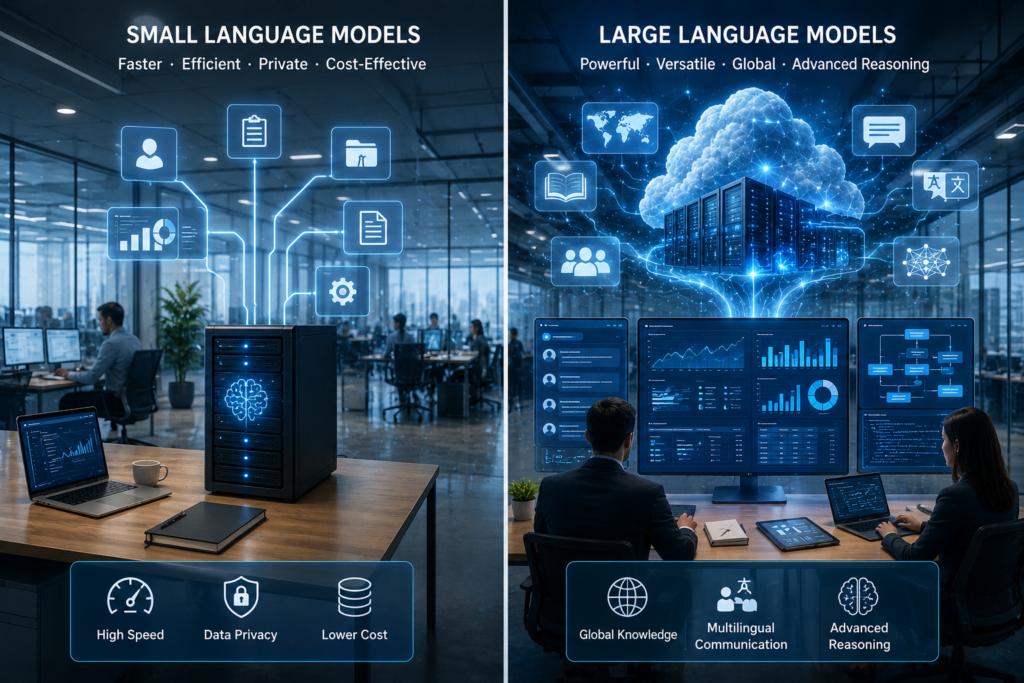
Small Language Models vs Large Language Models for Enterprises Choosing the Right AI Foundation Artificial intelligence has become a practical tool for improving business operations, customer service, document management, and decision support. Among the technologies driving this change are language models, which allow computers to understand, generate, and process human language with remarkable accuracy. Many organizations assume that larger models automatically provide better business outcomes. While Large Language Models (LLMs) offer impressive capabilities, they are not always the most suitable choice for every enterprise application. In many situations, Small Language Models (SLMs) deliver faster performance, lower operating costs, and stronger control over business data. Selecting the right language model requires understanding how each option aligns with business objectives, technical requirements, security expectations, and operational budgets. At Product Siddha, we help organizations evaluate AI technologies and implement solutions that deliver measurable business value rather than unnecessary complexity. Understanding Language Models Language models are artificial intelligence systems trained to understand text, answer questions, summarize documents, generate content, classify information, and assist with business workflows. The primary difference between Small Language Models and Large Language Models is the number of parameters used during training. Large Language Models contain billions or even trillions of parameters, allowing them to perform a wide range of language tasks across many subjects. Small Language Models contain fewer parameters and are usually optimized for specific business functions or industry applications. Both approaches have strengths depending on the intended use. What Are Large Language Models? Large Language Models are designed for broad knowledge and versatile language understanding. They can perform tasks such as: Content generation Document summarization Translation Customer support Programming assistance Research support Business communication Data analysis Because they are trained on extensive datasets, they can respond to diverse questions without requiring task-specific training. However, this flexibility often comes with higher infrastructure costs and greater computing requirements. What Are Small Language Models? Small Language Models focus on efficiency rather than scale. These models are often trained or fine-tuned for specific business activities. Examples include: Customer service assistants Internal knowledge search Invoice processing Document classification Contract analysis HR support Technical documentation Product recommendations Since they require fewer computing resources, they are often easier to deploy within enterprise environments. Key Differences Between SLMs and LLMs Feature Small Language Models Large Language Models Model Size Smaller parameter count Billions or more parameters Processing Speed Faster Moderate Infrastructure Cost Lower Higher Resource Requirements Minimal Significant Deployment Easier More complex Domain Specialization Excellent Broad knowledge Training Cost Lower High Customization Easier More demanding The best choice depends on business priorities rather than model size alone. When Small Language Models Make Sense Many enterprise processes involve repetitive, structured tasks. Small Language Models perform well when businesses need: Fast Response Times Applications such as customer portals, internal chat assistants, and workflow automation benefit from low response times. Lower Operating Costs Organizations processing thousands of daily requests often reduce infrastructure expenses by using smaller models. Greater Privacy Businesses handling confidential information frequently prefer models deployed within private cloud or on-premises environments. Industry-Specific Knowledge A well-trained Small Language Model can outperform a larger general-purpose model within a specialized business domain. When Large Language Models Are the Better Choice Large Language Models remain valuable for broader business requirements. They are well suited for: Knowledge Discovery LLMs can summarize lengthy reports, compare documents, and answer complex questions across multiple subjects. Content Creation Marketing teams, technical writers, and business analysts benefit from their ability to draft reports, articles, and presentations. Multi-Step Reasoning Complex business scenarios involving several connected questions often require stronger reasoning capabilities. Language Support Global organizations working across multiple languages benefit from the multilingual capabilities of large models. Factors Enterprises Should Consider Choosing between SLMs and LLMs involves more than comparing technical specifications. Several business considerations should guide the decision. Cost Infrastructure expenses increase with larger models. Organizations should evaluate long-term operating costs rather than initial implementation alone. Performance A faster specialized model may produce better business outcomes than a slower general-purpose model. Performance should be measured against real business tasks. Security Many enterprises manage confidential financial records, legal documents, healthcare information, and customer data. Private deployment options may become a deciding factor. Scalability Future business growth should influence model selection. The chosen solution should support increasing workloads without excessive infrastructure investment. Integration Language models should integrate with existing systems, including CRM platforms, ERP software, document management systems, customer support tools, and business intelligence platforms. Hybrid Approaches Are Becoming Common Many organizations no longer choose between Small Language Models and Large Language Models exclusively. Instead, they combine both. For example: A Small Language Model handles internal document classification. A Large Language Model assists with research and report generation. Workflow automation routes requests to the most suitable model. Sensitive business data remains inside private infrastructure. This hybrid architecture balances cost, speed, and capability. Common Enterprise Applications Businesses across industries are already using language models. Typical applications include: Customer support automation Internal knowledge assistants Contract review Employee self-service Document summarization Financial reporting Compliance monitoring IT support Procurement assistance Sales enablement Each application should be evaluated according to complexity, privacy requirements, and expected workload. Looking Ahead Language model technology continues to evolve rapidly. Small Language Models are becoming more capable through efficient training techniques and domain-specific optimization. Large Language Models continue expanding their reasoning abilities and multilingual performance. Future enterprise AI platforms will increasingly combine several specialized models instead of relying on one large system for every task. Businesses that carefully evaluate their operational requirements will gain greater value from AI investments while maintaining flexibility as technology advances. Product Siddha works with organizations to identify suitable language model strategies, design enterprise AI solutions, and integrate intelligent automation into existing business processes with security, scalability, and long-term efficiency in mind.

Product Siddha
Privacy Overview

This website uses cookies so that we can provide you with the best user experience possible. Cookie information is stored in your browser and performs functions such as recognising you when you return to our website and helping our team to understand which sections of the website you find most interesting and useful.