
Product Siddha

Indian Real Estate

AI Automation, Case Studies

Horizon Realtors: Zero Dropped Leads and 100% Automated Pre-Qualification on WhatsApp

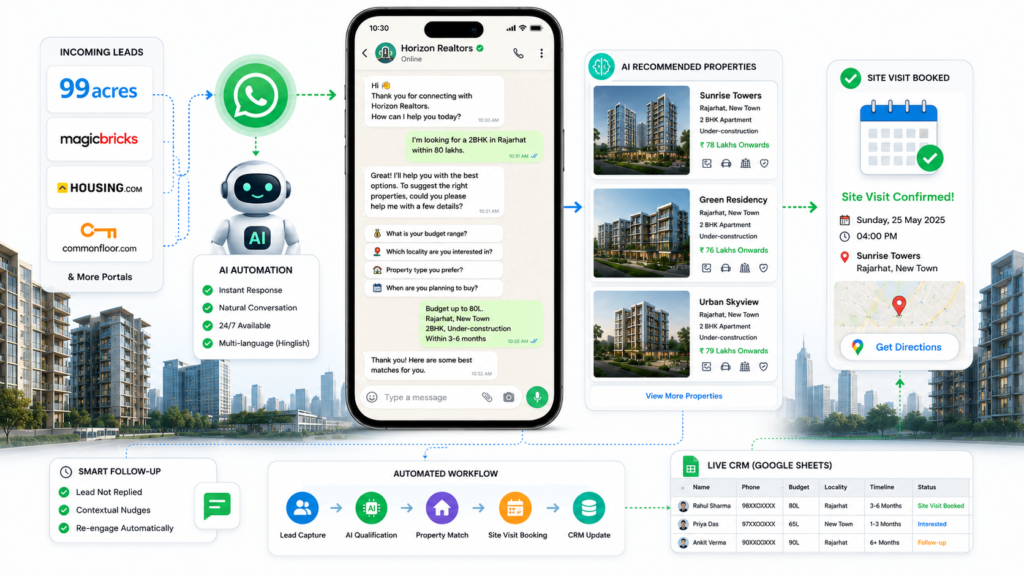
Horizon Realtors: Zero Dropped Leads and 100% Automated Pre-Qualification on WhatsApp Client Horizon Realtors And Developers, Kolkata Service Provider Product Siddha Industry Real Estate / PropTech Service AI Automation Services / WhatsApp Lead Qualification & Scheduling Automation The Metrics 0-minute response time to new 99acres leads 100% automated lead pre-qualification Zero manual CRM data entry 24/7 site-visit scheduling Automated follow-ups for inactive prospects Faster sales team response to high-intent buyers Before: High Lead Volume, High Lead Leakage Horizon Realtors And Developers generated a steady flow of inbound enquiries through property portals such as 99acres. The problem was not lead volume. The problem was what happened after a lead arrived. Every new enquiry required a sales representative to call the prospect, ask qualifying questions, understand requirements, recommend suitable properties, and coordinate site visits. By the time a sales rep connected with a buyer, that prospect had often spoken with several competing developers. The qualification process itself created another bottleneck. Sales teams repeatedly asked the same questions: What is your budget? Which locality are you interested in? Are you looking for a ready-to-move or under-construction property? When are you planning to buy? This manual process slowed down response times and prevented agents from focusing on serious buyers. Even worse, many prospects stopped responding midway through conversations. Without a structured follow-up system, those leads simply disappeared from the pipeline. The properties were strong. The lead flow was healthy. But qualification and follow-up were causing significant leakage. That was the opportunity. After: Instant Engagement and Qualified Buyers Ready for Sales Product Siddha built an AI-powered WhatsApp sales assistant that engages every lead the moment it arrives. Instead of waiting for a salesperson, prospects receive an immediate WhatsApp message in natural conversational language, including Hinglish. The AI guides them through a qualification journey, recommends matching properties, and schedules site visits automatically. By the time a sales representative becomes involved, the lead is already qualified, interested in specific properties, and often has a site visit scheduled. The sales conversation begins with intent, not data collection. What We Built 1. Instant WhatsApp Engagement As soon as a lead is submitted through 99acres, the AI starts a conversation. Rather than forcing users through rigid menu options, the assistant communicates naturally, references the original enquiry, and gathers information in a conversational format. The experience feels like chatting with a helpful property consultant rather than interacting with a chatbot. 2. Automated Lead Qualification The AI collects four key qualification signals: Budget Preferred locality Property type Purchase timeline Every lead is pre-qualified before being handed to the sales team. 3. Dynamic Property Recommendations Once requirements are captured, the system matches available inventory against the prospect’s preferences. The AI instantly shares: Relevant property listings Project details Property photos Pricing information Instead of generic brochures, buyers receive options tailored to their needs. 4. Real-Time CRM Updates The moment qualification is completed, all lead information is automatically pushed into a live Google Sheets CRM. Sales teams no longer need to manually enter: Contact information Budget Locality preferences Purchase timelines Site visit details Everything is updated automatically. 5. Automated Site Visit Scheduling The AI actively moves conversations toward the next step. Prospects are offered available visit slots directly inside WhatsApp. Once a time is confirmed, the system records the appointment and sends Google Maps directions automatically. This removes scheduling friction and accelerates the buying journey. 6. Smart Follow-Up Automation Many real estate leads go silent before making a decision. To prevent lead leakage, the system automatically sends contextual follow-up messages when prospects stop responding. These nudges feel natural and conversational while helping recover opportunities that would otherwise be lost. Technology Stack Built using: Python FastAPI Twilio WhatsApp API OpenAI GPT-4o Google Sheets API The Takeaway Real estate buyers expect immediate responses. Delayed engagement often means losing prospects to competitors. By automating qualification, property recommendations, follow-ups, and site-visit scheduling through WhatsApp, Horizon Realtors transformed a slow and manual process into a scalable lead conversion engine. The result is simple: faster responses, fewer dropped leads, less administrative work for sales teams, and more qualified buyers progressing toward site visits.

AI Automation, Blog

Proptech Funding Trends 2026: Where Smart Money Is Going in Indian Real Estate Tech

  Proptech Funding Trends 2026: Where Smart Money Is Going in Indian Real Estate Tech In 2026, the Indian proptech market favors projects that demonstrate clear returns and repeatable results. Investors are increasingly prioritizing solutions that reduce operating costs, accelerate transactions, and improve asset performance. Product Siddha has observed a steady shift toward platforms that combine practical automation with reliable data intelligence. Within this landscape, AI Automation Services have evolved from an experimental concept into a commercial necessity, frequently appearing in funding discussions, pilot programs, and investment term sheets where measurable savings drive decision-making. Capital Flows and Priority Areas Marketplaces That Shorten Time to Deal Digital marketplaces that streamline property transactions continue to attract investor attention. Funding is flowing toward platforms that integrate property listings with automated document verification, compliance checks, identity validation, and secure payment processing. When these capabilities operate within a unified ecosystem, transaction friction decreases, customer confidence increases, and conversion rates improve. Investors favor platforms that can demonstrate measurable reductions in sales and leasing cycles. Property Operations and Tenant Experience Property owners are increasingly investing in technology that improves operational efficiency and tenant satisfaction. As a result, property management software remains one of the strongest-funded segments within proptech. Platforms offering automated tenant onboarding, maintenance scheduling, rent collection, and communication management are receiving significant capital support. AI Automation Services further enhance these systems by converting tenant messages into actionable work orders, prioritizing maintenance requests based on urgency, and automatically dispatching vendors. These capabilities reduce operational costs while improving occupancy and retention rates. Construction Tech and Supply Chain Automation Construction delays and budget overruns continue to challenge developers across India. Investors are backing technologies that address these issues through automation and data-driven planning. Areas attracting funding include: Offsite and modular construction solutions Automated site monitoring through sensors and imagery Procurement and supply chain management platforms Real-time project performance dashboards When automation connects construction data with supplier networks and procurement systems, project teams gain greater visibility and control, leading to more predictable budgets and timelines. Data Platforms and Underwriting Tools Lenders and financial institutions are seeking better tools for evaluating risk and investment opportunities. Consequently, startups that provide stronger property intelligence are attracting increased investor interest. Modern underwriting platforms combine public records, construction progress data, market trends, and transaction history to generate more accurate risk assessments. Features such as automated property valuations, predictive market insights, and batch reporting improve decision-making and create compelling value propositions for financial institutions. Why AI Automation Services Matter From Manual Tasks to Measurable Savings Automation is most valuable when it produces outcomes that can be measured and verified. Investors are increasingly interested in solutions that directly impact profitability and efficiency. Examples include: Automated document extraction for sale deeds and title verification Compliance reporting and audit preparation Smart maintenance scheduling based on sensor data Automated lease and payment management These capabilities translate into lower operating expenses, reduced administrative overhead, and improved revenue collection. Embedded Automation Within Existing Workflows Today’s investors favor automation that integrates seamlessly with existing technology stacks rather than requiring complete operational changes. AI Automation Services that connect through APIs and integrate with CRM systems, payment platforms, and property management software reduce implementation complexity and accelerate adoption. Product Siddha recommends packaging automation capabilities into modular components that customers can activate progressively. This approach minimizes disruption while maximizing adoption rates. Predictive Analytics and Proactive Operations The next stage of automation focuses on predicting problems before they occur. Predictive models can identify: Potential tenant vacancies Maintenance requirements Rental yield fluctuations Energy consumption anomalies Asset performance risks When predictive insights automatically trigger workflows, organizations can act before minor issues become costly problems. For example, a maintenance request can be generated automatically when a sensor detects abnormal equipment performance, reducing downtime and repair expenses. What Investors Measure Core Metrics That Drive Funding Decisions Investors increasingly rely on performance metrics rather than projections when evaluating proptech opportunities. Key metrics include: Net revenue retention Gross margins on recurring software services Time to deployment after contract signing Unit economics at scale Maintenance cost per property unit Occupancy improvements after automation Collection rate improvements Customer acquisition and retention costs Live case studies and measurable outcomes carry significantly more weight than future projections. For providers of AI Automation Services, controlled pilot programs that demonstrate quantifiable improvements often become the strongest funding catalysts. How Startups Should Position Themselves Start Narrow, Prove Value, Then Expand Many proptech startups attempt to solve too many problems simultaneously. Investors generally prefer focused solutions that deliver measurable results quickly. A strong market entry strategy begins with a single business outcome, such as: Faster leasing cycles Reduced maintenance costs Improved occupancy rates More accurate valuations Once measurable value is established, expansion into adjacent services becomes significantly easier. Make Integrations Simple Complex implementations can slow sales cycles and reduce adoption. Startups should prioritize deep integrations with critical systems such as: Property management platforms Payment gateways Listings networks Financial reporting systems Customer relationship management software Product Siddha recommends focusing on a smaller number of high-quality integrations rather than maintaining a large collection of partially developed connections. Build Partnerships That Accelerate Distribution Strategic partnerships remain one of the most effective growth mechanisms within proptech. Potential partners include: Large developer groups Property management firms Real estate brokerages Financial institutions Payment technology providers Partnerships not only provide access to customers but also enhance credibility during fundraising discussions. Prepare for Regulatory and Sustainability Scrutiny Environmental reporting and regulatory compliance are becoming increasingly important factors in property valuation and investment decisions. Investors are showing growing interest in solutions that automate: Energy consumption tracking Carbon emissions reporting ESG compliance documentation Audit preparation Sustainability benchmarking Startups that simplify compliance processes for building owners often command premium valuations and stronger buyer interest. Positioning Product Siddha: Practical Steps Lead With a Clear Business Outcome Every sales conversation should begin with a measurable business objective and the specific AI Automation Services module that supports it. Offer Pilot Programs With Defined Success Metrics Successful pilots establish credibility and provide evidence for future

Product Siddha
Privacy Overview

This website uses cookies so that we can provide you with the best user experience possible. Cookie information is stored in your browser and performs functions such as recognising you when you return to our website and helping our team to understand which sections of the website you find most interesting and useful.