
Product Siddha

MVP Developement

Real Estate Chatbots Valuable Tool or Just Digital Noise
AI Automation, Blog

Real Estate Chatbots: Valuable Tool or Just Digital Noise?

Real Estate Chatbots: Valuable Tool or Just Digital Noise? Setting the scene Real estate chatbots have become common across property websites, listing portals, and messaging platforms. Visitors are greeted instantly. Questions are answered around the clock. Enquiries are captured without human effort. Yet many brokers and developers quietly wonder whether these tools are helping or simply adding another layer of noise to an already crowded sales process. The answer is neither simple nor universal. Real estate chatbots can create measurable value, but only when their role is clearly defined and tightly connected to how buyers behave. When deployed without restraint or context, they often frustrate visitors and burden sales teams with low-quality conversations. This article examines where real estate chatbots earn their place and where they fail, using grounded examples and operational patterns observed across real-world automation projects by Product Siddha. What real estate chatbots are meant to solve At their core, real estate chatbots exist to handle early-stage interactions. They greet visitors, respond to basic questions, and collect information before a human steps in. In markets where response speed influences outcomes, chatbots promise immediate engagement without expanding staff. In practice, most buyer questions at the first touchpoint are predictable. Availability, price range, location, possession timelines, and site visit scheduling dominate early enquiries. A well-designed real estate chatbot can address these without friction, allowing sales teams to focus on conversations that require judgment and persuasion. Problems arise when chatbots are asked to do more than they should. Buyers do not want long scripted conversations. They want clarity, acknowledgment, and a clear next step. When chatbots attempt to replace human interaction rather than prepare for it, trust erodes quickly. Where real estate chatbots add real value The strongest use cases for real estate chatbots appear in three areas: speed, consistency, and qualification. Speed remains the most obvious advantage. Chatbots respond instantly, regardless of time or workload. For late-night visitors or weekend browsers, this immediacy signals seriousness and professionalism. Consistency matters just as much. Chatbots deliver the same accurate information every time. There is no fatigue, no skipped questions, and no variation in tone. This is particularly useful for large inventories where details must remain precise. Qualification is where value compounds. When chatbots are limited to collecting intent signals, such as preferred location, budget range, and timeline, sales teams receive better-prepared leads. Conversations begin further along the decision path. In Product Siddha’s case study titled “From Lead to Site Visit – Voice AI Automation for a Real Estate Platform,” early automation focused on filtering genuine interest before human follow-up. The result was not more conversations, but fewer and better ones. Site visit conversion improved because sales teams spoke to buyers who were already prepared to engage. When chatbots become digital noise Despite their promise, many real estate chatbots fail for the same reasons. Overreach, poor language, and weak integration turn them into obstacles rather than assets. Overreach is the most common mistake. Chatbots that ask too many questions at once or attempt complex conversations create friction. Buyers abandon the interaction or provide false answers simply to escape the flow. Language is another frequent issue. Chatbots often rely on stiff or generic phrasing that feels disconnected from real speech. This breaks trust quickly. Buyers sense when they are being processed rather than heard. Integration failures also undermine effectiveness. When chatbot data does not flow cleanly into the real estate CRM, leads lose context. Sales agents start conversations blind, repeating questions the buyer already answered. This repetition signals disorganization. In these situations, chatbots do not reduce workload. They increase it by generating shallow interactions that require cleanup later. Buyer expectations and conversational limits Understanding buyer psychology is essential when evaluating real estate chatbots. Property decisions involve emotion, risk, and long-term commitment. Buyers tolerate automation only when it respects these stakes. Chatbots are well suited for factual exchanges. They struggle with reassurance, negotiation, and nuanced objections. A buyer asking about parking availability expects a direct answer. A buyer expressing uncertainty about affordability expects empathy and explanation. Effective implementations recognize this boundary. Chatbots hand over conversations gracefully when questions move beyond basics. This handoff must feel intentional, not abrupt. A simple acknowledgment followed by human follow-up preserves continuity. Across Product Siddha’s automation projects, including non-real estate domains, the most successful systems treat chatbots as gatekeepers, not closers. Their role is to open doors, not to seal deals. Measuring value beyond lead count One reason chatbots disappoint is the way success is measured. Many teams focus on lead volume rather than lead quality. A spike in chatbot interactions may look impressive on dashboards but deliver little revenue impact. More meaningful indicators include response time, qualification rate, and progression to site visits or calls. These metrics reflect whether the chatbot supports real outcomes rather than surface activity. In real estate environments where chatbots are aligned with CRM workflows, teams gain clearer visibility into buyer intent. This allows managers to allocate attention where it matters most. When metrics stay shallow, chatbots remain superficial tools. Chatbots within a broader system Real estate chatbots rarely succeed in isolation. They perform best when embedded within a wider operational system that includes CRM discipline, response tracking, and clear ownership. Product Siddha’s work building lead engines and custom dashboards highlights this principle across industries. Automation elements that operate without feedback loops tend to drift. Those tied to regular review and adjustment improve steadily over time. In real estate, this means reviewing chatbot conversations alongside sales outcomes. Which questions correlate with site visits. Where buyers drop off. Which handoff points feel awkward. Without this reflection, chatbots stagnate. Aspect High-Quality Chatbot Conversations Low-Quality Chatbot Conversations Opening message Clear, polite greeting that explains purpose in one sentence Generic greeting with no context or value explained Question flow Asks one focused question at a time based on buyer intent Fires multiple questions at once, overwhelming the visitor Language tone Natural, simple language that mirrors how buyers speak Robotic, scripted phrasing that feels impersonal Information accuracy Provides precise
Blog, Product Analytics

Product Analytics Metrics Every SaaS Should Track

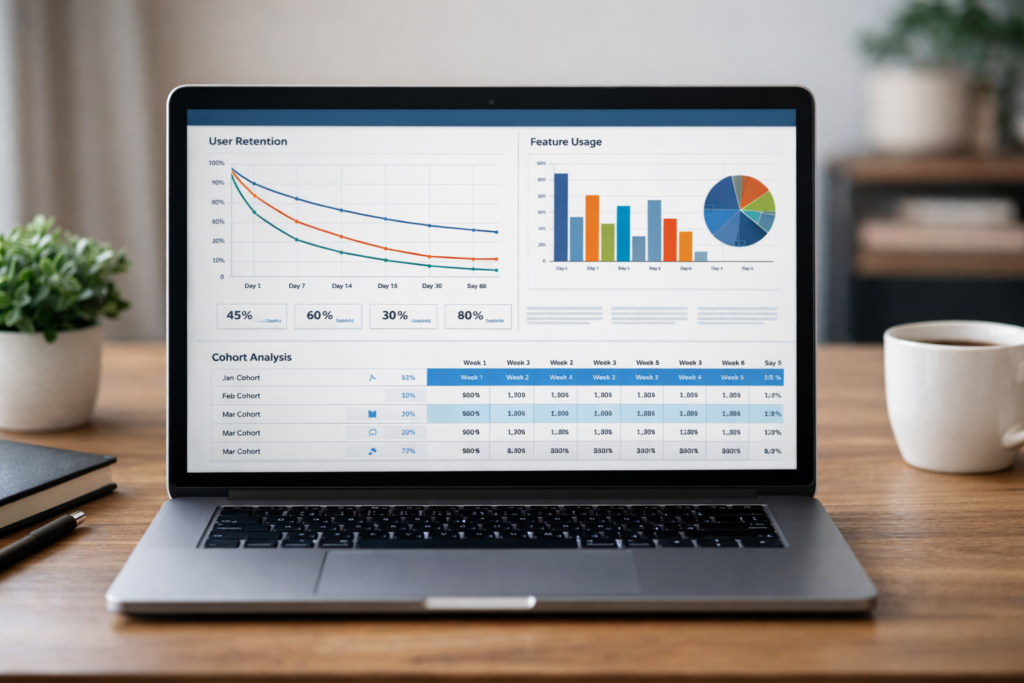
Product Analytics Metrics Every SaaS Should Track Signals That Matter SaaS growth rarely stalls because of a lack of features. It slows when teams lose sight of how real users interact with the product. Dashboards look busy, reports arrive on time, yet decisions feel reactive. This is where Product Analytics earns its place. Product Analytics focuses on behavior inside the product. It shows how users move, where they pause, what they repeat, and where they leave. For SaaS businesses, these patterns are often more valuable than revenue reports or campaign data alone. At Product Siddha, most analytics engagements begin with a single question. Which signals actually reflect product health? This article outlines the Product Analytics metrics every SaaS company should track, why they matter, and how they connect to real operational outcomes. Active Usage Metrics Daily Active Users and Monthly Active Users DAU and MAU remain foundational metrics in Product Analytics. They reveal how often users return and whether the product has become part of a routine. A rising user base with falling activity is an early warning sign. The ratio between DAU and MAU is often more telling than either number alone. A strong ratio suggests habitual use. A weak ratio points to shallow engagement. In a Product Siddha project involving a U.S. music streaming app, usage analysis showed a sharp gap between signups and weekly activity. By studying DAU trends by feature, the team discovered that users returned primarily for curated playlists, not social features. This insight redirected development priorities and improved retention without adding new acquisition spend. Activation Metrics Time to First Value Time to First Value measures how quickly a user experiences a meaningful outcome after signing up. In SaaS, this moment defines whether curiosity turns into commitment. Product Analytics tracks the actions that lead to that first success. It may be creating a dashboard, completing a setup step, or receiving a result. In a SaaS coaching platform analyzed by Product Siddha, activation time averaged eight days. Funnel analysis revealed that users stalled during data import. Simplifying that step reduced Time to First Value to under three days and lifted trial to paid conversions. Feature Engagement Metrics Feature Adoption Rate Not all features deserve equal attention. Feature adoption rates show which parts of the product users rely on and which ones remain unused. Product Analytics tools like Mixpanel or Amplitude allow teams to track usage by role, plan, or cohort. This prevents product decisions based on internal assumptions. In a ride hailing platform project, Product Siddha used feature level analytics to understand why a driver earnings view saw low usage. The data showed drivers preferred real time notifications over static reports. The interface was redesigned accordingly, increasing daily engagement among active drivers. Retention Metrics Cohort Retention Analysis Retention tells the long story of a product. Cohort analysis compares users based on signup period or behavior, showing how engagement changes over time. Product Analytics highlights when and why users disengage. This is far more useful than looking at churn numbers alone. In one Product Siddha engagement focused on full funnel attribution for a SaaS coaching platform, retention cohorts revealed that users who completed two sessions in their first week stayed three times longer than those who completed only one. This insight reshaped onboarding messaging and in app nudges. Engagement Depth Metrics Session Frequency and Event Volume Session counts and event frequency measure how deeply users interact with a product. A single login may signal curiosity. Repeated actions signal value. Product Analytics helps separate passive usage from meaningful engagement. High session counts with low event activity often point to confusion or friction. Metric What It Shows Why It Matters Sessions per user Visit frequency Habit formation Events per session Interaction depth Feature usefulness Avg session duration Focus time User intent Conversion Metrics Funnel Conversion Rates Conversion funnels show how users move from one key action to the next. This applies to onboarding, upgrades, renewals, or feature adoption. In a real estate platform project involving voice automation, Product Siddha mapped the journey from lead capture to site visit booking. Product Analytics revealed that users who engaged with voice follow ups converted faster than those relying on email alone. This allowed the team to double down on high intent channels. Revenue Linked Product Metrics Expansion and Usage Based Revenue Signals For SaaS models tied to usage, Product Analytics connects behavior directly to revenue. Metrics like seats used, reports generated, or API calls consumed reveal expansion opportunities. Rather than pushing blanket upsells, teams can identify accounts already showing growth signals. In a fintech marketing hub setup, Product Siddha used usage thresholds to trigger sales alerts only when accounts showed sustained product adoption. This reduced sales friction and improved close rates. Operational Metrics Error Rates and Performance Events Product Analytics is not limited to growth. It also protects reliability. Tracking error events, failed actions, and performance delays helps teams fix issues before support tickets spike. In a custom dashboard project, analytics revealed that slow load times correlated directly with abandoned sessions. Infrastructure changes improved both performance and engagement. Putting Metrics Into Practice Tracking metrics alone does not improve outcomes. Value comes from consistency, context, and ownership. SaaS teams should define a small set of core Product Analytics metrics tied to product goals. At Product Siddha, analytics implementations often focus on clarity over volume. Clean event definitions, reliable tracking, and shared dashboards matter more than complex reports. Measuring What Endures Product Analytics gives SaaS teams a way to listen without interruption. It captures behavior as it happens and reveals truths users may never articulate. The most effective SaaS companies track fewer metrics, but they track them well. They understand which signals reflect value, which predict growth, and which warn of risk. When Product Analytics becomes part of everyday decision making, products improve quietly and steadily. That kind of progress tends to last.

Blog, MarTech Implementation

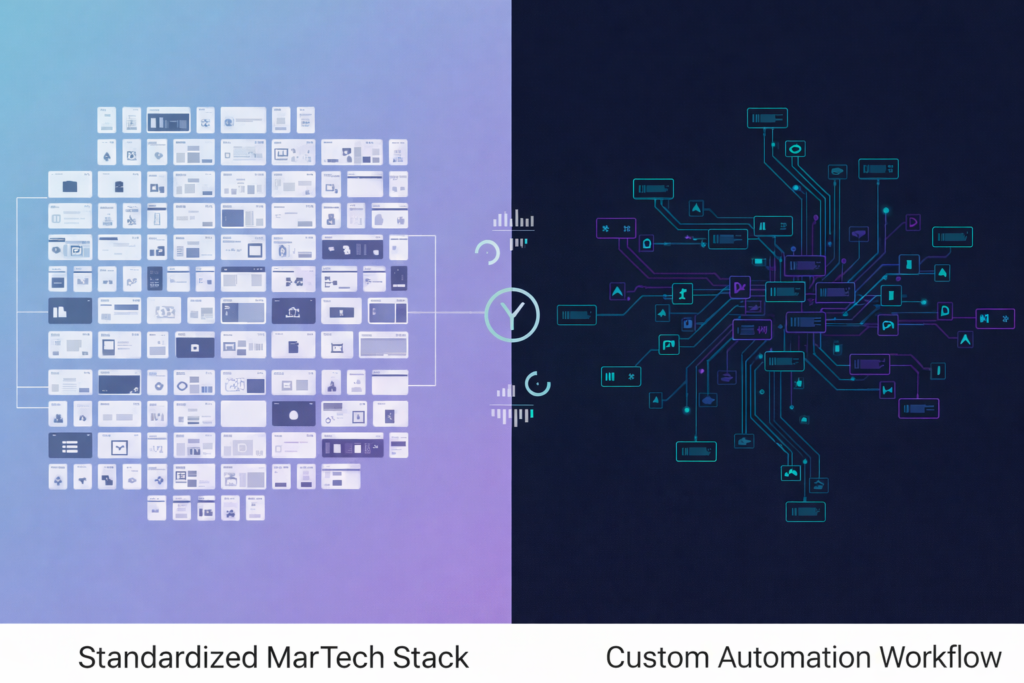
MarTech Tools vs Custom Automation: What Works Better in 2026?

MarTech Tools vs Custom Automation: What Works Better in 2026? A Decision Most Teams Face By 2026, most growing companies no longer ask whether to use technology in marketing operations. The real question is how. Off-the-shelf MarTech tools promise speed and structure. Custom automation promises flexibility and precision. Both approaches can work. Both can fail. The deciding factor is not budget or trend. It is how closely the system reflects real business behavior. Product Analytics plays a central role in this decision because it reveals how users, teams, and systems actually interact. This article examines where MarTech tools perform well, where custom automation becomes necessary, and how Product Analytics helps teams choose wisely. What MarTech Tools Do Well MarTech tools are designed to solve common problems at scale. Lead capture, campaign tracking, email workflows, and reporting come pre-configured. For many teams, this structure is helpful. These tools reduce setup time. They enforce consistency. They allow teams to operate without deep technical resources. Marketing teams often benefit early because MarTech tools offer immediate visibility. Dashboards show traffic, conversions, and engagement trends. For organizations with simple workflows, this may be enough. The Hidden Limits of Standard Tools Problems arise when business processes diverge from tool assumptions. Real customer journeys are rarely linear. Offline interactions, delayed decisions, and multi-touch relationships complicate tracking. MarTech tools often flatten this complexity. They show what fits predefined models. What falls outside those models is either ignored or forced into unsuitable fields. Product Analytics exposes these gaps. When teams analyze in-product behavior or operational workflows, they often find that standard tools fail to capture meaningful actions. This is where frustration begins. Teams have data, but not insight. What Custom Automation Offers Custom automation starts with how the business actually works. Workflows are designed around real stages, not vendor defaults. Data flows follow decisions, not templates. This approach requires more upfront thinking. It also requires technical expertise. The payoff is alignment. Custom automation adapts as the business changes. It integrates offline and online signals. It supports nuanced tracking that standard tools cannot handle. Product Analytics thrives in this environment because events and metrics are defined with purpose. Learning From Real Implementations Product Siddha’s work on Built Custom Dashboards by Stage offers a clear example. Standard dashboards showed activity volume. Custom dashboards revealed progress through meaningful stages. Teams could see where momentum slowed and why. In another case, Product Analytics for a Ride-Hailing App with Mixpanel, custom event tracking uncovered friction that off-the-shelf reports missed. Growth improved not through more campaigns, but through better product flow. These examples show how Product Analytics depends on data structure. When structure reflects reality, insight follows. When MarTech Tools Are Enough MarTech tools work well when processes are stable and predictable. Early-stage companies, single-market operations, and teams with limited variation often benefit. Tools like CRM platforms and email automation systems provide guardrails. They prevent chaos. They establish baselines. Product Analytics still adds value here by helping teams understand user engagement, but the need for customization remains low. The key is knowing when the limits are reached. When Custom Automation Becomes Necessary As organizations grow, complexity increases. Multiple products, regions, sales motions, or offline interactions strain standard systems. Custom automation becomes necessary when teams ask questions their tools cannot answer. Why do users drop after a specific interaction. Which offline actions influence conversion. How does behavior differ by segment. Product Analytics often triggers this realization. Data reveals patterns that tools cannot explain. In Product Analytics and Full-Funnel Attribution for a SaaS Coaching Platform, attribution required linking acquisition data with deep usage behavior. Custom automation made this possible. Standard tools alone could not support the analysis. Cost Considerations in 2026 Cost is often misunderstood. MarTech tools appear cheaper upfront. Subscriptions are predictable. Setup is fast. Custom automation appears expensive because development is visible. Over time, however, licensing costs rise and flexibility remains limited. The real cost lies in missed insight. When teams make decisions without clarity, waste increases. Product Analytics helps quantify this hidden cost by revealing where value is lost. Governance and Ownership Tools come with rules. Custom systems require governance. Without ownership, custom automation becomes brittle. Without flexibility, tools become constraints. The most effective teams assign clear responsibility for data definitions, tracking standards, and review cycles. Product Analytics acts as the common language across teams. This governance ensures that automation supports decision-making rather than obscuring it. A Hybrid Reality In 2026, most mature organizations use a hybrid approach. Core MarTech tools handle standard tasks. Custom automation fills gaps and supports advanced workflows. Product Analytics connects both worlds. It ensures that data remains consistent, meaningful, and actionable. The question is not tools versus custom automation. It is where each belongs. Common Mistakes to Avoid One mistake is customizing too early. Without stable processes, automation amplifies confusion. Another mistake is clinging to tools long after they stop serving the business. Comfort replaces clarity. Product Analytics helps teams avoid both. It reveals readiness for customization and highlights when tools no longer suffice. A Clear Way Forward Teams should begin with questions, not software. What decisions need better data. Where does uncertainty slow progress. Which actions matter most. From there, choose tools or automation accordingly. Product Siddha approaches this decision through analysis, not assumption. Systems are shaped around behavior, not branding. Final Thoughts MarTech tools and custom automation are not opposing choices. They serve different needs at different stages. In 2026, the organizations that perform best understand their boundaries. They use tools for efficiency and custom automation for insight. Product Analytics sits at the center, ensuring that every system supports real understanding. When data reflects reality, decisions improve. When decisions improve, growth follows.

Blog, Product Analytics

Product Analytics vs Marketing Analytics: Key Differences Explained

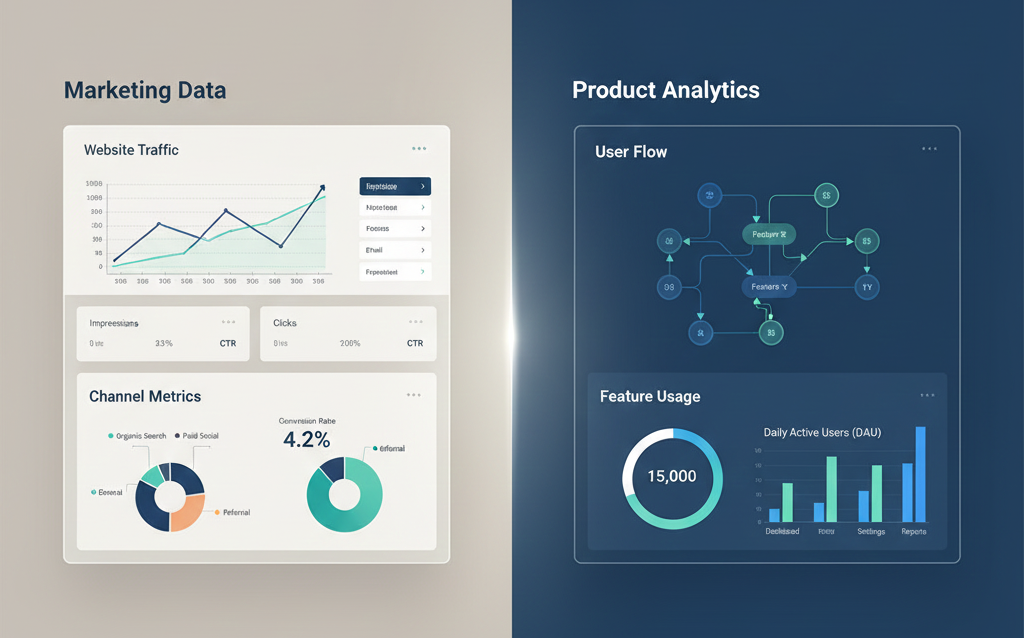
Product Analytics vs Marketing Analytics: Key Differences Explained Two Lenses, One Business As digital products mature, teams collect more data than ever before. Yet confusion persists around what that data should explain. Two disciplines often get grouped together, even though they serve different purposes. Product Analytics and Marketing Analytics answer different questions, support different decisions, and influence different teams. Understanding the distinction matters. When leaders treat both as interchangeable, they risk drawing the wrong conclusions. When used together with clarity, these analytics disciplines provide a complete picture of growth, usage, and value. What Product Analytics Focuses On Product Analytics examines how users interact with a product after they arrive. It tracks behavior inside the product experience. This includes feature usage, user flows, drop-off points, and long-term engagement. The goal is to understand how value is delivered. Are users completing key actions? Where do they hesitate? What patterns separate active users from those who leave? Product Analytics relies on event-level data. Every click, view, or action becomes part of a behavioral story. Over time, these stories reveal how the product performs in real conditions. This discipline supports product managers, engineering teams, and leadership responsible for product decisions. What Marketing Analytics Examines Marketing Analytics looks outward. It focuses on how users arrive, what messages attract them, and which channels drive awareness. It measures campaign performance, traffic sources, and conversion paths before users enter the product. The central concern is acquisition efficiency. Which channels bring relevant users. Which messages resonate. How spend translates into leads or sign-ups. Marketing Analytics helps teams allocate budgets and refine outreach. It answers questions about reach and response, not usage depth. Where Confusion Commonly Arises Confusion begins when teams expect Marketing Analytics to explain user behavior after onboarding. Click-through rates and campaign reports cannot explain why users stop using a feature or abandon workflows. Likewise, Product Analytics cannot explain why traffic dropped or why a campaign underperformed. Each discipline has limits. Product Analytics explains what happens after entry. Marketing Analytics explains how users arrive. Both are necessary. Neither replaces the other. A Practical Comparison To clarify the distinction, consider a simple example. A mobile app sees a drop in daily active users. Marketing Analytics may show stable traffic and consistent campaign performance. Acquisition has not changed. Product Analytics may reveal that a recent update introduced friction in a core workflow. Users encounter difficulty and disengage. Without Product Analytics, the team might increase marketing spend unnecessarily. Without Marketing Analytics, the team might miss early warning signs of declining acquisition quality. Product Analytics in Action Product Siddha’s work on Product Analytics for a Ride-Hailing App with Mixpanel illustrates the practical role of Product Analytics. In this case, detailed event tracking revealed where users dropped out during ride booking. The issue was not demand, but friction in a specific step. Once identified, teams adjusted the flow and engagement improved. Marketing efforts remained unchanged because the problem was internal to the product experience. This example shows how Product Analytics protects teams from guessing. It replaces assumption with evidence. When Marketing Analytics Takes the Lead Marketing Analytics becomes critical during expansion or repositioning. When entering a new market or testing new messaging, teams need clear feedback on reach and response. For example, HubSpot Marketing Hub Setup for a Growing Fintech Brand focused on organizing acquisition data and campaign tracking. The insights guided budget allocation and messaging adjustments. Product Analytics would not have solved this problem alone. Marketing Analytics provided clarity at the top of the funnel. The Overlap Zone There is a small overlap between the two disciplines. Conversion tracking sits at the boundary. The moment a user signs up or completes onboarding, responsibility begins to shift. This handoff is where alignment matters. Shared definitions and clean data ensure continuity. Without alignment, teams argue over numbers rather than improving outcomes. Why Product Analytics Drives Long-Term Value Product Analytics often receives less attention early on. Acquisition feels urgent. Growth targets demand traffic. Over time, however, retention and engagement determine sustainability. Product Analytics reveals whether users find lasting value. It highlights which features matter and which create friction. Teams that invest early in Product Analytics build products that improve steadily. Teams that delay rely on marketing spend to compensate for weak experiences. Common Mistakes Teams Make One common mistake is using marketing dashboards to judge product success. High traffic does not equal high value. Another mistake is tracking too many product events without a clear purpose. Data volume without direction creates noise. Product Analytics works best when tied to clear questions. Which actions predict retention. Which steps block progress. Which changes improve outcomes. Using Both Disciplines Together Strong organizations treat Product Analytics and Marketing Analytics as complementary. Marketing brings users in. Product ensures they stay and succeed. This balance was evident in Product Analytics and Full-Funnel Attribution for a SaaS Coaching Platform, where attribution connected acquisition sources with in-product behavior. Teams gained clarity across the entire journey without blurring responsibilities. Choosing the Right Metrics Metrics should reflect responsibility. Marketing teams focus on cost per acquisition and channel efficiency. Product teams focus on activation, retention, and feature adoption. Leadership reviews both through a strategic lens. The mistake is expecting one dashboard to answer every question. Product Analytics excels at explaining user behavior. Marketing Analytics excels at explaining reach and response. A Clear Takeaway The difference between Product Analytics and Marketing Analytics is not technical. It is conceptual. One examines how value is delivered. The other examines how attention is earned. When teams respect this distinction, decisions improve. Resources are used wisely. Growth becomes repeatable rather than reactive. Final Perspective Product Analytics and Marketing Analytics serve different masters. Confusing them weakens both. Organizations that understand the difference gain clarity at every stage. They know how users arrive and why they stay. They fix real problems instead of chasing surface metrics. For teams working with Product Siddha, this distinction forms the foundation of meaningful analytics work. Clear questions lead to useful data. Useful data leads to better

AI Automation, Blog

The Rise of Self-Managing Properties: Powered by AI Automation

The Rise of Self-Managing Properties: Powered by AI Automation A Quiet Change in Property Operations Property management rarely attracts attention unless something breaks down. A delayed response, a missed payment, or a vacant unit brings problems into view. What has changed over the past few years is not tenant behavior, but how properties are run behind the scenes. Self-managing properties are becoming more common, supported by steady advances in AI Automation. This shift is not about removing people from the process. It is about reducing friction in daily operations. Routine decisions are handled by systems. Repetitive tasks are resolved without manual effort. Property teams spend less time reacting and more time overseeing outcomes. By 2026, AI Automation is no longer be experimental in real estate operations. It is becoming a practical layer that supports leasing, maintenance, communication, and reporting. What Self-Managing Really Means A self-managing property does not operate without oversight. It operates with fewer manual dependencies. Tasks that once required constant supervision now follow predefined rules and data signals. Examples include automated rent reminders, maintenance ticket prioritization, occupancy tracking, and tenant communication flows. These systems respond to inputs and trigger actions consistently. AI Automation plays a central role by learning from patterns. It identifies recurring issues, predicts demand, and adjusts workflows accordingly. The result is not perfection, but stability. Why Property Owners Are Adopting Automation The pressure on property owners has increased. Margins are tight. Tenant expectations are higher. Compliance requirements are stricter. Managing scale with traditional methods is difficult. AI Automation offers relief in three practical areas. Cost control, response time, and visibility. When systems handle routine work, staffing needs stabilize. When responses are immediate, tenant satisfaction improves. When data is centralized, decision-making becomes clearer. These outcomes drive adoption more than technology trends. Leasing and Tenant Communication Leasing is one of the first areas where automation delivers value. Enquiries arrive at all hours. Manual follow-up introduces delay and inconsistency. Automated systems respond instantly. They share availability, schedule visits, and collect preliminary information. Human involvement begins when interest is confirmed. This approach mirrors lessons from From Lead to Site Visit – Voice AI Automation for a Real Estate Platform, where early-stage interactions were handled automatically. The same principle applies to rental and commercial properties. Early engagement sets expectations and filters intent. Maintenance Without the Chaos Maintenance requests consume time and attention. Traditional systems rely on manual logging and prioritization. This leads to delays and miscommunication. With AI Automation, maintenance tickets are categorized automatically. Urgent issues surface immediately. Routine tasks are grouped and scheduled efficiently. Historical data helps predict recurring problems. Property teams gain control without micromanaging. Tenants experience faster resolution. Over time, maintenance costs stabilize because problems are addressed before escalation. Financial Operations and Reporting Rent collection, expense tracking, and reporting are essential but time-consuming. Errors create disputes and erode trust. Automation introduces consistency. Payments are tracked in real time. Reminders are sent automatically. Reports are generated without manual reconciliation. Product Siddha’s experience in Built Custom Dashboards by Stage reflects the importance of clear visibility. When financial data is structured and accessible, owners make informed decisions faster. This clarity reduces surprises and improves planning. Learning From Non-Real Estate Use Cases Some of the strongest lessons in automation come from outside property management. AI Automation Services for a French Rental Agency MSC-IMMO demonstrated how operational workflows could be simplified through rule-based systems and predictive insights. While regional models differ, the operational logic transfers well. Similarly, Product Analytics and Full-Funnel Attribution for a SaaS Coaching Platform shows how tracking user behavior improves outcomes. In property management, tenant behavior offers similar signals. Payment patterns, service requests, and renewal timing all inform better decisions. Scaling Without Losing Control Growth exposes weaknesses. As property portfolios expand, manual oversight becomes fragile. Automation creates consistency across locations and teams. Self-managing systems ensure that standards remain intact as volume increases. This consistency protects brand reputation and operational quality. In Product Management for UAE’s First Lifestyle Services Marketplace, structured systems supported scale without chaos. Property management faces the same challenge. AI Automation offers a way to grow without sacrificing control. Human Roles in an Automated Environment Automation does not remove the need for people. It changes their focus. Property managers shift from task execution to exception handling. Their expertise is applied where judgment matters. Tenants still want human contact when issues are complex. Automation ensures that human time is available when it is needed most. This balance improves morale and service quality. Risks and Realistic Expectations Automation is not a cure-all. Poor configuration leads to frustration. Over-automation can feel impersonal. Systems require oversight and periodic adjustment. Successful adoption begins with process clarity. AI Automation amplifies existing practices. If those practices are flawed, automation exposes the flaws faster. Product Siddha approaches automation projects by addressing workflows before tools. This discipline protects long-term value. Where the Trend Is Heading Self-managing properties are gaining ground because they solve real problems. The trend is steady, not sudden. Adoption grows as results become visible. By 2026, properties that resist automation will struggle with efficiency and transparency. Properties that adopt it thoughtfully will operate with fewer disruptions and better insight. A Measured Outlook The rise of self-managing properties is not driven by novelty. It is driven by necessity. AI Automation supports stability in an increasingly complex environment. Property owners who view automation as infrastructure rather than innovation gain lasting benefits. Systems quietly handle routine work. Teams focus on oversight and improvement. That balance defines the future of property management.

Blog, Product Management

What Traditional Brokers Can Learn From Product-Led Growth in PropTech

What Traditional Brokers Can Learn From Product-Led Growth in PropTech A Shift Worth Studying Traditional real estate brokerage has long relied on personal networks, local reputation, and negotiation skill. These foundations still matter. Yet over the last decade, PropTech firms have grown by focusing on something brokers rarely formalize. The product itself. Product-led growth in PropTech does not mean replacing relationships with software. It means designing systems that make discovery easier, decisions clearer, and follow-through more reliable. At the center of this shift is disciplined product management, where every feature, workflow, and data point exists to serve a real user need. For traditional brokers, the lesson is not to become technology companies. The lesson is to adopt the thinking that has helped PropTech platforms scale trust and efficiency. Product Thinking Versus Deal Thinking Brokers often operate deal by deal. Each transaction is treated as a standalone effort. PropTech companies think in systems. They ask how one improvement can benefit thousands of users repeatedly. This difference comes down to product management discipline. Product teams map user journeys. They identify friction points. They improve processes incrementally. Brokers, on the other hand, often solve problems manually each time they arise. By studying product-led growth models, brokers can begin to document their processes, identify repeatable actions, and reduce dependence on memory and habit. Learning From Usage Data, Not Gut Feel Traditional brokers rely heavily on experience. Experience matters, but it has limits. PropTech platforms learn from usage data. They track what users search for, where they hesitate, and what prompts action. This approach does not require building an app. It requires observing patterns. Which listings attract repeat views. Which follow-ups lead to site visits. Which documents close deals faster. Product Siddha’s work on Product Analytics for a Ride-Hailing App with Mixpanel illustrates this mindset. While the industry differs, the principle applies. Decisions improved when data revealed real behavior rather than assumptions. Brokers who adopt even basic analytics thinking can refine their approach without losing the human element. Designing for Clarity Over Persuasion Product-led PropTech platforms focus on clarity. Clear pricing. Clear availability. Clear next steps. Traditional brokers often rely on persuasion and verbal explanation to bridge information gaps. From a product management perspective, clarity reduces effort on both sides. Buyers feel informed. Brokers spend less time explaining basics and more time addressing real concerns. This is not about removing conversation. It is about making conversations more productive. In Built Custom Dashboards by Stage, Product Siddha helped teams visualize user progress clearly. Translating this idea to brokerage work could mean standardized listing sheets, consistent follow-up summaries, or clearer site visit documentation. Reducing Friction at Key Moments Product-led growth pays close attention to moments where users drop off. In real estate, these moments are familiar. Missed calls. Delayed responses. Confusing paperwork. Unclear next steps after a site visit. PropTech firms design around these weak points. Automated confirmations. Structured follow-ups. Predictable timelines. One relevant example is From Lead to Site Visit – Voice AI Automation for a Real Estate Platform. In this case, automation reduced early-stage friction without removing human involvement later. Brokers can apply the same thinking by identifying where routine steps slow momentum and simplifying them. Treating Trust as a Product Outcome Trust is often described as intangible. Product-led companies treat it as a measurable outcome. They design features that reinforce reliability. Consistent communication. Transparent status updates. Predictable service quality. For brokers, this can translate into simple practices. Regular status messages. Clear timelines. Written summaries after meetings. These actions feel small, but together they form a dependable experience. Product management teaches that trust grows through repeated positive interactions, not grand gestures. Scaling Without Losing Quality One challenge for successful brokers is scale. As volume increases, quality often slips. Product-led PropTech firms address this through standardization. Not rigid scripts, but shared frameworks. In Product Management for UAE’s First Lifestyle Services Marketplace, Product Siddha helped structure offerings so quality remained consistent as the platform grew. Brokers can adopt similar frameworks. Defined service stages. Standard checklists. Clear ownership at each step. Scaling then becomes manageable rather than chaotic. Feedback Loops That Improve Over Time Product-led growth depends on feedback loops. What worked. What failed. What needs adjustment. This mindset is less common in traditional brokerage, where reflection often happens informally. By introducing simple review cycles, brokers can improve steadily. Post-deal reviews. Client feedback summaries. Pattern tracking across transactions. Product management emphasizes iteration. Brokers who adopt this habit evolve faster than those who rely solely on instinct. Learning From Outside the Industry Several Product Siddha case studies outside real estate offer relevant lessons. Building a Lead Engine After Apollo Shut Us Out shows resilience through system redesign. Driving Growth for a U.S. Music App with Full-Stack Mixpanel Analytics highlights the value of understanding user behavior deeply. These examples reinforce a core idea. Product-led growth principles travel well across industries because they focus on people, not platforms. Why This Matters Now The brokerage model is not broken. It is under pressure. Buyers expect speed, clarity, and consistency. Product-led PropTech firms meet these expectations by design. Traditional brokers who learn from product management do not lose their advantage. They strengthen it. Relationships supported by systems outperform relationships held together by memory alone. A Practical Closing Note Product-led growth is not a technology strategy. It is a way of thinking. It asks simple questions. What do users struggle with. Where do they pause. What makes progress easier. For traditional brokers, adopting this mindset does not require abandoning proven methods. It requires refining them with structure and reflection. Those who learn from PropTech’s product discipline will find their work easier, their clients more confident, and their outcomes more predictable.

AI Automation, Blog

The ROI of Real Estate Automation: What the Numbers Say in 2026

The ROI of Real Estate Automation: What the Numbers Say in 2026 Where the Money Really Moves Real estate has always been measured by land value, construction cost, and sales velocity. Over the past few years, another variable has entered the equation: operational efficiency. By 2026, Real Estate Automation is no longer a side investment or pilot experiment. It directly influences margins, sales cycles, and team productivity. Firms that deploy structured automation report 10–25% improvement in operating margins, largely driven by faster conversions and lower manual overhead. The return on investment does not come from automation itself. It comes from how effectively routine work is reduced, how accurately buyer intent is measured, and how quickly teams respond to serious prospects. When automation is applied with discipline, ROI becomes visible within 6–9 months, not years. Understanding ROI in Real Estate Terms ROI in real estate automation should not be viewed through a software lens. It must be assessed through business outcomes that developers, brokers, and operators care about. By 2026, firms measuring automation impact typically track: 20–40% reduction in cost per qualified lead 30–50% faster response times to buyer inquiries 10–18% improvement in site visit–to–booking conversion rates These are not abstract metrics. They directly influence cash flow, inventory turnover, and marketing efficiency. Firms that track only lead volume struggle to justify automation spend. Firms that track lead quality, response time, and stage progression can clearly map returns to every rupee invested. Lead Handling Efficiency and Cost Reduction One of the most immediate returns from Real Estate Automation comes from lead handling. Manual processes involving call centers, spreadsheets, delayed follow-ups, and repeated data entry inflate costs and leak high-intent buyers. Industry data from 2025–2026 shows that nearly 35% of real estate leads go cold due to delayed first response. Automation reduces this friction: Instant lead routing Early-stage qualification Behavior-based follow-ups Organizations implementing structured lead automation report: 25–45% reduction in manual follow-up hours 15–30% drop in overall lead handling costs A relevant Product Siddha case study is From Lead to Site Visit – Voice AI Automation for a Real Estate Platform. In this project, voice-based automation filtered early inquiries before passing qualified prospects to sales teams. The outcome included: 40% faster lead qualification ~18% increase in site visit conversion rate Noticeable reduction in sales team time spent on low-intent leads These gains translated directly into lower acquisition costs and higher revenue efficiency. Shorter Sales Cycles and Faster Closures Real estate sales cycles are inherently long, but unnecessary delays add weeks to buyer decision-making. Automation shortens cycles by maintaining consistent, timely engagement. Automated reminders, follow-up sequences, and intent-based alerts ensure interested buyers do not go silent due to human delay. By 2026: Firms using Real Estate Automation report 12–22% shorter sales cycles Faster movement from inquiry to site visit increases closure probability by 8–15% Reduced holding time lowers inventory carrying costs, especially in mid- and high-ticket projects Speed, in this context, becomes a measurable financial advantage. Better Use of Sales Team Time Sales productivity is often overlooked in ROI calculations. In many real estate firms, experienced sales professionals spend 30–40% of their time on tasks that do not require experience – data updates, reminder calls, and basic qualification. Automation shifts this balance: Routine tasks are system-managed Sales teams focus on high-intent conversations Product Siddha’s work on Built Custom Dashboards by Stage highlights this impact. Teams with real-time visibility into buyer readiness saw: 20–30% improvement in effective selling time Higher deal velocity without increasing headcount The ROI here comes from better utilization of existing staff, not from expanding teams. Improved Attribution and Smarter Spend Attribution remains one of the most challenging ROI questions in real estate. Marketing budgets are distributed across portals, paid search, social media, site activations, and offline events. Without automation, linking these touchpoints to bookings is nearly impossible. Real Estate Automation enables multi-stage attribution: First inquiry Engagement behavior Site visit Negotiation and closure Firms using full-funnel attribution models report: 15–25% reduction in wasted marketing spend Clear identification of channels driving actual bookings, not just leads Product Siddha has implemented similar models in Product Analytics and Full-Funnel Attribution for a SaaS Coaching Platform. The same logic applies to real estate – budget decisions become data-backed rather than assumption-driven. Operational Savings Beyond Sales ROI is not limited to revenue growth. Operational savings contribute significantly to long-term returns. Automation delivers: 50–70% reduction in manual reporting effort Faster decision-making through real-time dashboards Lower error rates due to standardized data flows In 2026, firms relying on weekly manual reports struggle to react to market changes. Firms with automated visibility reduce costly delays, especially during slow or volatile market phases. Additional savings come from improved compliance tracking, document handling, and communication logs – areas that quietly accumulate cost when unmanaged. Scaling Without Proportional Cost Increase Growth exposes operational weaknesses. As lead volume increases, manual systems break down. Automation allows firms to scale without proportional increases in operational cost. Product Siddha’s AI Automation Services for French Rental Agency MSC-IMMO demonstrated this principle. Automation enabled volume growth while keeping operational costs nearly flat. The ROI came from cost stability during scale, not aggressive expansion. For Indian developers expanding across cities, this scalability is critical. Automation ensures consistency across teams, projects, and regions – without adding layers of management. Risks That Dilute ROI Automation does not guarantee returns. Common mistakes include: Automating broken processes Ignoring sales team workflows Tracking vanity metrics instead of revenue-impacting stages Firms that rush tool adoption without system design often see single-digit or negligible ROI, despite high software spend. Product Siddha approaches Real Estate Automation as a system design problem, not a tool deployment task. This distinction often determines whether ROI is measurable or merely theoretical. What the Numbers Point To in 2026 By 2026, the financial pattern is clear: 10–25% operating margin improvement 20–40% reduction in lead-related costs 8–18% uplift in conversion efficiency Faster sales cycles and better team utilization The numbers do not favor automation for its own sake. They favor clarity, speed, and

Blog, MarTech Implementation

MarTech Implementation Challenges in Indian Real Estate

MarTech Implementation Challenges in Indian Real Estate The Ground Reality Indian real estate has always moved on relationships, site visits, and trust built over time. Over the last decade, digital channels have entered this space, but adoption has been uneven. Many developers and brokerage firms invested in CRM tools, marketing platforms, and analytics software without a clear plan for how these systems would work together. As a result, MarTech Implementation often becomes a collection of disconnected tools rather than a working growth system. Unlike retail or SaaS, real estate marketing in India deals with long decision cycles, fragmented buyer data, and a strong offline influence. These factors make technology adoption more complex. The challenge is not the lack of tools. The challenge lies in making them useful, measurable, and aligned with how real estate teams actually operate. Fragmented Data Across the Buyer Journey One of the most common problems in MarTech Implementation for Indian real estate is data fragmentation. Leads come from property portals, Google Ads, WhatsApp inquiries, site walk-ins, call centers, and channel partners. Each source captures data differently, often with missing or inconsistent fields. Sales teams rely on spreadsheets. Marketing teams depend on dashboards that only show surface-level numbers. Leadership sees reports that do not connect spend to site visits or bookings. Without a single view of the buyer journey, decisions are based on assumptions. Product Siddha has addressed similar challenges while building custom dashboards by stage for growth teams. In one such implementation, lead data was reorganized around buyer intent stages rather than source labels. This allowed teams to see where prospects dropped off and which channels actually influenced site visits, not just form fills. Misalignment Between Sales and Marketing Systems In many Indian real estate firms, marketing tools and sales tools operate in isolation. CRM systems are used as record-keeping software rather than decision tools. Marketing automation platforms are configured without understanding how sales teams follow up on leads. This misalignment creates gaps. Leads are generated but not contacted on time. Follow-ups are tracked manually. Campaign performance is judged by volume, not quality. A relevant Product Siddha case study is From Lead to Site Visit – Voice AI Automation for a Real Estate Platform. In this project, automation was introduced to qualify and route leads before they reached sales teams. The outcome was not more leads, but better conversations. Sales teams spent time with prospects who were ready for a site visit, while early-stage inquiries were nurtured automatically. This approach highlights an important truth. MarTech Implementation succeeds only when sales workflows shape the technology setup, not the other way around. Overdependence on Tools Without Strategy Many developers invest in popular platforms like HubSpot, Salesforce, or marketing automation tools because competitors use them. The assumption is that software alone will improve performance. In practice, these tools amplify existing processes, good or bad. Without a clear growth strategy, dashboards turn into vanity metrics. Email campaigns are sent without segmentation. Retargeting ads follow users who already booked a visit. Product Siddha’s experience with HubSpot Marketing Hub Setup for a Growing Fintech Brand shows how structured implementation changes outcomes. The same principles apply to real estate. Clear lifecycle stages, defined handoffs, and measurable goals must be set before the first workflow goes live. MarTech Implementation is not a one-time setup. It is an operational change that requires discipline and regular review. Difficulty Measuring Offline Conversions A major hurdle unique to real estate is offline conversion tracking. Site visits, broker meetings, and on-ground events play a critical role in closing deals. Most MarTech stacks fail to connect these offline actions to digital touchpoints. As a result, marketing teams cannot confidently answer basic questions. Which campaign drove site visits? Which channel influenced bookings? Which messages shortened the sales cycle? Product Siddha has solved similar attribution problems through product analytics and full-funnel attribution projects. By mapping offline actions back to digital identifiers, teams gained clarity on what actually influenced buyer decisions. This approach is especially valuable in real estate, where the final decision often happens weeks after the first interaction. Resistance from On-Ground Teams Technology adoption often meets resistance from sales managers and site teams. Many view MarTech tools as monitoring systems rather than support systems. This resistance leads to poor data quality, incomplete updates, and low platform usage. The solution is not more training slides. It is better system design. Tools must reduce effort, not add steps. Data entry should be minimal. Insights should be visible and useful to frontline teams. In Product Siddha’s Product Management for UAE’s First Lifestyle Services Marketplace, similar resistance was addressed by redesigning workflows around user behavior. The lesson carries over to Indian real estate. When systems respect how teams work, adoption follows naturally. Lack of Local Context in Global Tools Most MarTech platforms are built for Western markets. Indian real estate has unique realities such as joint ownership, regional language preferences, broker networks, and regulatory differences. Off-the-shelf setups often ignore these factors. Customization becomes essential. Lead scoring models must reflect local buying signals. Communication workflows must account for WhatsApp and phone calls, not just email. Reporting must align with how leadership reviews performance. Product Siddha’s work on AI Automation Services for French Rental Agency MSC-IMMO demonstrates how global tools can be adapted to local business models. The same approach applies to Indian real estate, where thoughtful customization bridges the gap between software capability and business reality. The Cost of Poor Implementation When MarTech Implementation fails, the cost is not just wasted software licenses. It is lost trust in data, slower decision-making, and missed opportunities. Teams revert to intuition because reports feel unreliable. Leadership questions marketing spend without clear answers. Successful implementation creates confidence. Teams understand what works. Budgets are allocated with clarity. Growth becomes repeatable rather than reactive. A Practical Way Forward Indian real estate firms do not need more tools. They need fewer tools that work together. A phased approach works best. Start by mapping the buyer journey honestly. Identify where data breaks. Align

AI Automation, Blog

Property Listing Syndication Hell? Here’s How to Update Once and Be Done

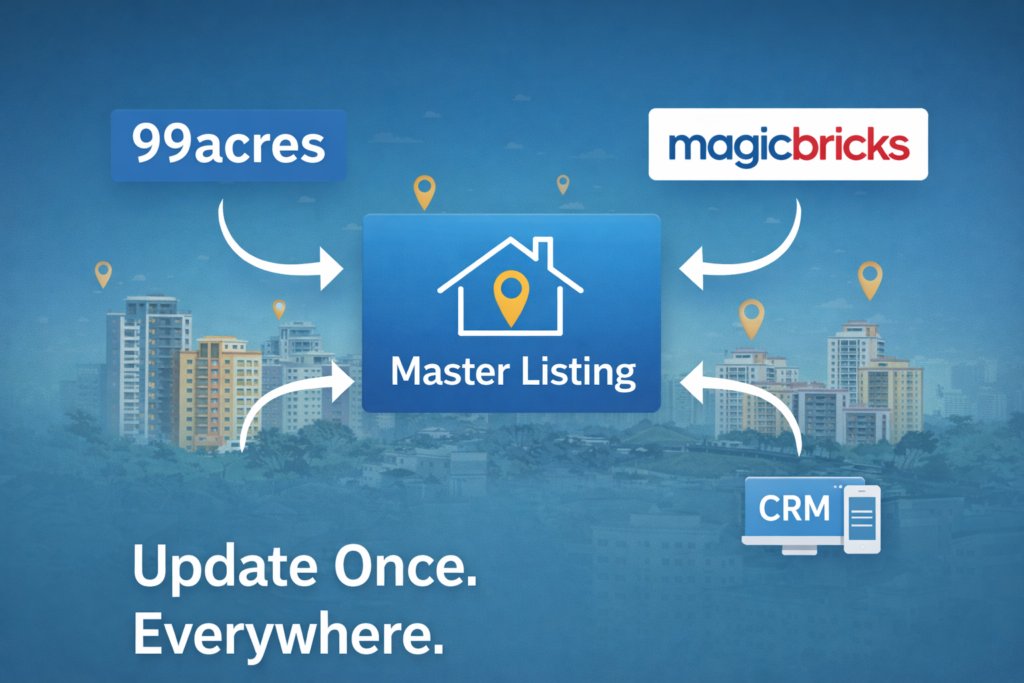
Property Listing Syndication Hell? Here’s How to Update Once and Be Done One Listing, Too Many Places In the Indian real estate market, a single property rarely lives in one place. A listing appears on 99acres, Magicbricks, Housing.com, broker WhatsApp catalogs, internal CRMs, and sometimes regional portals specific to a city. Each platform expects accurate data, but each treats updates differently. A price change reflects on one portal but stays outdated on another. A flat marked as sold continues to attract calls. Photos appear cropped, reordered, or missing altogether. Agents and back-office teams spend hours correcting issues they did not create. This is where Real Estate Automation becomes essential. When listings are managed as living records instead of static uploads, updates happen once and flow everywhere with consistency. Why Syndication Breaks Down in Indian Real Estate Most Indian brokerages still rely on manual uploads. Even large developers often maintain separate spreadsheets for portals, channel partners, and internal teams. CRMs rarely enforce strict listing standards. Portals like 99acres and Magicbricks have their own field structures, photo limits, and compliance checks. When each platform becomes its own source of truth, inconsistencies multiply. The cost goes beyond time. Buyers lose trust when listings feel unreliable. Agents waste energy explaining discrepancies. Managers struggle to assess pipeline health because listing data cannot be trusted. Automation fixes this by restoring order, not by pushing listings faster. Defining the Single Source of Truth Every successful syndication system begins with one decision. Where does the listing actually live? Strong teams create a master listing record. This record includes pricing, availability, property type, location details, media assets, and compliance fields relevant to Indian portals. All updates happen here and nowhere else. Real Estate Automation tools then distribute this data outward. Portals receive updates, but they never overwrite the master record. If a platform rejects a field, the system flags it immediately. This structure replaces guesswork with accountability. Choosing the Right Property Data for Indian Buyers Not every detail matters equally in India. Automation works best when it reflects buyer behavior. For residential listings, high-impact fields include carpet area, price breakup, possession timeline, floor number, parking details, and nearby landmarks. For rentals, furnishing status and maintenance charges matter more than descriptive copy. Automation allows these priorities to be enforced consistently. Mandatory fields cannot be skipped. Optional fields adapt by property type. The system does not rely on agent memory. This discipline improves listing quality before syndication even begins. Photos That Actually Convert Photos are where most Indian listings fall short. Blurry mobile images, poor lighting, and inconsistent order reduce inquiry quality. A clean process matters. Properties should be photographed in daylight, with wide shots of living areas first, followed by bedrooms, kitchen, bathrooms, and balconies. Amenities and floor plans come last. AI helps here at scale. Images can be auto-checked for resolution, orientation, and duplication. Thumbnails can be standardized. Platform-specific limits for 99acres or Magicbricks are handled automatically during upload. Automation ensures that media quality does not depend on who uploaded the listing. Writing Content That Fits Indian Portals Indian portals reward clarity over creativity. Buyers want facts, not adjectives. Automation templates help maintain consistency. Property descriptions pull from structured data rather than free text. Location benefits, project highlights, and pricing logic are assembled dynamically. AI can assist by adjusting tone for sales versus rentals, or for primary versus resale properties. The goal is accuracy, not persuasion. When content stays factual, syndication becomes smoother and rejections decrease. Updating Once Without Breaking Anything Updating once means designing a controlled process. A price change is made in the master record. Automation validates the update against portal rules. Syndication runs in sequence. Each platform confirms success or reports errors. If Magicbricks delays an update or 99acres flags a missing field, the system pauses and reports the issue. Nothing goes live partially or silently. This is how Real Estate Automation reduces listing maintenance from hours to minutes. Learning From Real Automation Work Product Siddha’s work with AI Automation Services for French Rental Agency MSC-IMMO followed the same principle. Listings across regional portals were centralized, validated, and distributed from one source. Availability updates reflected instantly, and manual corrections dropped sharply. The lesson translates cleanly to India. Control the source, then automate distribution. AI at Scale for Large Inventories For teams managing hundreds or thousands of listings, manual control is impossible. AI helps by classifying property types, detecting missing fields, and flagging anomalies before syndication. Duplicate listings can be identified. Expired properties can be archived automatically. This allows Indian brokerages and developers to scale without losing accuracy. Human teams focus on pricing strategy and negotiations instead of data hygiene. Syndication Feeds the Entire Stack Clean listings power more than portals. They feed voice bots, WhatsApp responders, lead routing systems, and site visit scheduling. In From Lead to Site Visit – Voice AI Automation for a Real Estate Platform, real-time listing data ensured that calls were routed only for available properties. Automation protected both the buyer experience and the agent’s time. Syndication cannot remain manual when downstream systems depend on it. Calm Returns to the Listing Process Property listing syndication does not have to feel like damage control. With the right structure, updates become predictable and reliable. One source of truth. One update. Clear confirmation across 99acres, Magicbricks, and every other channel. Real Estate Automation brings discipline to a process that too often feels chaotic. In the Indian market, where trust and speed define success, that discipline is no longer optional. Where Product Siddha Fits Into the Workflow Product Siddha supports property listing syndication by first bringing structure to how listing data is created and maintained. This begins with mapping existing CRM records, broker inputs, media storage, and portal requirements for platforms such as 99acres and Magicbricks. A master listing record is then defined, covering pricing, availability, location details, media assets, and compliance fields. Automation rules ensure that every update flows outward from this source with validation, sequencing, and confirmation built in, so errors are identified

AI Automation, Blog

How Email Automation Becomes a Revenue Channel When Done Right

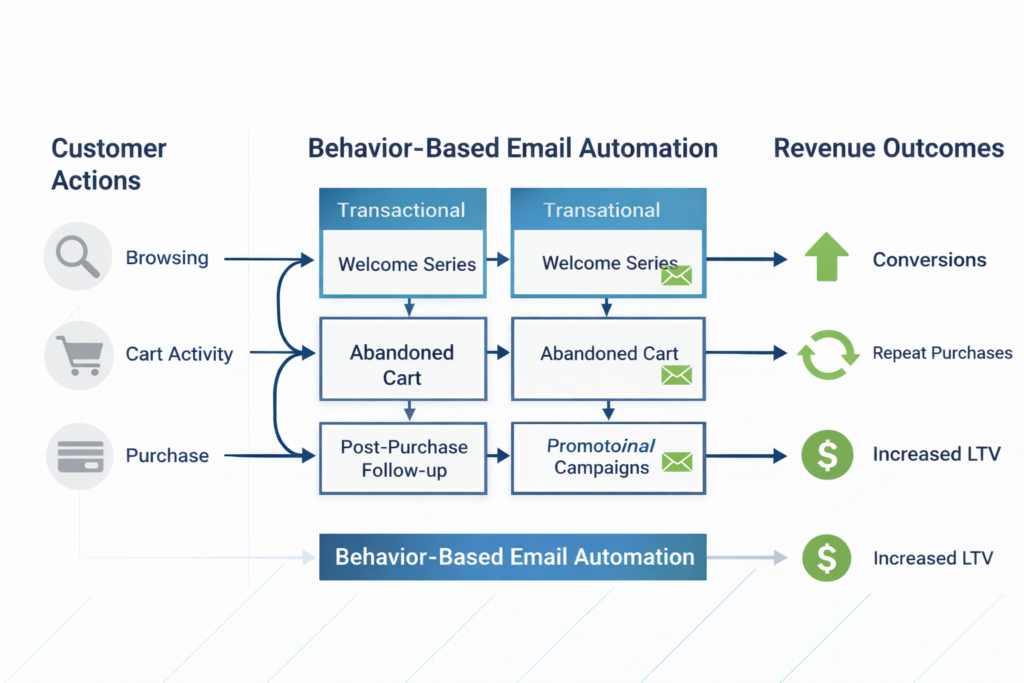
How Email Automation Becomes a Revenue Channel When Done Right From Inbox Noise to Business Asset Most inboxes are crowded. Buyers skim subject lines, delete without opening, and move on. This reality has led many teams to treat email as a support tool rather than a source of revenue. When email performance stalls, the channel is often blamed instead of the approach behind it. Email Automation changes this equation when it is built with purpose. Instead of sending campaigns on a schedule, strong teams design systems that respond to user behavior, timing, and intent. When done carefully, email stops being a reminder channel and starts acting as a steady contributor to revenue. This shift does not come from clever wording or volume. It comes from structure, data, and restraint. Why Email Often Fails to Drive Revenue Email fails when it is disconnected from user behavior. Messages are sent because a calendar says so, not because a user action triggered them. Content is generic because segmentation is shallow. Results are measured by open rates instead of outcomes. Another common issue is over-automation. Teams set up dozens of flows without understanding how users actually move through the product or store. Messages overlap. Timing feels random. Trust erodes. Email Automation works when it mirrors how customers already behave. The system should feel observant, not intrusive. The Difference Between Automated Email and Automated Thinking Sending automated emails is easy. Automating decisions is harder. The best Email Automation systems are built around decision points. A user browses but does not purchase. A customer buys once and disappears. A subscriber reads pricing pages repeatedly. Each of these actions signals intent. The role of automation is to respond with relevance, not repetition. Product Siddha has seen this pattern across industries. Automation that reacts to real behavior consistently outperforms automation based on assumptions. Revenue Starts with Clean Inputs No Email Automation system performs well without reliable data. This includes event tracking, purchase history, and lifecycle stages. In a Shopify brand engagement where Product Siddha helped boost email revenue using Klaviyo, the first step was not writing emails. It was cleaning event data. Product views, add-to-cart actions, and purchase confirmations were audited and corrected. Once the data reflected reality, automation flows were rebuilt around customer actions. Browse abandonment, post-purchase follow-ups, and replenishment reminders were timed based on actual behavior, not guesses. Revenue lift followed because the messages made sense to the recipient. This example highlights a quiet truth. Revenue growth through email usually starts with better inputs, not louder messages. The Technology Stack Behind Revenue-Driven Email Automation Email Automation becomes a revenue channel only when it is supported by the right technical foundation. Without a connected stack, even well-written automation flows fail to deliver consistent results. At a minimum, revenue-focused teams rely on four layers of technology. The first layer is data collection. Tools like Segment, Mixpanel, or native platform tracking capture user actions such as browsing, cart activity, purchases, and feature usage. These events form the raw signals that automation depends on. The second layer is the email delivery and automation platform. Systems such as Klaviyo, HubSpot, Customer.io, or Brevo handle workflows, triggers, and message sequencing. These tools decide when and to whom an email is sent. The third layer is customer context storage. This is often a CRM or data warehouse where user attributes, lifecycle stages, and historical behavior are stored and updated. Without this layer, personalization remains shallow. The final layer is analytics and attribution. Dashboards and reporting tools connect email actions to outcomes like conversions, repeat purchases, and lifetime value. This closes the loop between automation and revenue. In practice, Product Siddha has seen that email automation starts producing revenue only after these layers are properly connected. Writing emails comes later. Infrastructure comes first. Timing Matters More Than Frequency Many teams focus on how often emails are sent. Strong teams focus on when. A well-timed message sent once can outperform five poorly timed reminders. Email Automation allows teams to respond in hours or days based on user action, rather than batching communication. For example, in a SaaS coaching platform where full-funnel attribution was implemented, automated emails tied to trial usage proved more effective than weekly newsletters. Messages arrived after meaningful actions, such as completing a module or skipping sessions. Engagement increased because timing matched intent. Email Automation succeeds when it respects the user’s rhythm. Content That Supports Decisions Revenue-focused email content does not persuade aggressively. It supports decisions already forming. This means explaining value clearly, reducing friction, and answering common questions. It avoids urgency tactics that feel artificial. Strong teams write emails as if they are continuing a conversation, not starting one. The tone stays helpful and direct. In fintech environments, such as a HubSpot Marketing Hub setup for a growing brand, automated emails focused on clarity. Feature explanations, usage reminders, and simple prompts guided users toward action. Conversion followed because confusion was reduced. Segmentation Is About Behavior, Not Labels Many Email Automation systems rely on static lists. These lists age quickly. Behavioral segmentation adapts in real time. Users move in and out of flows based on what they do, not what they were once tagged as. This approach reduces wasted sends and increases relevance. It also keeps automation manageable. Across Product Siddha’s analytics and automation projects, behavioral triggers consistently outperform demographic or role-based segmentation. People reveal intent through action. Personalization at Scale Without Losing Control Personalization does not mean writing a different email for every user. At scale, it means designing systems that adapt automatically based on behavior. Revenue-focused Email Automation uses dynamic content, conditional logic, and real-time data. A returning customer sees different messaging than a first-time visitor. A high-intent user receives follow-ups sooner than a casual browser. This approach depends on rules, not guesswork. For example, users who view pricing pages multiple times may enter a value-focused email flow. Customers who complete a purchase may receive education or replenishment reminders instead of discounts. In real implementations, including automation setups using tools