
Product Siddha

n8n

Make vs n8n for Enterprise Automation
AI Automation, Blog

Make vs n8n for Enterprise Automation

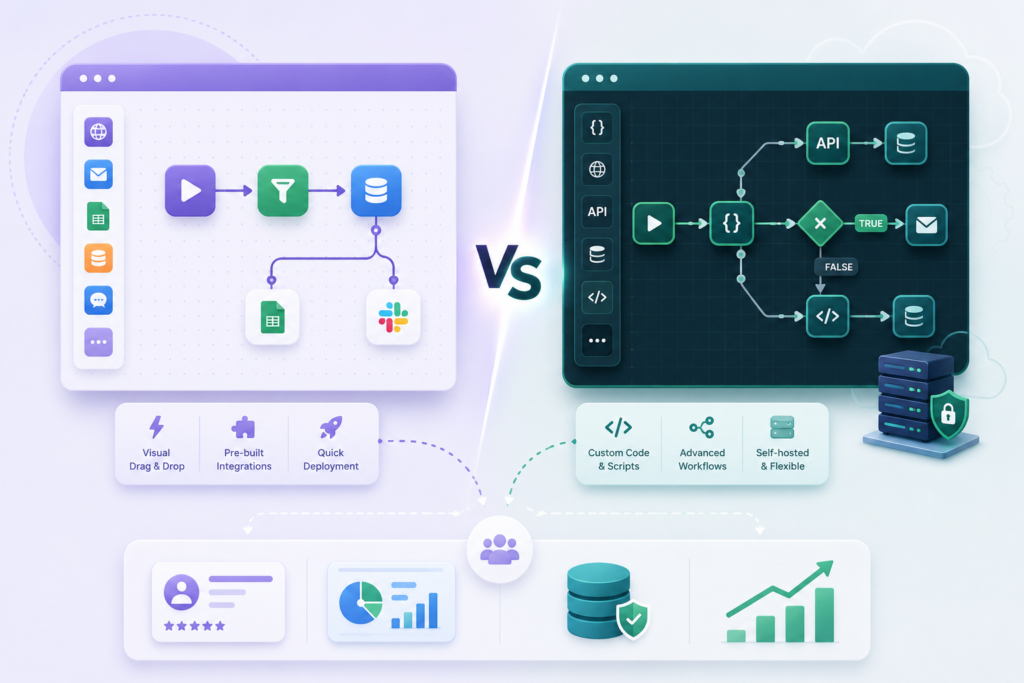
Make vs n8n for Enterprise Automation Automation has become an essential part of modern business operations. As organizations expand, manual processes often slow productivity, increase costs, and create unnecessary errors. Workflow automation platforms solve these challenges by connecting business applications, reducing repetitive work, and improving operational efficiency. Among today’s most widely used automation platforms are Make and n8n. Both offer powerful workflow automation capabilities, yet they differ in architecture, deployment options, customization, pricing, and enterprise suitability. Choosing between them requires more than comparing features. Businesses should evaluate long-term scalability, security, integration requirements, and technical expertise before making a decision. At Product Siddha, we help organizations implement enterprise automation solutions that align with their operational goals. Whether a business chooses Make or n8n, success depends on careful planning, system integration, and workflow optimization. Understanding Enterprise Automation Enterprise automation refers to the use of software to automate routine business processes across departments. Typical automation workflows include: CRM updates Lead management Customer support routing Invoice processing Employee onboarding Data synchronization Marketing workflows Business reporting Automation allows employees to spend more time on strategic work while reducing repetitive administrative tasks. What Is Make? Make is a cloud-based visual automation platform designed to connect thousands of applications through drag-and-drop workflows. It allows users to build automated scenarios with minimal coding knowledge. Common business uses include: CRM integration Email automation Cloud storage synchronization Project management updates Customer notifications Marketing workflows Its visual interface makes workflow creation accessible to both technical and non-technical users. What Is n8n? n8n is an open-source workflow automation platform that provides greater flexibility for businesses requiring custom automation. Unlike many cloud-only platforms, n8n supports self-hosting, allowing organizations to maintain greater control over their infrastructure and data. Businesses often use n8n for: Internal system integration API orchestration Custom business workflows Data transformation Enterprise software integration AI-powered automation Its ability to incorporate custom code makes it attractive for development teams and enterprises with specialized requirements. Comparing Make and n8n Feature Make n8n Deployment Cloud-based Cloud or Self-hosted Ease of Use Beginner Friendly Technical Flexibility Custom Coding Limited Extensive API Integration Excellent Excellent Visual Workflow Builder Yes Yes Self Hosting No Yes Enterprise Customization Moderate High Community Support Large Growing Open Source Community Both platforms provide strong automation capabilities, but their strengths serve different business needs. Ease of Implementation For businesses seeking quick deployment, Make offers an intuitive visual interface that simplifies workflow creation. Teams can connect applications using pre-built integrations without extensive technical knowledge. n8n offers similar visual workflow capabilities, but organizations often require development expertise when building advanced automation or custom integrations. Businesses with dedicated technical teams may appreciate this flexibility. Integration Capabilities Enterprise automation depends on reliable software integration. Both platforms support connections with: CRM systems ERP platforms Cloud storage Email services Databases Accounting software Customer support platforms API services n8n provides additional flexibility for organizations working with proprietary systems through custom API development. Security and Data Control Data security plays an important role in enterprise automation. Businesses handling sensitive customer or financial information often require greater control over their infrastructure. Make Cloud-hosted environment Vendor-managed infrastructure Built-in security management Reduced maintenance responsibilities n8n Self-hosting available Complete infrastructure control Internal security policies Flexible deployment environments Organizations operating under strict compliance requirements may benefit from self-hosted solutions. Scalability for Growing Businesses As organizations grow, automation requirements become more complex. Large enterprises typically require: Multiple workflow environments Department-specific automation High-volume API requests Centralized reporting Advanced permissions Workflow monitoring Both platforms scale effectively, although n8n offers greater flexibility for organizations managing highly customized enterprise environments. Workflow Customization Customization determines how well automation adapts to unique business operations. Make focuses on simplicity through visual workflow design. n8n supports: JavaScript functions API customization Conditional logic Complex data transformations Advanced workflow branching Development teams often prefer this level of control. Practical Business Example Consider a manufacturing company managing customer inquiries, inventory updates, supplier communications, and financial reporting. Using automation, the business connects: CRM software Inventory management Accounting platform Customer support system Internal databases With Make, the organization quickly builds standard workflows that synchronize customer and sales information across departments. With n8n, the same organization develops advanced automation that connects proprietary manufacturing systems through custom APIs while maintaining full control over internal infrastructure. Both solutions improve operational efficiency, but the preferred platform depends on business complexity. At Product Siddha, automation consultants evaluate business requirements before recommending the most suitable platform. Choosing the Right Platform Businesses should evaluate the following questions: Business Requirement Better Fit Quick implementation Make Minimal coding Make Custom API development n8n Self-hosting n8n Enterprise customization n8n Internal infrastructure control n8n User-friendly workflow builder Make Flexible automation architecture n8n No single platform suits every organization. The best choice depends on operational priorities and technical capabilities. How Product Siddha Helps Product Siddha works with businesses to design enterprise automation strategies that improve productivity while reducing operational complexity. Our services include: AI Automation Services Enterprise Workflow Automation CRM Automation Solutions API Integration Business Intelligence Dashboards Process Automation Consulting Data Integration Solutions Rather than selecting software based on popularity, we evaluate each organization’s existing systems, business goals, and long-term growth plans before implementing automation. Final Thoughts Both Make and n8n are capable enterprise automation platforms that support workflow optimization, system integration, and operational efficiency. Make provides a streamlined experience for businesses seeking rapid deployment and user-friendly automation. n8n offers greater flexibility for organizations requiring custom development, self-hosting, and advanced workflow control. Choosing the right platform depends on the complexity of your business processes, available technical resources, security requirements, and future scalability. With Product Siddha’s enterprise automation expertise, businesses can confidently implement automation solutions that simplify operations, improve collaboration, and support sustainable growth.
n8n vs Make vs Zapier Which Is the Best Automation Tool in 2026
AI Automation, Blog

n8n vs Make vs Zapier in 2026: Which Automation Platform Will Actually Scale With Your Business?

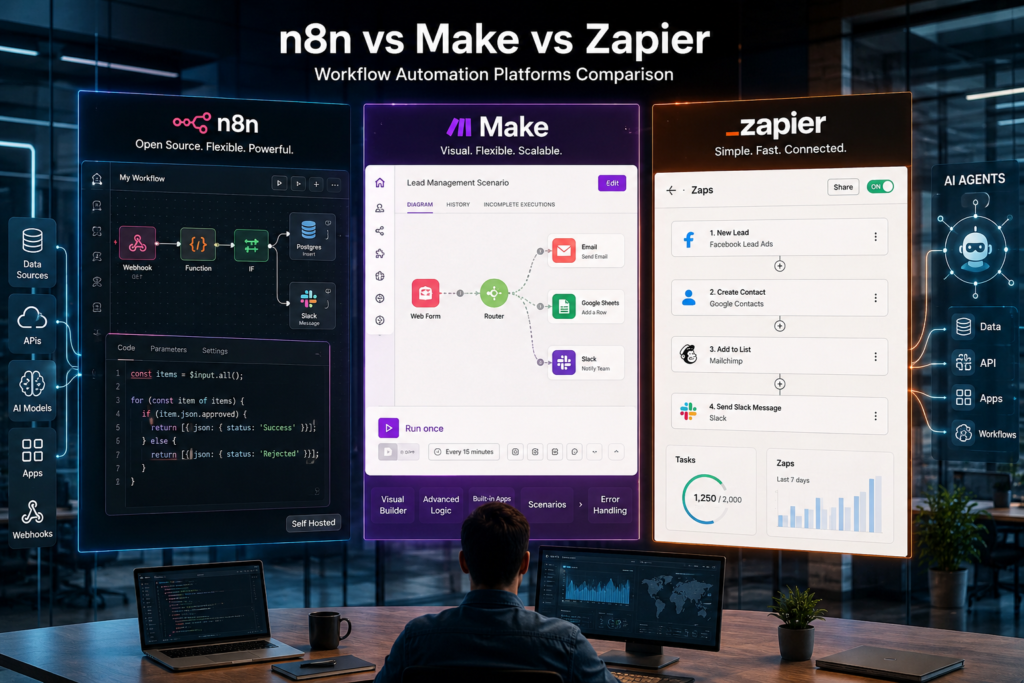
n8n vs Make vs Zapier in 2026: Which Automation Platform Will Actually Scale With Your Business?   The Automation Market Has Changed. Most Comparisons Haven’t. For years, businesses evaluated automation tools based on one simple question: “How easily can this platform connect my apps?” In 2026, that question is no longer enough. Automation has evolved from connecting software applications to orchestrating entire business processes powered by AI. Modern organizations are automating customer support, sales operations, lead qualification, marketing execution, analytics reporting, internal approvals, and even decision-making workflows. As AI agents become part of everyday operations, the automation platform you choose today will determine how effectively your business scales tomorrow. This is why the debate around n8n vs Make vs Zapier has become more important than ever. All three platforms are capable workflow automation solutions. However, they serve fundamentally different business needs. After evaluating their capabilities, market direction, AI readiness, scalability, and operational flexibility, one conclusion becomes increasingly clear: Zapier excels at simplicity. Make excels at visual workflow management. But n8n is increasingly becoming the platform most aligned with where automation is heading. Let’s examine why. Why Workflow Automation Matters More Than Ever Businesses now operate across dozens of applications: CRM systems Marketing platforms Analytics tools Customer support software Payment gateways AI applications Internal databases Without automation, teams spend countless hours performing repetitive tasks: Copying data between systems Updating customer records Sending notifications Creating reports Managing approvals Following up on leads Workflow automation eliminates these inefficiencies while improving speed, accuracy, and scalability. Organizations implementing automation effectively often experience: Faster operational execution Reduced manual labor costs Improved customer experience Better data consistency Increased employee productivity Greater scalability without proportional hiring The challenge isn’t whether to automate. The challenge is selecting the automation platform that will still meet your needs three years from now. The New Era: From Task Automation to AI-Powered Operations One of the biggest shifts since 2024 has been the rise of AI-driven automation. Businesses are no longer automating isolated actions such as: Sending emails Updating spreadsheets Posting notifications Instead, they’re building intelligent systems capable of: Understanding customer requests Making recommendations Analyzing business data Routing decisions automatically Coordinating workflows across departments This shift significantly changes how organizations should evaluate automation platforms. The best automation tool in 2026 isn’t necessarily the easiest one. It’s the platform capable of supporting increasingly intelligent and complex workflows. Understanding n8n: The Open-Source Automation Leader n8n has experienced remarkable growth over the last few years, largely because it aligns with several major technology trends: Open-source infrastructure AI-first workflows Data ownership Enterprise customization Unlike traditional no-code platforms, n8n gives organizations greater control over how workflows are built and deployed. Key Features Open-source architecture Self-hosting capabilities AI agent workflows Custom JavaScript logic API integrations Webhook support Database connectivity Enterprise-grade customization Where n8n Excels n8n shines when businesses need: AI-powered workflows Enterprise automation Internal operational systems Advanced integrations Data privacy and compliance Custom business logic Its flexibility makes it especially attractive to: SaaS companies Product-led businesses Engineering teams AI startups Mid-market enterprises The Biggest Advantage n8n allows businesses to own their automation infrastructure. As organizations increasingly prioritize security, governance, and AI customization, this becomes a significant competitive advantage. The Biggest Drawback Flexibility comes at a cost. Compared to Zapier or Make, n8n requires a steeper learning curve and often benefits from technical expertise. For small teams seeking immediate deployment, this can be challenging. Understanding Make: The Visual Automation Powerhouse Make has carved out a unique position in the automation market. It successfully bridges the gap between beginner-friendly tools and enterprise-grade workflow capabilities. Its visual workflow builder remains one of the most intuitive automation interfaces available. Key Features Drag-and-drop workflow builder Advanced branching logic Data transformation tools API support Scheduling capabilities AI integrations Extensive app ecosystem Where Make Excels Make performs exceptionally well for: Marketing automation Customer lifecycle workflows E-commerce operations Agency workflows CRM synchronization Operational reporting The platform allows users to build surprisingly sophisticated workflows without writing code. The Biggest Advantage Visual clarity. Complex workflows become easier to understand, manage, and optimize. The Biggest Drawback As workflows become larger and span multiple departments, visual scenarios can become difficult to maintain. Organizations often encounter workflow sprawl as automation complexity increases. Understanding Zapier: The Simplicity Champion Zapier remains one of the most recognizable automation brands in the industry. Its success is built on one principle: Anyone should be able to automate business processes without technical knowledge. That philosophy continues to resonate with startups, entrepreneurs, and small businesses. Key Features Easy setup Massive integration library AI-powered assistants Workflow templates Multi-step automations Built-in databases Chatbot functionality Where Zapier Excels Zapier works particularly well for: Small businesses Startups Sales teams Solopreneurs Marketing teams Workflows can often be built within minutes. The Biggest Advantage Speed and accessibility. Few platforms make automation easier. The Biggest Drawback Cost and flexibility. As workflow volume grows, pricing can increase significantly. Businesses with advanced automation requirements may eventually outgrow Zapier’s capabilities. Feature Comparison: n8n vs Make vs Zapier Feature n8n Make Zapier Open Source Yes No No Self Hosting Yes No No Ease of Use Moderate Easy Very Easy Visual Builder Good Excellent Good AI Agent Support Excellent Good Good Custom Coding Excellent Moderate Limited Integrations 1000+ 2000+ 7000+ Enterprise Control Excellent Good Good Data Ownership Excellent Limited Limited Pricing Flexibility High Moderate Moderate Which Platform Is Best for AI Automation? This is where the market is changing fastest. Automation is increasingly becoming AI orchestration. n8n for AI Workflows n8n currently leads in: AI agents Multi-agent systems Vector databases RAG architectures LLM orchestration Custom AI pipelines For businesses investing heavily in AI, n8n provides unmatched flexibility. Make for AI Automation Make supports: OpenAI integrations Content generation workflows AI-powered customer support AI-enhanced marketing automation It works well for operational AI workflows. Zapier for AI Automation Zapier focuses on accessibility. Common use cases include: AI-generated summaries Automated responses Content workflows CRM intelligence For lightweight AI adoption, Zapier remains highly effective. Pricing Analysis: Which Platform Delivers Better Long-Term Value? Pricing becomes increasingly

Product Siddha
Privacy Overview

This website uses cookies so that we can provide you with the best user experience possible. Cookie information is stored in your browser and performs functions such as recognising you when you return to our website and helping our team to understand which sections of the website you find most interesting and useful.