Product Siddha

Blog

Cursor vs Claude Code vs GitHub Copilot
Blog, Product Management

Cursor vs Claude Code vs GitHub Copilot – Which AI Dev Tool Ships Your MVP Fastest in 2026?

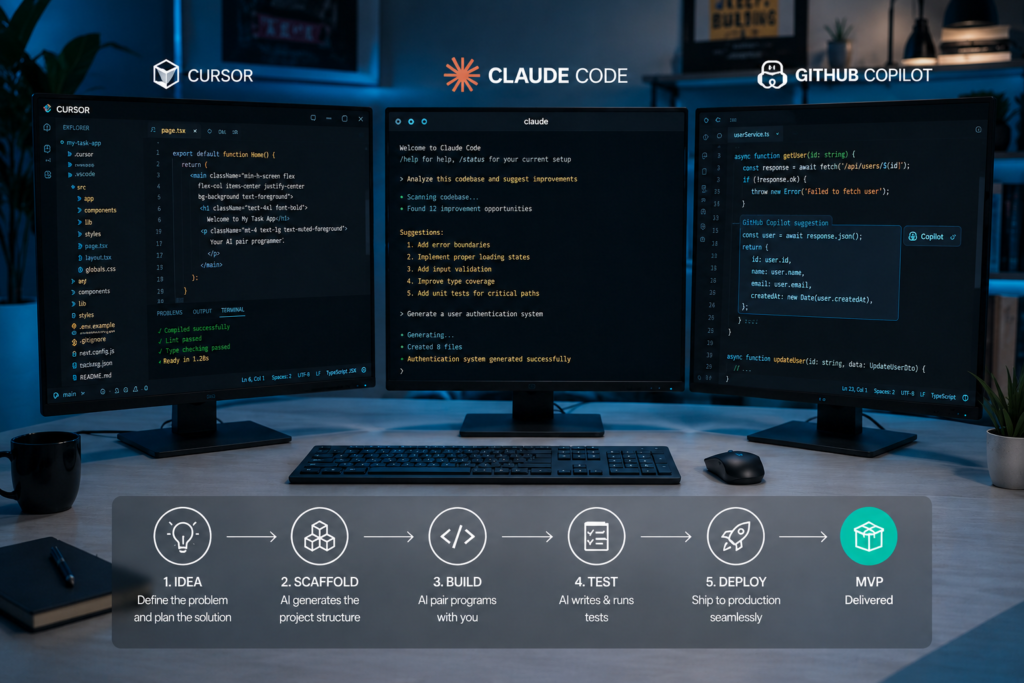
Cursor vs Claude Code vs GitHub Copilot – Which AI Dev Tool Ships Your MVP Fastest in 2026? Opening Note Choosing the right coding assistant matters when time is short and the market waits. In 2026 teams weigh developer experience, integration, and predictable outcomes. This comparison looks at three popular options – Cursor, Claude Code, and GitHub Copilot – to see which one helps deliver a minimum viable product fastest. The aim is practical. Product Siddha focuses on measurable workflows and straightforward trade offs, so the recommendations here favour speed to working software and reliable iteration. How to judge speed to MVP Before comparing tools, clarify what shipping an MVP means in practice. Useful measures include time to first working demo, number of meaningful iterations per week, lead time from idea to deploy, and defect rate after initial launch. Also consider onboarding time for engineers, integration with CI and deployment pipelines, and the effort to maintain quality and security. These operational metrics give a clear sense of productivity beyond marketing claims. Cursor – an IDE-first, agentic approach Cursor is built around a developer workspace with agent-driven automation. It can scaffold projects, run local tests, and help with debugging while keeping the developer inside an IDE-like surface. For small teams that value a tight feedback loop, Cursor shortens the distance between a prompt and runnable code. Strengths Workflow automation that follows the developer context. Tight local testing and live session features so problems are found early. Good for building prototypes that need rapid local iteration. Limitations The learning curve can be steeper for teams used to separate tools. Cost can rise if agent features run frequently across many repos. When Cursor helps ship faster Cursor shines when the product requires frequent local experimentation, for example when the MVP depends on complex client side interactions or quick iterations in backend logic. Its agent orchestration reduces manual glue work and lowers time to a stable demo. Claude Code – a careful, context-aware assistant Claude Code focuses on long-form reasoning and safe code generation. It excels at translating design documents or product requirements into structured scaffolds. The assistant is less about live IDE control and more about supplying robust, well explained code with an eye to clarity. Strengths Strong at turning specifications into tested stubs and detailed implementations. Emphasis on explainability so teams understand generated choices. Useful for documentation and handoff between product and engineering. Limitations Fewer in-IDE automation hooks compared with other options. Iteration speed depends on how teams integrate outputs into their pipelines. When Claude Code helps ship faster Claude Code is useful when the MVP has nontrivial business logic and the team needs clear audit trails. If the bottleneck is turning product intent into reliable code and tests, Claude Code reduces rework and clarifies design decisions for new engineers. GitHub Copilot – an inline, completion-first assistant GitHub Copilot operates as an extension to familiar IDEs and editors. It supplies line-level completions and small function suggestions. For many teams it accelerates routine coding and reduces context switching because the assistant lives inside the editor they already use. Strengths Low friction adoption and fast onboarding. Good at repetitive tasks, boilerplate, and API usage patterns. Integrates naturally with version control and developer workflows. Limitations Less suited to end-to-end automation of build, test, and deploy tasks. Quality varies with prompt clarity and surrounding context in the file. When Copilot helps ship faster Copilot is most effective when the MVP relies on standard frameworks, known libraries, and predictable patterns. It speeds up development for experienced engineers who know how to review suggestions quickly and accept or refine them. Practical comparison on core MVP tasks Project scaffolding Cursor: strong, with agent flows that create runnable scaffolds and local test harnesses. Claude Code: good at structured scaffolds with rationale and tests. Copilot: quick for file-level scaffolding but needs manual orchestration. Coding and iteration Cursor: fast for iterative cycles where tests run locally. Claude Code: careful, leading to fewer logic errors in complex modules. Copilot: fastest for filling standard code and reducing typing. Testing and quality Cursor: integrates test runs into the workflow. Claude Code: generates tests and explanations that support correctness. Copilot: suggests tests but leaves orchestration to the developer. CI, deploy, and ops Cursor: some orchestration features help, but teams still wire CI. Claude Code: produces scripts and docs that aid integration. Copilot: minimal on CI automation by itself. Security and code review All three tools require governance. Static analysis, dependency scanning, and human review remain essential. Product Siddha recommends treating generated code like third-party contributions and enforcing the same review gates and automated checks. Cost and team fit Cost affects speed indirectly. A tool that lowers manual toil but adds heavy runtime fees can slow teams through budget limits. Consider per-seat pricing, API usage, and the time cost of setting up integrations. Teams that already use GitHub find Copilot easiest to adopt. Teams that want a single workspace automation layer may prefer Cursor. Teams that value thorough specification and traceable outputs may pick Claude Code. A recommended workflow to ship fast Start with a tight scope and a one-week spike that defines the core feature. Choose the tool that best matches your bottleneck – scaffolding, specification, or inline productivity. Automate tests and CI from day one. Use the assistant to produce test stubs and deployment scripts. Measure time to first working demo and iterate in short cycles. Maintain human review for security and edge cases. Final Take No single assistant universally guarantees the fastest MVP. The right choice depends on what slows your team today. For rapid local experimentation Cursor often shortens the loop. For clear, auditable code generation Claude Code reduces rework. For low friction and steady developer speed GitHub Copilot accelerates routine tasks. Product Siddha advises teams to run a focused pilot, measure lead time and iteration velocity, and select the tool that improves those metrics. The practical outcome matters more than any feature checklist.


whatsapp commerce
AI Automation, Blog

WhatsApp Commerce in 2026 – Automating the Full Buyer Journey From Chat to Checkout

WhatsApp Commerce in 2026 – Automating the Full Buyer Journey From Chat to Checkout Opening Note WhatsApp has become a daily channel for millions of Indian consumers. By 2026 the app is a routine point of sale for many brands and merchants. The key shift is from isolated chat interactions to an orchestrated buyer journey that runs from initial inquiry to delivery confirmation. Companies that put AI Automation at the centre of that flow gain scale, speed, and clearer metrics. Product Siddha recommends a practical, staged approach to automation that balances reliability with measurable business outcomes. Why WhatsApp commerce matters in 2026 Consumers expect convenience and continuity. They begin discovery in chat groups, move to a private conversation, and expect a simple path to purchase. WhatsApp combines reach, trust, and rich message formats. For sellers, the channel reduces friction in product discovery and customer support. For financial institutions and insurers that work with merchant customers, WhatsApp provides a visible transaction record. The combination of conversational commerce, embedded payments, and automated workflows changes the economics of small-ticket sales and repeat purchases. Core components of an automated buyer journey Conversational interface and intent detection At the front end a conversation must feel natural and clear. Natural language understanding and intent classification identify whether a user is looking for product information, price negotiation, or checkout help. AI Automation converts that intent into discrete actions – show catalog cards, request delivery pin code, or offer installment options. Rapid intent routing reduces latency and keeps the customer engaged. Product catalog and discovery A catalog must be searchable, browsable, and presentable in chat. Rich messages, carousel cards, and quick replies help customers compare items. Behind the messages a catalog management system supplies up-to-date availability and pricing. Synchronised inventory prevents disappointment and reduces cancellations. Checkout and payment processing Checkout on WhatsApp combines a compact order summary with a secure payment link or an embedded payments flow. Payment gateways, wallet integrations, and UPI require tight compliance. AI Automation handles price validation, tax calculations, and fraud checks before the payment step. For recurring purchases the system can prompt saved-payment flows with explicit consent. Order management and fulfillment Once a payment clears the order must enter an OMS. The system allocates stock, schedules pick and pack, and triggers the courier. Automation can select the fastest or cheapest courier based on rules that include delivery window, product fragility, and past performance. Real-time tracking updates send messages to the buyer automatically. That reduces inbound support and improves perceived service quality. Post-purchase and retention After delivery automated flows confirm receipt, invite feedback, and offer cross-sell suggestions. Chat makes it simple to handle returns and warranty claims. AI Automation sequences follow-ups and recovery messages for abandoned carts. The result is a tighter retention loop with measurable lift in repeat purchase rates. How AI Automation powers the experience Natural language understanding and personalization Advanced NLU maps colloquial queries to product attributes. Personalization layers use purchase history, session signals, and declared preferences to present the most relevant items. AI Automation applies those models in real time so messages reflect the user’s context and increase conversion likelihood. Workflow automation and orchestration Automation platforms define deterministic flows – accept order, validate address, run fraud checks, call payment gateway, update OMS. Orchestration engines handle retries, error paths, and human handovers. For high volume merchants orchestration reduces manual steps and lowers time to fulfilment. Risk management and fraud prevention Automated fraud scoring evaluates velocity, device signals, and payment patterns. AI Automation flags suspicious transactions for manual review. That balancing act keeps acceptance rates high while protecting revenue. Analytics and lifecycle measurement Measurement is essential. Track conversion rate from first message to purchase, average order value, time to ship, and repeat rate. AI Automation can produce dashboards and trigger experiments to improve weak points in the buyer journey. Operational and regulatory concerns Compliance and consent WhatsApp commerce requires consent management and clear opt-in flows. Retain consent records and make unsubscribe simple. Payment flows must follow local rules including RBI guidance and data localisation where applicable. Data privacy and retention Protect message content and personal data. Encrypt stored records, limit access, and apply retention rules. Use zero-party signals – preferences provided directly by customers – where possible to avoid inference risk. Human oversight and escalation Automation must include human fallback. Complex negotiations, bespoke requests, and fraud investigations need a human agent. Design clear escalation paths so agents receive context-rich history and suggested responses. Integration and vendor choices Pick partners that offer robust WhatsApp Business API integration, reliable payment links, and an OMS that supports webhook-driven updates. Prefer modular systems that expose APIs for product catalog, inventory, and billing. Product Siddha advises starting with a core set of integrations and expanding based on measured value. A practical rollout plan Define a narrow scope – a best-selling product line or a single region. Implement a basic conversational flow and connect catalog and payments. Add AI Automation for intent routing and order validation. Run a live pilot with explicit success metrics such as conversion rate and fulfilment SLA. Expand the scope, automate returns and recovery flows, and add richer personalization. Measuring success Choose three metrics to track initially. Suggested options are conversion from chat to checkout, average time from order to dispatch, and repeat purchase rate within 90 days. Use A/B tests where possible. Keep the experiments small and statistically valid. Final Take WhatsApp commerce in 2026 is not merely a sales channel. It is a commerce platform that can deliver end-to-end buyer journeys when paired with reliable automation. AI Automation is the glue that maps conversations to actions, handles routine tasks, and leaves human agents to address exceptions. Product Siddha recommends a staged approach that begins with a tight pilot and clear metrics. That method reduces risk and produces evidence that supports broader rollout. For merchants, the payoff is faster conversions, lower operating cost, and more predictable customer relationships.

Digital_Twins_Real_Estate
AI Automation, Blog

Digital Twins for Real Estate – The Next Frontier After Virtual Tours

Digital Twins for Real Estate – The Next Frontier After Virtual Tours Opening View Digital twins have moved from industry labs into everyday property practice. Where virtual tours gave a visual sense of space, digital twins provide a live, data-driven replica of buildings and portfolios. For developers, asset managers, and facility teams the shift matters because a functioning replica supports decisions across design, operation, and value management. Product Siddha recommends treating digital twins as an operational platform rather than a marketing asset. That change in perspective guides how teams deploy sensors, integrate systems, and use AI Automation to drive measurable outcomes. What a digital twin actually is A digital twin is a dynamic model that mirrors a physical asset in detail. It combines 3D geometry, building information modeling (BIM) data, time-series sensor feeds, and business records into a single reference. Unlike a static model or a filmed walkthrough, a digital twin updates as conditions change. It can simulate scenarios, run performance forecasts, and expose APIs for downstream systems. For real estate this means using spatial analytics, geospatial data, and live telemetry to manage day-to-day tasks and longer term strategy. How digital twins differ from virtual tours Virtual tours are immersive but passive. They show space at a moment in time. Digital twins are active and connected. They allow queries such as which rooms have rising humidity, which floor has the highest energy draw, or where deferred maintenance is accumulating. That operational capability is what turns a digital twin into a tool for facility management, tenant services, and underwriting. Core components of a real estate digital twin A detailed geometry layer drawn from BIM or photogrammetry. An asset registry that links physical objects to identifiers. Sensor and IoT feeds for temperature, occupancy, vibration, and energy. Historical and transactional data that add context to live readings. A simulation and analytics layer that supports predictive maintenance and energy optimization. Integration endpoints and APIs that connect the twin to CAFM, ERP, and loan systems. Practical use cases that add value Design and planning Digital twins let design teams validate layouts and services before construction. They support clash detection, staging plans, and procurement schedules. BIM data in the twin reduces rework on site. Operations and maintenance Facility teams use twins to prioritize repairs based on real-time risk. AI Automation can turn sensor thresholds into tickets, order parts, and schedule vendors. The result is lower downtime and predictable maintenance costs. Energy and sustainability Twins link building meters, weather forecasts, and occupancy patterns. Automated routines tune HVAC settings based on predicted load. This approach supports energy reporting and helps owners meet audit requirements. Leasing and tenant experience Leasing teams use dynamic occupancy heatmaps and performance reports to demonstrate building value. Tenants receive responsive service because automated workflows route issues and provide progress updates. Construction and retrofit During construction a twin tracks progress against schedules. For retrofit projects the twin models baseline energy use and projects savings under different upgrade scenarios. That clarity helps owners prioritise investments. Risk, compliance, and insurance A twin that logs sensor data and maintenance actions offers a clear audit trail. Insurers and regulators often accept documented monitoring more readily than manual logs. This reduces friction in claims and compliance reviews. Implementation hurdles and how to address them Data quality and identity A twin is only as reliable as its identifiers and inputs. Standardise asset coding early and resolve duplicate records. Work with cadastral and parcel data so physical boundaries match model geometry. Systems integration Many buildings have legacy systems. Prioritise adapters to critical systems such as access control, metering, and CAFM. Use modular APIs to keep future integration straightforward. Governance and model drift Define who owns the twin and how changes are versioned. Models evolve as equipment is replaced. Apply model governance and record retraining or re-surveys. Security and privacy Protect sensor feeds and tenant data. Encrypt streams and enforce role based access. Apply data retention policies that comply with local regulation. Measuring return on investment Select a small set of outcome metrics before deployment. Good candidates include mean time to repair, energy cost per square meter, occupancy efficiency, and vendor response time. Track baseline performance, run the twin for a pilot, and measure change. Use that evidence when expanding coverage. How AI Automation amplifies the twin AI Automation is the connective layer that turns insights into action. Use cases include automated anomaly detection on time-series data, rule-based ticket generation, predictive failure alerts, and scheduling optimization for field crews. Automation reduces manual steps and delivers a predictable workflow. Product Siddha advises pairing automation with clear human review gates in the earliest phases. That keeps teams confident while the system matures. A practical rollout path Pilot on a single building with complete sensor coverage in core systems. Confirm data mappings and asset identifiers. Run parallel operations for a defined interval and collect outcome metrics. Introduce AI Automation for low-risk, high-frequency tasks such as HVAC scheduling. Scale across the portfolio, adding integrations and governance rules. Vendor selection and internal skills Choose partners that demonstrate open APIs, a history of integration, and tools for model governance. Internally hire or train a small team responsible for data quality and twin stewardship. Success depends on repeatable processes as much as on software features. Closing Perspective Digital twins represent a practical advance over virtual tours. They deliver continuous value by linking physical operations to analytics and by enabling automated workflows. The most successful deployments blend technical rigor with operational discipline. Product Siddha recommends starting with a narrow pilot, proving savings with clear metrics, and then expanding the twin to support broader business functions. When AI Automation is introduced carefully, it reduces routine labor and frees teams to focus on higher value work. The twin then becomes a living asset that supports better decisions across the property lifecycle.

AI Automation, Blog

AI Property Valuation in 2026: Can Algorithms Replace Human Appraisers in India?

AI Property Valuation in 2026: Can Algorithms Replace Human Appraisers in India? A Practical Beginning The question of whether algorithms can replace human appraisers is both timely and highly relevant in India’s evolving real estate market. In 2026, property valuation benefits from unprecedented access to data, including public records, transaction histories, satellite imagery, and building permit information. These datasets power Automated Valuation Models (AVMs), enabling faster and more scalable property assessments. At the same time, professional appraisers continue to provide field inspections, local market expertise, and contextual judgment that algorithms cannot fully replicate. The real question is not whether AI will replace appraisers, but how AI Automation can be integrated into valuation workflows that demand accuracy, transparency, and fairness. How Automated Valuation Models Work Understanding the Foundations of AVMs Automated Valuation Models use a combination of statistical techniques and machine learning algorithms to estimate property values. Common valuation inputs include: Recent comparable sales Property size and floor area Building age and condition Zoning classifications Neighborhood characteristics Additional data sources may include: Geospatial information Transit accessibility Infrastructure developments Building permit records Market activity indicators Through predictive analytics and feature engineering, AVMs transform raw property data into valuation estimates accompanied by confidence ranges. These models can process thousands of properties simultaneously, making them ideal for portfolio valuation, tax assessments, and preliminary mortgage underwriting. Where AI Automation Helps Streamlining Valuation Workflows AI Automation improves efficiency throughout the valuation process by handling repetitive and data-intensive tasks. Key applications include: Extracting information from deeds and loan documents Standardizing property addresses across datasets Detecting missing or inconsistent information Running batch comparable-property analyses Updating market indices automatically Recalibrating models using new transaction data For lenders, insurers, and asset managers, these capabilities reduce manual effort and significantly shorten decision-making timelines. Product Siddha has observed that automation solutions offering comprehensive audit trails and measurable performance metrics are particularly attractive to institutional clients. Limits of Pure Algorithmic Valuation Data Availability Challenges Despite advancements in property technology, data quality remains inconsistent across many regions of India. Challenges include: Incomplete transaction records Informal property transfers Private sales not reflected in public datasets Inconsistent municipal recordkeeping These limitations reduce the reliability of algorithmic predictions in certain markets. Local Market Nuances Many property characteristics remain difficult for algorithms to evaluate accurately. Examples include: Construction quality Interior finishes Illegal additions or modifications Neighborhood reputation Local demand drivers These factors often require physical inspection and human judgment. Explainability Concerns Most machine learning models provide estimates alongside error margins, but understanding why a specific valuation was generated can be difficult. For high-value transactions, legal disputes, and complex collateral assessments, stakeholders frequently require detailed explanations that automated systems may struggle to provide independently. Bias, Transparency, and Regulation Addressing Algorithmic Bias Automated models learn from historical data. If past valuations contain biases, those biases can influence future predictions. Reducing this risk requires: Bias testing and mitigation strategies Transparent model development Continuous performance monitoring Diverse training datasets The Growing Importance of Explainability Regulators and financial institutions increasingly demand explainable AI systems. Valuation platforms must provide: Traceable decision pathways Feature attribution reports Model documentation Version control records Mortgage underwriting and lending decisions, in particular, require transparent methodologies that can withstand regulatory scrutiny. Governance and Compliance Requirements As AI adoption grows, valuation providers must establish governance frameworks that monitor: Model accuracy Bias across property segments Performance drift System updates and retraining cycles AI Automation should support these governance requirements by automatically logging model changes and maintaining audit-ready documentation. A Hybrid Approach That Scales Combining Algorithmic Speed With Human Expertise Rather than replacing appraisers, the most effective strategy combines automated valuation with professional oversight. A typical hybrid workflow may involve: AVMs screening large property portfolios. High-confidence properties proceeding through automated processes. Low-confidence or high-value properties being escalated for human review. Appraisers using automation tools to improve efficiency. This approach balances scalability with valuation reliability. How Automation Supports Human Appraisers AI Automation can assist appraisers by: Prepopulating valuation reports Gathering comparable property data Providing satellite imagery and geospatial insights Identifying valuation anomalies Product Siddha recommends hybrid valuation frameworks for organizations seeking both operational efficiency and defensible property assessments. Operational Concerns for Adoption Data Quality Remains the Primary Challenge Valuation accuracy depends heavily on data quality. Organizations should prioritize: Address standardization Duplicate record detection Parcel identifier consistency Data validation procedures Poor-quality data inevitably leads to unreliable valuation outputs. Managing Model Drift Property markets change over time, causing predictive models to lose accuracy. AI Automation can address this challenge by: Monitoring performance continuously Scheduling automated retraining cycles Tracking valuation errors Measuring bias across market segments Common performance metrics include: Mean Absolute Error (MAE) Median Absolute Error Segment-specific bias indicators Integration Drives Adoption Valuation platforms gain traction when they connect seamlessly with existing business systems. Critical integrations include: Loan origination software Property management platforms Asset management systems Payment infrastructure CRM platforms Modular APIs and automation frameworks reduce implementation complexity and improve adoption rates. Use Cases Where Algorithms Already Dominate Portfolio Monitoring Institutional investors increasingly rely on automated valuations to monitor large property portfolios in real time. Tax Assessment and Insurance Analysis Government agencies and insurers use batch valuation models for: Risk scoring Property sampling Premium calculations Tax assessment reviews Consumer Property Estimates Online real estate platforms routinely provide instant property value estimates generated through AVMs. Standardized Residential Lending For routine mortgage applications involving standard housing units, AVMs combined with limited human review can significantly accelerate loan approvals while maintaining acceptable accuracy levels. Where Human Appraisers Remain Essential Complex Property Types Certain property categories continue to require specialized human expertise, including: Commercial assets Industrial facilities Heritage properties Mixed-use developments Legal and Title Complications Properties involving title disputes, ownership irregularities, or legal challenges often require detailed field inspections and professional interpretation. Qualitative Property Assessment Human appraisers remain uniquely qualified to evaluate: Construction quality Design appeal Amenities Neighborhood desirability Micro-location influences These factors often have significant impacts on value but are difficult to quantify using data alone. A Reasoned Outlook Algorithms will not completely replace human appraisers in India

AI Automation, Blog

Proptech Funding Trends 2026: Where Smart Money Is Going in Indian Real Estate Tech

  Proptech Funding Trends 2026: Where Smart Money Is Going in Indian Real Estate Tech In 2026, the Indian proptech market favors projects that demonstrate clear returns and repeatable results. Investors are increasingly prioritizing solutions that reduce operating costs, accelerate transactions, and improve asset performance. Product Siddha has observed a steady shift toward platforms that combine practical automation with reliable data intelligence. Within this landscape, AI Automation Services have evolved from an experimental concept into a commercial necessity, frequently appearing in funding discussions, pilot programs, and investment term sheets where measurable savings drive decision-making. Capital Flows and Priority Areas Marketplaces That Shorten Time to Deal Digital marketplaces that streamline property transactions continue to attract investor attention. Funding is flowing toward platforms that integrate property listings with automated document verification, compliance checks, identity validation, and secure payment processing. When these capabilities operate within a unified ecosystem, transaction friction decreases, customer confidence increases, and conversion rates improve. Investors favor platforms that can demonstrate measurable reductions in sales and leasing cycles. Property Operations and Tenant Experience Property owners are increasingly investing in technology that improves operational efficiency and tenant satisfaction. As a result, property management software remains one of the strongest-funded segments within proptech. Platforms offering automated tenant onboarding, maintenance scheduling, rent collection, and communication management are receiving significant capital support. AI Automation Services further enhance these systems by converting tenant messages into actionable work orders, prioritizing maintenance requests based on urgency, and automatically dispatching vendors. These capabilities reduce operational costs while improving occupancy and retention rates. Construction Tech and Supply Chain Automation Construction delays and budget overruns continue to challenge developers across India. Investors are backing technologies that address these issues through automation and data-driven planning. Areas attracting funding include: Offsite and modular construction solutions Automated site monitoring through sensors and imagery Procurement and supply chain management platforms Real-time project performance dashboards When automation connects construction data with supplier networks and procurement systems, project teams gain greater visibility and control, leading to more predictable budgets and timelines. Data Platforms and Underwriting Tools Lenders and financial institutions are seeking better tools for evaluating risk and investment opportunities. Consequently, startups that provide stronger property intelligence are attracting increased investor interest. Modern underwriting platforms combine public records, construction progress data, market trends, and transaction history to generate more accurate risk assessments. Features such as automated property valuations, predictive market insights, and batch reporting improve decision-making and create compelling value propositions for financial institutions. Why AI Automation Services Matter From Manual Tasks to Measurable Savings Automation is most valuable when it produces outcomes that can be measured and verified. Investors are increasingly interested in solutions that directly impact profitability and efficiency. Examples include: Automated document extraction for sale deeds and title verification Compliance reporting and audit preparation Smart maintenance scheduling based on sensor data Automated lease and payment management These capabilities translate into lower operating expenses, reduced administrative overhead, and improved revenue collection. Embedded Automation Within Existing Workflows Today’s investors favor automation that integrates seamlessly with existing technology stacks rather than requiring complete operational changes. AI Automation Services that connect through APIs and integrate with CRM systems, payment platforms, and property management software reduce implementation complexity and accelerate adoption. Product Siddha recommends packaging automation capabilities into modular components that customers can activate progressively. This approach minimizes disruption while maximizing adoption rates. Predictive Analytics and Proactive Operations The next stage of automation focuses on predicting problems before they occur. Predictive models can identify: Potential tenant vacancies Maintenance requirements Rental yield fluctuations Energy consumption anomalies Asset performance risks When predictive insights automatically trigger workflows, organizations can act before minor issues become costly problems. For example, a maintenance request can be generated automatically when a sensor detects abnormal equipment performance, reducing downtime and repair expenses. What Investors Measure Core Metrics That Drive Funding Decisions Investors increasingly rely on performance metrics rather than projections when evaluating proptech opportunities. Key metrics include: Net revenue retention Gross margins on recurring software services Time to deployment after contract signing Unit economics at scale Maintenance cost per property unit Occupancy improvements after automation Collection rate improvements Customer acquisition and retention costs Live case studies and measurable outcomes carry significantly more weight than future projections. For providers of AI Automation Services, controlled pilot programs that demonstrate quantifiable improvements often become the strongest funding catalysts. How Startups Should Position Themselves Start Narrow, Prove Value, Then Expand Many proptech startups attempt to solve too many problems simultaneously. Investors generally prefer focused solutions that deliver measurable results quickly. A strong market entry strategy begins with a single business outcome, such as: Faster leasing cycles Reduced maintenance costs Improved occupancy rates More accurate valuations Once measurable value is established, expansion into adjacent services becomes significantly easier. Make Integrations Simple Complex implementations can slow sales cycles and reduce adoption. Startups should prioritize deep integrations with critical systems such as: Property management platforms Payment gateways Listings networks Financial reporting systems Customer relationship management software Product Siddha recommends focusing on a smaller number of high-quality integrations rather than maintaining a large collection of partially developed connections. Build Partnerships That Accelerate Distribution Strategic partnerships remain one of the most effective growth mechanisms within proptech. Potential partners include: Large developer groups Property management firms Real estate brokerages Financial institutions Payment technology providers Partnerships not only provide access to customers but also enhance credibility during fundraising discussions. Prepare for Regulatory and Sustainability Scrutiny Environmental reporting and regulatory compliance are becoming increasingly important factors in property valuation and investment decisions. Investors are showing growing interest in solutions that automate: Energy consumption tracking Carbon emissions reporting ESG compliance documentation Audit preparation Sustainability benchmarking Startups that simplify compliance processes for building owners often command premium valuations and stronger buyer interest. Positioning Product Siddha: Practical Steps Lead With a Clear Business Outcome Every sales conversation should begin with a measurable business objective and the specific AI Automation Services module that supports it. Offer Pilot Programs With Defined Success Metrics Successful pilots establish credibility and provide evidence for future

AI Automation, Blog

Why n8n is the Best Kept Secret for Marketing Agency Automation

Why n8n is the Best Kept Secret for Marketing Agency Automation A Tool Few Talk About Most agencies rely on familiar names when it comes to automation. These tools are widely used and easy to adopt. They solve basic problems and help teams get started. Yet there is another category of tools that receives less attention. These tools are not always simple at first glance, but they offer a level of control that standard platforms cannot match. This is where n8n stands out. Among modern AI tools for marketing automation, it remains relatively underused, even though it can support complex workflows with precision. What Makes n8n Different To understand its role, it helps to look at how n8n operates. Unlike many automation tools that rely on fixed templates, n8n allows users to design workflows step by step. Each action can be defined, modified, and connected as needed. This flexibility changes how agencies approach automation. Open Structure n8n is built with an open approach. Users are not limited to predefined paths. Workflows can be adjusted to match specific requirements. Custom Logic Conditions, filters, and sequences can be designed without restriction. This allows agencies to handle complex scenarios. Data Control Information moves through workflows in a structured way. Teams can decide how data is processed and where it is sent. A Simple Comparison Feature Standard Automation Tools n8n Workflow Flexibility Limited High Custom Logic Basic Advanced Data Control Restricted Full Scalability Moderate Strong Where n8n Fits in an Agency Setup n8n is not designed for simple tasks alone. Its strength lies in handling workflows that involve multiple systems. Lead Management Leads can be captured, filtered, and routed based on specific conditions. Reporting Data from different tools can be combined and structured before being sent to dashboards. Communication Notifications can be triggered based on events, ensuring that teams stay informed. Why Many Agencies Overlook n8n Despite its advantages, n8n is not widely adopted. Learning Curve It requires a basic understanding of workflows. Teams used to simple interfaces may take time to adjust. Lack of Awareness Many agencies are not familiar with the tool. They rely on platforms that are more commonly discussed. Preference for Simplicity Simple tools are easier to start with. They provide quick results for basic needs. Where n8n Becomes Valuable As agencies grow, their workflows become more complex. At this stage, limitations of simpler tools begin to appear. Workflows need to handle multiple conditions Data must move across several systems Processes must remain consistent at scale This is where n8n proves useful. It allows agencies to build systems that match their requirements. A Pattern Seen Across Projects The need for flexible workflows appears in many cases. In a project focused on building the world’s first AI-powered networking assistant, structured workflows were essential. Data had to be processed in stages and routed based on user behavior. In another case involving product analytics for a SaaS coaching platform, automation ensured that data moved smoothly across the funnel. This reduced manual effort and improved clarity. These examples show that the value of advanced AI tools lies in their ability to adapt to complex processes. How to Start with n8n Adopting n8n does not require immediate complexity. A gradual approach works best. Begin with a Simple Workflow Start with a basic task such as lead routing or notification. Add Logic Step by Step Introduce conditions and filters as needed. Connect Additional Tools Expand the workflow to include more systems. A Balanced View n8n is not the right tool for every situation. For simple tasks, basic automation tools may be sufficient. They are easier to use and quicker to set up. However, when workflows become detailed and interconnected, a more flexible system becomes necessary. The Broader Perspective The role of AI tools in marketing automation continues to grow. Agencies are moving toward systems that can handle complexity without increasing manual effort. Tools like n8n represent a shift in how automation is approached. Instead of relying on fixed templates, agencies can design workflows that reflect their actual processes. Final Thoughts n8n remains less visible compared to widely used platforms. Yet its capabilities make it a valuable option for agencies like Product Siddha that need flexibility and control. The decision to adopt it depends on the complexity of the work and the readiness of the team. For agencies like Product Siddha that require structured workflows and scalable systems, it offers a practical solution.

Blog, Product Analytics

How Project Managers Can Automate Client Reports Using Dashboards + AI

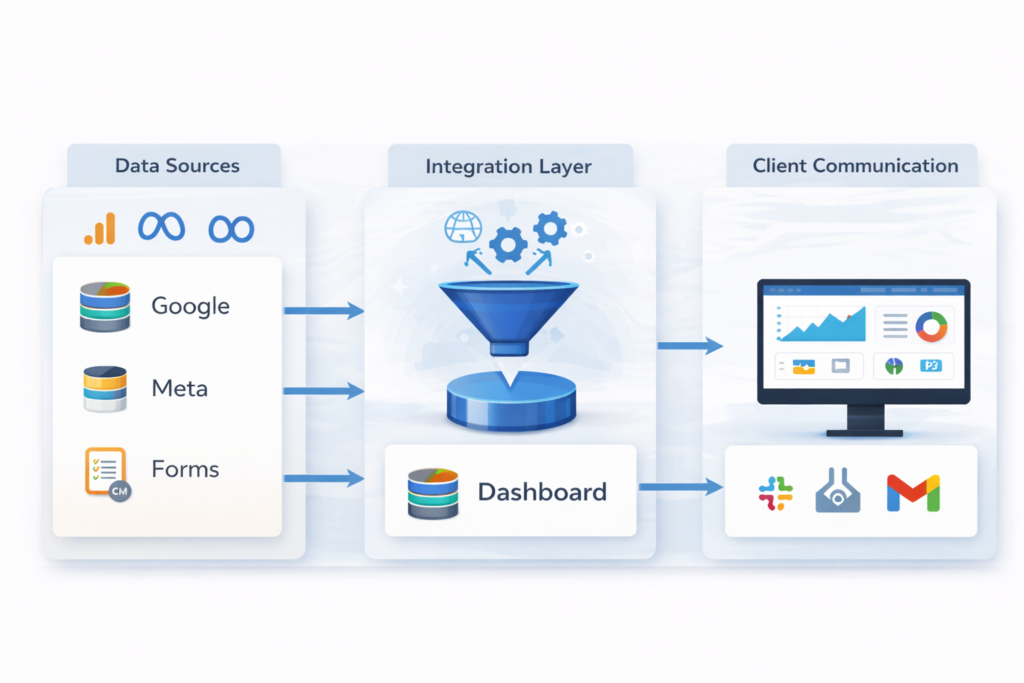
How Project Managers Can Automate Client Reports Using Dashboards + AI A Daily Burden That Slows Delivery For many project managers, reporting is a constant responsibility. It sits between execution and communication. It requires attention, accuracy, and time. Each reporting cycle follows a familiar pattern. Data is collected from different tools. Numbers are verified. Slides or sheets are prepared. Updates are shared with clients. The process works, but it consumes hours that could be used elsewhere. With the rise of structured dashboards and AI tools, this routine is changing. Reporting no longer needs to be rebuilt each time. It can run as part of an ongoing system. Where Time Gets Lost To improve reporting, it is useful to identify where effort is spent. Data Collection Information is pulled from analytics platforms, CRM systems, and campaign tools. This often involves switching between multiple interfaces. Data Preparation Numbers are formatted and arranged. Metrics are selected and aligned with reporting goals. Report Creation Reports are built using spreadsheets or presentation tools. This step requires consistency and attention to detail. Review and Delivery Reports are checked for accuracy before being shared. Any correction leads to repetition. The Shift Toward Automated Reporting Automated reporting changes the structure of this process. Instead of building reports manually, project managers rely on AI-powered dashboards that update continuously. These systems: Pull data directly from source tools Organize information into a fixed structure Present updates in real time This reduces the need for repeated effort. A Comparison of Workflows Step Manual Reporting Automated Reporting Data Collection Manual extraction Direct integration Data Preparation Repeated formatting Predefined structure Report Creation Built each time Always available Updates Periodic Continuous Time Required High Reduced What Makes Dashboards Effective A dashboard is not simply a display of numbers. Its value depends on how it is designed. Clear Metrics Only relevant metrics should be included. This prevents confusion. Consistent Layout Information should appear in the same format each time. This helps users read reports quickly. Real-Time Updates Data should reflect the current state of the system. This reduces delays in decision-making. The Role of AI Tools AI tools enhance dashboards by handling tasks that would otherwise require manual effort. Data Integration They connect multiple data sources and ensure that information flows without interruption. Pattern Recognition They identify trends within the data. This helps project managers understand performance changes. Automated Alerts They notify teams when certain conditions are met, such as a drop in performance. A Pattern Across Different Projects The need for automated reporting appears in many cases. In a project focused on driving growth for a U.S. music application with full-stack analytics, structured dashboards allowed teams to track performance without manual data collection. In another case involving HubSpot setup for a growing fintech brand, dashboards ensured that customer data remained visible across stages. This improved coordination between teams. These examples show that reporting systems are most effective when they are integrated with the broader workflow. How Project Managers Can Start The transition to automated reporting can be gradual. Identify Repetitive Reports Focus on reports that are created frequently. These offer the most immediate benefit. Connect Data Sources Use AI tools for reporting automation to link analytics platforms, CRM systems, and other tools. Build a Basic Dashboard Start with a simple structure that reflects key metrics. Expand as Needed Add more data and features once the system is stable. A Balanced Approach Automation does not remove the need for human judgment. Project managers still play a key role in: Interpreting results Communicating insights Adjusting strategies Automation supports these tasks by reducing routine effort. A Broader Perspective The move toward automated reporting reflects a larger change in how work is organized. Tasks that involve repetition are increasingly handled by systems. Human effort shifts toward understanding and decision-making. For project managers, this shift provides an opportunity to focus on higher-value work. Closing Note Client reporting will always remain an essential part of agency work. What changes is how that reporting is prepared. With the support of dashboards and AI tools, Product Siddha project managers can reduce manual effort and improve consistency. The result is a reporting system that supports both clarity and efficiency.

AI Automation, Blog

Stop Using Spreadsheets: Smarter Client Reporting Systems for Agencies

Stop Using Spreadsheets: Smarter Client Reporting Systems for Agencies A Habit That Refuses to Change Spreadsheets have been part of agency work for decades. They are familiar, flexible, and easy to share. For a long time, they were the default way to manage client reporting. Yet most teams know the limitations. Data must be copied from multiple tools. Formulas break. Versions get mixed up. Reports take hours to prepare and still require review. Despite this, many agencies continue to rely on spreadsheets. The reason is simple. Changing systems feels difficult. However, the shift toward structured reporting systems is already underway. With the help of AI tools, agencies are moving beyond manual reporting and building workflows that run with far less effort. Where Spreadsheets Fall Short Spreadsheets were never designed to handle the complexity of modern reporting. Manual Data Entry Each report begins with collecting data from different sources. This process repeats every week or month. Version Confusion Multiple versions of the same file create uncertainty. Teams spend time confirming which file is correct. Limited Scalability As the number of clients grows, spreadsheets become harder to manage. Each new account adds more work. Risk of Errors Even small mistakes in formulas or data entry can affect the entire report. The Shift Toward Smarter Systems Modern reporting systems take a different approach. Instead of building reports from scratch each time, they rely on AI-powered reporting tools that connect directly to data sources. These systems: Pull data automatically Update in real time Present information in structured dashboards This removes the need for repeated manual work. A Comparison of Approaches Aspect Spreadsheet Reporting Automated Reporting System Data Collection Manual Automatic Updates Periodic Real-time Accuracy Depends on input System-driven Scalability Limited High Time Required High Low What Makes a Reporting System “Smarter” A smarter system is not defined by complexity. It is defined by how well it handles routine tasks. 1. Direct Data Integration The system connects to data sources such as analytics tools and CRM platforms. This ensures that information is always current. 2. Automated Updates Reports update without manual input. This removes the need for repeated data entry. 3. Clear Structure Information is organized in a consistent format. This makes it easier to interpret. 4. Easy Access Reports are available at any time. Teams and clients do not need to wait for scheduled updates. A Pattern Seen Across Different Use Cases The limitations of spreadsheets are not limited to one type of work. In a project focused on product analytics for a ride-hailing application, manual tracking created delays in understanding user behavior. Automated tracking systems replaced spreadsheets and provided continuous insights. In another case involving email revenue growth for a Shopify brand, structured reporting allowed teams to monitor performance without preparing separate reports for each campaign. These examples show that the move away from spreadsheets is not limited to reporting alone. It reflects a broader shift toward structured systems. Why Agencies Delay the Shift Despite the advantages, many agencies hesitate to move away from spreadsheets. Familiarity Teams are comfortable with existing tools. Learning a new system requires effort. Perceived Complexity Automated systems may seem difficult to set up. Short-Term Focus Manual methods continue to work in the short term, even if they are inefficient. How to Move Away from Spreadsheets The transition does not require a complete overhaul. It can be done step by step. Identify High-Effort Reports Start with reports that take the most time to prepare. Connect Data Sources Use AI tools to link analytics platforms, CRM systems, and other data sources. Build a Basic Dashboard Create a simple structure that reflects key metrics. Expand Gradually Add more data and features as needed. The Broader Impact Moving away from spreadsheets affects more than reporting. Teams spend less time on routine tasks Data becomes easier to access Decisions are based on current information This leads to a more stable and predictable workflow. A Thoughtful Transition It is not necessary to eliminate spreadsheets entirely. They can still serve specific purposes. However, relying on them as the primary reporting system limits growth. The goal is to reduce dependency and build systems that support consistent work. Final Perspective Spreadsheets have served agencies well. They remain useful in certain contexts. Yet the demands of modern reporting require a different approach. Product Siddha for marketing reporting provide a way to move beyond manual processes and toward structured systems. Agencies that make this transition tend to operate with greater clarity and less effort.

AI Automation, Blog

Done-for-You vs DIY AI Automation for Agencies: What Scales Better?

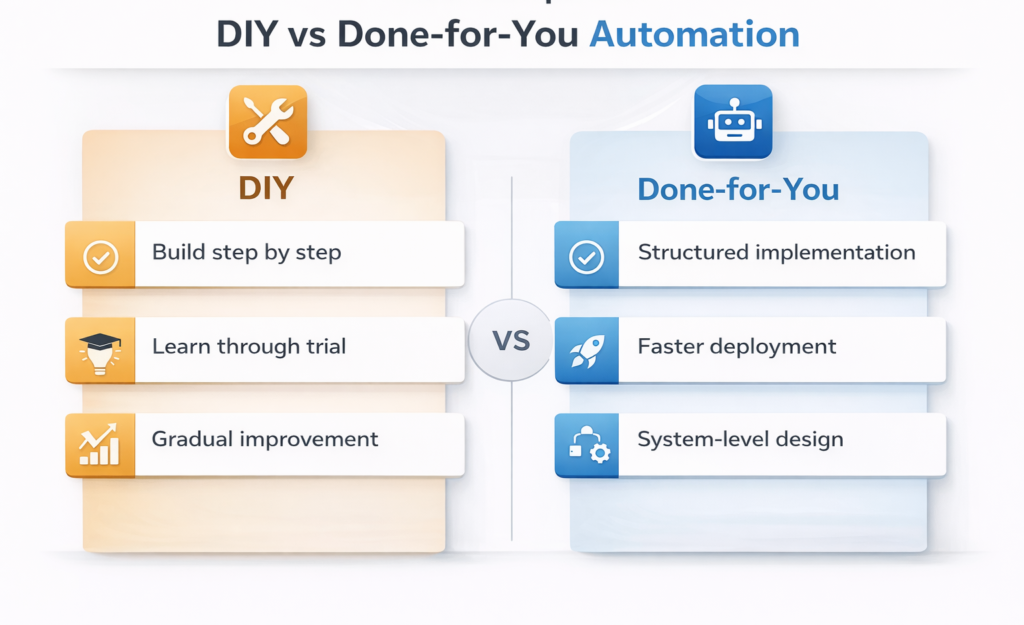
Done-for-You vs DIY AI Automation for Agencies: What Scales Better? A Practical Choice Agencies Must Make Most agencies reach a point where manual work begins to slow them down. Reporting takes longer than expected. Lead handling becomes uneven. Systems grow, but they do not connect. At this stage, the question is no longer whether to adopt automation. The question is how to adopt it. Should the agency build its own workflows using available AI tools, or should it rely on a done-for-you setup designed by specialists? The answer depends on scale, capability, and long-term intent. Understanding the Two Approaches Before comparing outcomes, it helps to define both approaches clearly. DIY AI Automation In this model, the agency builds its own systems. Teams select AI tools for marketing automation Workflows are designed internally Integration is handled step by step This approach gives full control. It also requires time and technical understanding. Done-for-You Automation Here, the agency works with a partner that designs and implements the system. Workflows are planned externally Tools are selected based on use case Integration is handled by specialists This reduces the burden on internal teams. It also speeds up implementation. A Comparison Table Factor DIY Approach Done-for-You Approach Setup Time Longer Shorter Control High Moderate Expertise Needed Internal External Scalability Gradual Faster Maintenance Internal responsibility Managed support Where DIY Works Well The DIY route suits agencies that have: A technically skilled team Time to experiment and refine workflows Fewer clients during the early stage In such cases, building systems internally can lead to a deeper understanding of tools and processes. However, the cost is often hidden. Time spent learning and fixing systems reduces time available for client work. Where Done-for-You Becomes Practical As agencies grow, the limits of DIY become visible. Workflows become complex Tools need to be connected across departments Errors begin to affect delivery At this stage, a done-for-you approach often becomes more practical. It allows teams to focus on outcomes rather than setup. The Role of AI Tools in Both Models Regardless of the approach, AI tools remain central. They are used to: Automate repetitive tasks Connect data across systems Provide real-time visibility The difference lies in how these tools are used. In DIY setups, tools are often used individually. In done-for-you setups, tools are arranged as part of a larger system. A Pattern Seen Across Projects This choice appears in many situations. In a project focused on HubSpot setup for a growing fintech brand, the challenge was not tool selection. The tool was already available. The difficulty was in structuring workflows and connecting data. A structured implementation ensured that: Customer data moved correctly between stages Marketing and sales systems remained aligned Reporting reflected accurate progress This reduced confusion and improved efficiency. The Question of Scale The core issue is scalability. DIY systems often work at a small scale. As the number of clients increases, complexity grows. More workflows need to be maintained More tools need to be connected More errors need to be resolved Done-for-you systems are designed with scale in mind. They account for growth from the beginning. Common Mistakes Agencies Make Many agencies face challenges not because of the approach, but because of how it is applied. Overbuilding in DIY Teams try to create complex systems too early. This leads to confusion and delays. Underplanning in Done-for-You Agencies sometimes adopt external systems without understanding their structure. This limits long-term flexibility. A Balanced Approach In practice, many agencies use a mix of both models. Core systems are built with expert support Smaller workflows are handled internally This allows control without overburdening the team. Looking at the Long Term The decision between DIY and done-for-you is not permanent. It changes as the agency grows, and Product Siddha helps guide that transition. In early stages, DIY may be sufficient. As complexity increases, structured systems built with Product Siddha become necessary. The focus should remain on building workflows that are reliable and scalable, with Product Siddha supporting that progression. Final Thoughts The question is not which approach is better in all cases. It is which approach suits the current stage of the agency. AI tools for marketing provide the foundation. The method of implementation determines how effectively that foundation is used. Agencies that choose carefully tend to scale with fewer disruptions.

AI Automation, Blog

The New Agency Stack: AI Tools Every Marketing Agency Needs in 2026

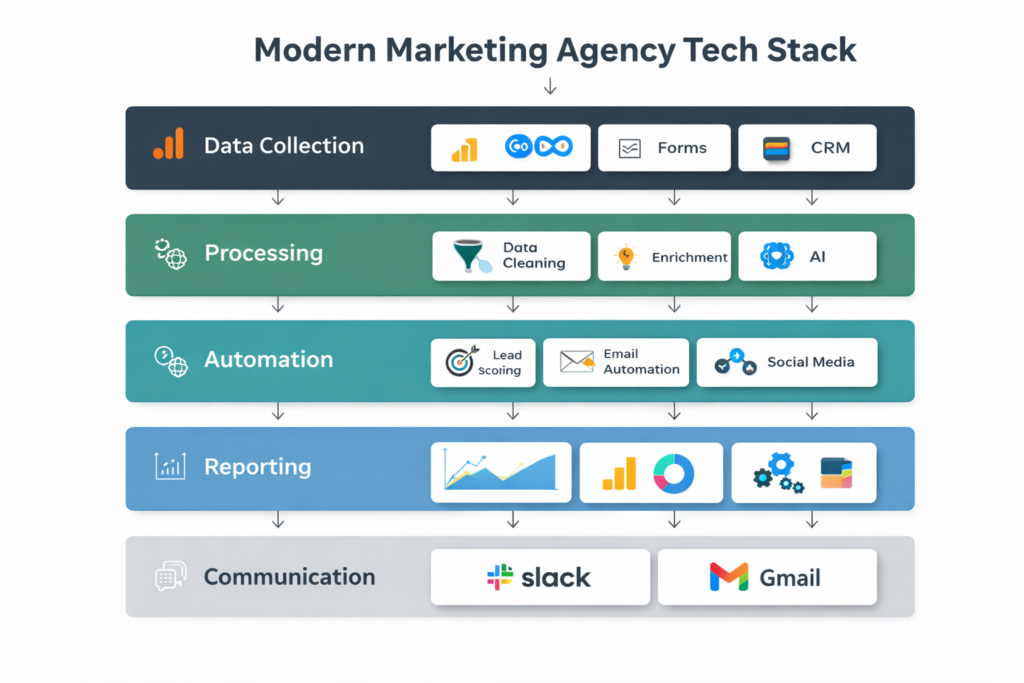
The New Agency Stack: AI Tools Every Marketing Agency Needs in 2026 A Shift in the Tools Agencies Depend On Agency work has always relied on tools. In earlier years, these tools were separate systems. One handled reporting, another managed customer data, and a third tracked campaigns. Platforms like HubSpot for CRM, Google Analytics for website tracking, and Mailchimp for email marketing often operated independently. Teams moved between them and filled the gaps manually. That pattern is changing. The modern agency stack is no longer a collection of disconnected tools. It is a connected system where AI tools support daily work and reduce the need for constant oversight. Tools like n8n, Zapier, and Make now connect workflows across platforms, reducing manual effort. The focus is no longer on using more tools. It is on using the right ones in a structured way. What Defines the New Agency Stack The new stack is not built around volume. It is built around connection and flow. A well-structured stack has three characteristics: Tools share data without manual transfer Workflows run without repeated input Outputs are consistent across projects This is where AI tools for marketing agencies – such as HubSpot, Klaviyo, and Customer.io, play a central role. They allow systems to function together rather than in isolation. Core Layers of the Modern Stack A useful way to understand the stack is to break it into layers. 1. Data Collection Layer This layer gathers information from different sources. Examples include: Website analytics (Google Analytics, Mixpanel) Application usage data (Amplitude) Campaign performance metrics (Meta Ads Manager, Google Ads) The role of AI-powered analytics tools here is to ensure that data is captured accurately and in real time. 2. Data Processing Layer Once collected, data needs to be organized and interpreted. In earlier setups, teams handled this manually. Now, AI data processing tools such as Segment (Twilio Segment) and BigQuery help structure the information and prepare it for use. This reduces the need for repeated cleaning and formatting. 3. Automation Layer This is where the stack becomes active. AI automation tools like n8n, Zapier, and Make connect systems and trigger actions: Updating CRM records in HubSpot Sending notifications via Slack Routing leads to sales teams This layer removes routine tasks from daily work. 4. Reporting Layer Reporting is no longer a monthly activity. It is continuous. AI reporting tools such as Looker Studio, Power BI, and Tableau create dashboards that reflect current performance. Teams no longer wait for reports, they access them at any time. 5. Communication Layer Communication tools ensure that insights reach the right people. Instead of long reports, updates are shared through: Email summaries (via Customer.io, Brevo) Messaging platforms (Slack, Microsoft Teams) Automated alerts from dashboards A Simple Table of the Stack Layer Purpose Example Tools Data Collection Gather information Google Analytics, Mixpanel Data Processing Organize data Segment, BigQuery Automation Connect workflows n8n, Zapier Reporting Present insights Looker Studio, Power BI Communication Share updates Slack, Customer.io A Real Pattern Across Different Projects The same structure appears in different types of work. In a project focused on product analytics for a ride-hailing application, tools like Mixpanel and Segment replaced manual tracking. Data was captured continuously and processed without delay, while automation tools triggered alerts and updates across teams. This example shows that the value of AI tools lies in how they are arranged, not just in what they do individually. How Agencies Can Transition to a Connected Stack Moving from disconnected tools to a structured system does not happen all at once. Most agencies already have the tools they need. The gap is usually in how those tools are connected. A practical transition often follows three steps: 1. Audit the Existing Stack Start by listing all active tools across marketing, sales, analytics, and reporting. Identify where data is duplicated or manually transferred. These gaps indicate where automation can add value. 2. Identify Repetitive Workflows Look for tasks that are repeated daily or weekly: Manual report creation Lead data entry Campaign performance tracking Internal status updates These are strong candidates for automation using tools like n8n or Zapier. 3. Build One Workflow at a Time Instead of rebuilding everything, focus on one workflow. For example, automate lead capture → CRM update → notification. Once stable, expand to other workflows. This step-by-step approach reduces risk and makes adoption easier for teams. Common Challenges in Adoption Even with the right tools, agencies often face challenges when building a connected stack. Fragmented Data Sources Data exists across multiple platforms but lacks a unified structure. This slows down reporting and decision-making. Over-Reliance on Manual Processes Teams continue manual work even when automation is possible. This limits scalability. Tool Overload Adding more tools without clear integration creates complexity instead of solving it. Lack of Workflow Clarity Without defined processes, automation tools cannot deliver consistent results. Addressing these challenges requires a focus on systems rather than individual tools. Why Structure Matters More Than Tool Selection Two agencies can use the same tools and achieve very different results. The difference usually comes down to structure. A structured system ensures that: Data flows in a predictable way Actions are triggered at the right time Outputs remain consistent across projects Without structure, even the most advanced tools create inconsistent results. This is why the modern agency stack is defined less by tool choice and more by workflow design. Finally The shift toward connected systems is not a trend. It is a structural change in how agencies operate, as seen in the approach taken by Product Siddha. AI tools, automation platforms, and analytics systems are no longer optional additions. They are part of the foundation of modern agency work. Agencies that focus on building structured, connected workflows are better positioned to handle complexity, maintain consistency, and scale efficiently.